

By Sophie Bunar, ’27
Staff Writer
Recently, I had the absolute pleasure of experiencing The Company Theatre’s production of Cabaret. This iconic musical, which premiered on Broadway in November 1966, tells the story of American author Cliff Bradshaw, who visits a Berlin nightclub and falls for the vivacious English performer Sally Bowles. Set against the backdrop of 1930s Germany, the play also explores the lives of those around them—like Fraulein Schneider, a struggling landlady, and Herr Schultz, a Jewish man deeply in love with her. As fascism and the Nazi party rise, embodied chillingly by the deceptively charismatic Herr Ludwig, the characters’ lives unravel, forcing them apart. In the words of The Company Theatre, Cabaret is “a powerful music and dance-driven immersive experience that explores the intoxicating and turbulent life of Berlin under the emerging Third Reich.”

Throughout the performance, the audience is repeatedly drawn back to the Kit Kat Club, where Sally performs. Michael Tokar’s brilliant portrayal of the Emcee offers a darkly playful escape from the world’s troubles, inviting the audience to “Leave your troubles outside! So, life is disappointing? Forget it!”
Yet beneath the Emcee’s humor and innuendo lies a harsh reality. The first act bursts with love, laughter, and performative joy, but this façade shatters at Schultz and Schneider’s engagement party when Herr Ludwig reveals his Nazi allegiance. The haunting anthem “Tomorrow Belongs to Me” follows—a song crafted to mimic a traditional Nazi march. The brief intermission leaves the audience to grapple with this unsettling revelation before plunging them back into the seductive atmosphere of the Kit Kat Club.
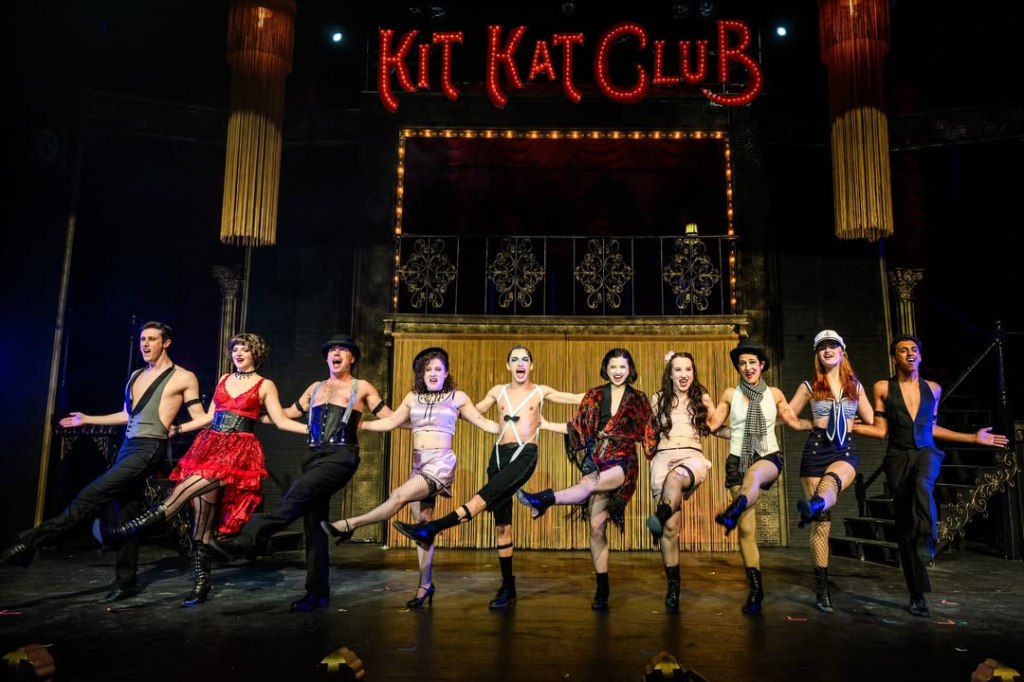
The second act spirals into darkness. Schneider and Schultz’s engagement dissolves, and Cliff and Sally clash bitterly over politics. Ultimately, one line from Cliff lingered with me: when Sally dismisses the Nazi rise as “only politics” that doesn’t affect them, Cliff retorts, “Don’t you see? If you’re not against all this, you’re for it.” This confrontation ends their relationship, with Cliff leaving for Paris and Sally returning to the nightclub’s illusion. In her final number, Sally calls life “only a Cabaret”—a dazzling performance that distracts us from our harsh realities. Today, many remain too privileged to recognize that politics matter deeply and shape our lives. Ignoring them only traps us in the end.
In the end, Cabaret warns that immersing ourselves in distractions blinds us to the dangers unfolding around us. When reality finally crashes in, we risk being caught in a downward spiral toward ruin.
 The Hawk