All posts by dcampbell27

Should Cell Phone Hotels Be ‘Closed’?

By Danny Campbell, ’27

Staff Writer

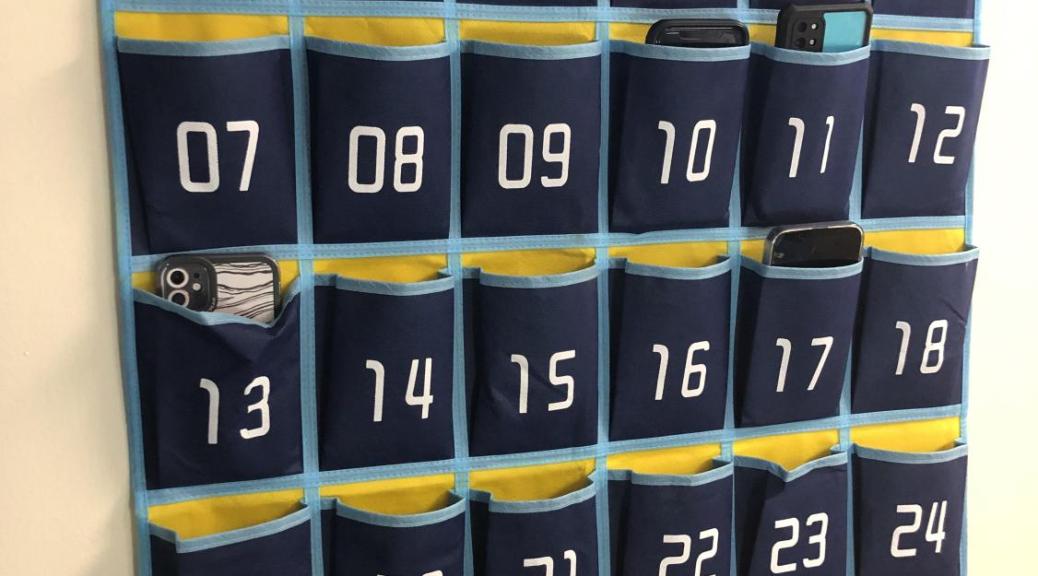
Most likely, everyone has an opinion about the Hanover High School student cell phone policy by now, since we’re into its second year. To minimize distractions, the handbook restricts students from using cell phones in class without the teacher’s permission. Most teachers require students to place their phones in the classroom “phone hotel” (better known, in my opinion, as the “prison”), or keep them in student backpacks. This is enforced with varying levels of strictness depending on the teacher. The policy, implemented by district administration and approved by School Committee, is part of a state and nationwide trend toward restricting cell phone use in schools. I personally think the cell phone “hotels” are a waste of time. They not only show distrust of students, but also could lead to safety issues.

In the last few years, cell phones have become a major part of our lives, and nearly everyone in the United States now has a phone that they use frequently. I can almost guarantee that you – the person reading this page – have spent large chunks of time only on your phone, letting a platform like YouTube, TikTok, Instagram or games consume hours of your day. Many have fallen victim to it, admit it! This is why school districts across the country started limiting or restricting cell phones in school. The Massachusetts legislature is considering a bill this year to ban students from using cell phones and other personal electronic devices during the school day. Most teachers think that getting rid of the phones in class will automatically make the students pay more attention to them during their lessons. Other supporters of the policies feel limiting phones will reduce bullying and improve students’ mental health.

But we need to note three things about these arguments. First of all, NOT every single student in the school is tied to their cell phone! This is a very big thing that I feel people completely ignore when discussing whether or not to restrict phones. There are students who only bring their phones to check the time, text important people during their downtime, or keep in contact with their parents during school hours. So restricting our only form of outside communication is very unfair for those of us who barely take them out.

Secondly, the policy can cause safety problems during an emergency. Imagine that a fire or some other catastrophic event happens that could lead to school being evacuated. If students are as attached to their phones as administrators seem to think, the first thing they’ll do in an emergency is try to get their phones from the “hotel.” This could cause injuries and a delay in getting students out of the building quickly.

Finally, having to put phones in a classroom “hotel” makes it possible for students to forget them when the bell rings for dismissal. This means students have to interrupt their next class to come back and retrieve them, or wait until the next day to pick them up if school is over. It could even lead to theft of the often expensive devices.

I think a better approach to the cell phone issue would be to teach students how to use the technology responsibly. This could be taught in a unit for middle school health class, during Mrs. McHugh’s library sessions, or through auditorium presentations like the ones we have about topics like drug abuse and lockdown drills. Students need to be taught the benefits of moderating screen time to take care of their mental health. If we can do this, there won’t be the need for phone “hotels.”
Does the MCAS Still Matter?

By Danny, Campbell, ’27

Staff Writer

So I bet most of you are aware of the fact that on November 6th, the people of Massachusetts voted in favor of getting rid of MCAS as a graduation requirement. I personally believe this was a great decision, since it means that students won’t have to worry about not getting their diploma for scoring poorly on it. However, I think we still have to take the standardized tests seriously because of how much they still can affect students and our school.

The MCAS, or Massachusetts Comprehensive Assessment System, is a series of standardized tests created in 1993. Starting in third grade, all students take tests in English Language Arts and Math. A Science, Technology and Engineering exam is given in grades five and eight. Civics is administered to 8th graders and biology is given to 9th graders. Passing the tests had been a requirement for a diploma in Massachusetts, while schools used the data to evaluate teaching and learning. After the vote, the graduation requirement has been removed, but schools are still giving the tests to collect information.

But how did this movement to remove the MCAS graduation requirement get onto the ballot in the first place? You see, this movement was started by a mom in Lexington and the Massachusetts Teachers Association because they felt like MCAS was unfair to students who don’t take tests well. The movement was further spread by Adriana Mason and another mom from Hanover who helped to get the word out locally and get the question on the ballot.

One of the main concerns that went into having MCAS as a graduation requirement is the belief that students with special needs are treated unfairly by the system. I can relate to this concern from personal experience; while I was in elementary and middle school, I was given extra support in my classes to address my needs. However, when you are taking the MCAS, you are not allowed to have the same extra support you have had for the entire year. This would cause issues for students, who might have to take the high school tests repeatedly to finally earn a passing grade and qualify for their diploma. Teachers were forced to spend a lot of time each year preparing students for MCAS. It is either that or risk having students unprepared for test day.

Between 2003 and 2024, 400-450 students left HHS without their diploma, according to Mason. This large number has to do with their MCAS grades, and many of the students impacted were students with disabilities. Most students with disabilities already have hard lives, and not being able to get their diploma made their lives unfairly harder. Without a diploma, your job opportunities are reduced. You cannot go to college or into the military, and you cannot become a police officer or firefighter. Thankfully, with this law passing, students who graduated HHS from the 2003-2024 are able to now receive their diploma.

With all of that being said, and with the ELA test taking place at the high school this week, it leads me back to my question, “should we still be worried about the MCAS?” I will say once more that I am beyond glad that this law has passed, and I have NO complaints about this vote. However, as a sophomore, it feels very anti-climactic after being told numerous times since middle school that the 10th grade MCAS was the extremely important one that would determine whether or not I received a diploma. Now, the test feels just like an extra thing to do.

Still, my final verdict is that while MCAS shouldn’t be treated AS seriously as it was in previous years, I do believe students should still try to do well. The test results will be used to check in on how students are doing in school, and to make sure that teachers are successfully providing instruction in important skills. All of this can now be done without stressing out students yearround.

featured image: https://www.boston.com/news/education/2021/09/21/mcas-scores-2021-pandemic/

Twelve-hour TikTok Ban, Months of Uncertainty

By Danny Campbell, ’27

Staff Writer

Normally I don’t like diving crazy deep into political topics (I actually hate politics strongly, and I’d be much happier without it in my life), but the argument over banning the app TikTok has been boggling my mind since 2022. With it now partially banned in the U.S, I felt like weighing in on the debate.

You are probably aware that on Jan. 19, the bill to have the popular social media app TikTok permanently banned in the U.S. went into effect . . . for 12 hours. Last April, Congress cited national security concerns to pass a law banning the app in this country if it wasn’t sold by its Chinese owner. But when Donald Trump became president on Jan. 20, he signed an executive order delaying the law for 75 days, even though he himself tried to have TikTok banned back in 2020! So while the app now works for current users, it can’t be downloaded by new users — or anyone who deleted it when they heard the ban was coming.

But why ban TikTok and not other social media platforms like YouTube or Instagram? Politicians have been talking about a ban since 2020 because of major security concerns regarding its owner, ByteDance. Like all social media and websites we use, TikTok collects user data. But since it’s owned by a Chinese company, it has to hand over that data to the government, the Chinese Communist Party. The CCP and the U.S. government aren’t exactly the best of friends. Lawmakers and the U.S. Department of Justice argue that TikTok could be used by the Chinese government to spread misinformation and that user data could be misused. Critics of a ban say there’s no proof the CCP has done anything wrong and a ban violates free speech. The law was challenged all the way to the Supreme Court, who on Jan. 17 ruled in favor of a potential ban if the company isn’t sold.

So where do things stand now? President Trump, tech innovator Elon Musk and others are talking about having an American company or even the U.S. government buy TikTok, or at least half of it. ByteDance has long said the app is not for sale. So what will happen on April 5, when the 75-day executive order expires, is up in the air. TikTok says its 170 million American users spent nearly an hour a day on the app in 2024, according to the BBC News.

I, for one, have never once used TikTok and at first I saw why the government wanted to ban it. But then I wondered, what is the Chinese government going to do with user data? If you think about it, the only people the Chinese government really wants to keep an eye on is those who work for the U.S. government. In this case, banning the app from government devices is a smart move and should be enough. In my opinion, a larger ban is not needed for ordinary users. The worst thing that the app can do is reduce our attention spans.

Right now, it’s anybody’s game. According to CNN, Americans since the ban have started downloading an app by the name of Xiaohongshu, also known as RedNote, another Chinese-owned social media platform. If the U.S government is concerned about the CCP getting Americans’ data from TikTok, RedNote is probably far worse, and would also likely be banned. Banning social media is a very slippery slope, because if the U.S bans TikTok and other ByteDance products like CapCut, what’s next? If this is considered constitutional, the U.S can ban basically anything it deems dangerous. 

In addition to TikTok, many other Chinese-owned companies are used by Americans, including video game makers. Tencent is a Chinese conglomerate that owns a small portion of Epic Games (the creators of Fortnite) and much larger portions of Supercell (the makers of Clash Of Clans) and Riot Games (League Of Legends). With the law to ban TikTok, the U.S. government could go after companies like these. The situation is a disaster.

Students Hold the Keys to Keeping Bathrooms Open

By Danny Campbell, ’27

Staff Writer

Students often complain when our school bathrooms are closed and they have to walk to a different floor or down to the cafeteria to find one open. But in an interview with Principal Mattos and custodian Fabz Saldanha last week, I learned that students are often the ones responsible for the closures.

In the past, Hanover High School regularly had just one bathroom open per floor to minimize issues with students gathering, creating messes and getting into trouble. Also in the past, teachers were assigned duties to monitor the halls and bathrooms. Last spring, concerns about the rotating closed bathrooms were brought to the HHS School Council (composed of students, teachers and community members) and the HHS Student Advisory Council. This led the administration to open all bathrooms after announcements were made to the student body about care and maintenance.

“Students control what happens,” Mr. Mattos said, echoing a message he gave during assemblies on the first day of school. “If students respected the bathrooms, they would be open forever. They only get closed for cleaning and maintenance as needed.”

Unfortunately, only three days into the school year, the bathroom in the World Language wing was seriously vandalized. A student or students pulled the stall dividers right out of the wall. Damage like this has cost the school thousands of dollars in the past, Mr. Mattos said. With the school budget tight this year, and a busy maintenance staff serving all the school buildings, it’s going to take time to fix. That bathroom has been locked since.

While students who commit vandalism are just a small part of the school population, Mr. Mattos said, it’s hard to catch them because the general law prohibits cameras in the bathrooms. Due to budget cuts, the school also doesn’t have enough staff to constantly monitor the spaces.

Aside from that closure, the school has been handling the issue much better than years prior, Mr. Mattos said. I noticed one day in September when both bathrooms on the second floor were closed at the same time, leading students to have to walk farther. But Mr. Saldanha said that was a temporary closure because a motion-activated sink needed repair; town health officials say a bathroom must be closed if a sink or toilet is not working.

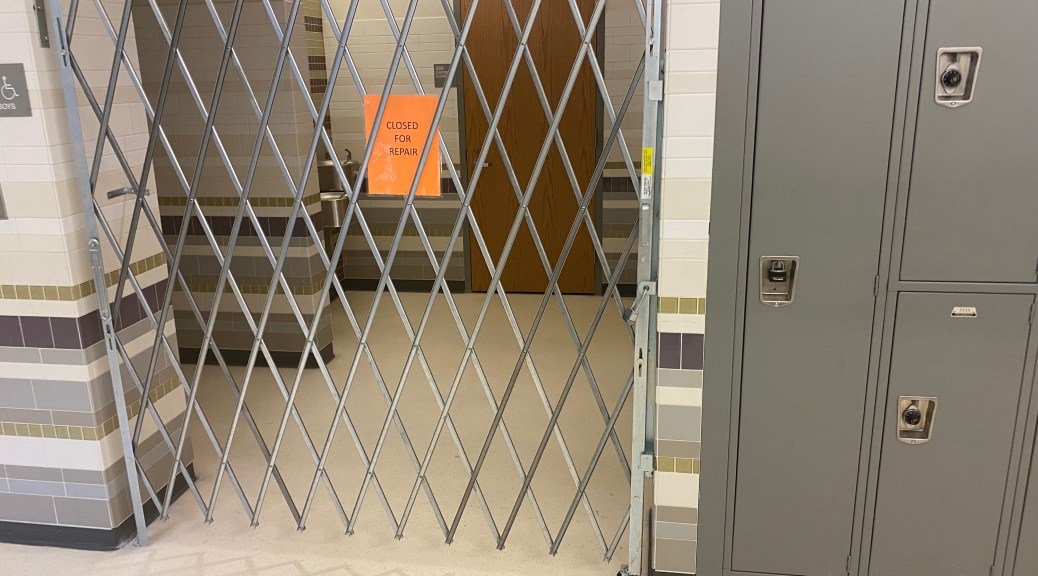
The metal gates were installed in 2022 to lock and secure bathrooms as needed, but the idea of closing a school bathroom for cleaning or a repair is not new. Prior to that, the school had used movable plastic barriers for years, but students would simply push them aside and enter the bathrooms. “With the gates, bathroom maintenance has been much better,” Mr. Mattos said.

We should all be aware by now that the administration and custodians are not in the wrong to close the bathrooms when issues occur. It’s up to students to treat the bathrooms with respect. Having a clean, working bathroom close to your classroom is a privilege, not a given. If you are responsible and behave in the bathrooms, they will stay open. Throw your trash in the bins. Do not put unflushable items in the toilets. Show courtesy to your classmates who use the bathrooms and to the custodians who keep them clean. If only as much as one student misbehaves in the bathrooms, they are all at risk of being closed!

I have done my part in covering this issue. Now it is your turn to do yours!