
By Emily Davis, ’27
Entertainment Editor
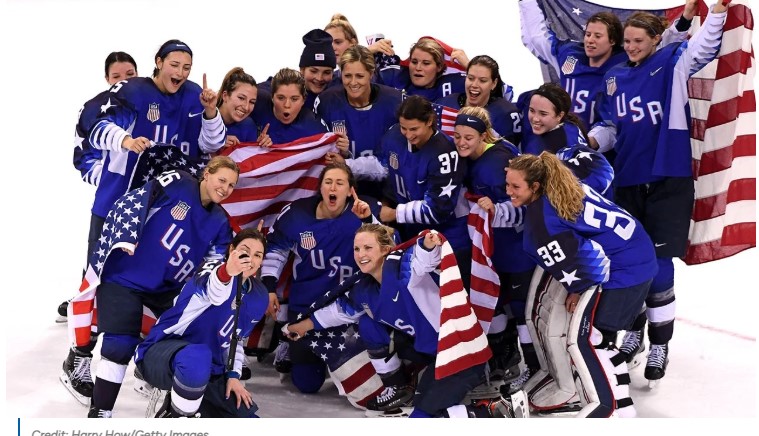
In a moment that will be remembered as one of the greatest achievements in American hockey history, both the U.S. men’s and women’s teams captured gold medals at the 2026 Winter Olympics, defeating rival Canada in dramatic overtime victories. The dual triumph marked the first time the United States has swept both Olympic hockey tournaments in the same games – a feat that underscores the nation’s rising dominance on the ice.

For the U.S. men’s team, the victory carried historic weight. Their gold medal was the program’s first since the legendary Miracle on Ice, ending a 46-year drought in Olympic play. Meanwhile, the women’s team delivered a powerful statement of consistency and excellence, securing another gold medal in a rivalry that has defined Olympic Women’s hockey for decades.
The celebration, however, was briefly clouded by political controversy involving President Donald Trump. Following the men’s victory, Trump congratulated the team and invited them to the upcoming State of the Union address, joking that he would “have to” invite the women’s team as well or risk impeachment. Some players laughed during the exchange, sparking backlash from fans and athletes who felt that the comment diminished the women’s achievement.

Women’s team captain Hilary Knight described the remark as “distasteful,” emphasizing that the focus should remain on the historic accomplishments of both teams. Some members of the men’s team apologized, while others dismissed the issue by arguing that politics shouldn’t be injected into sports. The men’s team attended the State of the Union, but the women’s team declined the invitation. Captains of both teams appeared on the show Saturday Night Live to reiterate their mutual respect and unity, stressing that the shared gold medals–not controversy–defined the games.
While the men’s victory was historic, it is the sustained success of the U.S. women’s program that has long set the standard for American hockey. Since women’s hockey was introduced to the Olympics in 1998, the United Sates and Canada have dominated the sport, with Team USA consistently competing for gold and producing some of the most iconic moments in Olympic history. From their breakthrough gold in the Olympics 1998, and now another championship in 2026, the women’s team has built a legacy defined by resilience, skill, and leadership. The women’s team has won three gold, four silver and one bronze medal since 1998.
In the end, the story of the 2026 Olympic Hockey tournament is not one of controversy, but one of unity and achievement.
Two teams. Two gold medals. One defining moment for American hockey.
As the players left the ice in Milano-Cortina, Italy, they carried more than medals – they carried a legacy that reflects both the breakthrough of the men’s team and the enduring excellence of the women’s program.
And together, they made history.






 The Hawk