All posts by ehersey29

Understanding Cognitive Biases

By Emma Hersey, ’29

Staff Writer

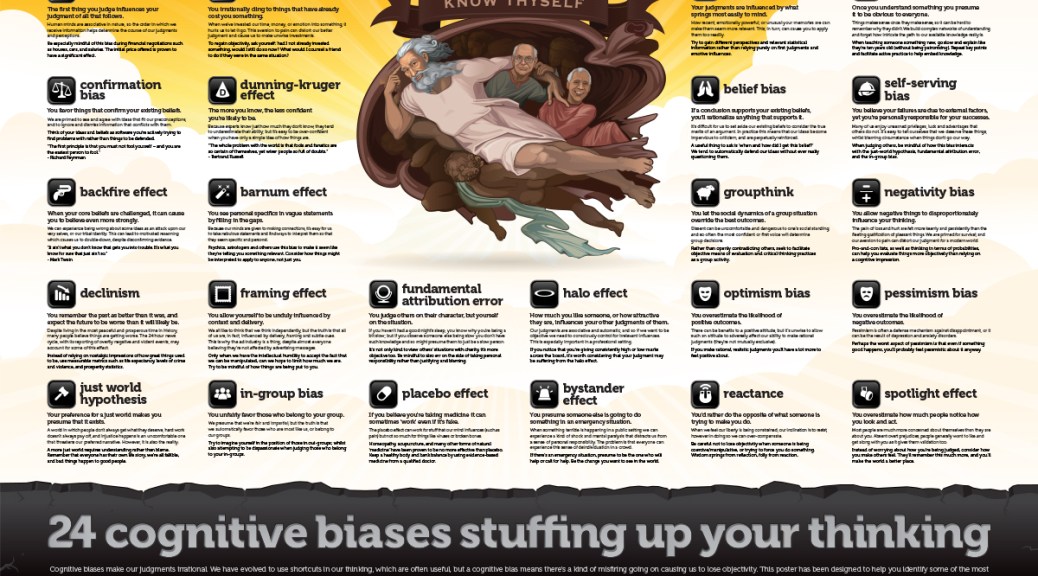
What are cognitive biases? Cognitive biases are mental shortcuts that lead to systematic errors, affecting or counteracting your inner rationale. Your brain can be overloaded with information, and to process that information faster, these shortcuts are used to come up with a quick response to what is being said. This can create misinterpretation or inaccurate conclusions and lead to flawed judgment, poor decision-making, and distorted perceptions of reality. The creators of the idea of cognitive biases are Amos Tversky and Daniel Kahneman, who brought this idea to light in the 1970s. They also introduced the concept of heuristics, which induce immediate judgment that guides you to make irrational decisions.

The inability to make a good judgment on a subject is induced by fatigue, stress, and emotions, which are personal factors, but are also caused by cognitive biases. Cognitive biases play a part in flawed judgment because they cause the brain to process information too quickly. With the quick processing of information comes the capability to miss or overlook important factors that can affect your argument. For example, if you see a news article that several people have died from a plane crash, and it makes you not want to fly, you are exhibiting the availability heuristic. You take what you have just seen or learned, over weigh the probability of it happening, and let it generate fear, even though fewer planes crash, than those that do. The availability of information on plane crashes is, at the moment, more prevalent than information available on planes that have successful trips, causing you to believe crashes are more common than they are.

Anchoring is also one of the biases that can affect your judgment because it uses the first piece of information that you collect on someone, and refuses to acknowledge any change that occurs. If you are at a restaurant, for example, and see a $90 steak and then further down on the menu you see a $50 steak, you will rationalize the price of the $50 steak. In your mind, you will think that you are getting a cheap steak, when in reality, $50 for a steak is not cheap.

People make decisions every day, whether they are good or bad. “Should I eat pizza or burgers tonight?” is a decision that doesn’t have any consequences. But deciding not to do something after someone asks you to, does. That kind of decision, when you prefer to do the opposite of what someone is trying to make you do is called reactance. This tricks the brain into thinking there is a loss of freedom or a forced action. This gives you a sense of need to rebel against the enforcer to regain your control over what you do, causing you to not do what is asked of you, resulting in punishment. For instance, if your parents tell you to put on a jacket when it is cold outside, it may make you not want to wear one because you are being forced to instead of making the choice on your own. Especially if it really is cold outside, you will refuse to admit that they were right about wearing a jacket.

These mental shortcuts make your mind susceptible to receiving and believing distorted information, causing you to make decisions that aren’t always beneficial. The sunk cost fallacy is another effect of cognitive biases because it makes you irrationally cling to things that have already cost you something. If you have run a business for many years that is now going bankrupt, for example, you will not want to sell it because you have put so much money, time, and effort into it. This bias highlights the desire to hold onto something that you have put time and effort into, even though it is no longer relevant or beneficial.

A distorted perception of reality is when someone’s view or interpretation of the world is skewed, which is exhibited by irrational thought patterns. The biases associated with this are declinism and the self-serving bias. They both touch on how things can easily affect our perception and judgment to make room for misinterpretation of things happening in the world. If you believe that earning a good score on your test is due to studying hard, for example, but when you fail, it is because the teacher put hard questions on the test, then you are a victim of the self-serving bias. The self-serving bias is when you believe that your failures are due to external factors, yet you’re personally responsible for your success. This skews the perception of reality and romanticizes your past accomplishments, thus making you less accountable for your mistakes. It makes you unable to take criticism because you believe that it will not be beneficial to you, and your mistakes are not your own. Judging others comes easy when you don’t know the circumstances, but you give yourself leeway because you know what is going on and your thought process. This creates overconfident people who believe they are always right and are never wrong because their mistakes are not their fault.

People who are stuck in the past, always hoping that life will go back to how it was in the past, are subject to declinism. Declinism is when you remember the past as better than it was, and expect the future to be worse than evidence suggests it will be. But in reality, the past isn’t as good as you remember; it is just your mind believing that because you don’t want to experience life in the world you live in now. We believe the past to be better than reality because we are handpicking the good memories to remember, and blocking out the bad ones. The reason reality is not favored is that we are now living through the good and the bad events happening at the same time. Being stuck in the past will change how you view the present world because you will be resistant to change, and want to continue to see the past world through “rose colored glasses.” 

Cognitive biases are the root of systematic errors in thinking that are illustrated through flawed judgment, poor decision-making, and the distortion of the perception of reality. There are so many biases that highlight the errors of the thought process that the human mind uses to formulate a conclusion. Being aware of cognitive biases is beneficial because it will help you make better life choices as well as educate you on how to form rational judgments. But even with this knowledge, you may still make mistakes and struggle with judgment. Also, knowing the cognitive biases isn’t the most important part; being able to see and apply them to your life is what really matters. If you are not aware of your own actions and problems, then there is no way that you can reflect and fix them.

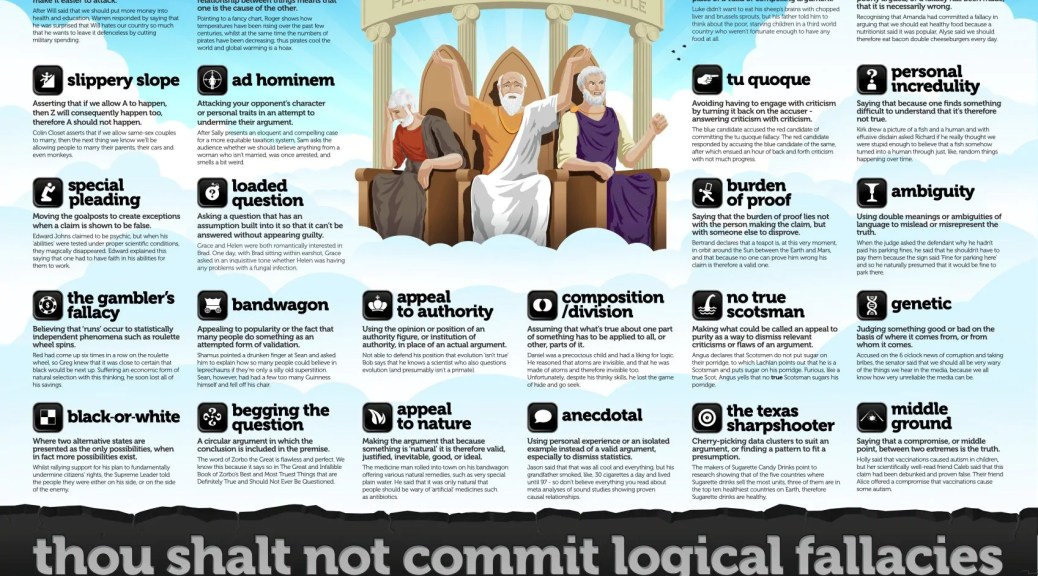
There are many more cognitive biases that I didn’t mention in this article. If you want to know more, go to https://yourbias.is/ And if you like this article, then make sure to read my next one on the Danger of Logical Fallacies next month!

Will AI Take Over The World?

By: Emma Hersey, ’29

Staff Writer

The concept of Artificial Intelligence, or AI, has been around for a long time, dating back to around the 1950s. It started with just chatbots on your computer, and now you can create original images, text, videos and more. The world has changed significantly due to AI, but as with all progress, it can have a downside. AI has already done much good, but what damage will follow close behind?

Recently, AI has been very popular among students. It is a quick and easy way to get your work done without having to think too hard on your own. But using AI to complete your work will only cause harm to yourself. Getting your work done is important, but there is no point in homework if you don’t complete it yourself. Using AI doesn’t help you to know the material and actually learn it. The grading system has become more uptight because of the increase in AI usage. AI checkers can be controversial because they are programmed to see em dashes (a long horizontal dash that emphasizes a claud) and Oxford commas (the comma before “and” or “or” in a list) as indicators of AI. But in fact, these are just basic grammar tools. Now, people who use Oxford commas and em dashes might be flagged down by a teacher for the use of AI.

With the recent popularity and interest in AI, there has been a surge in the abilities that these tools can accomplish in a matter of seconds. Due to the complex code behind AI, it has been able to take the place of many jobs, thus putting humans out of work. Jobs such as editing, manufacturing, bookkeeping, customer service and graphic design are among those impacted by AI. If someone wanted to use AI to write and sell a book, it would be possible. AI tools can write the chapters, edit the pages, create the cover, have it published and manufactured, keep track of its financial standing. If there are any problems with the customers, AI can accommodate them. These five jobs listed are all part of the process that goes into creating and selling a book. If the decrease in jobs for humans remains steady, AI could displace 6-7 percent of the population’s current jobs. 

AI has become a staple of everyday life, to the point that some people don’t even realize they’re using it. To be able to predict things, AI uses your past actions and creates a pattern to follow to anticipate what will happen next. Google, autocorrect, face recognition and personalized recommendations are all examples of the AI that is integrated into your everyday life. When you pick up your phone and unlock it with Face ID, turn on a recommended playlist based on your prior listening, and use automatic correction in Google search, these are all ways that AI works behind the scenes. While many debate the use of AI in school and the workplace, it is hard to argue that we haven’t benefitted from the increased efficiency and personalization.

AI allows tasks that require human intelligence to be completed via computer; it helps with problem-solving, decision-making, etc. Though this is created by computers and loads of complex data coding, the system is not perfect and leaves room for misinterpretation. Most people in this world do not have a higher level of intelligence than AI, but human thinking will always be superior. This idea of higher human thinking is shown when making important court decisions. AI can always present wrong output, and that can put the client’s freedom and privacy at risk. Information coming out of AI would be expected to be correct, but there can always be AI hallucinations in which it presents false evidence to set forth. It is also risky to put in the information of your client for the AI to do its job, because that would be a breach of confidentiality of the client. This now gives the people managing and overseeing the program information about your client. That information that you put in will also be remembered by the system. AI is not a perfect system and cannot always be trusted; this is why the human brain will always be superior regarding AI.

AI is everywhere, even in places that you don’t expect it. There are many benefits that come with using AI, but it also has its drawbacks. The use of this technological tool is enabling cheating and lowering the integrity of education. It is impacting the job market. In the future, its reach could be even more extensive than it already is. AI has become a fundamental part of our world, but will it get to a point where it is the world? When considering the seemingly limitless potential of technology, we must think about not just what AI can do, but what it should do. AI is just at the beginning of its full potential, so what will the world look like when AI reaches its full capacity? What will the world look like? Will there still be humans? Will AI take over? We are only at the advent of our journey to figure out this question.

 Works Cited

Balto. “Examples of AI in Everyday Life.” Balto, 2 July 2021, www.balto.ai/blog/how-ai-already-impacts-our-lives-in-unforeseen-ways/

Goldman Sachs. “How Will AI Affect the Global Workforce?” Goldmansachs.com, 13 Aug. 2025, www.goldmansachs.com/insights/articles/how-will-ai-affect-the-global-workforce.

Marr, Bernard. “5 Reasons Why Artificial Intelligence Really Is Going to Change Our World | Bernard Marr.” Bernard Marr, 2 July 2021, bernardmarr.com/5-reasons-why-artificial-intelligence-really-is-going-to-change-our-world/.

Thomson Reuters. “Key Legal Issues with Generative AI for Legal Professionals.” Thomson Reuters Law Blog, 1 Mar. 2024, legal.thomsonreuters.com/blog/the-key-legal-issues-with-gen-ai/

Urwin, Matthew. “AI Taking over Jobs: What to Know about the Future of Jobs.” Built In, 15 May 2025, builtin.com/artificial-intelligence/ai-replacing-jobs-creating-jobs