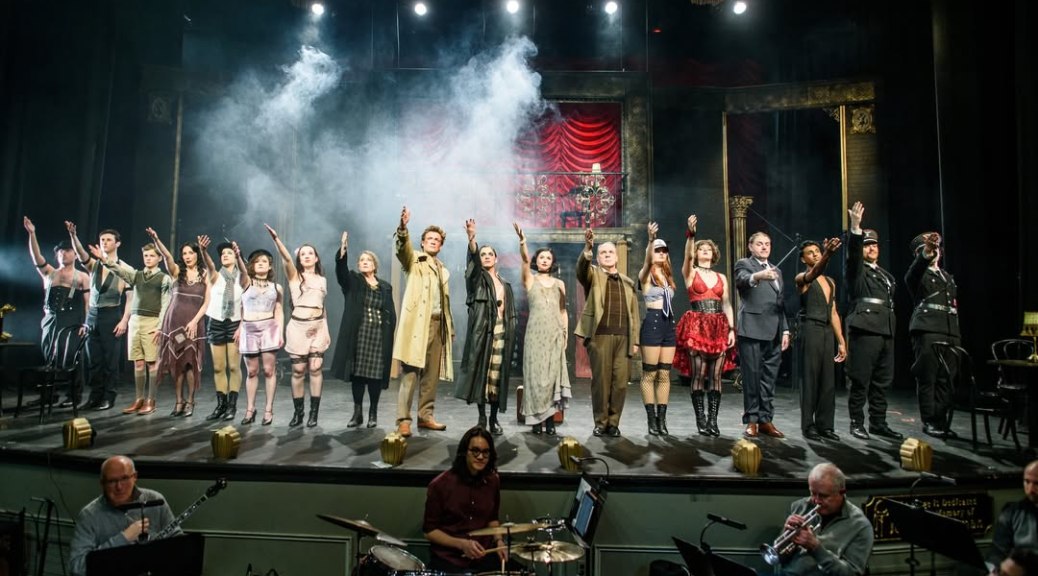
Recently, I had the absolute pleasure of experiencing The Company Theatre’s production of Cabaret. This iconic musical, which premiered on Broadway in November 1966, tells the story of American author Cliff Bradshaw, who visits a Berlin nightclub and falls for the vivacious English performer Sally Bowles. Set against the backdrop of 1930s Germany, the play also explores the lives of those around them—like Fraulein Schneider, a struggling landlady, and Herr Schultz, a Jewish man deeply in love with her. As fascism and the Nazi party rise, embodied chillingly by the deceptively charismatic Herr Ludwig, the characters’ lives unravel, forcing them apart. In the words of The Company Theatre, Cabaret is “a powerful music and dance-driven immersive experience that explores the intoxicating and turbulent life of Berlin under the emerging Third Reich.”
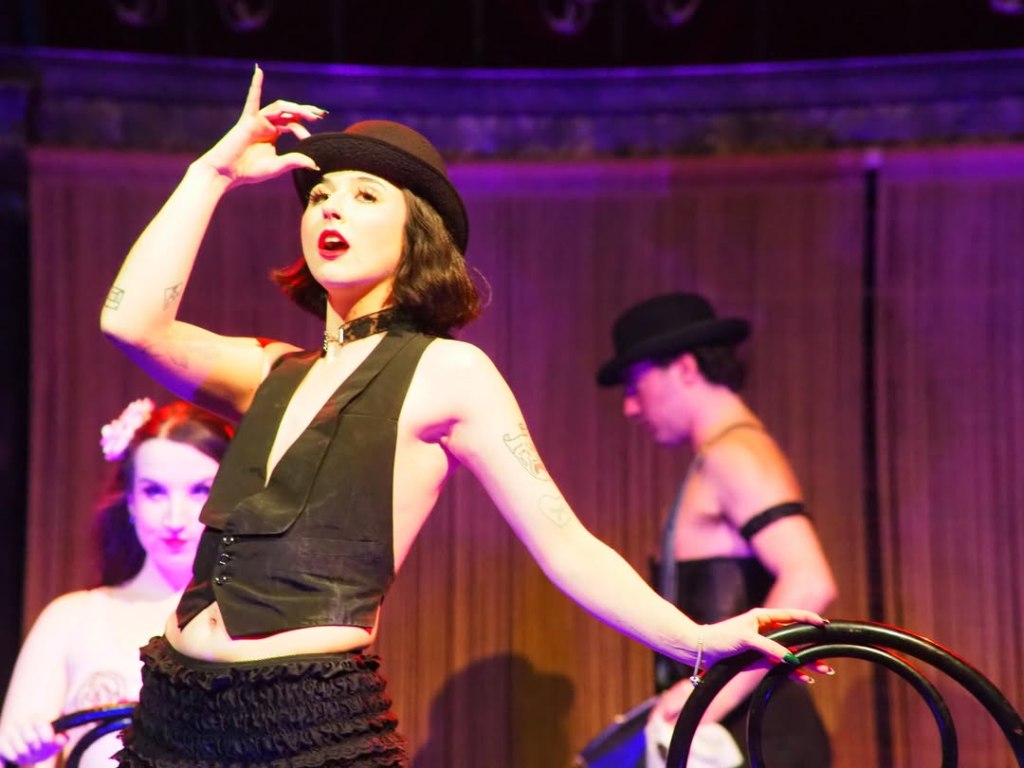
@Companytheatre on instagram — Haley Shaye as Sally Bowles
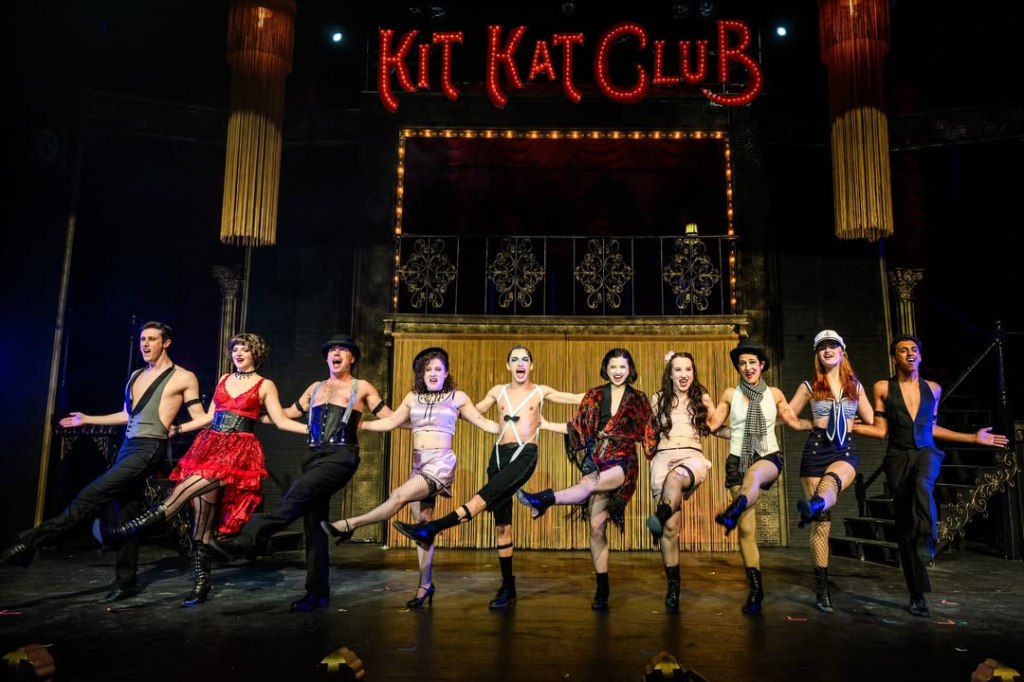
Throughout the performance, the audience is repeatedly drawn back to the Kit Kat Club, where Sally performs. Michael Tokar’s brilliant portrayal of the Emcee offers a darkly playful escape from the world’s troubles, inviting the audience to “Leave your troubles outside! So, life is disappointing? Forget it!”
Yet beneath the Emcee’s humor and innuendo lies a harsh reality. The first act bursts with love, laughter, and performative joy, but this façade shatters at Schultz and Schneider’s engagement party when Herr Ludwig reveals his Nazi allegiance. The haunting anthem “Tomorrow Belongs to Me” follows—a song crafted to mimic a traditional Nazi march. The brief intermission leaves the audience to grapple with this unsettling revelation before plunging them back into the seductive atmosphere of the Kit Kat Club.
@Companytheatre on instagram
The second act spirals into darkness. Schneider and Schultz’s engagement dissolves, and Cliff and Sally clash bitterly over politics. Ultimately, one line from Cliff lingered with me: when Sally dismisses the Nazi rise as “only politics” that doesn’t affect them, Cliff retorts, “Don’t you see? If you’re not against all this, you’re for it.” This confrontation ends their relationship, with Cliff leaving for Paris and Sally returning to the nightclub’s illusion. In her final number, Sally calls life “only a Cabaret”—a dazzling performance that distracts us from our harsh realities. Today, many remain too privileged to recognize that politics matter deeply and shape our lives. Ignoring them only traps us in the end.
In the end, Cabaret warns that immersing ourselves in distractions blinds us to the dangers unfolding around us. When reality finally crashes in, we risk being caught in a downward spiral toward ruin.
“There may be times when we are powerless to prevent injustice, but there must never be a time when we fail to protest.”
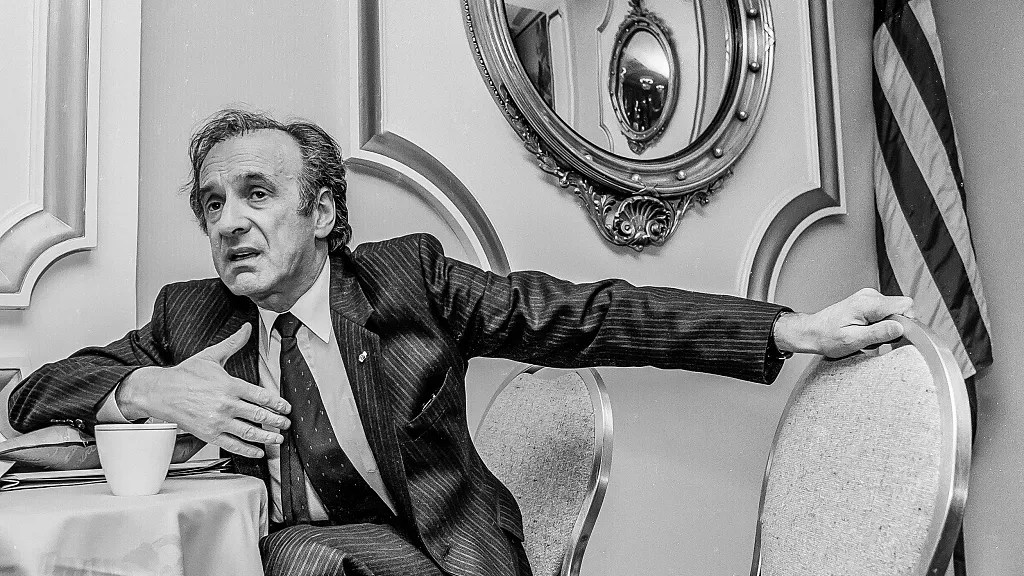
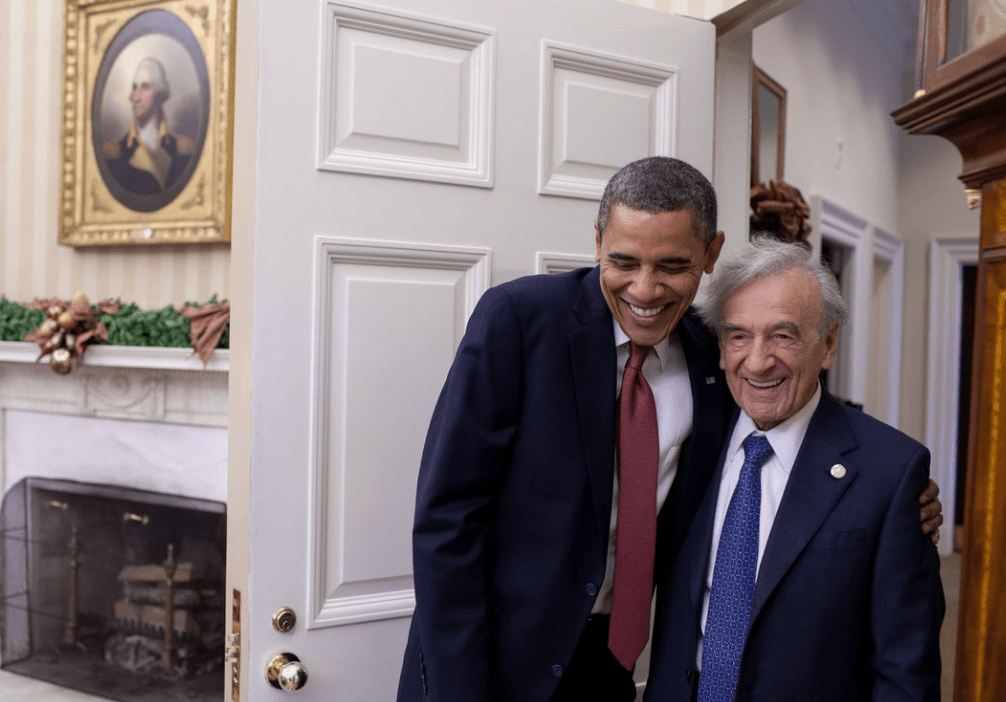
These are the words of Romanian-born activist Elie Wiesel, a noted Holocaust survivor who has dedicated his life to advocating for human rights and fighting intolerance. He is most commonly known within school systems for his memoir Night, which described his life as an adolescent when he survived the Auschwitz and Buchenwald concentration camps.
Wiesel’s speech “The Perils of Indifference” delivers a profound warning about the dangers of apathy in the face of human suffering. Delivered at the White House in 1999, the speech emphasizes that indifference (an absence of concern or empathy) is more harmful than hatred because it enables oppression and tyranny to persist unchallenged. Wiesel recounts how, during the Holocaust, the world’s indifference allowed atrocities to unfold. He stresses that indifference dehumanizes both the victim and the bystander. “In denying their humanity, we betray our own,” Wiesel says.
Wiesel warns that indifference allows injustice to flourish, creating a dangerous silence that enables violence and oppression. When people choose not to speak out or act against wrongdoing, they become complicit in the suffering of others. This message resonates deeply today, as many witness the ICE raids and the notably tragic losses of Renée Good and Alex Pretti, yet remain silent. Although many in Minneapolis, as well as across the nation, have stood up against this outrage, those who refuse to protest or even acknowledge these events perpetuate a cycle of harm, making indifference a form of passive acceptance.
A protester in Oakland held a sign urging the public to “Avenge Renee Good” at a vigil the night of her fatal shooting. (Getty Images)
In standing up against oppression, protest becomes more than just an act of defiance; it is a vital expression of dignity, compassion, and solidarity. Additionally, it honors the humanity of those affected and challenges systems that devalue human lives. As Wiesel’s life and words remind us, the fight against intolerance and violence requires courage from all of us—not just to confront hatred, but to resist the quiet force of indifference.
In this era, in this moment, choosing to raise our voices, join protests, or simply bear witness is a way to ensure that history does not repeat its darkest chapters. As Wiesel states in his speech, “Together we walk towards a new millennium, carried by profound fear and extraordinary hope.”
White House Archived. ““In the Face of Evil, We Must Summon Our Capacity for Good.” — @POTUS on Elie Wiesel: Http://Go.wh.gov/C9asbs.” X (Formerly Twitter), 2026, x.com/ObamaWhiteHouse/status/749389707650314240. Accessed 4 Mar. 2026.
Zohran Mamdani was recently elected mayor of New York City, and he’s sharing his progressive ideas with the country. Mamdani proudly describes himself as a democratic socialist, similar to Sen. Bernie Sanders of Vermont and Rep. Alexandria Ocasio-Cortez of New York. So what exactly is democratic socialism?
After President Donald Trump tried to label Mamdani a communist, the candidate became very vulnerable with his political and economic beliefs in public. When CNN’s Erin Burnett asked Mamdani during the campaign if he liked capitalism, he said:
“No, I have many critiques of capitalism. And I think ultimately, the definition for me of why I call myself a democratic socialist is the words of Dr. King decades ago. He said, call it democracy or call it democratic socialism. There must be a better distribution of wealth for all of God’s children in this country. . . . For too long, politicians have pretended that we’re spectators to that crisis of affordability. We’re actually actors, and we have the choice to exacerbate it, like (outgoing) Mayor (Eric) Adams has done, or to respond to it and resolve it like I’m planning to do.”
Democratic socialism, as described by both Mamdani and Martin Luther King Jr., is a political ideology advocating a socialist economy within a democratic framework. It seeks to achieve a more egalitarian and just society by controlling the economy to benefit the majority, not just the one percent at the top. Democratic socialists support policies like universal health care, higher minimum wages, and worker cooperatives. They strongly distinguish it from both communism, which is seen as authoritarian, and social democracy, which they believe doesn’t challenge capitalism enough.
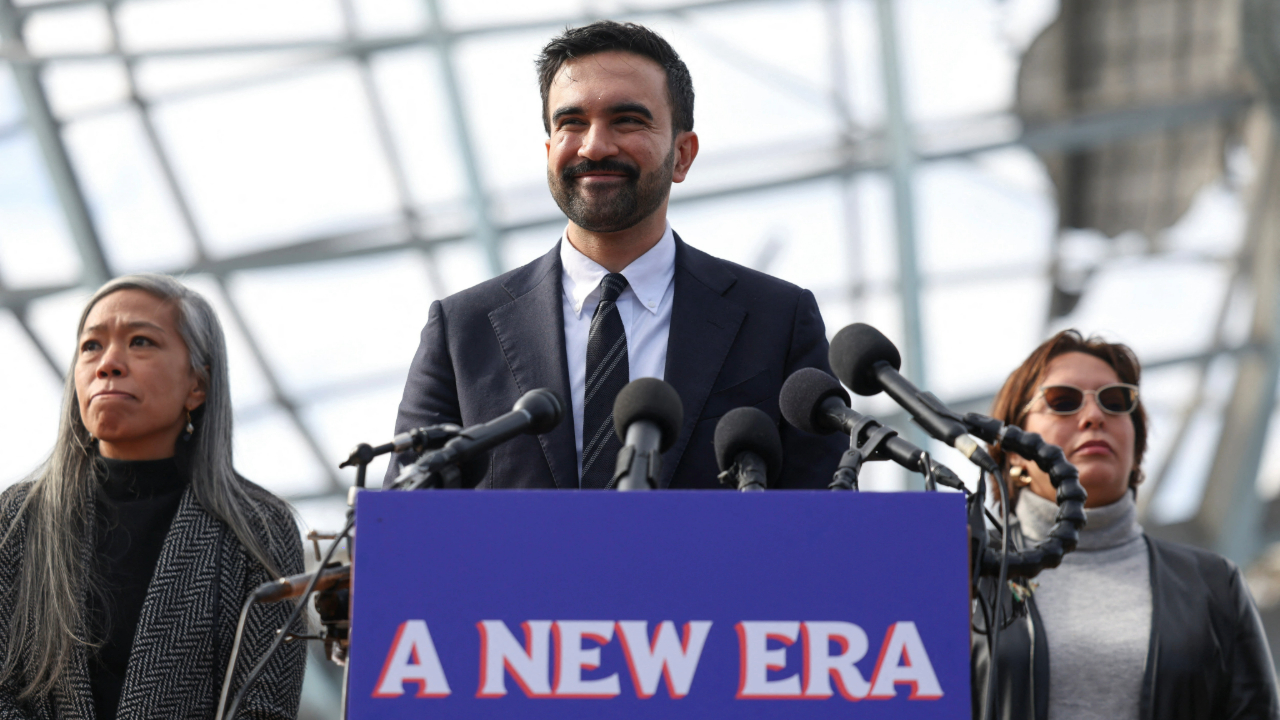
New York City Mayor-elect Zohran Mamdani holds a press conference at the Unisphere in the Queens borough of New York City, on Nov. 5, 2025. (Kylie Cooper/Reuters)
While no country is a pure democratic socialist state, Nordic nations such as Norway, Sweden, Finland and Denmark are often cited as examples that follow many of the ideals. They utilize a mixed-market economy that combines private ownership with a strong social safety net, and they’re known for their comprehensive welfare system, including universal health care. Public services are funded through taxation. Labor unions, as well as labor market policies, reduce conflict between labor and capital. Other countries influenced by democratic socialism include Canada, Germany, New Zealand, Portugal, Belgium, France and the Netherlands.
Despite how beneficial these ideas sound, is America ready for democratic socialism? The U.S. operates under a representative democracy with a capitalist-based economy. Capitalism is a stark contrast to socialism; it features private ownership, free markets and competition, while socialism involves government or collective ownership with a focus on equitable distribution. Capitalism promotes individual economic freedom and innovation through competition, but it can lead to inequality, which is what socialism aims to reduce. However, socialism has potential drawbacks as well. Despite its just basis, it can stifle innovation due to reduced competition and government control. Also, like many “unchecked” economies, it can lead to authoritarianism and gradually devolve into communism. However, under the current administration, many people are asking for either a socialist shift or a mix of both socialism and capitalism.
Mamdani’s own ideals are probably part of the best basis we have when it comes to the modern understanding of democratic socialism. His big policies are all focused on making life more affordable for working people. He aims to:
Freeze the rents for one million people in rent-controlled apartments. This means a temporary, legal halt on increasing rent for residential properties, preventing landlords from raising it for existing tenants and sometimes for new ones too.
Subsidize New York City buses to make them free to riders, as well as making child care free for New Yorkers.
Start a pilot program of one city-run grocery store in each borough to see whether removing the profit motive makes groceries cheaper—a risky arrangement.
One of Mamdani’s policies is the most ambitious, though: increasing taxes on the wealthiest New Yorkers and on the city’s corporations. In the same CNN interview, Mamdani goes on to say:
“I think the dream at its core is a dream for stability in one’s life. And what you’re saying is that you work hard enough and that you then reap the benefits — too many New Yorkers, and Americans for that matter, are working eight hours and then still feeling like they haven’t made enough money to keep living in the city they call home.”
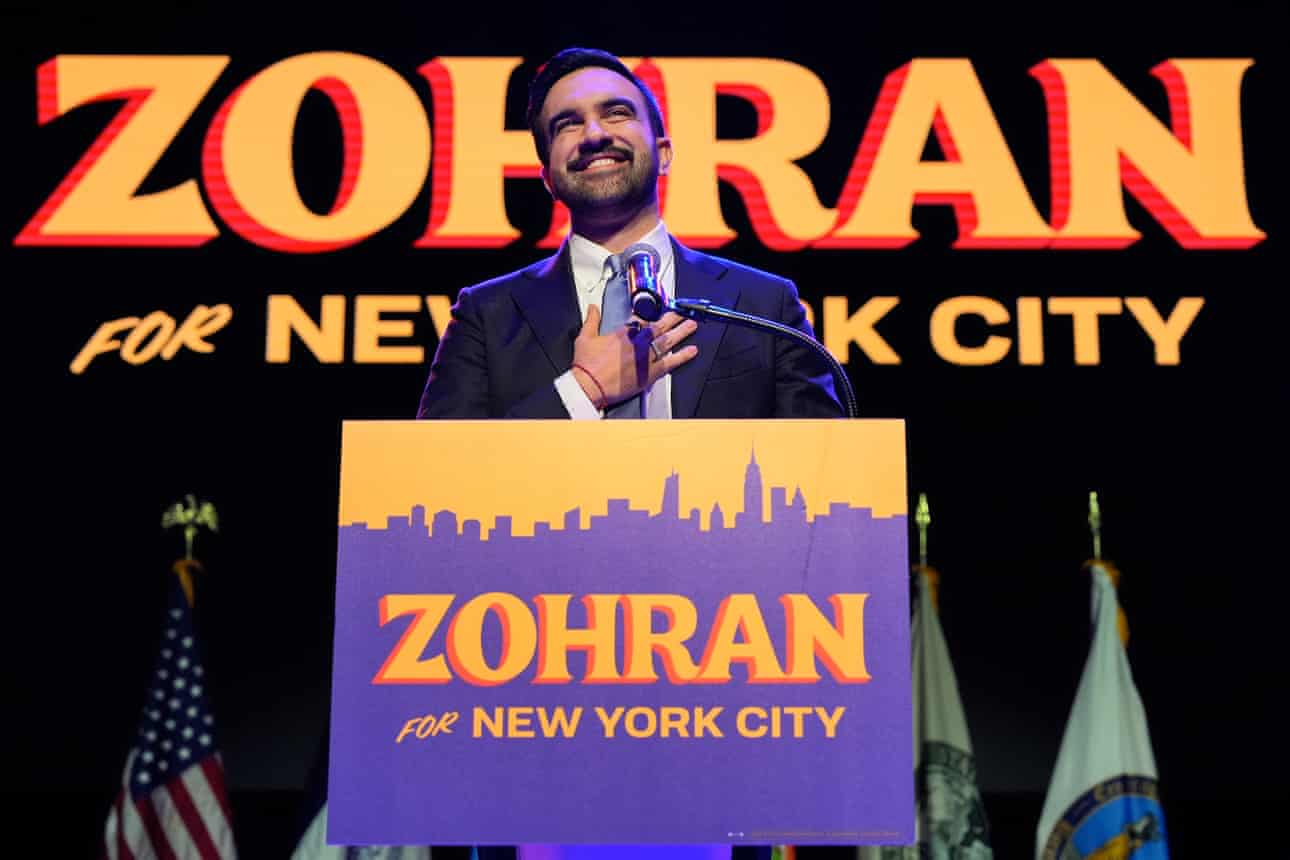
Zohran Mamdani speaks during a victory speech. Photograph: Yuki Iwamura/AP
National Museum of American History. “Preparing for the Oath: U.S. History and Civics for Citizenship.” Americanhistory.si.edu, americanhistory.si.edu/citizenship/learn/government-basics/11/learn.
Thaywick, Lena. “15 Democratic Socialist Countries and Social Democracies.” HowStuffWorks, 22 Oct. 2025, people.howstuffworks.com/democratic-socialist-countries.htm. Accessed 7 Nov. 2025.
“Education isn’t just about feeding the brain. Art and music feed the heart and soul.” ~ Julie Garwood
Art and music surround us, bringing humanity to our computed, monotonous lives. They allow free expression, enjoyable experiences, and even a future career for many. Here in Hanover, we strive to create a place where students can find companionship, acceptance, and invaluable skills. However, with the overwhelming town budget struggles forcing cuts to art and music this year – and threatening more for next year – the voice of our community needs to be louder than ever. To better understand the importance of art and music curricula, I interviewed several educators and students.
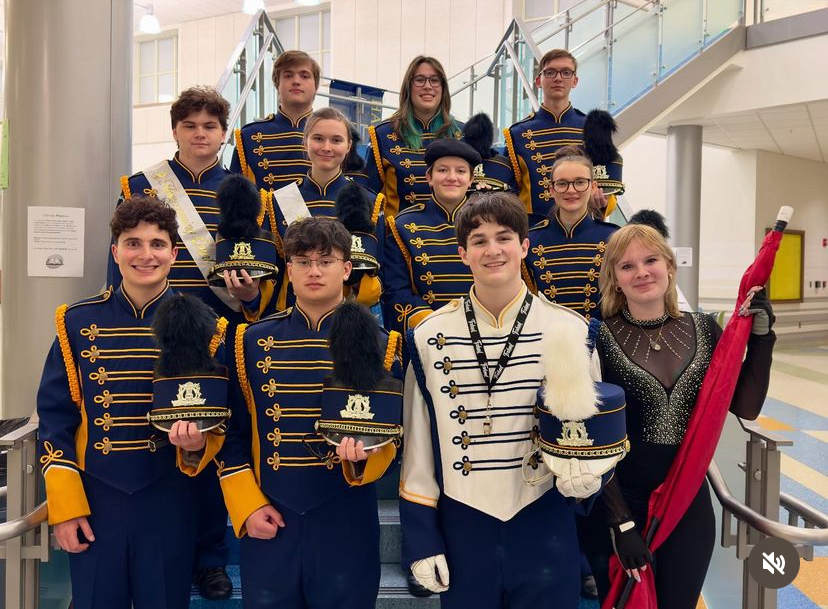
“The arts programs here at Hanover are the most important parts of our public schools,” said Dante Heffron, senior drum major of The Pride of Hanover Marching Band. “These programs provide a sense of belonging for students and also provide a place for students to explore their skills or learn new ones.”
Even if they may not excel in other subjects, many students find their strength and community through the arts. Everybody is different and distinctively skilled, but a group that works together and embraces these differences is what many students need to succeed both in school and in life. Just as Hanover High School band director and music teacher Matthew Harden explained, “Not every young person is an athlete or scholar in the traditional sense; however, music and art speak the language of emotion, connection, and community.” Providing students with a place where they can express themselves on a level that surpasses standardized academics is essential within any school system.
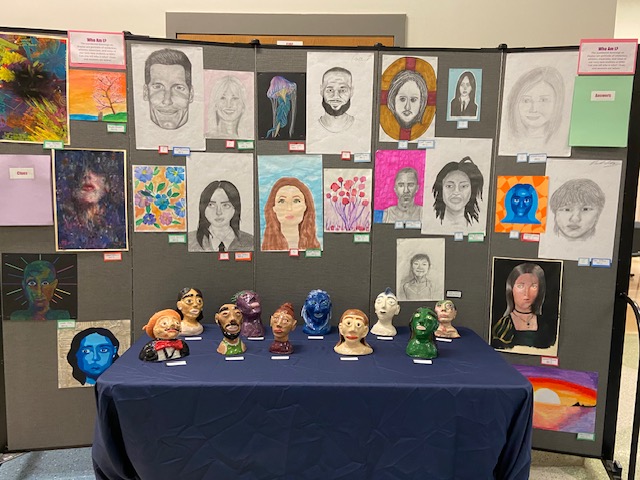
Work created by HHS students in 2D and 3D art courses
The arts are also significant because of their ability to foster community and friendship within educational environments. Many students meet their lifelong friends in school, especially in programs like music and art, which are close-knit and inclusive. “People you meet in your band or in your section of AP Art tend to be people who you become so connected to,” said Sadie Hofford, chorus and music educator. “In VOX and Chorus, I watch students help and support each other every single day in big and small ways.”
Art and music programs are also important because individuals involved in the arts work hard to make sure that people of all races, genders, and backgrounds are welcome and feel welcome. “Art transcends racial, socio-economic, cultural, and political boundaries while also calling upon each artist to reflect on their audience’s backgrounds and interpretation,” commented Mr. Harden, describing the diversity within the arts programs. It is crucial that students feel connection and belonging during their years in school because it helps to stimulate positive social skills and provides relationships that will prove useful in their years after graduating.
Another reason why the arts programs are indispensable in our schools is because of the advancing technology and increasing use of AI in our ever-changing world. “In a world of instant gratification and artificial intelligence, the arts foster long-term investment and dedication,” said Mr. Harden. “The arts challenge us to see the humanity in each other—to find empathy and cohesion amidst apathy and divisiveness.” Because of the influx of artificial intelligence within education systems, people are finding easy ways to complete assignments and pass their classes. However, the arts are some of the few programs where students cannot cheat. They require perseverance, humanity, and diligence. A robot cannot play a song or create a painting that has feelings and meaning behind it; only people can do that.
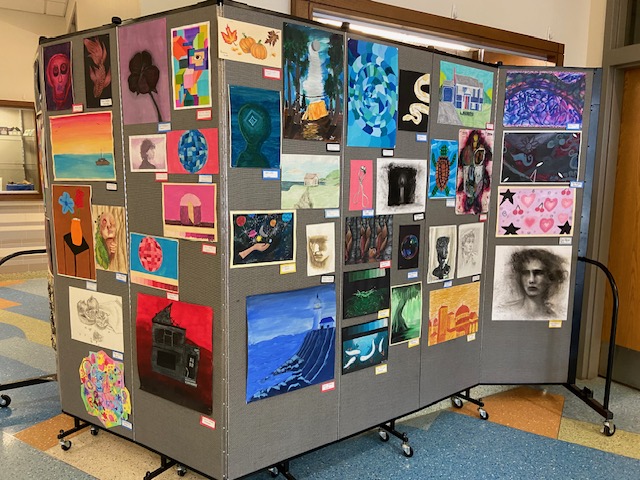
Work created by students in 2D art classes.
Just as technology evolves, our society evolves, oftentimes causing disharmony and even leading to periods when the people controlling the technology thrive while those under them face tribulation. The art community currently is facing immense adversity with the use of AI, stealing from artists, and creating “art” by data-scraping the Internet in order to provide entertainment that can be shared across social media. As Maria-Rita Silva, a sophomore at HHS, said: “In a world where capitalism, materialism, overconsumption, and the lack of creativity have captivated so many lives, we cannot let the arts die, and to deprive Hanover High School of the arts will take away the opportunity to engage in such a beautiful thing from thousands of current and future students.” By cutting or eliminating the arts, one takes away humanity and pure expression, which is far beyond the understanding of computers.
Many may argue that the arts are complicated, time-consuming, and unnecessary, especially during the early years of education. However, they fail to understand that art is humanity’s way of creating a legacy, of solidifying their presence far into the uncertainty that is our future. “It is not suprising to me that at every level we educate our students with visuals, from counting apples in kindergarten to drawing complex organic systems in anatomy. We are, after all, a sight-centered species,” said HHS art teacher Mr. File. “Ever since we began to coalesce into societies, whether in caves or early towns and cities, humans have been trying to create visual evidence they existed. The historical version of ‘File was here’ echoed throughout human existence.”
The arts have always resulted from mankind, starting from the very moment we evolved into what we are. When you observe art such as cave drawings, Beethoven’s symphonies, or Van Gogh’s paintings, one fact remains true: it doesn’t matter what one has, it matters what one gives, and the arts are gifts that influence our society forever. Teaching this in our schools strengthens the interest in and appreciation of art and all that results from it.
As Mr. Harden said, “A comprehensive and sequential education in the arts is essential for a myriad of reasons.” Art provides students with an expressive environment, a diverse community, and unfathomable knowledge of humanity and emotion. To take away the opportunity of participating in such an influential phenomenon from those in any level of education is to take away the individualism and soulfulness that society could use more of.



 The Hawk