
You’ve probably heard the term “one-hit wonder” in talking about musicians, the ones who strike it rich with one song but never repeat that success and fade into obscurity. The term can be applied to writers as well. Sara Gruen with Water for Elephants. Margaret Mitchell and Gone With the Wind. Perhaps the most famous is Harper Lee, who became a cultural icon with To Kill a Mockingbird, but failed to publish another book (I refuse to count Go Set a Watchman, a draft of Mockingbird that Lee released shortly before her death which many, erroneously, consider a sequel — but that’s an issue for another day). Sure, you’ve got your Stephen King, James Patterson, Jodi Picoult, writers who produce at least one hit a year for decades. But, they’re the exception. More often than not, it’s one and done.
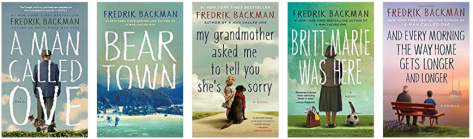
That’s why I was overjoyed to discover Fredrik Backman, a Swedish author whose novel A Man Called Ove spent more than 30 weeks on the New York Times bestseller list. Turns out, his other works are not only just as good, but maybe even better. (and not to worry, they’re all in English. Even I’m not that highbrow)
Ove is the story of a grumpy old man (think the lead character in the movie “Up”) whose attempts at suicide after his wife’s death are thwarted by his quirky neighbors. Sounds heavy, but it’s told with such humor, and the cast of characters is so engaging, that it ends up being an uplifting story. I had heard rave reviews about it from all my reader friends, so when I finally stopped waiting for it from the public library and ordered it online, I had high expectations. I was not disappointed. I’m a fast reader, in general, but this book I devoured. I laughed, I cried, and then I worried: should I try his other books and risk that they won’t be as good?
Backman’s second novel My Grandmother Told Me To Tell You She’s Sorry had the benefit of an intriguing title, so I gave it a try. It’s similar to Ove in that it centers on a community of people – quirky, flawed, likable and not – that grab your attention. Also like Ove, the truth is revealed in bits and pieces that kept me eagerly turning pages. The main character of this book is 7-year-old Elsa, a misfit who loses her best friend when her unorthodox grandmother passes away. The grandmother leaves Elsa a sort of of treasure hunt that reveals her greatest joys and deepest regrets. Drawn as I am to precocious child characters, I may even have liked this better than Ove.
Another novel, Britt Marie was Here, takes a somewhat unlikable character from Grandmother and tells her story. Having scored twice with this author, I gave it a shot and was not disappointed. It was a different story, not quite as good, but with enough of Backman’s interesting characters and charm to keep it enjoyable. Much of the plot revolves around a down-and-out soccer team, so if you like the sport, that may draw you in.
The short novel Every Morning, the Way Home Gets Longer and Longer is about the effects of dementia. I only skimmed it, not being in the right frame of mind to read it at this time. I’ve heard it’s beautiful but difficult if you’ve lost someone to the disease.
Finally, Backman’s Beartown may be the book that young adult readers would find most riveting. It’s a story of a remote, and shrinking, town that pins its hopes for success on its local hockey team. But when the star player is accused of a brutal crime, those in the community take sides and the town’s future is jeopardized. While Backman’s other books are written in episodes that all tie together, this one is more of a straight narrative. In an age when sports is valued and athletes are revered, this was a thought-provoking read.
 Out of Darkness by Ashley Hope Perez: Inspired by a true event, the 1937 explosion of an East Texas school that killed 300 people, this novel follows the experiences of a Mexican-American girl and an African-American boy whose growing love crosses racial barriers and risks another kind of eruption. Extremely well-written, riveting and heartbreaking.
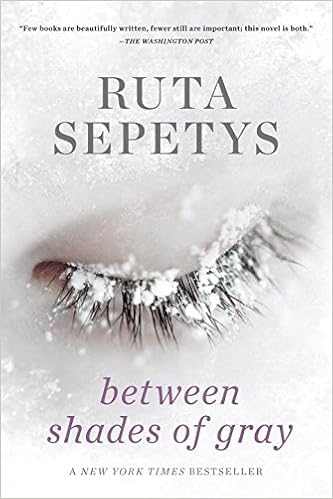 Between Shades of Gray by Ruta Sepetys: No, this is not a sequel, prequel or related in any way to the Fifty Shades of Grey series. This novel is about the killings, imprisonments and deportations of thousands committed during Josef Stalin’s “reign of terror.” When Stalin’s Soviet Union invaded the Baltic nation of Lithuania in 1939, he ordered attacks on doctors, lawyers, professors, political activists and pretty much anyone he thought could pose a threat to his rule. Lina’s family was among them, enduring hard labor, starvation and unimaginable abuse in Siberian prison camps.
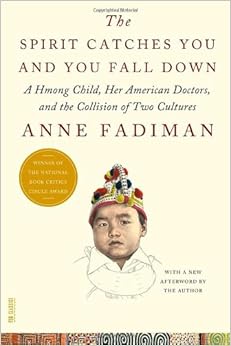 The Spirit Catches You and You Fall Down: A Hmong Child, Her American Doctors and the Collision of Two Cultures by Anne Fadiman: Don’t be embarrassed if you’ve never heard of the Hmong. I’d mistakenly grouped them with the Vietnamese refugees who came here after the fall of Saigon. They’re a different culture, from an entirely different Southeast Asian country. But the lessons learned from this book — that doctors must be culturally sensitive, that medicine is not always stronger than spiritual beliefs — could apply to any interaction between different ethnic groups. The book follows a young girl with epilepsy and how stereotypes and misunderstandings nearly cost her life.
 The Hawk