
By Siena Oliver, ’27
News Editor
Throughout the span of human evolution, there have been great strides made in the areas of technology and science. Individualism has also become an important part of many societies, and has helped lead to many of those innovations. One constant throughout all of this, though, has been conflict. In the form of wars, political strife, or just general disagreements, conflicts have hindered the progress of humans, making it almost impossible to efficiently accomplish even simple community-based goals. The definition of conflict, as seen in the Merriam-Webster dictionary, is “to be different, opposed, or contradictory: to fail to be in agreement or accord.” This suggests that it is possible to avoid conflict by compromising and communicating. These skills, which seem to be hard for humans to use effectively, come naturally to ants.
Ants, like humans, have populations living almost everywhere around the world. Unlike humans, though, ants are not often engaged in debates or conflicts; according to the National Wildlife Federation, they are able to make meaningful progress in accomplishing goals for the good of their entire community. The collaboration we see in ants provides an obvious contrast to the way that humans live. One of the most valued concepts in human society is freedom: of speech, religion, to protest and disagree. All of these freedoms, laid out in the constitutions of the U.S. and many other countries, are vital in maintaining personal autonomy and expression, and protecting individuals from an overreach of government power. But freedom also opens the doors to conflict. For the U.S, 2021 was a time defined by protests and social change. During the year, many individuals in the U.S. exercised their rights and freedoms by participating in protests and movements for causes such as Black Lives Matter, pro- and anti-vaccination, LGBTQ+ issues, and more. Many of these movements were successful and peaceful, but some instances –such as the politically charged riot against the capitol on January 6th — ended up turning violent. In a 2021 article from the Pew Research Center, 81 percent of Americans felt that the country was “more socially divided” than ever before. This shows that, while valuable, freedoms of opinion and speech can lead to conflict and division. To be clear, I am not proposing that we get rid of human rights. However, it would be beneficial to recognize that, while humans are free to have differing opinions, and these opinions can lead to positive change, our differences should not come at the cost of progress and collaboration. After all, if humans cannot agree on even simple issues, how are we supposed to make meaningful progress in any area?
In an ant colony, each individual helps to make up a part of a larger system. Worker ants, who constitute the biggest part of the colony system, divide up chores such as finding food, creating and defending the nest, and even raising the young, according to Time Magazine. They do all of this in exchange for the protection and benefits of the work of others. Humans, however, tend to follow an ‘every man for himself’ system, where each person focuses on their own goals and survival rather than that of the group. For many, the average lifestyle consists of going to work, and then buying food and other necessities with the money earned from working in order to sustain themselves until the next time they are paid. This system allows for upward mobility in social and economic classes, but because of the need for self-subsistence and self betterment, humans are often more inclined to focus on those personal goals rather than those of the overall community or world. Imagine the potential if humans, like ants, worked together for the betterment of the community as a whole. For an ant, it is easy; it is in their nature to work collectively, but for humans, working together is a choice. The question is, why not choose ‘every man for every man’ rather than ‘every man for himself?’ If we can put our differences aside to accomplish a goal, important progress may be made.
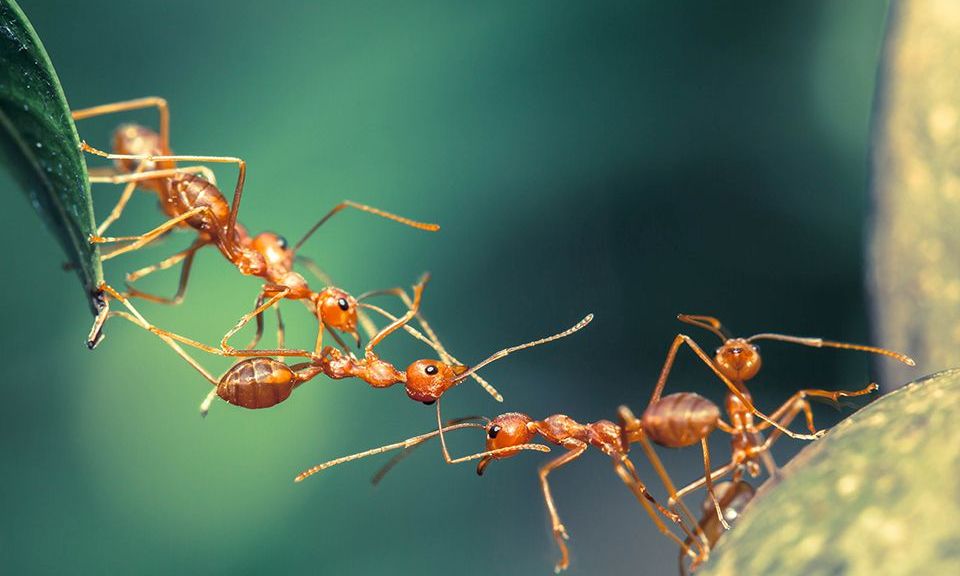
As a species, ants are exceptionally good problem solvers and teamworkers. They are notoriously good at carrying objects much heavier than themselves, but when a piece of food or an object is too large for an ant to carry by itself, a group forms to help. A study published in the Journal of Experimental Biology shows that, when working together, ants can easily transport objects weighing up to 1900 times the mass of a singular ant back to their nest. This collaboration ensures that difficult tasks and problems are easily and efficiently resolved. Humans are capable of leveraging teamwork to complete difficult tasks just like ants, but, often, individual interests or opinions get in the way of working together — especially when a problem is high stakes or very large. Currently, climate change is a problem at the forefront for many people. Climate change is a global issue that requires nations to work collaboratively, but, due to conflicting priorities or political disagreements, progress is moving slowly. A report from the United Nations states that this lack of collaboration has been a barrier to achieving important climate goals. Just as ants work together to solve challenges, humans must use a similar approach to solve large global issues, such as global warming, where individual efforts alone are not enough.
Think of the world like an ant hill: no different colonies or separate nests, just one large home that needs protection from its residents in order to survive. Think of humans as ants, working together to solve challenges and ensure the health of every other ant in their hill. Ants are often looked at by humans as small and inconsequential, but these small creatures may just be the key to the prosperity and survival of the human race. By setting aside individual interests and opinions, and focusing on the greater good, humans can overcome conflict and make progress on pressing global issues. So, perhaps it’s time for humans to take a closer look at the life of an ant, and apply their collaborative ways to our own lives.
Sources
“Ants.” National Wildlife Federation, http://www.nwf.org/Educational-Resources/Wildlife-Guide/Invertebrates/Ants#:~:text=Most%20species%20live%20in%20soil,than%2010%20times%20their%20weight.&text=Ants%20use%20their%20keen%20senses%20to%20communicate%20with%20colony%20members. Accessed 1 Jan. 2025.
Blanchard, Heather Campbell and Benjamin. “What Ants Can Teach Us about Working Together.” Time, Time, 17 Feb. 2023, time.com/6256519/ants-working-together-ant-man-and-the-wasp-quantumania/.
“Conflict Definition & Meaning.” Merriam-Webster, Merriam-Webster, http://www.merriam-webster.com/dictionary/conflict. Accessed 1 Jan. 2025.
Devlin, Kat. “People in Advanced Economies Say Their Society Is More Divided than before Pandemic.” Pew Research Center, Pew Research Center, 23 June 2021, www.pewresearch.org/global/2021/06/23/people-in-advanced-economies-say-their-society-is-more-divided-than-before-pandemic.
“Inadequate Progress on Climate Action Makes Rapid Transformation of Societies Only Option – UNEP.” UN Environment, http://www.unep.org/news-and-stories/press-release/inadequate-progress-climate-action-makes-rapid-transformation. Accessed 1 Jan. 2025.
Jeb.Biologists.Org, jeb.biologists.org/content/222/17/jeb206821. Accessed 1 Jan. 2025.
“A New Era of Conflict and Violence.” United Nations, United Nations, http://www.un.org/en/un75/new-era-conflict-and-violence. Accessed 1 Jan. 2025.
The Protests and Unrest That Defined 2021 – The Washington Post, http://www.washingtonpost.com/world/interactive/2021/protests-world-year-review/. Accessed 1 Jan. 2025.
 The Hawk