
By Danny Campbell, ’27
Staff Writer
Normally I don’t like diving crazy deep into political topics (I actually hate politics strongly, and I’d be much happier without it in my life), but the argument over banning the app TikTok has been boggling my mind since 2022. With it now partially banned in the U.S, I felt like weighing in on the debate.
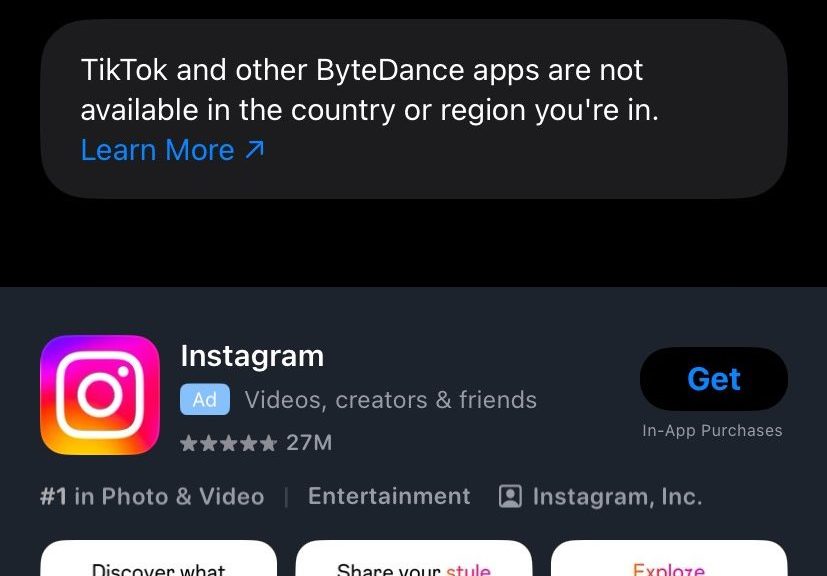
You are probably aware that on Jan. 19, the bill to have the popular social media app TikTok permanently banned in the U.S. went into effect . . . for 12 hours. Last April, Congress cited national security concerns to pass a law banning the app in this country if it wasn’t sold by its Chinese owner. But when Donald Trump became president on Jan. 20, he signed an executive order delaying the law for 75 days, even though he himself tried to have TikTok banned back in 2020! So while the app now works for current users, it can’t be downloaded by new users — or anyone who deleted it when they heard the ban was coming.
But why ban TikTok and not other social media platforms like YouTube or Instagram? Politicians have been talking about a ban since 2020 because of major security concerns regarding its owner, ByteDance. Like all social media and websites we use, TikTok collects user data. But since it’s owned by a Chinese company, it has to hand over that data to the government, the Chinese Communist Party. The CCP and the U.S. government aren’t exactly the best of friends. Lawmakers and the U.S. Department of Justice argue that TikTok could be used by the Chinese government to spread misinformation and that user data could be misused. Critics of a ban say there’s no proof the CCP has done anything wrong and a ban violates free speech. The law was challenged all the way to the Supreme Court, who on Jan. 17 ruled in favor of a potential ban if the company isn’t sold.
So where do things stand now? President Trump, tech innovator Elon Musk and others are talking about having an American company or even the U.S. government buy TikTok, or at least half of it. ByteDance has long said the app is not for sale. So what will happen on April 5, when the 75-day executive order expires, is up in the air. TikTok says its 170 million American users spent nearly an hour a day on the app in 2024, according to the BBC News.
I, for one, have never once used TikTok and at first I saw why the government wanted to ban it. But then I wondered, what is the Chinese government going to do with user data? If you think about it, the only people the Chinese government really wants to keep an eye on is those who work for the U.S. government. In this case, banning the app from government devices is a smart move and should be enough. In my opinion, a larger ban is not needed for ordinary users. The worst thing that the app can do is reduce our attention spans.
Right now, it’s anybody’s game. According to CNN, Americans since the ban have started downloading an app by the name of Xiaohongshu, also known as RedNote, another Chinese-owned social media platform. If the U.S government is concerned about the CCP getting Americans’ data from TikTok, RedNote is probably far worse, and would also likely be banned. Banning social media is a very slippery slope, because if the U.S bans TikTok and other ByteDance products like CapCut, what’s next? If this is considered constitutional, the U.S can ban basically anything it deems dangerous.
In addition to TikTok, many other Chinese-owned companies are used by Americans, including video game makers. Tencent is a Chinese conglomerate that owns a small portion of Epic Games (the creators of Fortnite) and much larger portions of Supercell (the makers of Clash Of Clans) and Riot Games (League Of Legends). With the law to ban TikTok, the U.S. government could go after companies like these. The situation is a disaster.
 The Hawk
Very persuasive article here, Danny! Despite my concerns regarding national security, I am seeing this issue in a new light.
LikeLike
i can very well agree on this article….. great work.
LikeLike
Class GIST: “Danny’s article informs the reader about TikTok’s possible ban based on national security concerns. Danny expresses that it is a slippery slope for the government to ban companies they find ‘dangerous’.”
LikeLike
the kid nice article Danny
LikeLike
I agree that once we start banning things we enter dangerous territory.
LikeLike