
By Greyson Potter, ’29
Staff Writer
If you know anything about the Boston baseball scene, you’re probably familiar with our rivalry with the New York Yankees. Intense is an understatement. Sox and Yankees fans (and many players) genuinely despise each other. From the days of Babe Ruth and Ted Williams vs. Joe DiMaggio to the A-Rod era, every generation has had its defining moments in this storied feud. This year, a new chapter was added as the Red Sox and Yankees faced off in the Wild Card round of the Major League Baseball playoffs. The Yankees ended the Sox’s season, only to be eliminated by Toronto. With both teams now out of the running, it feels like the right time to reflect on the rich, 100-plus-year history of this legendary clash and consider where it might be headed next.
This story starts way back in the early 19th century. The Red Sox were a dominant force in the early days of the MLB, winning World Series titles in 1903, 1912, 1915, 1916, and 1918. Many of these championship teams were led by Boston’s star lefty pitcher, who could also hit. His name was Babe Ruth. At the same time, the Yankees were the bottom feeders of the MLB and had no World Series titles to show. But everything changed in 1916, when a man named Harry Frazee, the anti-Christ to Sox fans, bought the team. Frazee was a Broadway producer. His shows were successful when he bought the team, but by 1920, many of his shows had flopped, and Frazee was swimming in debt. He needed a way to pay off all of his bills, so he decided to trade away some of his baseball players in exchange for cash. Fortunately for him, the Yankees owner, Jacob Ruppert, had plenty of money and was very willing to give it to Frazee in exchange for his championship-winning players. So Harry and Jacob met up and talked shop for a while, and Harry eventually decided to sell Babe Ruth to Jacob for $100,000, paid in four installments of $25,000 with 6 percent interest. Little did they know that this would change the course of baseball history forever.
Three years later, the Yankees, led by Babe Ruth and his staggering .393 batting average and 41 home runs, won their first World Series title, kicking off decades of dominance. By the year 2000, the Bronx Bombers had claimed 25 championships. No other team even had double-digit titles at that point. Meanwhile, Boston’s Olde Towne Team took a very different path, breaking the hearts of generations of fans. The Red Sox wouldn’t win another World Series for 86 years, until the self-proclaimed “Idiots” of 2004 finally changed the narrative. The Curse of the Bambino was just beginning.
Babe Ruth won four World Series championships during his time in the Bronx and retired with a staggering 714 career home runs, by far the most in league history at the time. Even after Ruth, the Yankees sustained their excellence. There were the legendary days of switch-hitting Mickey Mantle, and the historic 1961 season when Roger Maris became the first player to hit more than 60 home runs in a single year, finishing with 61. During this era, there wasn’t much of a true rivalry between the two teams. The Yankees were consistently excellent, while the Red Sox were, more often than not, far from it.
But the Red Sox got a beautiful ray of sunshine in 1939, when Teddy Ballgame made his Major League debut against the Yankees. Ted Williams, the man whose one desire in life was to be remembered as the greatest hitter who ever lived, brought something to the Sox that they had not experienced in years: success. During the 1940s and 1950s, the Yankees and Red Sox began to compete more closely. The Yanks were led by Joe DiMaggio, whose brother, Dom, played for the Red Sox. Joe and Ted were the cream of the crop in baseball, with one constantly being compared to the other. Williams had the numbers; DiMaggio had the rings. Teddy hit .406 in the 1941 season, becoming the last player to hit .400 in a season, along with 37 home runs and 120 RBIs. But Joe DiMaggio edged him out for MVP, hitting .357 with 30 taters and 125 RBI. The difference was that while Williams’ Red Sox were 84-70, a respectable record, DiMaggio’s Yankees were 101-43 and went on to win the World Series. So, despite Williams having the better career numbers and being part of the 500 home run club, many argue that DiMaggio was better because he got the championships. In fact, Ted Williams only made one World Series appearance in his entire 19-year career. It was 1946, and Teddy Ballgame had just returned from three years of war service. He won MVP in his first year back and led the Red Sox to the World Series, where they would play the Cardinals. But in an exhibition game just days before the Series, Ted was hit by a pitch, breaking his elbow. He still played in the World Series, but hit a measly .200 with zero extra-base hits and a single RBI. The Sox lost in seven games. Williams would never make it back to baseball’s grandest stage. This was the first time that the Curse of the Bambino struck the Red Sox hard.
The Yankees and Red Sox would not face each other in the playoffs again until 1978, and the stakes could not have been higher. At the end of the season, the Sox and Yankees were tied for first place in the American League East. A one-game tiebreaker was needed. The winner would advance to the playoffs, while the loser would pack their bags for home.
The game would be played at historic Fenway Park in Boston. The Sox had Hall of Famers Jim Rice, Carl Yastrzemski, and Carlton Fisk hitting 3-4-5, while the Bombers had Reggie Jackson in the 4 hole and Goose Gossage at the back end of their bullpen. The Sox took a 2-0 lead into the top of the seventh inning, with starting pitcher Mike Torrez on the bump. Two men were on base, and nine-hole hitter Bucky Dent was at the plate. Dent was a light-hitting, defensive-minded shortstop who had hit a mere four home runs all season long. He got a fastball from Torrez, and he sent it far over the iconic Green Monster to give the Yankees a 3-2 lead. They would go on to win, 5-4. This cemented Dent as one of the biggest villains in Boston baseball history and earned him the nickname Bucky (bleep)ing Dent. The Curse of the Bambino was in full force.
Fast-forward to 2003, and the Red Sox and Yankees were tied at 3-3 in the American League Championship Series. Everything rested on Game 7 in the Bronx. The pitching matchup featured Red Sox ace Pedro Martinez, a historically good pitcher for the team, versus Roger Clemens, the 41-year-old ace for the Yankees in his final season. Clemens had spent years with the Red Sox, including their 1986 World Series loss. Pedro had some of his best stuff that day. He threw seven innings and led his team to a 5-2 lead in the top of the eighth. He was at 105 pitches. Now, the stats showed that Pedro’s performance severely dropped off after 100 pitches. He sent a kiss to the heavens, walking off the mound in the seventh inning, as he always does once he is done pitching. He got all his high-fives once he was back in the dugout, as he always does after a start. But when the eighth inning rolled around, Red Sox manager Grady Little asked Martinez if he wanted to go back out. Martinez wasn’t going to say no; he was too competitive. Grady had a man warm in the bullpen, but despite the numbers saying to avoid this at all costs, he sent Pedro out to pitch the eighth inning.
Grady’s decision would cost him not only his job but also his legacy in Boston. Pedro struggled, and the Yankees tied the game. That was when Grady decided to pull him. The game went to extra innings, and at 12:16 AM, in the bottom of the 11th inning, knuckleballer Tim Wakefield was on the mound for the Red Sox. Wake threw a knuckleball that didn’t knuckle to Aaron Boone of the Yankees, and Boone hit to the midnight moon. Game over. Red Sox lose. Grady Little was replaced by Terry “Tito” Francona as manager.
That offseason, the Red Sox knew they needed to make some changes. But the back-and-forth between them and the Yankees was unlike anything we have ever seen. Pedro was getting older, and the Red Sox needed another ace. Curt Schilling, a World Series champion with the Arizona Diamondbacks, was on the trade market. He was also being pursued by the Yankees, whom he had publicly stated he would love to play for. But Boston general manager Theo Epstein, the youngest GM in baseball history, swooped in, wooed Schilling, ate Thanksgiving dinner with him, and traded for him on November 28.
But Schilling was not the prime target for Boston that offseason. The best shortstop that the game had possibly ever seen, Alex Rodriguez of the Texas Rangers, was on the trade market too. He was the highest-paid player in the history of baseball at the time, but couldn’t even deliver the Rangers a playoff berth. They were looking to get out of that massive deal they gave to A-Rod. The Red Sox had their own elite shortstop, fan favorite “No-mahh” Garciaparra, who had declined an extension with the Red Sox, and they also had the second-highest-paid player in baseball, Manny Ramirez. Manny was an outstanding player, but he could be a prima donna in the clubhouse and never looked like he cared about anything. So Theo met with Alex, and they became very friendly. Alex was charming and charismatic, precisely what the Red Sox needed. A deal was agreed upon between the Sox and Rangers, but the MLB Players’ Union rejected it. Boston had attempted to renegotiate A-Rod’s contract, which the Union opposed. Rodriguez was still in Texas, Manny was still in Boston, and Nomar was unhappy about almost being traded away.
The Yankees made some moves of their own, too, signing big names like Gary Sheffield. But it was not until January that the Yankees would pursue one of the biggest deals in baseball history. In January, Aaron Boone, the man who sent the Red Sox packing in the 2003 ALCS, was playing a game of pickup basketball. He tore his ACL in that game. Now the Yankees were stuck without a third baseman for the whole season. A-Rod was on the trade block, and the Yankees definitely had the resources to pay him. The only problem was that the Yankees already had a shortstop, Derek Jeter. Owner George Steinbrenner and GM Brian Cashman spoke with A-Rod, and he agreed to play third base for the Yankees. The deal was done around Valentine’s Day, 2004. Leadoff hitter Alfonso Soriano was sent to the Rangers, and the Yankees got Alex Rodriguez.
Red Sox fans were devastated. It’s hard not to be when you have the chance to acquire one of the greatest players the game has ever seen at his prime age of 28, then have it slip through your fingers. Still, the Sox did not have a bad offseason at all. They traded for Curt Schilling, who made a scary ace combo with Pedro Martinez. They signed the American League leader in saves, Keith Foulke, to serve as closer. This whole drama would lead to one of the most memorable regular and postseasons in baseball history.
Spring training 2004 arrived, and although it was usually a quiet time, it already felt like September. Garciaparra was clearly upset with the organization, feeling betrayed after they tried to trade him. He was sidelined with a mysterious case of Achilles tendinitis and would end up missing the first 57 games of the season. Manny Ramirez was also upset, with rumors suggesting Pedro Martinez believed Boston was trying to “replace” him with Schilling. What would a Red Sox season be without drama?
The first spring training game for the Red Sox was against the Yankees. The game was a sellout, with hordes of rivals traveling down to Florida for a game that meant nothing, where most starters were going to sit on the bench. The Sox and Yankees would play each other multiple times in spring training, and it would be much of the same, foreshadowing almost every rivalry game that season.
Pedro Martinez was the opening day starter. He had a rocky outing and showed some signs of maybe having to be replaced by Schilling. Nomar did not play, and the Red Sox lost, 7-2. They were up-and-down to start the season, and sulky Nomar, who had been sitting by himself on the bench for over a month and a half, returned to the lineup on June 10th. Sox Nation thought this would provide the team the spark it needed to really live up to its potential, but instead, it only made things worse. Nomar was never a Gold-Glove caliber shortstop, but his defense that season was lackluster. Additionally, he was cold with the bat, his most potent weapon. The team struggled with his sulky attitude and subpar play, and we had a tough June. Finally, in July, Theo Epstein knew something had to be done. So, to the dismay of many of the Fenway faithful, young Theo traded Nomar, the beloved fan favorite for so many years, to the Chicago Cubs. He got first baseman Doug Mientkiewicz and shortstop Orlando Cabrera, two top defensive players at their respective positions that would plug some holes in the Red Sox’ spotty infield defense.
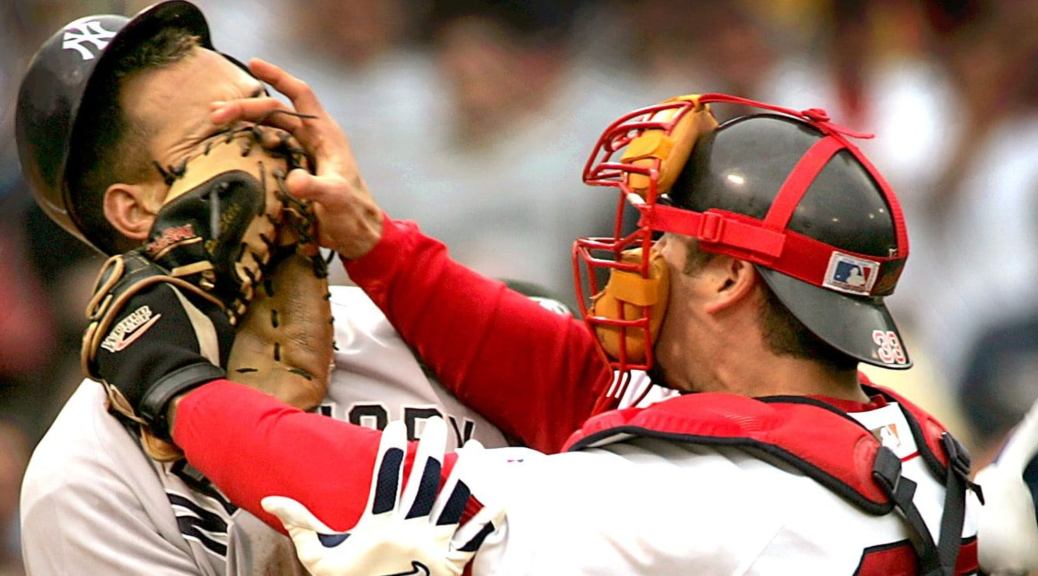
That was not the only memorable event from July 2004, however. On July 24, the man the Red Sox failed to acquire in the offseason helped make a portrait that would be framed in New England dens for many years to come. Bronson Arroyo was pitching for Boston against the Yankees. It had been a pretty chippy game, but it climaxed when Arroyo hit Alex Rodriguez with a pitch. A-Rod was not happy, to say the least, and had some words for Arroyo. Jason Varitek, the Red Sox catcher, did not appreciate what Rodriguez had to say to his pitcher. So he stepped up to A-Rod and punched him in the face with his catcher’s mitt, sparking a benches-clearing brawl. It was a memorable moment that really sparked the Red Sox team and sent them on the right path for the rest of the season.
The Sox were unstoppable after Varitek punched A-Rod. Schilling was as good as advertised, David Ortiz and Manny Ramirez were mashing in the heart of the order, and the defense had been cleaned up. We came very close to catching the big, bad Yankees in the American League East division race. One of our last series of the season was against the Yankees. Pedro Martinez pitched and got struck, resulting in one of his worst outings of the season. Pedro had been shaky against New York all year long. When asked about it post-game, he said, “…I guess I just have to tip my cap and call the Yankees my daddy.” Not the best thing to tell if you ever want to return to Yankee Stadium.
It was now playoff time. October baseball. The Red Sox clinched a Wild Card spot and took on the soon-to-be MVP Vladimir Guerrero and the Anaheim Angels in the American League Division Series. The Yankees had won the AL East and were playing a series against the Minnesota Twins, with soon-to-be Cy Young Award winner Johan Santana. We swept Anaheim, with Big Papi and Manny delivering many clutch hits. New York won their series as well.
The stage was set. One year after Grady Little’s stupid mistake and Aaron Boone’s heartbreaking home run, the Red Sox and the Yankees were meeting in the ALCS. The ace for the Red Sox, Curt Schilling, had hurt his Achilles tendon in the series against the Angels. He tried to pitch in game one of the Sox-Yankees series, but he was essentially pitching off one leg and got beaten up. The Red Sox lost, 10-7. Game 2 was a low-scoring affair, with Pedro Martinez receiving “Who’s your daddy?” chants throughout the game. Red Sox lose, 3-1. Game 3 was just embarrassing. The Yankees pounded the Sox in a demoralizing 19-8 win.
We were down 3-0 in a best-of-seven series. All the Yankees had to do was win one of the next four games, and they would be back in the World Series. No one in the history of Major League Baseball had come back from a 3-0 deficit. Some teams would simply accept that the Yankees are better. But not the Red Sox. Records are made to be broken, right?
Before game 4 in the Bronx, Kevin Millar went around during warm-ups, hyping up his teammates and telling them, “Don’t let us win tonight.” Derek Lowe was on the mound for the Red Sox, and he had been shaky at best during the regular season. But he pitched a solid game and kept his team close. It was 4-3 Yankees heading into the 9th inning. New York had Mariano Rivera, the best closer in baseball history, on the mound. He walked Millar, who was pinch-run for by the speedy Dave Roberts. Roberts did not play much during the season, but he was one of the fastest in the league. He was one of those players who everybody knew was stealing, yet he still managed to get to second. And in this case, everybody did know he was stealing.
Game 5 was very reminiscent of Game 4, with Rivera coming in for the Yankees in the ninth with a 4-3 lead. Again, he blew it, this time on a Jason Varitek sacrifice fly that would score Dave Roberts. The game went 14 innings this time, and Big Papi delivered again, with a walk-off single well into the next day.
Curt Schilling was scheduled to pitch in Game 6, but his Achilles was still hurt. He went to a doctor that morning, who practically stapled his tendon together in an effort to enable him to pitch. Early on in the game, however, whatever was holding Schilling’s ankle together came apart. No bother; Schilling proceeded to go out and deliver a masterful 7-inning effort with a giant blood stain on his sock, going down in Boston lore as the “Bloody Sock Game” that would lead the Red Sox to tie the series at 3-3, heading back to New York.
Game 7 was over as soon as it started. Papi hit a two-run bomb in the first inning, and Johnny Damon hit a grand slam in the fourth to give Boston a 6-0 lead. The Red Sox held on to win 10-3. They were the first MLB team to ever come back from a 3-0 series deficit and win. They had finally beaten the hated Yankees. Unsurprisingly, David Ortiz took home the honor of ALCS MVP.
The World Series, somehow, oddly felt like a formality. Everyone knew the Red Sox were going to win. The Cardinals were the best team in the National League, featuring one of the scariest top four hitters in the MLB, but their pitching was not very strong. The Red Sox swept the team that Ted Williams lost to in his only World Series appearance, with Manny Ramirez taking home World Series MVP honors.
They had finally done it! The Red Sox had reversed the Curse of the Bambino and won their first World Series in 86 years. Many people never even lived to see the Red Sox win a World Series. Most could not remember the last time they won it all, if they were even alive. This title changed a fan base. The team was no longer the pitiful, cursed Red Sox that were always so close, but just not quite there. They were the Red Sox that won the World Series, starting an era of dominance that included titles in 2007, 2013, and 2018. The only World Series the Yankees would win with Alex Rodriguez was in 2009. There would be no more “1918” signs or chants, no more snarky curse remarks from Yankees fans. New York had accomplished arguably the biggest collapse in league history and was thoroughly embarrassed. Somewhere up in the sky, Babe Ruth, the Great Bambino, was smiling down upon Red Sox Nation.
The rivalry has certainly quieted down in recent years. The Sox have won the World Series, but the Yankees haven’t been winning as much. But this year, the Red Sox and Yankees played each other in the American League Wild Card Series. The Red Sox took game one of the best-of-three series in a low-scoring pitchers’ duel between the Red Sox’s #1 starter, Garrett Crochet, and the Yankees’ #1, Max Fried. The Yankees’ inconsistent bullpen lost them the game, though. Carlos Rodon was great for the Yankees in game 2, and the Red Sox pulled starter Brayan Bello in only the third inning. Garret Whitlock, our lights-out setup man, lost us the game, 4-3. Game 3 was sure to be exciting. Winner takes all. Two rookies were on the mound. Conelly Early was the starter for Boston, who had a mere four career major league starts under his belt. Walpole, Mass., native Cam Schlittler was pitching for New York. Schlittler’s fastball was electric that night. He put up one of the best postseason pitching performances ever, becoming the first pitcher to go 8 or more innings with 12 strikeouts and zero walks in a playoff game.
Hopefully, one day soon, the rivalry will be as intense as it was back in the glory days of the early 2000s. Both teams appear poised to be playoff contenders for years to come, boasting exciting players like Roman Anthony for Boston and Aaron Judge for New York. This rivalry is undoubtedly one of the strongest and most brutal clashes in the sports world.
 The Hawk
This catches all of the important moments that went into the long rivalry between the Yankees and the Red Sox, providing detail from the legacies of players such as Joe DiMaggio, to more modern times like the Pedro dynasty and the victory of the 2004 world series ending an 86 year long drought against the St Louis Cardinals after sweeping the Yankees in the wild car spot. while using a healthy amount of sources.
LikeLike