
By Emma Hersey, ’29
Staff Writer
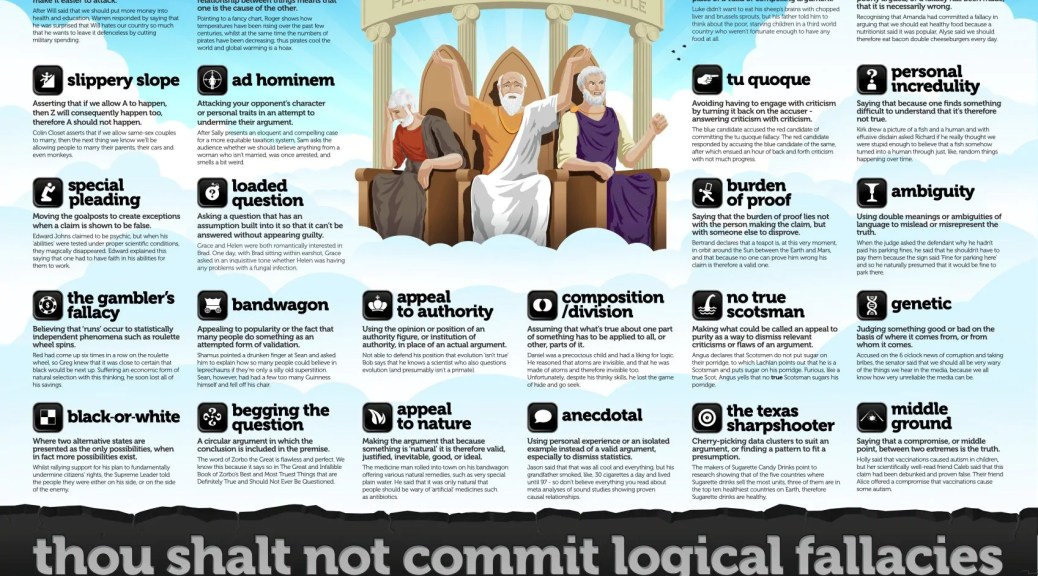
Whether debating the best holiday movie or an important social issue, it’s important to support our arguments with sound reasoning. However, logical fallacies – an error in reasoning that has plagued debaters since the days of Aristotle – can stymie the best of us. How do we ensure we avoid logical fallacies, which lead to unreliable conclusions, emotional manipulation and deviations from the truth due to false assumptions? Let’s start by diving into the two types of fallacies: material and verbal.
Material fallacies are when the main point or assumptions in a sentence are flawed instead of the structure of the sentence. Verbal fallacies are sentences that use ambiguity to trick people with the double meanings of the stressed words.These two fallacies are important to be aware of because they can cause weakened arguments and lead to misconceptions. To test your understanding of these two types of fallacies, you can take this quiz. Once you submit your answers, you can check to see what you got right.
Through these logical fallacies, many people are tricked into formulating shaky arguments, and making incorrect conclusions about the situation at hand. An unsound argument is when you make a claim that fails in its logical structure, or has a piece of information that is questionable to be true. Two types of arguments that fall under logical fallacies are the loaded question fallacy and the ad hominem fallacy. The loaded question fallacy puts the responder in a situation where the answers of “yes” or “no” are both wrong or contradictory. The question “are you always this disrespectful?” is one example; if you answer “yes,” then it proves that you are aware that you are disrespectful, but if you answer “no,” then you are admitting that you usually are disrespectful but you just aren’t as bad at this given moment. These questions lead to unreliable conclusions.
The ad hominem fallacy judges people based on what they do instead of the information they offer. Attacking the person because of their past actions and not the argument at hand creates distorted conclusions. If you do not believe in the actions of the person, then what is it that will push you to believe the words coming out of their mouth? People often have the tendency to judge people based on their clothing, with a negative response to poorly dressed individuals and a positive response to people who are decked out in luxurious brands. Sadly, someone can be speaking complete lies and the audience will take to heart everything they say just because they believe they are competent due to the clothes on their body.
There are several other kinds of fallacies too:
Appeal to Emotion – Have your parents ever said to you, “You have to finish your dinner because there are starving children in the world that could use that food?” That’s an appeal to emotion, which manipulates a person’s feelings and coerces the receiver to accept this formulated conclusion. Through this fallacy, people are misled and manipulated by their emotional response and thus change their actions based on it. When your parents deliver the line about “staving kids,” it makes you want to sit back down and finish your food because of the human response of empathy. Even if you argue about the food at first, your body will respond to a change in emotion and will cause you to finish the food out of guilt for the other children out there.
Slippery Slope – An example of this is when an adult says, “If you don’t do your homework, you’ll fail the class. If you fail the class, you won’t graduate. If you don’t graduate, you won’t get into college or a good job, and you’ll end up poor and homeless.” This fallacy supposes that if you do A, it will cause a chain reaction that not only causes B, but causes C and D too. Many parents use this fallacy to control their children because they believe that it will coerce their children into obeying their instructions. Once children hear how bad life can get if they don’t do a certain thing, parents might believe, they will steer away from the action. But sometimes this can have the opposite effect and make children even more rebellious.
Bandwagon – This fallacy implies that who is making the statement is crucial for its believability. Many stores use the bandwagon effect when marketing products. By paying influencers to positively review the products, the store makes the product seem popular, and that entices shoppers to try it for themselves. When someone uses the bandwagon fallacy, they are putting the claim of a good product on an item just because of its growing popularity, not its actual performance.
Appeal to Nature – This fallacy tricks your brain into believing something is better because it is natural, rather than unnatural. The word “natural” has positive connotations, while “unnatural” is associated with poisons and pesticides. A common marketing tool is to put the words “all natural” on the package because people will believe that anything “natural,” or from the earth, is automatically healthy. When grocery items are labeled organic, it makes many people more inclined to buy them, even though it’s not clear what definition of “organic” the store is using.
Logical fallacies are a big part of our world, leading to unreliable conclusions, emotional manipulation, and deviations from the truth because of false assumptions. It is easy to be swayed by other people and what they are voicing, but being aware of logical fallacies will help you avoid being manipulated. If you want to know more about logical fallacies, check out this link.


I talk about some of this when I teach students about bias in the media. Good work taking on such a complicated topic!
LikeLike