Category Archives: Entertainment

What’s the Deal with Barbenheimer?

By Leah Dillon, ’24

Staff Writer

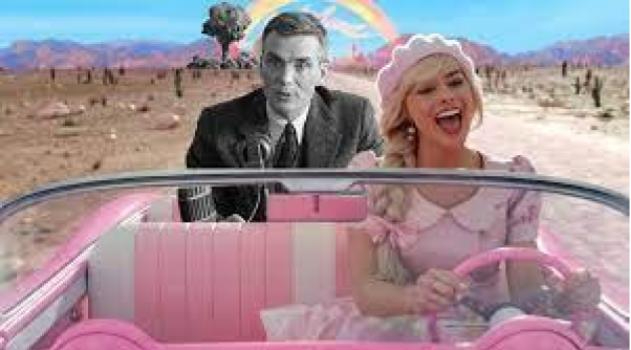
“Barbenheimer,” or the dual release of the polar-opposite films Barbie and Oppenheimer, has been possibly the most unusual trend to sweep the Internet in recent memory. The contrast between the campy and glitter-clad Barbie versus the gritty and dramatic biopic of Oppenheimer seemed to fascinate audiences, who flocked to the theaters en masse to see both films back to back, despite the massive difference in target audience. During my two trips to the new Hanover cinema to see each film, I saw teenage girls and adult men in hot-pink attire crammed into both theaters, hoping to get their fill of the pop culture phenomenon. 

But why? 

https://www.menshealth.com/entertainment/
a44627406/barbenheimer-barbie-oppenheimer-movie-experience/

Beyond the obvious irony of sitting in Oppenheimer wearing bright pink and sequins, I think the “Barbenheimer” trend shows some of the long-term social effects of Covid. Between the virus and now the Hollywood writers’ strike, good movies have been few and far between. There haven’t exactly been many opportunities to go to the local cinema in a while. So why not marathon Barbie and Oppenheimer? Even less broadly, I think the opening of the new Showcase Cinema in Hanover also had a significant hand in reviving local interest in going to the movies. Even if your personal interest in both films could be described as ironic at best, there’s a wealth of experience in going to the movies with friends after several years of isolation and re-integration into the world. 

As for my personal “Barbenheimer” experience, I went in not expecting very much out of either film, except maybe a good time. I didn’t think of myself as the target audience for either movie, and with the last few years of mostly soulless cash grabs in the cinema (with a few notable exceptions), I didn’t have a reason to expect these to be anything different. While both Barbie and Oppenheimer ultimately left me with mixed feelings, I will say that I feel more positive than cynical, and my expectations for both were thoroughly subverted. Here’s my overall thoughts on the “Barbenheimer” experience. 

SPOILERS AHEAD!

Of the two movies, I’ll admit to having higher expectations for Oppenheimer than Barbie. In terms of my personal interest, I expected to like the gritty historical drama much more than something frivolous and in your face (as Barbie undoubtedly was). I dismissed Barbie as one of those “so bad it’s funny” types of movies, ultimately a glorified advertisement. However, the movie managed to rise above the company that conceived it, and in actuality, I liked Barbie considerably more. While I have criticisms of some of the characters and the presentation of some of its themes, it had a lot more substance than I originally gave it credit for, and overall made for a more enjoyable experience. 

I haven’t trusted any big blockbuster movie releases for the past several years because of a widespread decline in the quality of movies and other popular culture. Since roughly 2016, theaters have been inundated with live-action remakes, unnecessary and weirdly executed sequels, and obviously soulless cash grabs. Most of the new movies that have come out in the past few years feel like they’ve been written by accountants rather than screenwriters; the trailers for Barbie made me feel like I’d be walking into a 90-minute commercial for Mattel, and to an extent, it was. With Mattel working on the film, and with a marketing budget of $150 million, the fact that Barbie existed to sell products is unavoidable. However, being what it was, Barbie was extremely self aware. Barbie was able to make fun of its source material and parent company without drawing any corporate ire, from criticizing the male CEOs selling empowerment to young girls, to discussing the unlivable expectations promoted to little girls through the dolls (and the potential impact on self esteem), to playing with the absurdity of its own concept. The whole movie is written in an overly snarky and self-aware kind of way, which genuinely impressed me as I walked out of the theater. On top of that, the movie takes the time to tell a layered story and explore existential questions about the human condition — the very last thing one would expect from a movie about Barbie. The movie managed to surpass my disdain for corporate involvement in art by being aware of the product it’s selling and the subsequent impact, while still leaving ample room for an interesting story and relevant themes. Barbie is so far from just a marketing tool; it manages to be funny and borderline absurd, while also telling a mature story of self-actualization, and giving real-life commentary about the detrimental impacts of patriarchal gender roles.

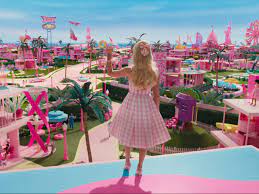
One of the standout aspects of Barbie is its brand of humor. Right from the get-go, the movie makes it obvious that it is not directed at a child audience; rather, it’s for the adults who grew up with the dolls. The whole movie is permeated with both subtle and explicit adult humor, starting with the Kens talking about “beaching each other off,” and escalating to Barbie discussing her non-existent genitalia with a group of pervs on the street. The opening scenes make a point to show the absurdity of human actors in a life-sized manufactured world: there’s no water in the shower or the ocean, the cars are too small, the food is made of plastic. All the Barbies have upturned heels, and flat feet are an object of derision and disgust. Almost none of the world feels believable, but it isn’t supposed to be; it’s all plastic. In writing and screenwriting, there exists this concept called “suspension of disbelief,” which is essentially the audience’s capacity to pretend that the events of the story are really happening. The human mind craves patterns and consistency, and suspension of disbelief is anchored in the mechanics of the pretend world mimicking life and making relative sense. Barbieland does not make sense—and it’s better off for it. The lack of suspension of disbelief contributes to the humor by forcing the audience to continue to think about Barbie as a product and a doll, even when she leaves that mold and ventures into the human world; the awareness also serves as a setup for a lot of the jokes laced throughout the movie. Some of it feels kind of clunky—the “beach you off” scene felt kind of overdone to me, for example—but more jokes landed than not. Even so, the clunky bits felt more campy – in other words, bad enough to be good — than anything else, which worked with the mood the movie was going for. There wasn’t a single moment that I wasn’t having a good time (except for when I lost my wallet in the theater, but I can’t find a way to blame Barbie for that).  The movie takes itself just seriously enough to deliver perfectly, and I’ll never get over how perfect Ryan Gosling was as Ken — from his first scene, you can tell he’s having fun with the role. The humor is one of Barbie’s biggest selling points for a good reason, and even my painfully unfunny self got a kick out of most of it. 

The acting in Barbie is another standout point of the movie, although it’s a point on which I have mixed feelings. I’ll start off by saying that Margot Robbie and Ryan Gosling were as close as possible to perfect in their respective roles. Ken is undoubtedly the funniest part of the movie, and Margot Robbie’s portrayal of Barbie’s existential crisis was completely unexpected, but brilliant nonetheless. On the other hand, though, America Ferraro’s character and the daughter really didn’t work for me, and a lot of their delivery feels off. I can’t pinpoint why, but all of their lines were delivered really weirdly, and by the time I was at Ferraro’s speech about the contradictory expectations of womanhood, my suspension of disbelief was completely broken (and not in the deliberate way that Barbieland was trying to deliver). I was disappointed that the most surface level points of feminism were delivered as this revolutionary revelation, and her tone of voice during the speech reminded me too much of a cartoon character, or rather somebody reading off a script. This is one of the only bits where I feel like the movie wasn’t as self aware as it could have been. Honestly, since the two most important characters were written and portrayed as well as they were, I suppose I have little grounds to complain about the side characters. 

Despite some of its visible flaws in the delivery, the story is one of Barbie’s strongest points, and genuinely surprised me with how well it was executed. Being somewhat of a commercial for Barbie toys, I expected it to be a sort of girl-power, very basic feminist movie. While it delivered that premise on the surface, the way it portrayed the premise was much more creative than I expected. Barbie’s entanglement with the patriarchy was to be expected, but whose idea was it to have Ken teach all the other Kens what the patriarchy is, and to have them engage in a singing battle of all things? Barbie’s existential crisis and the movie’s meditation on the human condition were a very pleasant surprise, and in my opinion, the aspect of the film that elevated it. Some aspects didn’t work for me — I thought the resolution of the mother-daughter relationship problems was poorly done, and kind of dropped in favor of focusing on Barbie’s conflicts, and the first half of the movie prioritized being funny and self aware over story development. However, the second half of the movie and the ending absolutely justify the first half, and the flawed side characters pale in comparison to the characters who are done well, which are most of them. 

The other half of the story is the theme, which is roughly the same as the rest of the story; slightly flawed, but mostly very impressive. The implicit themes of this movie are portrayed much better than some of the explicit themes; for example, Barbie touches on the ways that men suffer under the patriarchy, which is almost never discussed in feminist conversation. However the explicit discussion about the contradictions of womanhood falls flat. The existential pondering about death, aging, and what we are made for are wonderfully executed, but the real-world feminist issues aren’t tackled to the fullest extent. I think a part of this is the limits of the medium — screenwriters can only have so much happen in that hour and a half window (unless you’re Chris Nolan) and the Barbie movie tries to juggle it all. It’s only natural that some aspects thrive while others fall flat. It’s the implicit themes that really elevate this movie, and thankfully, those are executed very well. 

Overall, Barbie was a fantastic experience. It delivers great humor, engaging characters, and unexpectedly poignant questions for the audience to consider. Barbie is without a doubt one of the best movies that I’ve seen in a while, and will be a pleasant surprise for anyone that ventures to watch it, target audience or not. 

Oppenheimer, on the other hand, left me with much stronger mixed feelings. Walking into the film about the “father of the atomic bomb,” I anticipated that I’d like it a lot — I enjoy history and biopics and the like, and knowing my disconnect from Barbie’s target audience, I thought Oppenheimer would resonate with me much more. In actuality, I feel divided on it. I want to say in advance that some of the criticism I could make about Oppenheimer’s content is unfair given what it is — a modern retelling of recent history. The world of fiction is different from the world of reality and of history in that it’s streamlined to be as interesting and coherent as possible. Characters aren’t people, but rather vehicles for themes, and plots follow a structure to keep the audience engaged. Oppenheimer was a real person, and his life wasn’t meticulously planned for an audience in 2023. To expect the story to be consistently entertaining is impossible without betraying the source material of his life and defeating the entire purpose of the film; in this case, that’s not the writer’s job. What the writer has control over is framing, and in that regard, there’s plenty to praise and criticize for Oppenheimer

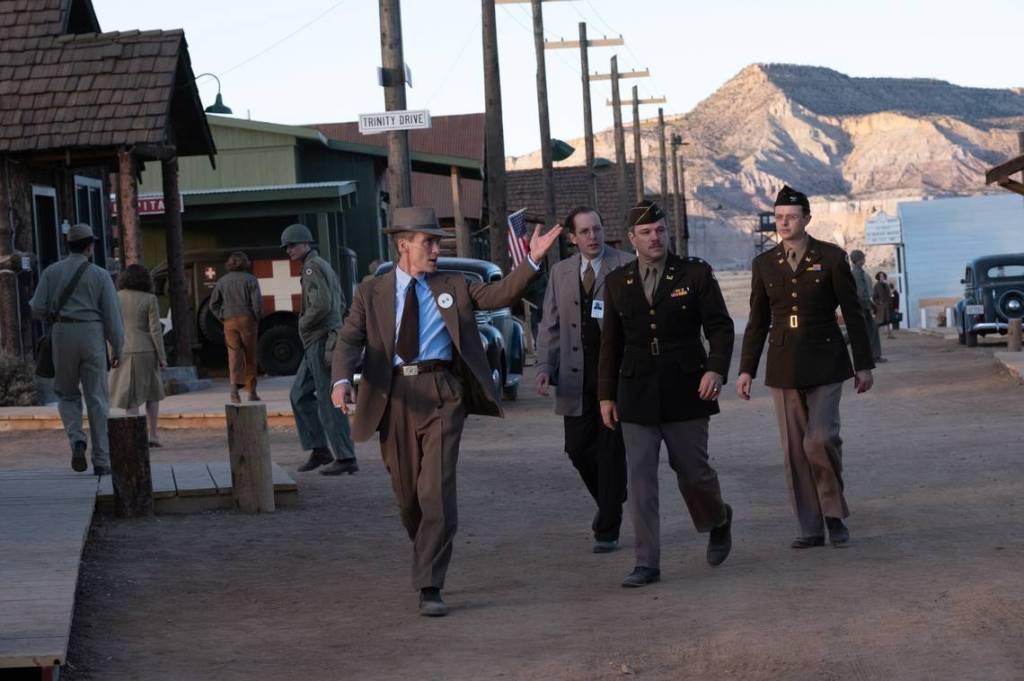
Oppenheimer is just over three hours, and the first and second half of the movie feel like entirely separate films. I’ve never experienced a movie or book that had such a compelling first half and such a lackluster final act. The movie starts out with Oppenheimer’s trial, where he’s charged with having Communist ties in his past. The trial is then used as a framing device for telling the story of his life. The best part of the movie is the dynamic between the past and the present, his actions and the guilt and consequences he faces, all building up to the grand crescendo of the bomb being dropped on Japan. And it’s handled brilliantly: the movement between the past and the present, the growing sense of unease as the plans for the bomb are made, and the brilliant soundtrack and visuals gave the film a constant sense of motion. Even when the content was just men talking in rooms, writing on a chalkboard, making calculations and big science statements far beyond my understanding, everything was infused with this growing sense of tension. The visual design and the soundtrack had a lot to do with this — the music plays for the entirety of the film, except for the abject silence that follows the dropping of the bomb, and scenes of men talking in rooms are often supplemented with visuals from its aftermath; one minute, you’re in the courtroom with Oppenheimer, and in the next, the lawyers are living corpses with their skin flayed off from the radiation. The viewer is allowed to experience the guilt that follows Oppenheimer everywhere he goes, and the dynamic between the past and present really enhances the film. It’s after this dynamic is dropped that I start to have issues with the film. 

The last hour and a half of Oppenheimer are entirely dedicated to his trial, and very quickly, everything that made the movie engaging tapers off. The historical biopic becomes a legal drama; the movie about the man who made the atomic bomb becomes a movie about men talking in rooms. The soundtrack, which used to feel impactful, feels like it’s trying to give tension to something lifeless. The many facets of Oppenheimer’s character that the first half of the movie explores so carefully are erased in favor of playing up his guilt. It’s tedious, and lasts for 90 minutes. It didn’t take long for me to lose the thread and any interest I had. The only two reasons I chose not to leave the theater were because I was writing this review and I had spent $17 on the ticket. I was extremely disappointed in the loss of momentum, needless to say, and it sours my impression of the rest of the film. Oppenheimer was a waste of potential. 

Despite this, I think “Barbenheimer” was a fun experience overall, and one I would recommend to just about everyone. For anyone who missed the trend, honestly just streamline the experience and watch Barbie; maybe get dressed up in pink and huddle around the TV with a group of friends. I never thought I’d be saying that Barbie is better than Oppenheimer, but here I am typing it. Actual movies aside, it’s nice to be able to go to the theater again and make new experiences with friends. Hopefully, the film industry will see that people respond well to good movies rather than soulless cash grabs, and we the viewers can continue to have more “Barbenheimer” summers in the future. 

Featured image: https://www.latimes.com/entertainment-arts/business/newsletter/2023-07-11/wide-shot-newsletter-barbenheimer-barbie-oppenheimer-box-office-the-wide-shot

Taylor Swift & Barbie Drive Economic Boon

By Sienna Lamond, ’26

Staff Writer

The entertainment industry certainly serves its role in keeping the United States economically sound. But lately there have been two factors in particular that seem to be driving the numbers: Taylor Swift and Barbie. Now, how are these two empowering feminists promoting positive economic growth? 

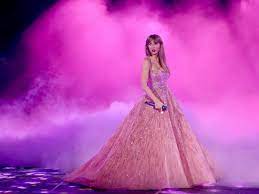
Taylor Swift, beloved across the world, has surpassed a remarkable number of records with her latest tour, the Eras Tour. The tour features songs from each of her 10 studio albums (excluding her debut album, self-titled Taylor Swift), with extravagant costumes to accompany each set. The tour would have been successful even if every high school and college student in America was not obsessed with Swift’s music, but fortunately for her – and the U.S. economy – they are. The tour has already grossed over $2 billion dollars, which is over a billion more that the last record holder, Elton John’s Farewell tour. While that tour spanned five years from September 2018 to July 2023, Swift has managed to double that revenue in a matter of months. 

One of the reasons why Swift is so popular in American high schools is because she touches so many different genres and styles in her 10 albums and three re-releases. Since her first country album was released in 2006, she has managed to grow her empire by switching to more mainstream pop, and dabbling in indie, rock, and folk music. One thing that Swift is expert at as well is getting people’s attention. She creates music that directly responds to rumors, calls out institutions that mock her, and defends her reputation when she’s under scrutiny while maintaining a sense of grace and dignity. Through this forward mentality, she has earned the devotion of girls and women of all ages. These die-hard Swifties will pay as much as $800 for a nosebleed ticket, not to mention the price they are willing to pay for merchandise, hotels, restaurants, gas, and more. The average price each concert attendee had to pay for a ticket, based on data from Business Insider, was $1300. According to The National News, “Her six-night residency is projected to deliver a $320 million boost to Los Angeles County and $160 million in local earnings.” 

It is a dangerous game being so popular, though. If Swift were to cancel just one show in any given city, fans would cancel hotels and restaurants, shops would lose walk-in customers, and no one would spend money on the merchandise sold on site. A sick day would essentially destroy the initially generated revenue overnight. As Swift prepares for the international leg of her Eras Tour, fans who reside in the U.S. are scrambling to get their hands on tickets for shows as far as Japan, Brazil and The Netherlands. It’s not a stretch to say that the future of the world’s economic developments lies with Swift and her future enterprises.

Another iconic blonde that has managed to generate an absurd amount of revenue is Barbie. The new movie based on the long-popular doll has generated just under $1.4 billion in box office worldwide, according to Dexerto. The tear-jerking story focuses on Margot Robbie as Barbie, living in a female-run utopia; when she visits the “real world,” the story spirals, depicting the problems of patriarchy and sexism in a horribly realistic light. Not only is the box office revenue insane, but the attention across social media platforms has driven people to purchase Barbie merchandise from both the official organization as well as small businesses through Etsy, Tiktok, Redbubble, and others. Believe it or not, these hyper-supportive fans will spend $35 on a t-shirt and $10 on a keychain to get their hands on unique Barbie merchandise, as shown from websites like Etsy and Redbubble.

Furthermore, women across the globe are using the movie to push for gender equality. Some men have been offended by the way in which they are depicted in the movie, but few realize that it isn’t inaccurate to the way they are perceived in reality. The movie has stirred gender equality movements in all sorts of jobs across the globe, but the social impact does not stop there. Since it could only be seen in theaters for its first two months – just recently becoming available to stream for $25 a rental –  Barbie has reinvigorated the theater business after a nearly two-year slide due to the COVID-19 pandemic. In addition, Barbie is a refreshing new film in the midst of remakes, prequels, sequels, and overall bad original pictures due to a lack of general creativity that has befallen the film-making industry, which is a story for another time. (see What’s the Deal with Barbenheimer? for more on the Barbie movie)

Overall, the U.S. economy can thank Taylor Swift for a near $5 billion increase this past year, according to The National News, and that number is only expected to grow in the coming months. Add to that the revenue generated from the Barbie movie, and most sources agree that we’ll likely never see another such pop culture and economic phenomenon in our lifetimes. The enthusiasm surrounding both the tour and the movie is different than ever seen before and will continue to bolster the national economy in unprecedented ways in the months to come.

Featured image: https://www.insider.com/taylor-swift-eras-tour-outfits-behind-the-scenes-videos-photos-2023-3

Iron Man Saved Marvel from Bankruptcy

By Abbey Kinzel, ’23

Staff Writer

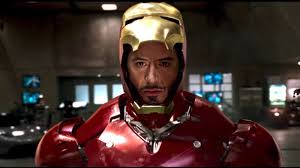
Marvel had been great at producing superhero movies. (I think everyone can agree that statement belongs in the past tense; their movies and TV shows recently haven’t been the best.) But despite the acclaim Marvel received during phase one of the MCU, the company almost filed for bankruptcy in the late ’90s. What saved them was a little movie called Iron Man. When Iron Man came out, it was a huge hit, and Marvel began to create more movies to form a narrative for years to come, like Captain America: The First Avenger, Thor and Guardians of the Galaxy. So let’s take a look back at all three Iron Man movies and see how well they have done.

Iron Man (2008)

The movie starts with Tony Stark  almost dying, then a flashback to a few hours earlier to show he has a lot of money from the manufacture of weapons for the military. He is kidnapped and forced to make one of his most powerful weapons with all the parts he needs in a cave. With the help of this one engineer, they instead make a prototype of the Iron Man suit. Once Tony escapes, he makes more suits and has to battle a former colleague who comes into possession of the prototype suit. This was a good movie, obviously. There is nothing I particularly hate about it, which I’m typically good at. Some worried that casting Robert Downey Jr. as the leading role, and Jon Favreau as the director, were questionable choices. But all in all it’s a good movie. Rotten Tomatoes gives this movie a 94 percent.

Iron Man 2 (2010)

In Iron Man 2, everyone knows that Tony Stark is, get this, Iron Man. The military makes many attempts to make an Iron Man suit of its own so Tony isn’t the only one with a suit and they can control it however they like. The new villain is a guy named Whiplash who, get this, uses electrified whips. So the primary conflict is that Tony is being poisoned on the inside by his tiny arc reactor which is also, ironically, the thing that is keeping him alive. We get introduced to Black Widow – I’ll just keep it at that – and they switched the actor playing Rhodey for Don Cheadle. The movie’s plot is a mix of fighting Whiplash, people trying to obtain blueprints to the Iron Man suit and Tony having a midlife crisis. This movie received 71 percent on Rotten Tomatoes.

Iron Man 3 (2013)

After saving New York from being an alien attack in The Avengers, Tony begins to suffer hard. He gets insomnia and anxiety from some kid’s drawing of him going into space with a missile. Tony starts to rely on his Iron Man suits and even makes more of them so they can protect the world when aliens attack in the future. All of this puts a strain on his relationship with his girl, Pepper. With all that going on, a terrorist group called the 10 Rings begins to, guess what, terrorize America under the leadership of a man named the Mandarin. Tony also has to fight these guys that glow and explode. With all that, this movie earned 79 percent on Rotten Tomatoes.

Featured image: https://www.gamespot.com/gallery/iron-man-28-easter-eggs-to-look-for-while-you-rewatch-the-mcu-classic/2900-4200/

Fantastic Four Fizzled in Fox’s Hands

By Abbey Kinzel, ’23

Staff Writer

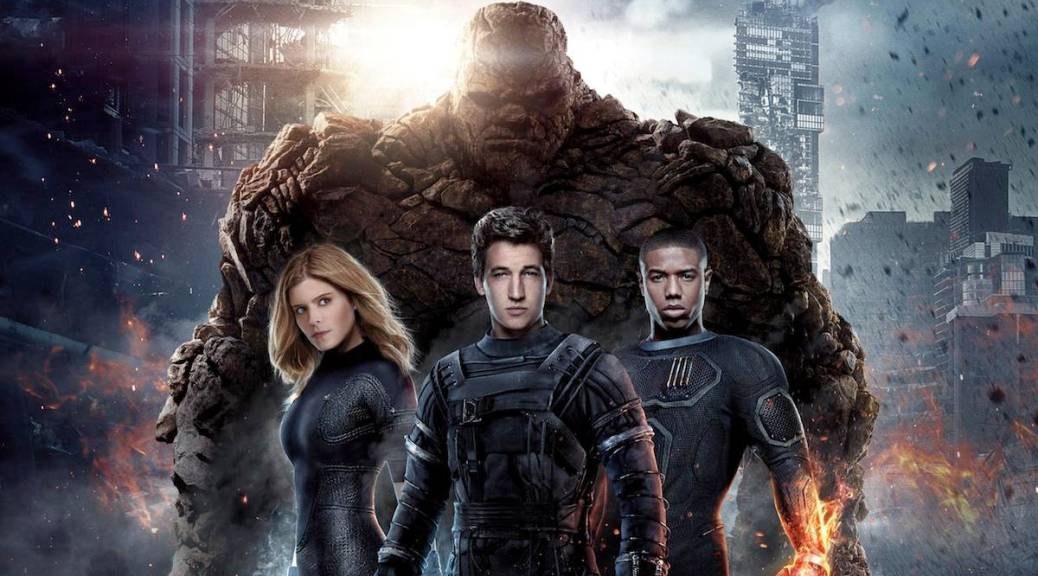
The Fantastic Four has been done so dirty by 20th Century Fox, so much so that the highest rated film on Rotten Tomatoes has earned just 37 percent. I feel like 20th Century Fox can’t get the story right for the silver screen; they have done three films, but some force of nature is keeping them from being any good. But after Disney purchased 20th Century Fox in 2019, the rights returned to Marvel’s hands, so hopefully the story can finally be done right.  Marvel has announced that its MCU Fantastic 4 will hit theaters in February 2025. So let’s dive in and talk about the things we hopefully won’t see in the upcoming movie.

Fantastic Four (2005): The first movie actually got the origin story right, (I’m looking at you, 2015 remake). Reed Richards and Victor von Doom are smart, Reed’s friend Ben is bald and strong, Susan Storm is Victor’s girlfriend and Johnny Storm (Susan’s brother) likes to do stunts. They all go into space and get radiation poisoning from this cloud, and that gives them superpowers. The Fantastic Four minus Victor have to fight the super villain Doom, absolutely no relation to Victor in any way, shape or form (wink wink). With the CGI looking passable, it’s a decent movie standing at 28 percent on Rotten Tomatoes.

Fantastic Four: Rise of the Silver Surfer (2007): In this movie, Reed and Susan are getting ready for their wedding but Reed also has to help the government figure out the cause of multiple supernatural events. The four learn that Silver Surfer is the cause of these events, big surprise. He says he is the “message” that will bring Galactus to Earth so he can munch munch crunch the planet. And it’s up to the Fantastic Four plus Victor von Doom to save the planet. It feels like this was better than the first movie and it has a higher rating, 3 percent on Rotten Tomatoes.

Fantastic Four (2015): I absolutely love to say this was a total disaster. This movie deserves every bit of hate it gets. The origin story isn’t the original, Victor and Reed are supposed to be the same age but it seems like Victor is 4-5 years older, and none of the characters’ ages match the story from the comics. The only person that is even close to their comic book age in the movie is Johnny.  I also hate how they go to a different planet and get powers rather than in space, and I can’t say anything else without spoiling it even though I highly recommend watching something else. But if you want to watch it, you better be ready to laugh at it. The movie earned only a 9 percent rating on Rotten Tomatoes, which I think is way too generous.

Featured image: https://www.forbes.com/sites/scottmendelson/2015/08/10/box-office-4-reasons-fantastic-four-flamed-out/

Two Dystopian Novels Imagine What Happens When Fear and Hate Win

By Mrs. McHugh

HHS Librarian/The Hawk advisor

Our Missing Hearts by Celeste Ng can be called a dystopian novel, a genre which imagines a future world destroyed by war, disaster or other catastrophes. But like Internment by Samira Ahmed, the premise is not such a big leap from our current reality. The story imagines our country has gone through a terrible recession and violent unrest, only settled by a law prohibiting anything foreign or unpatriotic. Asian-Americans unfairly bear the blame for the country’s problems, and any criticism of the new rules is quickly squashed: protests are stifled, books are removed from libraries and children are taken from “unfit” parents. Still, a resistance rises, one that uses story and art to amplify voices that are being silenced. It’s not an action-packed book, focusing heavily on the families and friendships torn apart, so it’s not exactly a thriller. But it’s not science fiction or straight realistic either. It’s a bit of a slow build as you follow 12-year-old Bird, his enigmatic mother and those who support the resistance. The author, who is known for family dramas like Little Fires Everywhere and Everything I Never Told You, says she was inspired by our current divisive politics and the anti-Asian sentiment stirred up by COVID. 


Internment was similarly inspired by politics and American history. In the near future, the U.S. government has imprisoned all Muslim-Americans in internment camps, including 17-year-old Layla and her family. Even though they are citizens, they are stripped of their rights and possessions and considered enemies of the state. This echoes what happened to Japanese-Americans during World War II. It also draws on the hate and fear directed at Muslims after the September 11th attacks committed by radicals in the name of their religion. This is a fast-paced, thrilling story of tolerance and reason triumphing over fear and hate. It also highlights the danger when people stay silent in the face of injustice.

There are countless examples of dystopian novels, including The Hunger Games by Suzanne Collins, The Road by Cormac McCarthy, The Handmaid’s Tale by Margaret Atwood and 1984 by George Orwell. But in each of those books, something catastrophic has happened and our world is barely recognizable. In Our Missing Hearts and Internment, the world is very familiar. The good – and the bad – feel very real. Perhaps that is why these books have such a strong impact.

Making Music, Memories at SEMSBA

By Jake Faghan, ’23

Staff Writer

For athletes, the goal is taking your team to the championship game. For musicians, the equivalent of the “big game” is SEMSBA. The Southeastern Massachusetts School Bandmasters Association involves about 30 towns and 250 student musicians. Students are divided up to form chorus, jazz, orchestral and concert ensembles. It’s a huge moment for the performing arts, as schools come together to create emotion and life, and to form an even stronger community as musicians and singers. 

For SEMSBA 2023 at Middleborough High School March 17-18, Hanover High School sent a strong contingent: seniors Emily Dillon (trumpet), Cassie Lopes (french horn), Owen Forrand (vocals – bass), Andrew Keegan (vocals – bass) and myself (bassoon); juniors Aidan O’Connor (trombone) and Abby Lamb (vocals-alto); and sophomore Brian Tawa (timpani).

To qualify for SEMSBA, students must first audition. In addition to preparing the audition piece they are given, they practice their scales and sight reading (the act of playing a song for the first few times and interpreting it based on what’s on the paper and what one believes it should sound like), as the judges will ask them to play a small piece they have never seen before. HHS music teachers Mr. Harden and Mr. Wade shepherded students through the process. This year, roughly 400 students from across the region tried out, and as is a common theme, it was so amazing to see so many other musicians. The process itself was enjoyable too. It was more of an evaluation instead of harsh grading. There was only one judge so it was easier to think of it as practicing with yourself, and not in front of an audience. When auditions were over, students were slotted into the different musical groups.

The first day of SEMSBA began at 9 am with groups practicing their respective pieces. The school’s gymnasium, auditorium, and practice room were filled with talent. The concert band, which I was a part of, had about 80 students, which was really nice to see and experience. Despite never playing together before, it was remarkable to watch songs quickly fit together and sound complete. Our first song of the selection, Americans We by Henry Filmore, was sight-read only once and it came out perfectly. It was a promising day of practice, and each section worked hard to provide their voice and pull their weight. After lunch, each group swapped locations and began practicing again. Lunch was provided by the host school, and it was a chance to meet new people from other towns. Once we were back at it, practice continued until 4 pm; it was amazing how much we all improved in that time. The first day was a huge success, and we all looked forward to the concert the next day.

The second day started similarly with the early hours used for practicing before the performances. Other pieces the concert band played included October by Eric Whitacre and Parkour by Samuel Hazo (which, from this, has become one of my favorite arrangements ever). The auditorium was packed for each performance, and every song from each group – chorus, jazz, orchestra, and concert band – went exceptionally well. 

Overall, it was a wonderful experience. It gave us the chance to see a broader world of music, and enabled friendships to form. I was able to meet fellow bassoonists, and saw myself improve from the experience. It was my first time playing at SEMSBA, and it is something I will never forget. I believe every young musician should at least try it, because there is a lot to gain from an opportunity like this. To anyone considering auditioning in the future, I would strongly recommend it, as it is a wonderful experience and a great opportunity to grow. I’m lucky to have experienced it, and I’m grateful every day for being able to make music.

HMS Theater Returns to the Spotlight

By Paulina Leskow, ’24

Staff Writer

After almost three years, and a global pandemic, Hanover Middle School’s theater program is back in the spotlight. The school’s production of Annie Jr., which tells the story of an orphan girl living in a rich man’s mansion with a desire to meet her real parents, took the Hanover High School stage March 23-25. Based on a 1924 comic strip, the musical was created for Broadway in 1977; the “junior” version is adapted for length, younger voices and bigger casts.

HMS students held both acting and technical roles in order to assure a smooth running production with fantastic music and acting performances. The show was directed by music teacher Dustin Lindsay with the help of HHS teacher Mr. Fahey and many others, including students from the HHS Drama Club.

Sophomore Marie Fortier, the assistant stage manager for the show, said the high school students tried to help their younger counterparts “feel more comfortable in a space they haven’t been in as often.”

“I was able to help the show go from scene to scene,” she added, “whether it was moving set pieces, helping with props, or answering the questions of the middle schoolers.”

Junior Baylor Speckmann, the show’s prop master, said, “I thought it was a great experience to be able to work with the middle schoolers and serve as a role model.” 

It is so great to see theater coming back to Hanover schools; the high school performed 13: The Musical in November and the Brothers Grimm Spectaculathon for the Massachusetts Educational Theater Guild festival last month. Be sure to check out the summer musical of Nemo Junior, scheduled for August 11-12.

Star Wars Movie Franchise is Dying, But the TV Shows May Save It

By Abbey Kinzel, ’23

Staff Writer

If you asked someone what movie comes to mind when you think of science fiction, they are likely to answer Star Wars. The franchise is a classic in the world of sci-fi and is referenced in many other movies and TV shows. To a lot of people, the series will never get old. But to me and many others, it has become repetitive over time and the direction taken with the storylines in the latest movies has been very questionable. Rotten Tomatoes still thinks the franchise is the best thing since the invention of the iPhone. But while the visuals may be good, from a plot and canon standpoint, the recent movies have been appalling. At the beginning of a film, we’ll learn about the newest characters and what makes them who they are, but then later they’ll do things that don’t make sense. You could say it’s “character development” but I think there is little to no development at all. I’ll get into that more when I discuss the latest three films.  I’ll start by going over every Star Wars movie in order of release date, and then touch on the television shows. It may be that, despite the place in pop culture the Star Wars movies hold, their future may be better on the small screen.

Star Wars: Episode IV-A New Hope (1977):  This is a classic for multiple reasons: unforgettable characters, quotes that are still relevant, a villain that has become a staple of pop culture and the introduction of a very influential weapon, the lightsaber. And who can forget the Death Star, the Millennium Falcon, “It’s a trap,” C3P0 and R2D2? Of course, after you watch it for the 17th time, you lose that feeling of excitement and pure joy. To quote my cousin after we were forced to watch it with our younger cousins, “Wow . . . It’s just like the first 200 times I’ve seen it.” Rotten Tomatoes gives this a 93 percent fresh rating, but my opinion at this point is probably a little more mixed.

Star Wars: Episode V-The Empire Strikes Back (1980): Ok look, trust me, some of these I watched tons of times when I was a kid, like A New Hope, The Phantom Menace and Revenge of the Sith. But that doesn’t mean I’m not going to go hard on them. This isn’t one of them. All I remembered before I rewatched it recently was carbonite, Boba Fett and Darth Vader. After seeing it again, I realized I had forgotten about Leia kissing Luke for some reason that still puzzles me, Yoda (yeah he’s in here), the Planet Hoth, XT-XT’s, AT-AT’s and Lando. It has a good plot twist, but it’s a plot twist that has been ingrained into Star Wars fans’ heads forever. This movie wasn’t the best and greatest, it did feel better story-wise than the first. That’s probably why this movie is actually rated one percent better on Rotten Tomatoes than A New Hope.

Star Wars: Episode VI-Return of the Jedi (1983): This installment wraps up the original trilogy (although creator George Lucas always had ideas for prequels in his head). Episodes 1-3, made almost 20 years later, tell the story of Anakin, Luke’s father. But episodes 4-6 serve as Luke’s story. The film features the rescue of space pilot Han Solo, the death of Boba Fett and Yoda, and the reveal of the real evil Darth Sidious aka Emperor Palpatine. With Darth Sidious defeated and Darth Vader dead, Luke and his friends have officially defeated the empire for good. Now it’s time for the prequels. This has gotten 83 percent on Rotten Tomatoes.

Star Wars: Episode I-The Phantom Menace (1999): This starts the story of Anakin Skywalker, and we meet him when he is a little kid. Obi-Wan Kenobi and his master Qui-Gon Jinn are escorting Padmé Amidala, queen and senator of the planet Naboo, who Anakin later gets a crush on. We are introduced to Darth Maul and he dies 45 minutes later. We are also introduced to the second best character in the franchise, suspected sith lord Jar Jar Binks. Obi-Wan and Qui-Gon sense that Anakin has the force and want to train him. Anakin wins a race, Qui-Gon dies, Anakin blows up an empire space station, and Anakin is evaluated by Yoda and other Jedi masters. Yoda says  he is too old even though Anakin is like 6 or 7 years old, but Obi-Wan convinces them to let him train Anakin. This movie received a 51 percent rating on Rotten Tomatoes. The kid actor that played Anakin is named Jake Lloyd, and after this role he was bullied intensely at school for his portrayal, leading him to quit acting in 2001 and get into legal trouble later in life.

Star Wars: Episode II-Attack of the Clones (2002): This second installment of the prequel trilogy is much better. Obi-Wan discovers a planet that makes clones of Jengo Fett, father of Boba Fett. There are also assassination attempts on Padmé. Jar Jar Binks is an ambassador, teenaged Anakin is tasked with keeping Padmé safe, and he acts really creepy. I’m surprised Padmé eventually gets married to this guy. Anyway, Jengo dies, and Boba decides to become a bounty hunter just like his dad. This one got 65 percent on Rotten Tomatoes.

Star Wars: Episode III-Revenge of the Sith (2005): Upon a recent rewatch, this is better than the first two movies. Anakin and Obi-Wan save Palpatine, kill this guy Count Dooku, and Padmé becomes pregnant. Anakin is torn between staying with the Jedi Council or helping Palpatine. Eventually Anakin joins the dark side since Palpatine manipulates him with the promise of finding out how to save Padmé, who Anakin dreams will die in childbirth. Palpatine orders the clones to initiate Order 66, which is basically the order to kill all Jedi and children with the force. Anakin takes over this one lava planet and is visited by Obi-Wan and Padmé. Anakin hurts Padmé and Obi-Wan & Anakin fight. Anakin loses the fight and is somehow still alive, even though he lost an arm and both his legs and suffered extensive burns. He is rescued and taken back by the dark side for recovery. After losing the will to live, Padmé gives birth to her twin babies. One of the babies was given to, I think, Padmé’s advisor, and the other was given to a part of his family on Tatooine. I don’t know, it’s really confusing. Padmé dies and the babies are officially given to the families and the movie ends. This movie ties up a lot of loose ends, but if anyone finds any new loose ends or plot holes let me know quickly. This movie received 79 percent on Rotten Tomatoes.

Star Wars: The Clone Wars (2008): Let me explain why I found it really hard to initially write this. This was one movie I couldn’t stop watching. It’s one of those movies where you can’t quite remember the plot of but you know it’s good. Surprisingly, it is the lowest ranked movie of all of them, getting just 18 percent on Rotten Tomatoes. It’s really hard to explain. The animation was fine but at times it looked cheesy and flat; some characters felt two-dimensional, dull and sometimes annoying; and the plot is spotty at times. I have zero clue why no one hates Jabba the Hutt’s ugly baby, since so many people hate the Ice Age baby. I found it very hard to stay engaged when watching this movie.

Star Wars: Episode VII-The Force Awakens (2015): Since it has been seven years since a Star Wars installment (and 10 years since a Star Wars movie with a Rotten Tomatoes score above 50), a lot of people forgot how good they could be and must’ve lowered their expectations. This movie wasn’t great or awful; it was just ok with an alright comeback. The characters are blah with just one standout, Oscar Issac’s Poe Dameron, who has recently appeared in the insanely good TV series Moon Knight. The plot is sometimes spotty and left open-ended which is perfect for building terrible sequels. Some of the characters don’t make sense, including a villain who is a man-child who has temper tantrums. It feels like this movie fooled everyone including Rotten Tomatoes, since it has a 93 percent rating. If you get rid of all the weird choices in this movie, it has potential to be good.

Rogue One: A Star Wars Story (2016): Rogue One is a prequel movie that comes directly before A New Hope. The only character’s name that I recognize is Cassian Andor, hero of the rebellion. This is one of the movies that you didn’t quite expect in terms of the ending. This movie introduced deep fakes to me in the form of Wilhuff Tarkin and Princess Leia Organa, the younger CGI versions of deceased actors Peter Cushing and Carrie Fisher. It’s really hard not to spoil this without spoiling A New Hope. This movie received an 84 percent on Rotten Tomatoes.

Star Wars: Episode VIII-The Last Jedi (2017): This movie has been memed to death thanks to Adam Driver and the weird things the directors decided to include. Basically, Luke Skywalker is a big jerk and tells everyone he is a jerk and he sucks, but Rey is like “but you don’t suck” and won’t stop begging him to train her. Finn and Rose’s storyline is just to extend the runtime and is one big waste of time. Also, Rose kisses Finn and the writers thought they could pull a fast one on us and have absolutely no romantic tension or show any romance at all. The producers also hyped up Rey’s parents as being important but it turned out they weren’t. I’m even more surprised that it got a high score on Rotten Tomatoes, 91 percent I really hate this movie. I laughed at the movie and they screwed up the story and destroyed my respect for the franchise.

Solo: A Star Wars Story (2018): I’m not going to say a lot about this movie. It was just a big letdown for me. The only person I cared about was Chewbacca, and I hated everyone else. There was the underlying feeling that they aren’t remotely redeemable. Also, can someone help me understand how, if you were cut in half at the waist, you are still alive? The only thing that kept me going were the references to other Star Wars films. Might I add this is the second lowest rated movie of all of them, earning a 69 percent on Rotten Tomatoes.

Star Wars: The Rise of Skywalker (2019): Ok I literally laughed at this movie. There were giant plot holes, moves that didn’t make sense and almost all of the classic characters die. Having Rey’s parents be nobodies but her grandparents be somebodies just doesn’t make sense. Also, rewriting the force to make specific powers genetic is dumb and against canon; everything we thought we knew about the force and what the previous movies had established over the years was just thrown out the window. It pains me to watch the Skywalker saga go out with a whimper, and this movie received just 52 percent on Rotten Tomatoes.

How Do The Shows Help Star Wars as movies? You may be asking, if these movies keep going up and down with their ratings, how are they still pumping out successful TV shows like nothing happened to the franchise? Well, it’s because the TV shows have a completely different tone and story compared to the movies. The shows add more to the Star Wars films and fill in some plot holes, but they’re not just some bland productions to answer questions we didn’t ask. They get you invested and fearful when you think the protagonist’s story is going to end, even though we know which characters are going to make it. Shows like The Mandalorian, The Clone Wars, Obi-Wan Kenobi and most recently Andor are all respectfully rated in the 80s or above on Rotten Tomatoes. The Book of Boba Fett earned a 66 percent.

Featured image: https://comicbookmovie.com/sci_fi/star-wars/poll-which-star-wars-movie-is-the-best-one-heres-your-chance-to-decide-a200956

Avengers: Each Installment is Bigger, Better than the Last

By Abbey Kinzel, ’22

Staff Writer

A lot of Gen-Z movie-goers have said that the most iconic franchises are Pirates of the Caribbean, the live-action Diary of a Wimpy Kid, and The Avengers. The Avengers saga, part of the Marvel Cinematic Universe, is by far the most successful of them all. I personally have seen all four movies in theaters with either my friends or my family, and each one tops the previous installment.

The Avengers (2012): Even though this is the first movie of the saga, it doesn’t have the highest score on Rotten Tomatoes. Disregarding that fact, it’s an amazing movie. Marvel was setting up these characters in stand-alone single movies that filled in their backstories and who they are as individuals. Having these six characters come together and defeat a common enemy and a giant space army was game-changing — and a little funny. Captain America, Black Widow, Hawkeye, The Hulk, Iron Man and Thor have to defeat Thor’s brother Loki and throwing a big ol’ space army into the mix was good for the runtime and for the consequences when The Avengers fail their mission. This movie has a 91 percent on Rotten Tomatoes, setting a goal for future Marvel movies. This is a modern classic, and I wouldn’t doubt that when Gen-Z become adults and have families, they are probably going to show this to their kids.

Avengers: Age of Ultron (2015): This was the most anticipated sequel in the summer of 2015. Avengers: Age of Ultron was a near direct sequel to The Avengers. Everyone’s the same, character-wise, but Iron Man made more of his suit of armor to combat different situations. They begin to show off  two new characters that might be added to the gang, “enhanced individuals” named Wanda and Pietro (they can’t call them mutants since FOX owns the X-Men franchise). The team has to defeatUltron, a rogue robot made by Tony Stark and Bruce Banner. And Ultron has a very elaborate plan to kill off the world population. That’s all I have to say about this movie without spoilers. It earned a score of 76 percent on Rotten Tomatoes, the third best in the saga. This movie was very exciting but there is always the feeling deep down that they will save the day. The same cannot be said about the next movie.

Avengers: Infinity War (2018): I believe this is the first movie that made me cry in theaters. I can’t say too much due to spoilers. After many events in some movies that began with the name Captain America, the newly separated Avengers team up with some runaways, criminals and new heroes to fight some big purple man’s armies. This big purple man’s name is Thanos and he is trying to collect the “Infinity Stones” little rocks with different powers that have been referenced or featured in the different MCU movies. A lot of people die and there is a lot of sadness in this one, which has a score of 85 percent on Rotten Tomatoes.

Avengers: Endgame (2019): Not surprisingly, this has the highest score on Rotten Tomatoes, and for many good reasons. One is that a lot of fan theories are confirmed in this movie; two, is that it references many storylines from the comics; and three, the CGI in this movie is downright gorgeous. Thanos returns in this movie and the same sadness and death are in this too. This movie has a 94 percent on Rotten Tomatoes and lays the groundwork for the next phase of the MCU.

Featured image: https://www.seventeen.com/celebrity/movies-tv/g31672673/marvel-moves-in-order/

Mary Shelley: the Mother of Science Fiction and How Pop Culture Has Failed Her

By Leah Dillon, ’24

Staff Writer

Classic literature and science fiction are, to the inattentive critic, genres which seldom collide. And why would they? Classic lit is, to many, stuffy and overburdened with words, antiquated and boring to anyone with a social life. Science fiction presents itself as the opposite; it’s the storytelling of the future, full of ideas and potential. But what if those assessments are inaccurate? As hard as it might be to believe, a novel published in 1818 provides a vision of the future that remains cutting edge, still relevant today in its precautionary message. Mary Shelley’s Frankenstein tells the repeating tale of human error, of our tendency to extend ourselves further than we should, to mess with forces that we seldom understand in pursuit of selfish ambition. While many are familiar with the premise of a doctor and his pursuit of creating life, much of the pop cultural reception of Frankenstein is skewed, dramatized for the sake of marketing. Not once in the novel was the iconic line “It’s alive!” uttered, and few know that Frankenstein was the doctor, the real monster, while his creature was the unwitting victim. Through an exploration of the original source material, we can discover truths about today’s iteration of sci-fi and the nature of entertainment, as well as commentary about the relentless world that we live in. 

Mary Shelley grew up at the precipice of a new century, in a household fraught with enlightened ideas and conflict alike. Her mother, Mary Wollenstonecraft, was largely credited with the conception of feminist literature with her writing of A Vindication of the Rights of Women, and her father, too, was a radical thinker, giving the young Mary Shelley a hefty legacy to live up to. Though she never met her mother, who died just a few days after Shelley’s birth, it is evident through her writing and personal diary excerpts that her mother’s writing and ideas largely influenced her view of the world. Her mother’s writings inspired her to be fiercely independent, advocating for her own ideas and following her passions (namely, a married man), regardless of any pushback. These vividly independent ideas were conceived amidst a rapidly changing time period; in her lifespan, she viewed civil wars across the ocean and right next door, human rights movements aplenty (such as the one heralded by her mother), and radical change across the world. Countries colonized, and peoples were colonized, and those people rose up in rebellion. Corporations grew, economies boomed, and a working class languished. Individuals grew in power, and continued to grow. While Shelley saw herself as a reformer, far removed from her parents’ radicalism, her ideas still largely challenged the society that she lived in, as well as our society today. The trajectory of her life and the rapidly changing conditions of her world painted the backdrop of Frankenstein’s precautionary tale, which ultimately warns us about the pitfalls of individual ambition gone too far.

Beyond fitting into the framework of her time and challenging the ideas they perpetuated, however, the ideas behind Frankenstein remain cutting edge today. 

Prior to Frankenstein’s publication in 1818, science fiction did not formally exist as a genre. While it wasn’t unheard of to use the supernatural to ruminate on the natural circumstances which surround us, often through the lens of ancient Greek gods, fairies and ghosts, the merging of the supernatural with the scientific wasn’t as explored. Frankenstein changes this entirely. The story was largely inspired by the ideas of alchemy, a subject which blurs the scientific and the mythical. Alchemists sought to turn base metals to gold, to make an elixir of immortality and a philosopher’s stone, and most notably, to create new life from scratch. While these ideas are unfounded and ridiculous today, alchemy as a concept surfaced before most scientific processes and before the major sciences that we recognize today; we now view alchemy as the forerunner to chemistry. It was alchemy which drove scientists across the globe, and thus, Frankenstein’s story is framed.

Frankenstein follows the story of a young doctor, Victor Frankenstein, and his feverish pursuit of alchemy, his fascination with the mechanics of life and death. Ultimately, these special interests of his culminate in the creation of a creature, called simply “The Creature” or “The Being” (notably, not Frankenstein, as most movie adaptations would have you believe). The being was sewn together from a sundry mix of detached limbs and decaying body parts, selected from the most beautiful corpses that Frankenstein could find. “His limbs were in proportion, and I had selected his features as beautiful. Beautiful!” Shelley wrote. But as soon as The Being was reanimated, Frankenstein changed his mind about his beauty, and fled for the hills, hoping to never see the thing again. From here, the narrative unravels, revealing the real crux of the story, the conflict between a parent and his abandoned child, of the scientist and the monster he created. The Creature, who learned love from observing families, wants only for Frankenstein to love him despite his abhorrent appearance. Still, Frankenstein is overcome with disgust, and he rejects his creation once more. What follows are a series of injustices and a cycle of revenge that doesn’t end until both parties are in the grave. 

Upon publication, Frankenstein was an immediate hit. From its unique framing device of being narrated through letters, to the brand-new genre of science fiction, to the unique ideas about ambition and natural human limits, Frankenstein was a breath of fresh air to the publishing industry, a far-cry from its contemporaries. Above all else, it challenged nearly all of the predominant political ideas of the time it was published. Victor Frankenstein’s downfall at the hands of human ambition greatly contrasted with the popular notions of expansion and growth; the idea that nature and the world at large are ours to take, that the strong should overtake the weak, that we should continue to take, to grow, to expand. The idea that we’ve surpassed mother nature in the act of gaining sentience, as if we aren’t a part of the animal kingdom ourselves, destined to die and feed the soil. Frankenstein asserts the opposite; it says that nature has a wisdom that humans weren’t meant to try to replicate. It says that we have a place to honor in the cycle of life, and everyone suffers if we don’t. It says that we, human beings, are limited, and that is okay. Victor Frankenstein is a lesson in himself, the cautionary tale of the novel. We aren’t meant to emulate Frankenstein; and yet, disturbingly, that seems to be the current trajectory of the human race, and it doesn’t seem to be changing. 

Pop culture has failed to adapt this book in a way that does the story and its messages justice, eschewing the more psychological fear of one’s own progeny and the evil in human nature for the much-shallower monster-horror present in most film adaptations. Frankenstein loses its soul to the modern media lens. And why wouldn’t it? A message about the limits of humanity’s ability to achieve, and the danger of the pursuit of greatness, is the exact opposite of marketable. It’s important to understand that so much of what we consume is dictated by our other consumption. Businesses and corporations who want to sell us our lives, entertainment included, for their own exponential growth, don’t benefit from a story telling us the danger of that level of ambition. Thus, the reconfiguration of Frankenstein’s story commences. The monster is called Frankenstein, not the doctor. Iconic and easily quotable lines like “It’s alive!” are interjected. The beautiful features sewn together to make something less beautiful are thrown away and Frankenstein becomes a symbol, a mask you can buy for Halloween. Thus is the engineering of Sci-Fi. No longer can we see the fears of our own nature. Instead, we observe the next biggest monster, fitted with more spikes and teeth and scales, or the next bit of cutting edge-technology, first imagined onscreen, then perhaps produced in our world. The message of Frankenstein becomes eroded and unreadable, when it is as relevant as it ever has been.

We see the consequences of Frankenstein play out every single day. Greenhouse gasses in the atmosphere, pumped there from the newest, fastest car they can make. Conglomerate corporations buying out their competitors, until every last dollar of yours is spent on only them (looking at you, Disney.) The cancer cells of one woman, Henrietta Lacks, taken from her without her knowledge or consent and being experimented on, and becoming a multi-billion dollar business for doctors and researchers, all the while her family doesn’t see a dime of that fortune. Now, more than ever, we humans step out of place and mess with things bigger than our understanding, making consequences bigger than our understanding. For what? Progress that hurts us more in the long run? An earth so advanced that it becomes unlivable? The decline of humans and mother nature alike? This isn’t progress. Such extreme ambitions, the want for such severe control, is not progress. Progress is learning to work with mother nature, to improve within our human bounds so that members of our own species prosper before we work on the next big advancement, or the next big buck. Progress is the understanding that one person or group of people should never be that powerful, as power corrupts. Mary Shelley knew this, and she warned us. Now, we are just beginning to live out its consequences.

Classic literature is called classic because, despite its age, it tells us universal truths about the human condition. Frankenstein is among these timeless truths; it’s our job to listen. Though classic literature might not be everyone’s idea of a good time, it’s certainly not antiquated, and remains valuable through the lessons it shares, the ideas it pioneers. The work of the past tells us the truths of our future, without the added lens of marketability. If only more people were willing to look to the past to understand our future, then maybe we would be better equipped to escape Frankenstein’s fate, and our own reality wouldn’t become such a precautionary tale. 

featured image: https://www.hcpl.net/blog/2022/06/six-ways-frankensteins-creature-surprised-me