Category Archives: Opinion

The Decline of Mainstream “News”

By Samuel Frattasio, ’27

Opinions Editor

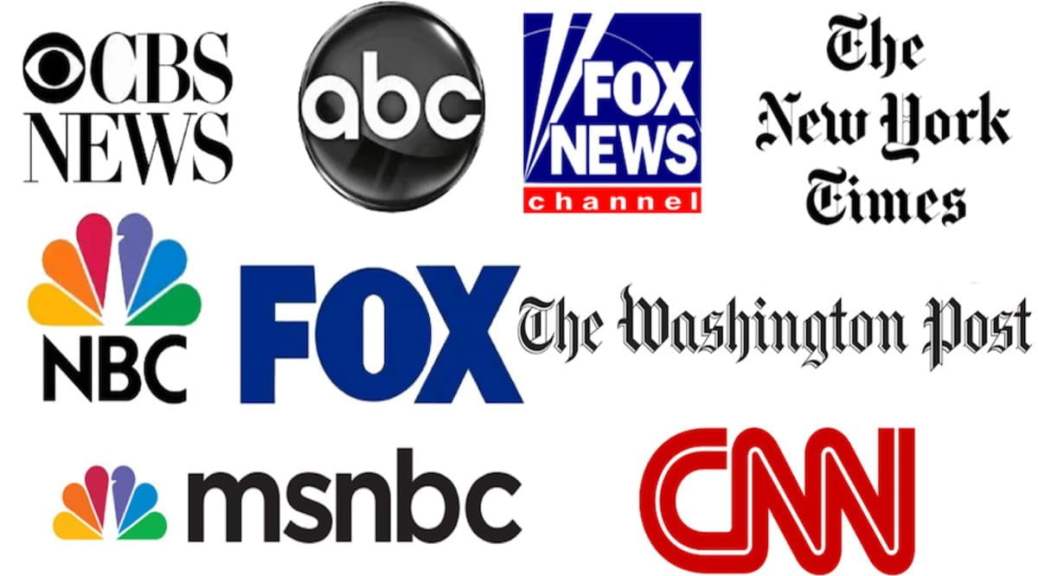
It’s safe to say that many were surprised by the results of the 2024 U.S. Presidential Election. Among those taken aback were left-wing broadcasters from networks such as CNN and MSNBC, who spent months leading up to the election accusing the now-President, along with his family and political allies of various transgressions. While opinions on these accusations may vary, two crucial questions arise: Is such rhetoric necessary? Should broadcasters not strive to maintain impartiality? The evidence suggests otherwise. This perceived lack of objectivity is most definitely contributing to the struggles many mainstream television networks face today. This includes declining ratings and multi-department layoffs. In the case of MSNBC, there is an uncertain future. Their prime audiences are turning to information online, often from the popular social media platform X, formerly known as Twitter, newer outlets, and podcasts.

To understand this phenomenon, we have to address how we got here. The mainstream media, or “Legacy Media,” began in the 1900s, broadcasting from radios. Televisions were introduced in the 1940s. Families across America would gather every evening in the parlor to watch the nightly news. This was when the news wasn’t divisive, before the negative commentary and constant back and forths as seen today. Back then, the news was simple, with straight facts and barely any opinions. Fast forward to the present day, and it seems you can’t turn on the news and just watch the news. It’s ALWAYS negative. As the mainstream media’s prime audiences scatter, they need to find a solution fast or it may be too late.

Is this rhetoric really necessary?

It’s not difficult to research a topic like this. A quick look at a few news programs and the key points become clear. For instance, I recently watched Morning Joe and The Rachel Maddow Show on MSNBC. Both cover much of the same material but with slightly different styles. Yet, they both lean heavily on the same rhetoric. Take Joe Scarborough and Mika Brzezinski from Morning Joe, for example. They’ve spent countless episodes attacking anyone who supports Republican ideologies, only to meet with Trump after the election results were in. Many saw this as an attempt to pander to him or preserve their jobs, further alienating their own audience. As for Rachel Maddow, a seasoned broadcaster and arguably the most popular figure on MSNBC, her nightly show blends current events, pop culture, and political guests. However, she’s been criticized repeatedly for a hypocritical and subjective approach to reporting. Despite trying to cater to her left-leaning viewers, many of them are leaving. It’s clear that people are tired of the constant arguing, the rhetoric, and the misinformation, that’s often found on these networks—and they’re turning elsewhere.

It’s important to recognize that right-wing networks have been equally guilty of bias. Take Fox News, for example. The network has faced its own share of criticism for promoting divisive rhetoric, especially surrounding the 2020 election. However, lately, viewers have been flocking to conservative outlets, and it’s clear that these networks are benefiting from a model that prioritizes partisanship. Whether left-wing or right-wing, the focus on political division and entertainment at the expense of objectivity has become a standard across much of the mainstream media.

Why aren’t broadcasters impartial?

I genuinely believe that most journalists strive to present the facts without letting their personal biases influence their reporting. This is generally true for many centrist networks like CBS, ABC, and NBC, which have historically been trusted for their more neutral coverage. According to a 2020 Pew Research Center study, 67 percent of Americans say that “journalists should aim to be neutral and unbiased in their reporting.” Unfortunately, the same can’t always be said for networks like CNN, Fox News, or MSNBC, where partisanship often colors their coverage. In fact, a Pew Research Center report from 2019 found that 60 percent of Democrats trust CNN, while 60 percent of Republicans trust Fox News, highlighting the ideological divides in modern media. Even within centrist outlets, subjectivity can creep in. Take Kristen Welker, for example, the moderator of NBC’s Meet the Press. Welker has publicly stated that her goal is to present the facts and nothing but the facts, yet, at times, her reporting seems to be influenced by her personal opinions rather than pure, impartial facts. Similarly, Margaret Brennan of CBS’s Face the Nation, and other broadcasters at ABC, have occasionally been critiqued for leaning into more subjective tones, especially when covering political topics.

In my view, it’s impossible to completely escape bias, and some argue that it makes news more entertaining, but in today’s deeply polarized world, can we afford to let personal beliefs dominate the news cycle? In a society already torn apart by division and hostility, the need for impartial, fact-based journalism is more crucial than ever. While no one is perfect, news presenters have a responsibility to set aside their personal beliefs, or at least strive for balance, when reporting the news. It’s not too much to ask. In fact, the public demands it. According to a 2021 Gallup poll, trust in media has plummeted to record lows—only 36 percent of Americans say they have a “great deal” or “fair amount” of trust in the media. This decline in trust can be attributed to growing concerns about bias and partisanship. What’s happening now is that audiences are turning to other forms of media—like podcasts, independent news outlets, and social media—where they feel they can get a more “unfiltered” or “honest” perspective. So, is it too much to ask journalists to put aside their personal opinions and simply present the facts? I don’t think so.

So where is everyone going?

The answer is podcasts, social media, and online news websites. On the popular platform TikTok, news influencer Dylan Page emerged as a leading source for election night coverage. His videos announcing election updates garnered over one million engagements and 6 million views, according to the Columbia Journalism Review. Currently, more than half of U.S. adults turn to social media for at least some of their news, as revealed in a Pew Research study from September. Furthermore, about half of TikTok users under 30 rely on the platform for news, while 79 percent of Instagram users aged 49 and under catch breaking news as it unfolds on the site, according to the Columbia Journalism Review.

Online news is especially convenient for younger generations of voters. In the lead-up to the election, President Trump made a guest appearance on The Joe Rogan Experience, which attracted around 40 million views, surpassing the viewership of last year’s World Series. Similarly, former Vice President Kamala Harris appeared on the Call Her Daddy podcast, amassing over 7 million views. These appearances not only amplified their voices but also led many viewers to cement who they would vote for. It is widely believed that President Trump’s appearance on Rogan’s podcast helped push the President across the finish line with undecided voters.

For mainstream media to stay relevant, they must shift their focus from entertaining to prioritizing facts and accuracy. Since November, many major news outlets have had to make significant layoffs; they should take notes on the simplicity of online media.

Ultimately, I hope for a return to a time when watching the news wasn’t a source of anxiety, when discussions weren’t dominated by shouting matches, and when people could respectfully disagree and still get along.

“The most important thing is to be accurate, to be fair, and to be honest. That’s what you’re supposed to do in this business.”
– Tom Brokaw, former anchor of NBC Nightly News

The Menendez Brothers: Villains or Victims?

By Sienna Lamond, ’26

Staff Writer

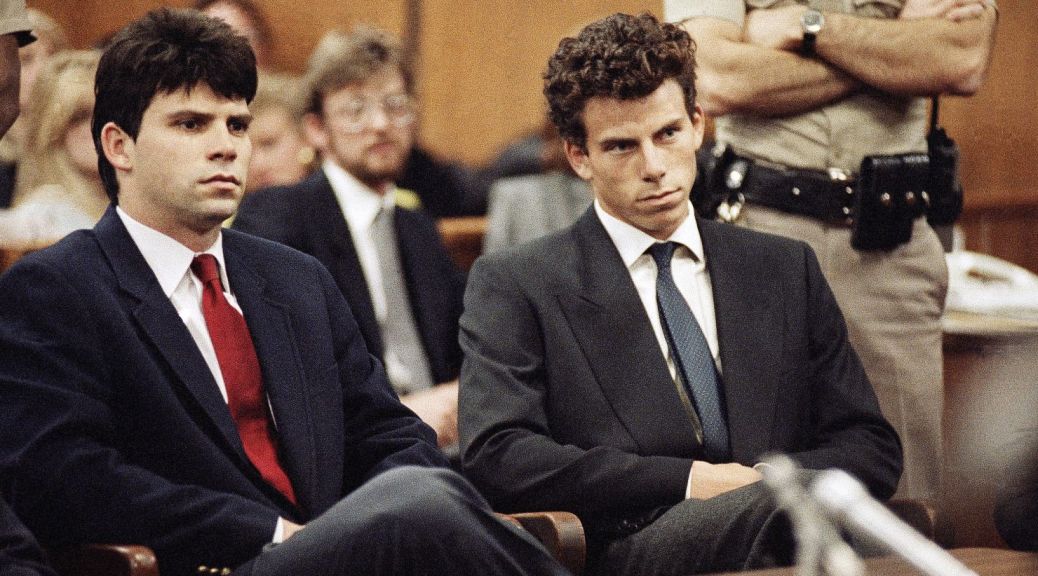
On August 20, 1989, José and Kitty Menendez were murdered in their Beverly Hills, Calif., home. Their sons, Joseph Lyle Menendez and Erik Galen Menendez, were hysterical and devastated. As police began to investigate, what they found was astonishing. On March 8, 1990, Lyle Menendez was arrested for the murder of his parents, and days later, so was Erik.

The brothers’ family hired Leslie Abramson, one of the best criminal defense attorneys in the area. She got a story out of the boys that no one had ever heard before; a story of betrayal and tragedy. Erik admitted to Abramson that his father had been molesting him from the time he was a child until the week before he killed him. And worse, according to Erik, his mother knew the whole time and didn’t do anything to stop it. This, Abramson argued, is what pushed 18-year-old Erik and 21-year-old Lyle to murder their parents.

The original trials took place back in the 1990s, and the brothers were sentenced to life in prison without the possibility of parole. But some recent events have gotten conversations about the case and the brothers stirring again. Los Angeles County’s former District Attorney, George Gascón, released a statement in October recommending that the brothers be eligible for parole immediately. This is an effect of new evidence and the press’s reinvigorated interest in the case due to shining Tinseltown herself: Hollywood.

A true-crime drama series released on Netflix in October called Monsters: The Lyle and Erik Menendez Story may have been a catalyst for these new developments. The show received massive amounts of attention for its incredible costumes, set, script, and, most importantly, impressive actors. Cooper Kotch, who took on the role of playing Erik, emulated the character’s pain and emotion in a one-take 45 minute episode titled “The Hurt Man,” which captured and stunned audiences nationwide. Due to the theatrically impressive nature of the 9-episode sequence, it commanded attention from the press and social media. In the ’90s when the case was first being publicized, the public’s attention on the event and the brothers swayed the atmosphere in court. The media lost interest in the case after the first trial was declared a mistrial; that is thought to be one factor that may have impacted the brothers’ ultimate sentence. Now that the brothers are back in the public eye, general feelings of sympathy, hope, and justice are igniting in the people, which could mean good things are to come for them both.

While in prison, it is my belief that Lyle and Erik have proven that they rebuke the title of the Netflix series; they are not monsters. Both brothers have worked for over 30 years to better themselves, others, and their community. Erik received an Associate’s Degree in Sociology and Social and Behavioral Sciences from UC Irvine, started a meditation group in prison, and he and Lyle started several support groups for inmates, including a group for inmates with physical disabilities and a general group therapy program. Meanwhile, Lyle received a Bachelor of Arts degree, also from UC Irvine, founded the Adverse Child Rehabilitation program in 2016, and founded the Greenspace Project, in which inmates had the opportunity to paint murals, which raised $250,000. Furthermore, the brothers’s family asks to bring them home. Their aunt, Joan Vandermolen stated in an AP News post, “They have grown, they have changed, and they have become better men, despite everything that they’ve been through. It’s time to give them the opportunity to live the rest of their lives free from the shadow of their past.” In addition, prison guards and fellow inmates express that Lyle and Erik are far from dangerous criminals, and instead are more like friendly neighbors. Cooper Kotch, the aforementioned star of the TV series about the brothers, visited Erik in prison and spoke on the experience in a press-tour interview promoting the show. He explained how he felt the same way as almost everyone who knows the brothers personally, and he believes they should be given a second chance.

If the brothers were so innocent the first time, why were they convicted and sentenced to life? To that, I answer that they weren’t so innocent. They certainly didn’t seem very innocent. While the prosecution maintained their charge of first-degree murder throughout the court proceedings, the brothers’ defense changed. At first, the brothers pleaded not guilty when their lawyer was Robert Shapiro, whose name you may recognize from his defense of OJ Simpson in his murder trial. The family eventually fired Shapiro and, instead, hired Leslie Abramson. When their lawyers switched, so did their plea, which the prosecution used to their advantage. On top of that, the brothers lied throughout the months following their parents deaths. Their family’s therapist recorded them confessing to everything except the whole base of their defense: the sexual abuse. Furthermore, not a single man on the jury voted in favor of the brothers’ story, leading to the conclusion that most men would not be sympathetic to their tragic tale of sexual abuse. In court, the question arose that if the brothers were being truthful about the sexual abuse, why didn’t they speak up sooner? Why didn’t they admit to the abuse while confessing to their therapist? Why lie about the murders in the first place? Why never tell anyone? These questions eventually resulted in the defense team losing the second trial and the brothers just narrowly avoiding the death penalty.

The 1990s were a very different time from now. Social, psychological, and scientific studies have been conducted to provide us with answers to not only this case, but all those that resemble this one as well. Why did they do it? The answer is in your head–literally. “Childhood is a pivotal time for brain development,” writes the Integrative Life Center, “The effects of physical abuse and neglect can disrupt this development.” The ILC goes on to describe all the ways in which an individual’s brain is affected developmentally when that individual experiences abuse in any form during childhood. Teenagers and young adults are known for being reckless, irrational, and irresponsible, and this is completely developmentally appropriate. The parts of the brain responsible for processing emotions and making decisions, the amygdala and the prefrontal cortex, are not fully formed until a person is around 25 years old. When childhood abuse is added to the equation, the growth of these crucial parts of the brain is stunted and brain maturity is reached much later in life. Taking this into account, not only were Lyle and Erik younger than the typical age for brain maturity, but their abuse further affected their ability to process emotions and make rational decisions. The Los Angeles Times wrote in a 1993 article, when the case was being tried, “By age 18, traumatized severely by 12 years of abuse, Erik Menendez was racked by overriding feelings of powerlessness, hopelessness, helplessness and fear . . . when he and his brother sensed violence on the night of Aug. 20, 1989, it was as if he was on autopilot when they blasted away at their parents.”

Despite new understanding about the impact of abuse on children, the brothers are still serving time in Richard J. Donovan Correctional Facility in San Diego, Calif. After over 30 years, they may get a second chance. The brothers maintain their defense that they were sexually and emotionally abused their whole lives, which leads to the belief that this story of tragedy and betrayal is the truth. While murder is unacceptable, so is manipulation, molestation, and abuse of a child. Lyle and Erik spent their whole childhoods feeling trapped and afraid in the place they were supposed to feel comfortable and relaxed. Given modern knowledge and the time since the whole cascade of events occured, it is within the realm of possibility for the brothers to see freedom again. Is justice imprisoning abuse victims, or is it setting murderers free? The situation begs the question that every individual must ask themselves: are the Menendez brothers the villains of the story, or have they been victims all along?

Art: A Cornerstone of Education

By Sophie Bunar, ’27

Staff Writer

“Education isn’t just about feeding the brain. Art and music feed the heart and soul.” ~ Julie Garwood

Art and music surround us, bringing humanity to our computed, monotonous lives. They allow free expression, enjoyable experiences, and even a future career for many. Here in Hanover, we strive to create a place where students can find companionship, acceptance, and invaluable skills. However, with the overwhelming town budget struggles forcing cuts to art and music this year – and threatening more for next year – the voice of our community needs to be louder than ever. To better understand the importance of art and music curricula, I interviewed several educators and students.

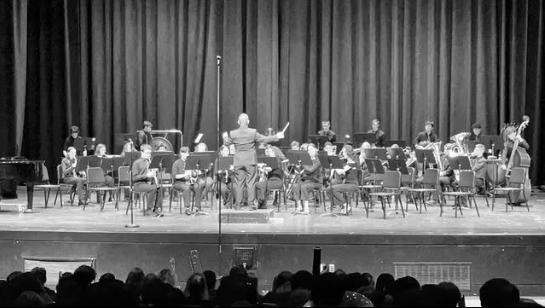
“The arts programs here at Hanover are the most important parts of our public schools,” said Dante Heffron, senior drum major of The Pride of Hanover Marching Band. “These programs provide a sense of belonging for students and also provide a place for students to explore their skills or learn new ones.”

Even if they may not excel in other subjects, many students find their strength and community through the arts. Everybody is different and distinctively skilled, but a group that works together and embraces these differences is what many students need to succeed both in school and in life. Just as Hanover High School band director and music teacher Matthew Harden explained, “Not every young person is an athlete or scholar in the traditional sense; however, music and art speak the language of emotion, connection, and community.” Providing students with a place where they can express themselves on a level that surpasses standardized academics is essential within any school system.

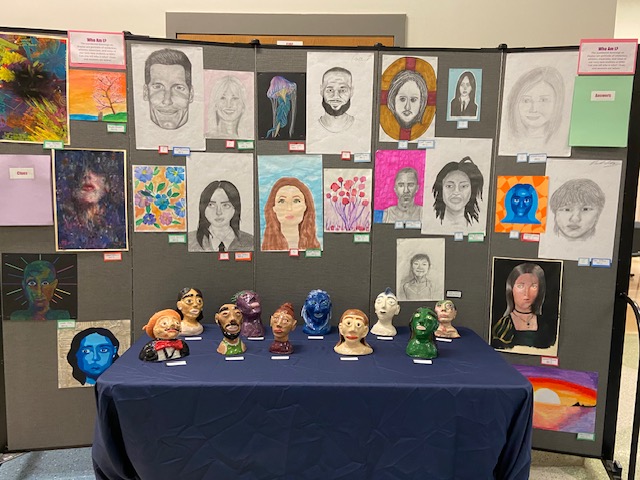
Work created by HHS students in 2D and 3D art courses

The arts are also significant because of their ability to foster community and friendship within educational environments. Many students meet their lifelong friends in school, especially in programs like music and art, which are close-knit and inclusive. “People you meet in your band or in your section of AP Art tend to be people who you become so connected to,” said Sadie Hofford, chorus and music educator. “In VOX and Chorus, I watch students help and support each other every single day in big and small ways.”

Art and music programs are also important because individuals involved in the arts work hard to make sure that people of all races, genders, and backgrounds are welcome and feel welcome. “Art transcends racial, socio-economic, cultural, and political boundaries while also calling upon each artist to reflect on their audience’s backgrounds and interpretation,” commented Mr. Harden, describing the diversity within the arts programs. It is crucial that students feel connection and belonging during their years in school because it helps to stimulate positive social skills and provides relationships that will prove useful in their years after graduating.

Another reason why the arts programs are indispensable in our schools is because of the advancing technology and increasing use of AI in our ever-changing world. “In a world of instant gratification and artificial intelligence, the arts foster long-term investment and dedication,” said Mr. Harden. “The arts challenge us to see the humanity in each other—to find empathy and cohesion amidst apathy and divisiveness.” Because of the influx of artificial intelligence within education systems, people are finding easy ways to complete assignments and pass their classes. However, the arts are some of the few programs where students cannot cheat. They require perseverance, humanity, and diligence. A robot cannot play a song or create a painting that has feelings and meaning behind it; only people can do that.

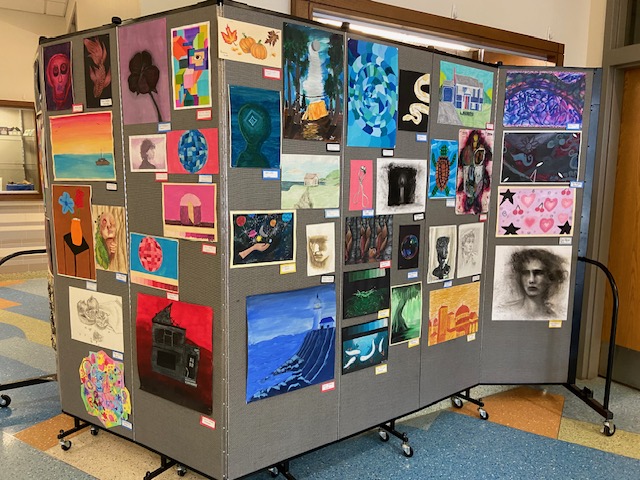
Work created by students in 2D art classes.

Just as technology evolves, our society evolves, oftentimes causing disharmony and even leading to periods when the people controlling the technology thrive while those under them face tribulation. The art community currently is facing immense adversity with the use of AI, stealing from artists, and creating “art” by data-scraping the Internet in order to provide entertainment that can be shared across social media. As Maria-Rita Silva, a sophomore at HHS, said: “In a world where capitalism, materialism, overconsumption, and the lack of creativity have captivated so many lives, we cannot let the arts die, and to deprive Hanover High School of the arts will take away the opportunity to engage in such a beautiful thing from thousands of current and future students.” By cutting or eliminating the arts, one takes away humanity and pure expression, which is far beyond the understanding of computers.

Many may argue that the arts are complicated, time-consuming, and unnecessary, especially during the early years of education. However, they fail to understand that art is humanity’s way of creating a legacy, of solidifying their presence far into the uncertainty that is our future. “It is not suprising to me that at every level we educate our students with visuals, from counting apples in kindergarten to drawing complex organic systems in anatomy. We are, after all, a sight-centered species,” said HHS art teacher Mr. File. “Ever since we began to coalesce into societies, whether in caves or early towns and cities, humans have been trying to create visual evidence they existed. The historical version of ‘File was here’ echoed throughout human existence.”

The arts have always resulted from mankind, starting from the very moment we evolved into what we are. When you observe art such as cave drawings, Beethoven’s symphonies, or Van Gogh’s paintings, one fact remains true: it doesn’t matter what one has, it matters what one gives, and the arts are gifts that influence our society forever. Teaching this in our schools strengthens the interest in and appreciation of art and all that results from it.

As Mr. Harden said, “A comprehensive and sequential education in the arts is essential for a myriad of reasons.” Art provides students with an expressive environment, a diverse community, and unfathomable knowledge of humanity and emotion. To take away the opportunity of participating in such an influential phenomenon from those in any level of education is to take away the individualism and soulfulness that society could use more of.

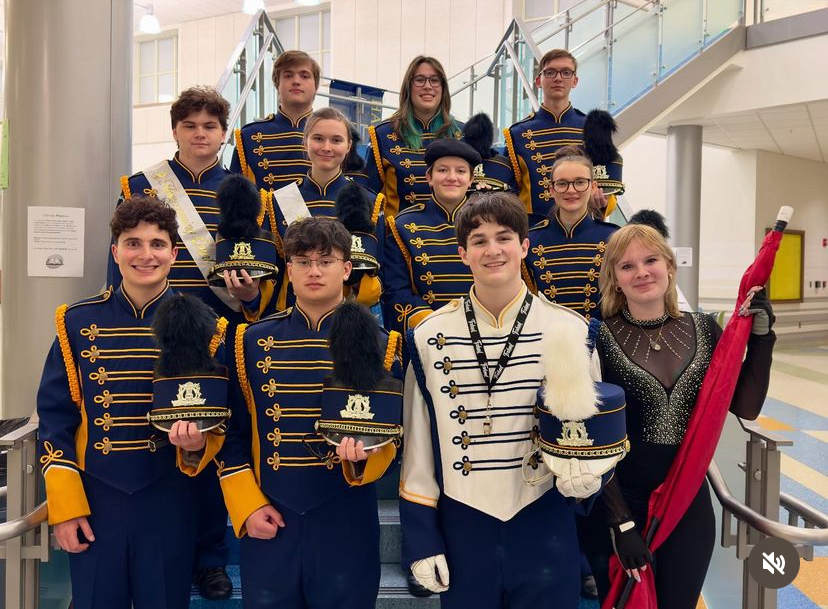
HHS seniors in the Band and Color Guard

Do We Still Need the Electoral College?

By Sienna Lamond, ’26

Staff Writer

The vote for president in the United States has never once been determined by the true popular vote but rather by the Electoral College system. When the topic of presidential elections is reinvigorated around Election Day, many Americans wonder why our president is not determined by our votes. Some even choose not to exercise their voting rights because they don’t believe their vote actually counts or matters. In some respects, they’re right.

In 1787, the Constitutional Convention came to the compromise known as the Electoral College. The issue was that nobody could agree on the best way to elect the president. Some wanted Congress to elect the president, and others wanted the people to choose the president directly. So the Electoral College system was born as an odd compromise between delegates from 237 years ago. In this system, a board of 535 electors each cast a ballot in accordance with the majority votes from the state they represent. To win the presidency, a candidate must win 270 of them. Additionally, in 48 states, all of the electoral votes go to only one candidate. For example, if the majority of Ohio votes Republican, all electoral votes would be given to the Republican candidate. This happens even if a decent amount of the state voted Democratic. Only Maine and Nebraska allow the electoral votes to be split.

The number of electors a state is allowed is determined by population. Heavily populated states such as California and Texas have more Electoral College votes than less populated states like Vermont and Wyoming. If you remember back to U.S. history class, this is why the Three-Fifths Compromise in 1787 was so significant. The vast majority of the southern states’ population was comprised of slaves, meaning if the slaves counted as people, the southern states would have more say in the Electoral College and have more representatives in Congress. The Fourteenth Amendment abolished the three-fifths compromise in 1868, which begs the question why do we still need the Electoral College?

In short, we don’t. It’s an antiquated system that deters people from voting and takes the voices away from millions of American voters. The foundation of our country is built on the principle that the people get to control the government. What we have with the Electoral College is a facade of a government elected by the people. According to the Pew Research Center, “More than six-in-ten Americans (63%) would instead prefer to see the winner of the presidential election be the person who wins the most votes nationally,” showing that the majority of Americans also wish to abolish the Electoral College to make their voices heard. Additionally, every other governmental election is determined by popular votes, even the election for the Senate and the House of Representatives, so we know that deciding an election by popular vote works. Why don’t we switch over?

In reality, it’s not so simple. The Electoral College is a part of the United States Constitution, which means we would have to move for an amendment to abolish it. For an amendment to be added to the Constitution, it must go through Congress, both the Senate and House of Representatives. With our Congress significantly divided, lawmakers have tried and failed to pass many bills in recent years. If a movement were made to make an amendment to abolish the Electoral College, it is likely that it would never make it through both chambers of Congress. USA Today writes, “There have been more than 700 federal proposals to change or abolish the Electoral College in U.S. history. . . But getting the remaining states to drop the Electoral College system in favor of the popular vote may be prohibitively difficult, as it would require buy-in from states that benefit from the system.” In all the years the Electoral College has been questioned, very little has been accomplished to change it.

In the past, some candidates have won the popular vote but lost the electoral vote. The most notorious example was the 2016 election between Hillary Clinton and Donald Trump. Clinton won the popular vote by nearly 3 million votes, but Trump won the Electoral College and became president. This is an example of how this system fails the American people. In total, 62,985,106 Americans voted for Trump that year while 65,853,625 voted for Clinton as reported by a New York Times post, a difference of 3 million American voters. Although I disagree with the policies and morals of President Trump, this is not a complaint about him; this is a fault of the system. More people living in the country wanted a certain candidate, and were denied that victory because of the Electoral College, and that statement could go for any candidate that has ever won the popular vote and lost the electoral vote. It’s not only unfair and unjust, it’s un-American and unpatriotic.

The year is not 1787. It is 2024. The world has changed, and we as people have changed. We need to remember the values and ideologies that the United States was originally founded upon: a government for the people, of the people, and by the people. No more Electoral College failures; it’s time for us to make a change and take our country, and our leaders, back into our hands. It is the only way to ensure our democracy will last for years to come. As former President Barack Obama said, “Change will not come if we wait for some other person at some other time. We are the ones we’ve been waiting for. We are the change that we seek.” We are the ones that have the power to make a change for the betterment of our government and our country.

Not to Get Political, but We Need to Talk about Politics

By Sienna Lamond, ’26

Staff Writer

With this year’s presidential election being at the forefront of news media nationwide, it’s important to remember what this really means. We, as a nation, are voting to put the best representation of what the United States is and what the United States stands for into our highest executive seat. We are giving that person the power to control policies that touch every aspect of our lives. This person needs to be reasonable, intelligent, honest, and most importantly, strong. The two major candidates are Democrat Kamala Harris and Republican Donald Trump. Both candidates certainly have characteristics of a good leader, and, of course, they both have their flaws. So how do you decide which one to support? 

The news media, as indifferent as it likes to appear, is always biased. It’s a known fact that Fox News tends to be “right-leaning” while CNN tends to sway to the “left.” Due to this, if you get your information solely from one of those sources, you cannot get a complete, honest picture. Furthermore, even if you watch both stations, it can get confusing. An action or event that is glorified by one news outlet could be condemned by the other. How do you tell which one is accurate, which one is skewed, and which one is closest to the truth? It seems as though people are willing to believe anything if it is presented by a well-known source, despite the questionable reliability of said source.

It is this willingness to believe anything a news outlet or a candidate says, no matter how absurd, that has doomed America, in my opinion. That is why I believe that education about politics should be encouraged. This has not always been supported in all public schools, however. Some argue that discussing topics such as politics or religion in school is indoctrination, which has caused many debates across the country in recent years. It is not indoctrination to be taught how the United States government works. It is not indoctrination to present a person with all the factual information, good and bad, and from there allow the person to develop their personal opinion, set of beliefs, and value system. I believe this education starts with parents. 

I am fortunate that in my home, I am encouraged to speak openly about my beliefs. I don’t always agree with my parents. Sometimes family dinners turn into full-on debate sessions. I like this intellectual exercise, and although my parents don’t always agree with me, they always appreciate my willingness to make an argument for something in which I believe. In my home, individuality, education, and disagreement are valued and even encouraged. My social worker mother and registered nurse father believe this is how we grow. We have to be open to accepting the perspectives of others as valid and valuable even when we may disagree with every fiber of our being. That is the beauty of living in this country – we are ALL entitled to our [political] opinions. In many homes, politics is either taboo or not up for discussion; children must believe what their parents believe, becoming what could be perceived as carbon copies of their parents. This occurs at both extremes of the spectrum, and maybe I am also a product of my parents’ liberal views. I believe that no parent or adult should force their beliefs on children but rather encourage young people’s intellectual growth through open and raw discourse on controversial topics.

Let me give you a benign example of what I mean when I refer to involuntary indoctrination. I was sitting in the car with my mom one day, with the radio playing some random station. I  didn’t recognize the song, but my mom did. It was Elton John. “Ugh, I hate Elton John,” my mom said, frustrated, and changed the station. In my head, that statement translated to Elton John is a bad artist. If my mom didn’t like him, then he obviously isn’t very good. I worship the ground my mother walks on and I value her opinion so much that I used to accept what she said as truth and fact. I’ve since learned that my mom’s opinions are not the only opinions out there, and just because she doesn’t like something doesn’t mean that I am not allowed to like it. I don’t think my mom was forcing me to also dislike Elton John, but children are impressionable, and children pick up on what their parents say. This is why I encourage people, regardless of what you believe or what values you have, to always be open to calm and respectful discussion so that young people can learn what cooperative discourse looks like.

In recent years, I have observed that politics is a continuing taboo in everyday life. Adults don’t want to discuss it with children and adolescents don’t want to discuss it with adults. This appears to be due to fear of confrontation or disagreement. In my opinion, this is the most dangerous fear in American society. We cannot be afraid to discuss controversial topics such as politics. We have to embrace the good and bad, learn and accept from what is, and move on stronger and smarter with a more comprehensive understanding of ourselves and others. It is of utmost importance to talk about politics for the sake of our country. Adolescents need to be educated on controversial topics so that when they become adults they can make informed and mature decisions about what they support and how they choose to exercise that right as Americans.

This country is special for so many reasons, the main one being that we are allowed to disagree with each other and our leaders. A government run by the people is one that is stronger than any other, which is why we cannot lose it. Nothing is accomplished by ignoring big topics or major problems because they make you uncomfortable. I am fortunate enough to have grown up in a household where I am free to formulate my own opinions, and that is valued. My parents challenge me to think critically about controversial topics and come to my own conclusions rather than accept their opinions as undeniable truth and fact. No matter which candidate you choose to support this upcoming election, I implore you to be open to acknowledging and accepting the opinions of others. Remember that it is because of our democratic society that we are able to formulate our own unique perspectives on every concept presented to us. To preserve what the United States is and what we stand for, educate yourself, educate your friends and family, and most importantly, educate your children. Your children will one day lead this country, so be mindful of your words and actions, as well as the criticisms you openly share in front of your children, because they are always listening. As composer Stephen Sondheim famously wrote in his musical masterpiece Into the Woods, “Be careful the things you say, children will listen. Be careful the things you do, children will see and learn. Children may not obey, but children will listen. Children will look to you for which way to turn to learn what to be. Careful before you say ‘listen to me,’ children will listen.”

Students Hold the Keys to Keeping Bathrooms Open

By Danny Campbell, ’27

Staff Writer

Students often complain when our school bathrooms are closed and they have to walk to a different floor or down to the cafeteria to find one open. But in an interview with Principal Mattos and custodian Fabz Saldanha last week, I learned that students are often the ones responsible for the closures.

In the past, Hanover High School regularly had just one bathroom open per floor to minimize issues with students gathering, creating messes and getting into trouble. Also in the past, teachers were assigned duties to monitor the halls and bathrooms. Last spring, concerns about the rotating closed bathrooms were brought to the HHS School Council (composed of students, teachers and community members) and the HHS Student Advisory Council. This led the administration to open all bathrooms after announcements were made to the student body about care and maintenance.

“Students control what happens,” Mr. Mattos said, echoing a message he gave during assemblies on the first day of school. “If students respected the bathrooms, they would be open forever. They only get closed for cleaning and maintenance as needed.”

Unfortunately, only three days into the school year, the bathroom in the World Language wing was seriously vandalized. A student or students pulled the stall dividers right out of the wall. Damage like this has cost the school thousands of dollars in the past, Mr. Mattos said. With the school budget tight this year, and a busy maintenance staff serving all the school buildings, it’s going to take time to fix. That bathroom has been locked since.

While students who commit vandalism are just a small part of the school population, Mr. Mattos said, it’s hard to catch them because the general law prohibits cameras in the bathrooms. Due to budget cuts, the school also doesn’t have enough staff to constantly monitor the spaces.

Aside from that closure, the school has been handling the issue much better than years prior, Mr. Mattos said. I noticed one day in September when both bathrooms on the second floor were closed at the same time, leading students to have to walk farther. But Mr. Saldanha said that was a temporary closure because a motion-activated sink needed repair; town health officials say a bathroom must be closed if a sink or toilet is not working.

The metal gates were installed in 2022 to lock and secure bathrooms as needed, but the idea of closing a school bathroom for cleaning or a repair is not new. Prior to that, the school had used movable plastic barriers for years, but students would simply push them aside and enter the bathrooms. “With the gates, bathroom maintenance has been much better,” Mr. Mattos said.

We should all be aware by now that the administration and custodians are not in the wrong to close the bathrooms when issues occur. It’s up to students to treat the bathrooms with respect. Having a clean, working bathroom close to your classroom is a privilege, not a given. If you are responsible and behave in the bathrooms, they will stay open. Throw your trash in the bins. Do not put unflushable items in the toilets. Show courtesy to your classmates who use the bathrooms and to the custodians who keep them clean. If only as much as one student misbehaves in the bathrooms, they are all at risk of being closed!

I have done my part in covering this issue. Now it is your turn to do yours!

Bridging Divides: Solutions to Political Extremism

By Samuel Frattasio, ’27

Opinions Editor

In a nation once defined by its shared ideals and a commitment to democratic discourse, the alarming rise of political violence serves as a stark reminder of how deepening divisions can threaten the very foundations of our society. As communities split along ideological lines, the consequences become increasingly evident: violent protests increase, rhetoric escalates into threats and civil discourse becomes chaotic. Most apparent are the two assassination attempts on our former president, Republican presidential candidate Donald Trump. No matter where you stand, we should all agree that this is unacceptable. We have come too far as a country to be ruined by individuals who are so blindly passionate and extreme toward their respective parties. We must confront a crucial question: can we bridge all that separates us, or are we destined to remain divided? 

I’m well-versed in news and politics, regularly engaging with various sources across the political spectrum. Whether browsing the Apple News app on my phone or reading articles from AP, Reuters, The New York Times and The Boston Globe, I make it a point to stay informed. I also watch broadcasts from NBC, ABC, CBS, CNN, and FOX. Some are left and right of the political spectrum, while others may be classified as more center. I enjoy getting information on all sides; this helps eliminate some of the inherent biases of most major media networks. For example, Fox leans right and CNN leans left. Even though these networks and their anchors, analysts, and correspondents differ from each other significantly, they all share one common belief: political violence is not okay, and it’s not the way to solve our division. Jeremey Adam Smith and Zaid Jilani of the Greater Good Magazine said it best: “The attempted assassination of Donald Trump highlights a terrible truth: Political violence and support for political violence have been rising in the United States.”

To better understand this issue, we need to discuss a few key topics: historical context, current trends, impact of rhetoric, mental health, consequences for democracy and potential solutions.

 Historical Context: Our country was born amidst political tensions. The great patriots of the “Sons of Liberty,” who dumped thousands of dollars worth of tea into Boston Harbor, did so in response to an increasingly harsh and dominant England. The split into Loyalists vs. Patriots and the Revolutionary War was the result. After the American Revolution, our country saw the emergence of political parties, which fostered intense rivalries, and political violence occasionally erupted in the form of duels. African American resistance was also prevalent during this period, most notably in Nat Turner’s Rebellion. Also during this time, abolitionist movements faced violent oppression from pro-slavery Americans. Fast forward to the Civil War era. The Southern states’ secession was driven by the desire to preserve slavery, leading to violent conflict between Union and Confederate forces. Throughout this period, political violence was often seen as a means to achieve social and political objectives; the tone of this era set the stage for ongoing conflicts that continue to affect our democracy. 

Current Trends: One may argue that our country is more divided than ever, and this is most obvious when one turns on the news and hears stories of violence and destruction, constant arguing, and continuous falsehoods from both sides of the political spectrum. Something has to be done to fix the wounds of our nation. The current trends of our divisive legislative, executive, and judicial branches have proven tragic; most apparently, the recent assassination attempt on former President Donald Trump, which came as a surprise for many, raised some eyebrows and questions on who is truly safe from political “extremists.” To better understand the motives of those who wish to destroy, we should examine former successful or failed attempts on politicians’ lives to identify what could have gotten us to this moment. Most notably in the mid-19th century, President Abraham Lincoln was assassinated over disagreements regarding slavery and the treatment of the South. In the late 19th and early 20th centuries, Presidents James A. Garfield and Willaim McKinley were killed over the growing discontent with the existing societal norms. Years later, the assassination of Martin Luther King Jr. highlighted the extreme opposition to the civil rights movement. Fast forward to present times, and we have seen several assassination attempts on politicians, including former congresswoman Gabrielle Giffords in 2011 and the attempted bombing of prominent Democrats in 2018. While these examples all were different in some ways, they were all results of individuals who disagreed so strongly with these politicians that they wanted to end their lives. This shows us the beliefs within American society and the complex interplay between ideology, power, and violence. 

 Impact of Rhetoric: As we have come to understand, words have great power, and the spread of hateful, negative, and false allegations has deep impacts on its listeners. We as a society have a duty to determine what words and ideas we want to resonate within ourselves, things that match our own beliefs. Sometimes extreme language evokes strong emotions like fear, anger, or pride, which can galvanize people to act or adopt more radical views. In my opinion, the most prominent effect of Democrat/Republican rhetoric is the Us vs. Them mentality, which often creates clear distinctions between individuals who are “in” groups and “out,”  fostering hostility toward those perceived as opponents. This is the case during political debates and interviews when candidates constantly try to belittle their opponents and spread lies. 

 Mental Health: Kevin Boyle, Professor of American History at Northwestern University who was featured on PBS just days after one attempt on the former president’s life, said, “So what that means is that you essentially have motives and means. I don’t know anything about the motivation of this young man, but I think we have to be willing to acknowledge that it is also tied, to a striking degree, to the mental health crisis that does afflict young men, particularly, and that leads some of those young men to extraordinarily violent behavior.” What Boyle is alluding to is that there has been an immense rise in violence in the last decade perpetrated by individuals who may have mental health struggles. According to an article in The Hill, the Trump shooter in Butler, Pa., had a form of depressive disorder. This issue raises many questions like, “How does one get to this point?” and “Is political rhetoric to blame?” In the case of the man who shot at the former president, one must ask “How can someone with a (known) mental condition have access to a weapon?” To answer the first, there are various reasons why an individual can become radicalized. Mental health struggles can exacerbate feelings of isolation, leading one to join extreme groups for a sense of belonging. In addition, mental health conditions can affect judgment and impulse control, potentially increasing the likelihood of violent behavior. And to answer the latter, it is hard to control what people do and what they have access to. “Are the parents to blame?” That is a question that gets asked after incidents of violence. In my opinion, I believe that individuals who are struggling with mental health disorders should not be anywhere near harmful objects; this was the complete opposite scenario for the man who hoped to assassinate Trump. 

 Consequences for Democracy: This alarming rise in political violence poses a significant threat to the very foundations of democracy. This phenomenon not only undermines public trust in democratic institutions but also deepens societal polarization, making it increasingly difficult for citizens to engage in constructive dialogue. The fear of violence deters many from participating in elections, protests, and civic activities, ultimately weakening the democratic process. The big issue with this is that it opens the door to others with beliefs of violence toward people with whom they disagree. We must commit to fostering dialogue, understanding, and respect for democratic processes to combat this rising tide of violence and protect the ideals that underpin our societies.

Potential Solutions: This pressing issue requires immediate attention and thoughtful solutions. One effective approach is to promote political unity across different groups. When leaders and citizens alike focus on common goals rather than differences, it could significantly reduce tensions and foster collaboration. Additionally, the language used in political discourse matters greatly. Leaders should strive to avoid harmful words and negative ideologies that can incite violence or deepen divisions. Instead, promoting a message of empathy and understanding can create a more positive political climate. Public awareness campaigns that encourage civil discourse and highlight the importance of listening to differing viewpoints can also play a critical role. Ultimately, addressing political violence involves a commitment to unity, respectful communication, and proactive engagement in communities.  

A Call to Action

It is time for us to take a stand against political violence. We live in a country not riddled with hate but with freedom, kindness, and, at our center, unity. Days after the assassination attempt of former President Donald Trump, politicians from all parties expressed their strong opinions on the matter, including how relieved they were that the president was not badly injured. Unity is possible. We’ve seen it done, not just after this incident but also during the aftermath of 9/11, where many Americans came together, or the pre-American Revolution, where a once divided 13 colonies joined together under a shared desire for independence. The stories in the news today can be frightening; they can be violent and negative. However, when I am overwhelmed by this, I try to remember moments when we have come together, and that is what gives me hope. Political violence is not and will never be ok. While all politicians and people may never agree on all the issues, we can agree to be civil, working for a common good and remembering that our democracy is worth preserving.

Wish Honors Disney Classics, But Likely Won’t Become One

By Billy Hersey, ’27

Staff Writer

I didn’t have high hopes for Wish, Disney’s latest animated film, mainly because of the negative press around it. After watching it, I can say that while it’s far from Disney’s best, it isn’t awful. The film’s message and soundtrack make it worth watching, at least if you’re a fan of Disney.

The creators wanted to celebrate the 100th anniversary of Disney and the company’s legacy, so they designed a whole new art style combining methods from the classics like Pinocchio and Snow White, but also using present-day technology. They wanted to prevent the film from feeling old while paying homage to the many films made through the years. Being so used to the recent animation style of films like Moana, I was originally surprised and skeptical of the art in Wish, finding it a little “off.” But after seeing the making of the movie and learning more about the creators’ vision, I started to understand and found the new style a nice change of scenery. 

This aspiration to honor Disney’s many classics led the filmmakers to include references or nods throughout the film. Some say there were too many “Easter eggs,” and in some cases I agree. But the nods also remind viewers of their favorite films and add to their appreciation, which I feel is just what the architects of the movie wanted. 

Critics of Wish have said that the plot is basic and the movie is too fast paced, and I have to agree. I feel there was a need for more character development which could have slowed the movie and made the writing and story more complex. Some also longed for the classic Disney villain and felt the “bad guy” in Wish was barely evil and his reasons for turning evil were valid. I also felt the villain was missing something and I feel that adding more background especially with the father would have been nice especially since the filmmakers are trying to show he and Asha, the main character, had a close relationship. We barely know anything about Asha’s friends or how they met, especially Dahlia, who she seems closest to. I think perhaps the film could have benefitted from more of a background behind their friendship especially when thinking about all the things Dahlia did for Asha and the trust they have for each other.

Since this is a movie whose intended audience is mainly children, there were many reviews from adults seeing it with their young children and loving it. A simple story that is easy to follow is probably better for kids who may not be able to follow a more complex plot preferred by adult viewers. Lots of people love the character Star, who has lots of personality and a strong connection with Asha even though he doesn’t speak. But they noted the missed opportunity to add more after reading or hearing about the different ideas that arose during the character’s development.

One thing that really added to the film was the creative and beautiful soundtrack, especially the song “This Wish” because of its hopeful lyrics and sound. Something else that redeems the movie’s flaws is its theme. The creators try to convey to viewers that it is never too late to try to make a dream come true, and that if you want your wishes to come true, you have to work for them.

While this is far from my favorite movie, I would recommend that Disney fans watch it at least once to experience the beautiful art, hear the songs and feel the message. The movie has its issues, but I feel its goal to celebrate a century of classics created by the company has been achieved.

Two Dystopian Classics Offer Different Reading Experiences

By Siena Oliver, ’27

Staff Writer

In English class the last two years, I’ve read 1984 by George Orwell and Fahrenheit 451 by Ray Bradbury. These two books were published four years apart in 1949 and 1953 respectively. They are both cautionary tales about the future, the use of technology, and mass censorship of a society that seems not to care that they are being manipulated.  Both books are extremely important in the literary world, but I found Fahrenheit far more enjoyable to read.

Both books follow men living in dystopian societies, who eventually start to question their ways. The protagonist of 1984, Winston, begins his story working at the “Ministry of Truth” where his job is to edit and censor all types of media and information, essentially changing history. Montag, from Fahrenheit 451, works as a fireman who burns books, which is another form of censorship. Both of these characters work in respected jobs for the government and actively take part in changing the information that is given to the public. At some point in both of the books, the protagonists each have a revelation about how they cannot stand to live under the rule of an all-powerful government that so blatantly controls the information they receive. Winston and Montag both end up rebelling, and in doing so make connections with people they otherwise would not have.  

Although the books are fairly similar in terms of content and meaning, I personally disliked 1984 but enjoyed Fahrenheit 451. In my opinion, 1984 was too long and often seemed to drone on with unnecessary and boring information, while Fahrenheit 451 was a fairly fast-paced and short read that held my attention throughout the entire story.  I found the authors’ writing styles to be a bit wordy and confusing at times, often sounding sort of like poetry. This can be a good thing or a bad thing depending on the length and excitement of the book. As a reader, I dislike stopping books in the middle, but with 1984, I nearly did because it was so hard for me to get through. 

Bob Marley Biopic Falls Short in Honoring Legend

By Sienna Lamond, ’26

Staff Writer

Like jazz was born in Louisiana, reggae was born in Jamaica; and just like jazz had stars such as Louis Armstrong, reggae had Bob Marley. A biopic called One Love about Marley was recently released in theaters. The highly anticipated film was preceded by a clip of Marley’s son, Ziggy Marley, who also works in the music industry, giving a statement on how proud the family was of this film. As I watched, though, I couldn’t help but feel like the movie was a disservice to Marley. The set design, costumes, and actors were all perfectly suited to the story, but the entire movie only captured two years of Marley’s life, accomplishments, and legacy (1976–1978). I feel that the movie failed to encapsulate just how great and impressive Bob Marley truly was and what he did, not only for music but for peace.

Bob Marley was born on February 6, 1945, the same year that World War II ended. For almost the entirety of Marley’s childhood, Jamaica was a piece of the British Empire. In 1962, Jamaica was granted independence as a nation but maintained its status as part of the British Commonwealth. However, political unrest still plagued the country. Tensions between two large political groups, the Jamaican Labor Party (JLP) and the People’s National Party (PNP), resulted in violence and danger throughout the country. 

Marley utilized his musical skills to speak on political topics, the most famous instance of which is the “One Love Peace Concert” held in Kingston, Jamaica in 1978. This is one of the most important highlights of his career, which thankfully the movie includes. Here, Marley stood as a symbol of unity as he clasped the hands of the PNP and JLP leaders, Michael Manley and Edward Seaga, in front of the roaring crowd. Marley sought more than an end to violence; he sought the betterment of his home country. Through songs like “War,” “Slave Driver,” “One Love,” “Get Up, Stand Up,” “Rebel Music,” and “Concrete Jungle,” he literally and metaphorically uses his voice and platform to provide the Jamaican people — and people globally — a sense of hope that the fight for peace will be heard and not silenced. 

To fully appreciate the mysticism of the legendary Bob Marley, one must understand the sociopolitical climate at the time he delivered his message to the world. The movie touches on the political unrest and violence in Jamaica, but Marley’s music had global implications wherever political unrest and unjust social structures existed. In his lyrics, “Rasta don’t work for no CIA,” it’s evident that Marley’s music was viewed as a pivotal motivator in elections and, thus, was threatening to various political regimes. Whether it be Cuba, Africa, or Chile, his music was viewed as destabilizing to the established structure. Ironically, Marley’s power came from remaining politically neutral even as his reach expanded globally. Despite assassination attempts and pressure from multiple sides, Marley never wavered from his philosophy: “Live for yourself, and you will live in vain. Live for others, and you will live again,” and that love is stronger than fear, hate, and violence. The movie could have included more examples of him as a symbol of peace, such as his music playing as the Berlin Wall came down in 1989 and its impact on civil rights worldwide. 

The few scenes that touched on his musical journey and the development of his songs seemed oddly placed to me. The drum circle scene does well to portray his Rasta roots and shed light on the spiritual nature of his music; however, I would have preferred a more chronological journey to understand and appreciate his early music that led to him ultimately creating his greatest hits and the sound that the world recognizes him for. I would have also liked to see the movie shed light on Marley’s legacy. Despite passing at the early age of 36 to cancer —which is another unclear aspect of the film—he had a tremendous impact on popularizing reggae music worldwide. Music tends to set the tone for an era. Think of the U.S. in the 1940s, being focused on classic stars like Frank Sinatra and Ella Fitzgerald, but then in the 50s, Elvis and Rock n’ Roll came to popularity, challenging the conformist norms of the decade. Reggae was the rock n’ roll of the 1970s. It was new and therefore alluring to younger folk, raising a generation focused on its message of peace and love. Many of Marley’s associates continued his musical journey. Others, from Eric Claypton to Lauren Hill, covered his songs. His children have had illustrious musical careers as well, such as the aforementioned Ziggy Marley, who released songs such as “Love is My Religion” and “True to Myself,”  carrying on his father’s legacy and message. His grandson (and Rohan Marley and Lauren Hill’s son), YG Marley, has recently come out with a modern reggae song called “Praise Jah in the Moonlight,” which has gained popularity through social media, namely TikTok. 

Overall, the movie does well to introduce us to Bob Marley, the man, but I attest that he deserved even more. A man whose music and message reverberate through the ages deserves more than an hour and 45-minute biopic covering two years of his life. A legend of his status deserves an epic film capturing all his trials and tribulations and the lessons he learns while overcoming them. Marley teaches the world that no matter what dire circumstance confronts you, there is love, hope, and belief in a brighter tomorrow, and he does so brilliantly through his music. I hope this is not the end of Marley’s tributes; as he says himself, “in this bright future, you can’t forget the past,” because acknowledging fault is how we progress and do better for ourselves and the world in the future.