Tag Archives: featured

How Much Does Gratitude Cost This Year?

By Mae Evans, ’27

Staff Writer

Turkeys, table settings, matching napkins, travel, desserts—the checklist of gratitude has never looked so expensive. Thanksgiving was built on simplicity, or at least that’s the myth we tell ourselves while scrolling through sales and calculating oven times. It’s supposed to be about pausing, appreciating, giving thanks—but somewhere between the grocery cart and the group photo, the holiday turned into a production. Gratitude now feels like a performance: the curated table, the perfectly browned turkey, the caption that insists “so thankful for everyone in my life.” 

We’re not giving thanks—we’re staging it. 

The irony is that Thanksgiving preaches humility while thriving on excess. We consume until we’re full, then talk about how grateful we are. We buy our way into meaning because it’s easier than sitting in silence and feeling it. It’s easier to measure love in portion sizes than in presence. For a holiday about appreciation, it depends heavily on abundance. Gratitude becomes something you perform with purchases—a kind of moral receipt that says, I’ve done enough to feel thankful

But when the table is cleared, the receipts crumpled, and the leftovers cooled in the fridge, what’s left that actually matters? Maybe the point isn’t to strip the holiday down, but to notice what would remain if we did. Without the desserts, matching napkins, or endless refills, could we still recognize the feeling we were trying to buy? Every year, we’re asked, “What are you thankful for?” Maybe the harder, more revealing question is the one we never say out loud: “What would still matter if everything else was gone?” 

The Science of Déjà Vu

By Gabriella DeLuca, ’27

Staff Writer

Have you ever walked into a room and had the strange sensation that you had already been there before? Or turned the corner while visiting a new city and gotten the overwhelming feeling that you had been in that exact same spot before, only you know there is no possible way you could have? This sensation is known as Déjà Vu, the French word for “already seen.” Nearly 97 percent of people will experience this phenomenon at least once in their lifetime. But what causes it? And what does it mean?

Déjà Vu is the fleeting sensation that you have already lived in a totally identical situation at some point in your life, only you haven’t. This conflict between false familiarity and rational knowledge feels as if your memory is telling you one thing, while your brain is saying something different. In fact, this conclusion is not as far off as you may think.

The concept of Déjà Vu has fascinated scientists for many years, and even now the true cause of this “glitch in the matrix,” as the popular movie franchise calls it, is still yet unknown. Some people have proposed that Déjà Vu could be a sign that you are recalling an experience from a past life or experiencing a paranormal event; however, after increased research and experimentation, scientists have developed scientifically proven theories to explain the reasons behind this uncanny sensation. Through the use of insights into neuroscience, scientists have proposed that Déjà Vu is likely the result of dysfunctional connections between the parts of the brain that have a crucial role in memory and familiarity.

According to Dr. O’Connor, a senior lecturer in the School of Psychology and Neuroscience at the University of St. Andrews, this miscommunication arises between two parts of the brain, namely the medial temporal lobe that is associated with recollecting memories and the frontal cortex that is responsible for higher order cognition and fact-checking. Déjà Vu may occur when the temporal lobe sends signals to the frontal cortex to indicate a familiarity with the experience at hand. The frontal cortex region then evaluates whether this signal is consistent with a prior experience. If a prior experience is not identified, the sensation of Déjà Vu occurs and you are left with the conscious feeling of familiarity without evidence to back it up; in other words, false memories.

In 2006, a group of medical researchers led by Leeds Memory Group conducted an experiment in an attempt to recreate Déjà Vu in a lab setting. First, the patients were presented with a simple memory while under hypnosis, such as playing a game or seeing a certain color. The test subjects were then given the suggestion to either forget or hold on to the memory. The experiment showed that this later triggered the sense of Déjà Vu when the patients were presented with a situation that reminded them of the memory they were introduced to while under hypnosis. The results of this confirmed to scientists the belief that Déjà Vu is a memory phenomenon, a feeling of familiarity that cannot be placed.

What does it mean if you experience Déjà Vu?

Although this memory quirk may seem as a sign your brain is working improperly, it actually indicates the opposite. The sensation of Déjà Vu demonstrates that the fact-checking brain regions are functioning correctly to prevent you from incorrectly remembering events. Having this feeling of false familiarity is a sign that your brain is functioning properly to accurately remember situations and events, and is overall a sign of a healthy brain and mind.

Through recent studies and experimentation, scientists have discovered specific situations that can increase the probability of experiencing Déjà Vu. For example, age can have an effect on whether you are more likely to experience Déjà Vu. Young people between the ages of 5 to mid-20s tend to experience more frequent instances of Déjà Vu due to the fact of healthier fact-checking frontal regions in younger brains. As you age, the brain’s ability to detect memory errors declines, and the instances of Déjà Vu become less common.

So, if you experience Déjà Vu in the future, do not worry – instead, view it as proof of a well-functioning brain and a healthy mind.

Works Cited:

“Can Science Explain Déjà Vu?” BBC Bitesize, Apr. 2024, http://www.bbc.co.uk/bitesize/articles/zdpbwsg.

Cleveland Clinic. “Why Does Déjà vu Happen?” Cleveland Clinic, 23 Oct. 2022, health.clevelandclinic.org/deja-vu-what-it-is-and-when-it-may-be-cause-for-concern.

Kennedy, Justin. “The Fascinating Science of Déjà vu | Psychology Today.” 20 Dec. 2023, http://www.psychologytoday.com/us/blog/brain reboot/202312/the-fascinating-science-of-deja-vu.

Stierwalt, Sabrina. “Can Science Explain Deja Vu?” Scientific American, 23 Mar. 2020, http://www.scientificamerican.com/article/can-science-explain-deja-vu/.

X-Ray Tables and “Injuries”: Inside the NBA’s Betting Scandal

By Greyson Potter, ’29

Staff Writer

For a very, very long time, the cardinal sin of professional sports has been gambling: players making bets on and fixing games for profit. Let’s be honest, who wants to watch a rigged game? If you want to watch something fixed, watch the WWE, not the NFL or the MLB. And pro sports leagues have not been very sympathetic toward those who have been caught gambling. Take the Chicago “Black Sox” of 1919. They intentionally lost the World Series to get a big payout. Eight players on that team were banned for life from Major League Baseball. Perhaps the most famous example of the consequences of athletes’ gambling is the late, great Pete Rose. The MLB’s hits king with 4,192 in his career was found guilty of betting on games, including his own, and throwing them, for years. In 1989, Rose was banned from baseball and the Hall of Fame, a place where someone with 4,000 hits belongs.

In late October, the FBI announced that they had made 38 arrests across eleven states involving illegal poker games and sports betting. Two of these people were NBA coaches, and one of them was an active player. Chauncey Billups, Hall of Fame guard and current Portland Trail Blazers head coach, allegedly worked with the mafia to run fixed poker games. Former Cleveland Cavaliers assistant coach Damon Jones and Miami Heat guard Terry Rozier III were arrested for providing illegal betting information. The news broke just days after the 2025-26 NBA season tipped off, putting a sour taste in the mouths of those happy that basketball is back. The sport has never really seen anything like this, and some reports indicate that the news so far may only be the tip of the iceberg, with an impact much more far-reaching.

Chauncey Billups was just entering his fifth season as the head coach of the Portland Trail Blazers when he was arrested. It was found that he had been working with the mafia to illegally rig poker games. He and his mafia pals would use high-tech gadgets such as rigged shuffling machines, X-ray tables, and special contact lenses to see marked cards. They also had poker chip trays that could read cards and fake cell phones with card analyzers. All of this information, along with how good each player’s hand was, was transmitted to a behind-the-scenes “quarterback” who would process it and send it to the players he or she was working with. The scheme allegedly made $7 million over six years, with one victim losing $200,000 at one of these tables. And if you could not pay your debts, the mafia thugs would not be shy about violently threatening you. Not only that, but Billups was involved in gambling as well. He allegedly gave bettors insider information about his team’s tanking, who he was playing, and who he was not playing in a given game.

Terry Rozier was entering his 10th NBA season, this one with the Miami Heat. He has been there for a couple of years now. But it was Scary Terry’s actions that sparked the whole investigation into the NBA and gambling.

It started all the way back in March of 2023, when Rozier told his childhood friend that he would leave the game early with an “injury” to hit his under bets. This friend, Deniro Laster, told other conspirators what Rozier said so they could all cash in on it. Terry stayed true to his word, leaving the game after about nine minutes. Thousands of dollars came in on his unders because of this, sparking the NBA to look into it. There was another instance in January 2024, when Rozier said he would leave the game with a leg injury. Sure enough, he left that game with a leg injury, and a considerable sum of money came in on his unders again. The NBA had been investigating him, but had supposedly cleared him to continue playing.

Damon Jones was the third person involved with professional basketball to be arrested. He was a former player and assistant coach with the Cleveland Cavaliers and the Los Angeles Lakers. He was more on the gambling side of things, where he supposedly told some conspirators to make a large bet on Milwaukee one night, because a specific player would be out. LeBron James showed up on the injury report that night, and Los Angeles lost again, with lots of money coming in on this loss.

Sports betting has always been a disgusting practice for a professional athlete, something frowned upon by all. It can tarnish a reputation and ruin a career in the blink of an eye. It happened to Pete Rose. And now it could very easily happen to someone like Chauncey Billups, who was inducted into the Naismith Memorial Basketball Hall of Fame. If he is found guilty, his reputation and how people remember him will be changed for the worse, forever. The same goes for Terry Rozier and Damon Jones. Neither of them was going to the Hall of Fame. But if found guilty, they will forever be associated with one of the biggest gambling scandals in the history of professional basketball. None of these people will ever be associated with the NBA again if convicted.

Not exactly the way I would want to go out.

Mamdani: The Dawn of Democratic Socialism

By Sophie Bunar, ’27

Staff Writer

Zohran Mamdani was recently elected mayor of New York City, and he’s sharing his progressive ideas with the country. Mamdani proudly describes himself as a democratic socialist, similar to Sen. Bernie Sanders of Vermont and Rep. Alexandria Ocasio-Cortez of New York. So what exactly is democratic socialism?

After President Donald Trump tried to label Mamdani a communist, the candidate became very vulnerable with his political and economic beliefs in public. When CNN’s Erin Burnett asked Mamdani during the campaign if he liked capitalism, he said: 

“No, I have many critiques of capitalism. And I think ultimately, the definition for me of why I call myself a democratic socialist is the words of Dr. King decades ago. He said, call it democracy or call it democratic socialism. There must be a better distribution of wealth for all of God’s children in this country. . . . For too long, politicians have pretended that we’re spectators to that crisis of affordability. We’re actually actors, and we have the choice to exacerbate it, like (outgoing) Mayor (Eric) Adams has done, or to respond to it and resolve it like I’m planning to do.”

Democratic socialism, as described by both Mamdani and Martin Luther King Jr., is a political ideology advocating a socialist economy within a democratic framework. It seeks to achieve a more egalitarian and just society by controlling the economy to benefit the majority, not just the one percent at the top. Democratic socialists support policies like universal health care, higher minimum wages, and worker cooperatives. They strongly distinguish it from both communism, which is seen as authoritarian, and social democracy, which they believe doesn’t challenge capitalism enough.

New York City Mayor-elect Zohran Mamdani holds a press conference at the Unisphere in the Queens borough of New York City, on Nov. 5, 2025. (Kylie Cooper/Reuters)

While no country is a pure democratic socialist state, Nordic nations such as Norway, Sweden, Finland and Denmark are often cited as examples that follow many of the ideals. They utilize a mixed-market economy that combines private ownership with a strong social safety net, and they’re known for their comprehensive welfare system, including universal health care. Public services are funded through taxation. Labor unions, as well as labor market policies, reduce conflict between labor and capital. Other countries influenced by democratic socialism include Canada, Germany, New Zealand, Portugal, Belgium, France and the Netherlands.

Despite how beneficial these ideas sound, is America ready for democratic socialism? The U.S. operates under a representative democracy with a capitalist-based economy. Capitalism is a stark contrast to socialism; it features private ownership, free markets and competition, while socialism involves government or collective ownership with a focus on equitable distribution. Capitalism promotes individual economic freedom and innovation through competition, but it can lead to inequality, which is what socialism aims to reduce. However, socialism has potential drawbacks as well. Despite its just basis, it can stifle innovation due to reduced competition and government control. Also, like many “unchecked” economies, it can lead to authoritarianism and gradually devolve into communism. However, under the current administration, many people are asking for either a socialist shift or a mix of both socialism and capitalism.

Mamdani’s own ideals are probably part of the best basis we have when it comes to the modern understanding of democratic socialism. His big policies are all focused on making life more affordable for working people. He aims to:

  • Freeze the rents for one million people in rent-controlled apartments. This means a temporary, legal halt on increasing rent for residential properties, preventing landlords from raising it for existing tenants and sometimes for new ones too.
  • Subsidize New York City buses to make them free to riders, as well as making child care free for New Yorkers.
  • Start a pilot program of one city-run grocery store in each borough to see whether removing the profit motive makes groceries cheaper—a risky arrangement.

    One of Mamdani’s policies is the most ambitious, though: increasing taxes on the wealthiest New Yorkers and on the city’s corporations. In the same CNN interview, Mamdani goes on to say:

“I think the dream at its core is a dream for stability in one’s life. And what you’re saying is that you work hard enough and that you then reap the benefits — too many New Yorkers, and Americans for that matter, are working eight hours and then still feeling like they haven’t made enough money to keep living in the city they call home.”

Zohran Mamdani speaks during a victory speech. Photograph: Yuki Iwamura/AP

Works Cited

Campbell, Lucy. “Who Is Zohran Mamdani, New York’s Democratic Socialist New Mayor?” The Guardian, The Guardian, 5 Nov. 2025, http://www.theguardian.com/us-news/2025/nov/04/zohran-mamdani-profile.

“Capitalism vs. Socialism: An Overview | EBSCO.” EBSCO Information Services, Inc. | Www.ebsco.com, 2019, http://www.ebsco.com/research-starters/political-science/capitalism-vs-socialism-overview.

Genovese, Daniella. “Business Leaders React to Zohran Mamdani’s NYC Mayoral Victory.” Fox Business, 5 Nov. 2025, http://www.foxbusiness.com/lifestyle/business-leaders-react-zohran-mamdanis-nyc-mayoral-victory. Accessed 7 Nov. 2025.

Lach, Eric. “The Mamdani Era Begins.” The New Yorker, 5 Nov. 2025, http://www.newyorker.com/news/our-local-correspondents/the-mamdani-era-begins. Accessed 7 Nov. 2025.

National Museum of American History. “Preparing for the Oath: U.S. History and Civics for Citizenship.” Americanhistory.si.edu, americanhistory.si.edu/citizenship/learn/government-basics/11/learn.

Thaywick, Lena. “15 Democratic Socialist Countries and Social Democracies.” HowStuffWorks, 22 Oct. 2025, people.howstuffworks.com/democratic-socialist-countries.htm. Accessed 7 Nov. 2025.

Treisman, Rachel. “4 Things to Know about Zohran Mamdani, Presumptive Democratic Nominee for NYC Mayor.” VPM, Virginia’s home for Public Media, 25 June 2025, http://www.vpm.org/npr-news/npr-news/2025-06-25/4-things-to-know-about-zohran-mamdani-presumptive-democratic-nominee-for-nyc-mayor. Accessed 7 Nov. 2025.

Wolf, Zachary B. “Democratic Socialism, according to Zohran Mamdani.” CNN, 6 Nov. 2025, http://www.cnn.com/2025/11/06/politics/mamdani-democratic-socialism-explained.

Will AI Take Over The World?

By: Emma Hersey, ’29

Staff Writer

The concept of Artificial Intelligence, or AI, has been around for a long time, dating back to around the 1950s. It started with just chatbots on your computer, and now you can create original images, text, videos and more. The world has changed significantly due to AI, but as with all progress, it can have a downside. AI has already done much good, but what damage will follow close behind?

Recently, AI has been very popular among students. It is a quick and easy way to get your work done without having to think too hard on your own. But using AI to complete your work will only cause harm to yourself. Getting your work done is important, but there is no point in homework if you don’t complete it yourself. Using AI doesn’t help you to know the material and actually learn it. The grading system has become more uptight because of the increase in AI usage. AI checkers can be controversial because they are programmed to see em dashes (a long horizontal dash that emphasizes a claud) and Oxford commas (the comma before “and” or “or” in a list) as indicators of AI. But in fact, these are just basic grammar tools. Now, people who use Oxford commas and em dashes might be flagged down by a teacher for the use of AI.

With the recent popularity and interest in AI, there has been a surge in the abilities that these tools can accomplish in a matter of seconds. Due to the complex code behind AI, it has been able to take the place of many jobs, thus putting humans out of work. Jobs such as editing, manufacturing, bookkeeping, customer service and graphic design are among those impacted by AI. If someone wanted to use AI to write and sell a book, it would be possible. AI tools can write the chapters, edit the pages, create the cover, have it published and manufactured, keep track of its financial standing. If there are any problems with the customers, AI can accommodate them. These five jobs listed are all part of the process that goes into creating and selling a book. If the decrease in jobs for humans remains steady, AI could displace 6-7 percent of the population’s current jobs. 

AI has become a staple of everyday life, to the point that some people don’t even realize they’re using it. To be able to predict things, AI uses your past actions and creates a pattern to follow to anticipate what will happen next. Google, autocorrect, face recognition and personalized recommendations are all examples of the AI that is integrated into your everyday life. When you pick up your phone and unlock it with Face ID, turn on a recommended playlist based on your prior listening, and use automatic correction in Google search, these are all ways that AI works behind the scenes. While many debate the use of AI in school and the workplace, it is hard to argue that we haven’t benefitted from the increased efficiency and personalization.

AI allows tasks that require human intelligence to be completed via computer; it helps with problem-solving, decision-making, etc. Though this is created by computers and loads of complex data coding, the system is not perfect and leaves room for misinterpretation. Most people in this world do not have a higher level of intelligence than AI, but human thinking will always be superior. This idea of higher human thinking is shown when making important court decisions. AI can always present wrong output, and that can put the client’s freedom and privacy at risk. Information coming out of AI would be expected to be correct, but there can always be AI hallucinations in which it presents false evidence to set forth. It is also risky to put in the information of your client for the AI to do its job, because that would be a breach of confidentiality of the client. This now gives the people managing and overseeing the program information about your client. That information that you put in will also be remembered by the system. AI is not a perfect system and cannot always be trusted; this is why the human brain will always be superior regarding AI.

AI is everywhere, even in places that you don’t expect it. There are many benefits that come with using AI, but it also has its drawbacks. The use of this technological tool is enabling cheating and lowering the integrity of education. It is impacting the job market. In the future, its reach could be even more extensive than it already is. AI has become a fundamental part of our world, but will it get to a point where it is the world? When considering the seemingly limitless potential of technology, we must think about not just what AI can do, but what it should do. AI is just at the beginning of its full potential, so what will the world look like when AI reaches its full capacity? What will the world look like? Will there still be humans? Will AI take over? We are only at the advent of our journey to figure out this question.

 Works Cited

Balto. “Examples of AI in Everyday Life.” Balto, 2 July 2021, www.balto.ai/blog/how-ai-already-impacts-our-lives-in-unforeseen-ways/

Goldman Sachs. “How Will AI Affect the Global Workforce?” Goldmansachs.com, 13 Aug. 2025, www.goldmansachs.com/insights/articles/how-will-ai-affect-the-global-workforce.

Marr, Bernard. “5 Reasons Why Artificial Intelligence Really Is Going to Change Our World | Bernard Marr.” Bernard Marr, 2 July 2021, bernardmarr.com/5-reasons-why-artificial-intelligence-really-is-going-to-change-our-world/.

Thomson Reuters. “Key Legal Issues with Generative AI for Legal Professionals.” Thomson Reuters Law Blog, 1 Mar. 2024, legal.thomsonreuters.com/blog/the-key-legal-issues-with-gen-ai/

Urwin, Matthew. “AI Taking over Jobs: What to Know about the Future of Jobs.” Built In, 15 May 2025, builtin.com/artificial-intelligence/ai-replacing-jobs-creating-jobs

Fall into Fall!

By: Gabriella DeLuca, ’27

Staff Writer

The fall season has finally arrived and there are so many ways to celebrate its arrival! Whether it’s baking delicious fall recipes, picking apples at Tougas Farm, or visiting Barrett’s Haunted House, there are fun fall activities for everyone to enjoy!

Fun Fall Recipes

Baked Apple Cider Donuts

Baked Apple Cider Donuts are a classic fall recipe that will fill your home with the aroma of fresh apples and warm notes of cinnamon. Whether you pair these delicious treats with a cup of warm apple cider, or simply enjoy one (or maybe two) on their own, you will experience the essence of fall with every bite. 

Ingredients for Donut:

  • 1 and ½ cups of apple cider
  • 2 cups of all-purpose flour
  • 1 teaspoon of baking soda
  • 1 teaspoon of ground cinnamon
  • 1 teaspoon of apple pie spice
  • ¼ teaspoon of salt
  • 2 tablespoons of unsalted butter (melted)
  • 1 large egg, at room temperature
  • ½ cup of packed light or dark brown sugar
  • ½ cup of granulated sugar
  • ½ cup of milk at room temperature
  • 1 teaspoon of pure vanilla extract

Ingredients forTopping:

  • 1 cup of granulated sugar
  • ¾ teaspoon of ground cinnamon
  • ¾ teaspoon of apple pie spice
  • 6 tablespoons of melted unsalted butter

Instructions:

  1. Simmer 1 and ½ cups of apple cider in a small saucepan over low heat. Stir occasionally and check first at 10 minutes, and then every 5 minutes until there is about ½ cup left of apple cider in the saucepan. Then set the reduced cider aside to cool for about 10 minutes.
  2. Preheat the oven to 350 degrees fahrenheit. 
  3. Spray the donut pan with a nonstick cooking spray and set aside.
  4. The next step is to make the donut batter, starting with the dry ingredients. To do this, gather the baking soda, baking powder, cinnamon, apple pie spice, and salt and mix these ingredients together in a large mixing bowl. (refer to measurements above)
  5. Now it’s time to prepare the wet ingredients! Referring to the measurements listed above, whisk together the melted butter, egg, brown sugar, granulated sugar, milk, and vanilla extract. 
  6. Combine the wet ingredients with the dry ingredients and then add the reduced apple cider. Whisk everything together until it is smooth with no visible lumps.
  7. Spoon the batter into the donut pan, preferably using a large zipped bag. This can be done by cutting a corner from the bottom and then piping the batter into each donut cup. Fill each cup halfway with batter.
  8. Place the donut pan in the oven and bake for about 10 to 11 minutes. After baking, the edges and tops of the donut should be light brown. 
  9. Cool the donuts for at least 2 minutes and transfer them to a wire rack.
  10. Re-grease the donut pan and bake any remaining donut batter.
  11. Now it’s time to coat the donuts! To do this, combine the granulated sugar, cinnamon, and apple pie spice together in a bowl. Dunk both sides of each donut first into the melted  butter and then into the apple spice topping.
  12. The donuts are now ready to eat! Enjoy with friends and family!

Classic Apple Pie

Nothing is cozier than a warm slice of apple pie on a crisp fall evening! Top with vanilla ice cream or whipped cream for the perfect taste of fall! Great for autumn get-togethers or even to bring to Thanksgiving dinner!

Ingredients:

  • Two nine-inch pie crusts
  • 7 large apples
  • ½ cup of granulated sugar
  • ½ cup of light brown sugar
  • 2 tablespoons all-purpose flour
  • 1 teaspoon of ground cinnamon
  • ⅛ teaspoon of ground nutmeg
  • 1 tablespoon of lemon juice & half the zest of a lemon
  • 1 large egg 

Instructions:

  1. Preheat the oven to 400 degrees Fahrenheit.
  2. Slice and peel the apples into ½ inch thick slices.
  3. In a large bowl, mix together the sliced apples, granulated sugar, light brown sugar, flour, cinnamon, nutmeg, and lemon juice & lemon zest. Toss to coat evenly.
  4. Remove the pie crust dough from the fridge and let it set at room temperature for about 5 minutes.
  5. Carefully lay the pie crust into the bottom of an ungreased deep dish pie plate.
  6. Spoon the apple filling into the pie crust and discard the juices at the bottom of the bowl.
  7. Use the second pie crust to lay over the apple filling. 
  8. Using a sharp knife, trim the dough along the outside edge of the pie. Gently press the pie crusts together to seal the pie. Rotate the pie plate and repeat this process.
  9. Cut 4 slits into the top of the pie dough to allow steam to vent. 
  10. Brush the surface of the pie crust with prepared egg wash and sprinkle with sanding sugar.
  11. It is important to cover the edges of the pie with a strip of foil to keep them from browning during the first 25 minutes.
  12. Bake the pie at 400 degrees Fahrenheit for 25 minutes. Carefully remove the strip of foil and turn the heat down to 375 degrees, then continue to bake for another 30-35 minutes until the top is golden brown.
  13. Cool the pie at room temperature for at least 3 hours. Then enjoy!

Gluten-Free Pumpkin Muffins

These pumpkin muffins are the perfect autumn treat! Plus, they are gluten free! Bake with friends and family for a taste of fall!

Ingredients:

  • 1 and ¾ cups of gluten-free all-purpose flour with xanthan gum
  • 1 and ½ teaspoons of baking powder
  • ½ teaspoon of baking powder
  • ½ teaspoon of baking soda
  • 2 teaspoons of cinnamon
  • ¼ teaspoon of salt
  • ¼ teaspoon of nutmeg
  • ¼ teaspoon of ground ginger
  • 2 large eggs
  • ⅔ cup of packed dark brown sugar
  • ½ cup of sugar
  • ½ cup of vegetable oil
  • 1 teaspoon of vanilla extract
  • 1 ¼ cups of canned pumpkin puree

Instructions:

  1. Preheat the oven to 350 degrees Fahrenheit. Line a muffin pan with 12 paper liners or lightly grease with cooking spray.
  2. In a large mixing bowl, combine the dry ingredients. Mix together gluten-free all-purpose flour, baking powder, baking soda, cinnamon, salt, nutmeg, and ground ginger. (refer to measurements above)
  3. In a separate bowl prepare the wet ingredients. Whisk together the eggs, brown sugar, granulated sugar, vegetable oil, and vanilla extract.
  4. After mixing the wet ingredients together, add the pumpkin puree and whisk together until combined and smooth.
  5. Now, carefully add the wet ingredients into the large bowl with the dry ingredients. Mix together until combined. 
  6. Dive the batter evenly into the 12 muffin cups. Make sure to fill each cup a little over halfway full.
  7. Place muffin tin in the oven and bake for about 18-22 minutes. To test whether muffins are cooked, insert a toothpick into the center and if it comes out clean the muffins are baked!
  8. Remove the tin from the oven and cool for 5 minutes. Then enjoy!

Local Fun Fall Activities

Sauchuk’s Farm

Looking for a fun outdoor activity to enjoy this season? If so, visit Sauchuk’s Farm! Located in Plympton, just 30 miles south of Boston, this local farm attracts thousands of visitors each year. Sauchuk’s offers countless fall activities for the whole family to enjoy, including hayrides, pumpkin picking, and best of all a seven-acre corn maze. 

Sauchuk farms has a contract with the world’s largest cornfield maze company, The MAiZE, allowing them to create a new cornfield design every year. In years past, Sauchuk farms has featured various designs including Snoopy in a pumpkin patch, Tom Brady, and even Sesame Street. This year, in celebration of the United States’ 250th anniversary, Sauchuck farms is featuring a Revolutionary War minuteman cornfield maze design.

Sauchuk’s farm is located at 200 Center Street, Plympton. This year the corn maze is open on weekends, September 13th through October 26th. Tickets are required so be sure to book your visit to Sauchuk’s farm before arriving! 

Barrett’s Haunted Mansion

Feeling spooky? Visit Barrett’s Haunted Mansion in Abington! This headquarters of horror attracts thousands of people from New England each year. Barrett’s Haunted Mansion features two attractions, the original Haunted Mansion and Outpost 34. Tickets can be purchased online or at the ticket window. This seasonal attraction is the perfect way to spend a spooky fall night! It’s located at 1235 Bedford Street, Abington.

Tougas Family Farm

Apple picking is a must-do this autumn season! Located in Northborough, just 45 minutes west of Boston, Tougas Family Farm is one of the best apple picking orchards in New England. With over 40,000 apple trees, this 2nd generation fruit farm offers over 30 apple varieties, including Honeycrisp, Cortland, Fuji, Gala, Golden Delicious, and more.

The Tougas Family Farm Store and Kitchen offers a one of a kind shopping experience. This farm store sells picked fruit, jams, fruit pies, fruit crisps, and homemade apple cider donuts made from fresh apple cider. 


Senior Spotlight Highlights Members of the Class of ’26

By Sienna Lamond, ’26 and Bradlee Dowling, ’26

Staff Writers

This year, The Hawk will profile some of the truly special students in the Class of 2026. Each issue, we’ll ask several seniors about their Hanover High School experience to get to know a little bit more about them before they head off into the world. The chosen seniors showcase excellence, whether as a team captain, award winner, club leader or academic achiever. This senior class is packed with incredible people with bright futures, so without further ado, let’s meet the seniors featured in our first Senior Spotlight!

Leo Galvin

Leo came to Hanover in the summer of 2016, starting third grade in Hanover schools. From elementary school to high school, Leo says he has maintained a consistent morning routine. In high school, Leo began to appreciate the little things rather than obsessing over them. One thing Leo misses now that he’s in high school is spending ample time with his family and friends, “which, with the busy schedule of a high schooler,” he says, “is extremely difficult to do.”

His favorite classes that he’s taken have been United States, World, and European History. Leo says he’s “always been interested in studying history, so the material within these courses was very intriguing.” All of Leo’s teachers have made a positive impact on him; he can’t choose a favorite! As far as high school activities go, Leo’s favorite has been participating in sports like Cross Country and Track and Field.

After graduating from HHS, Leo plans on attending college. He believes that taking those history classes, as well as AP Government and Politics in his senior year, has influenced his decision to pursue higher education in Political Science or Homeland Security. Leo is not only an accomplished student, but also an accomplished athlete. He is most proud of having the opportunity to be a captain for three Varsity sports at HHS! Outside of school, Leo works at Marathon Sports in Norwell.

Out of all four years in high school, Leo considers Junior year his favorite. If he could start high school over again, he says he “would’ve tried to invest more time in activities both in school and out of school.” If there is one lesson Leo has learned at HHS, he says, it’s to, “not to stress the little things, and to strive to be a positive influence every day.”

Abigail Kajunski

Abby has been a Hanover resident her whole life! She has played soccer from the time she was a little elementary schooler all the way to now, serving as a captain of this year’s Girls Varsity team. Since she’s been in high school, she’s joined several clubs and started working a job. Upon entering high school, Abby let go of doing gymnastics and playing basketball, but she doesn’t miss them too much as she’s contented by the activities she participated in now!

Her favorite class was sophomore year chemistry with Mr. Mitchell! She enjoyed the freedom and comfort she was granted while exploring this new subject. She recalls enjoying “being able to work at our own pace.” Despite her incredible academic record, Abby’s favorite activity, by far, has been getting to play her favorite sport: soccer!

After high school, Abby plans to become a nurse, or work in the healthcare field. Thanks to her time spent at HHS, she realized she’s more interested in the sciences than English or history. Her proudest accomplishment to date has been being inducted into the National Honor Society! Beyond school and besides playing soccer, Abby babysits and holds another job. 

If forced to choose a favorite year at HHS, she would assert that her sophomore year has been her favorite. If she had the opportunity to repeat high school, Abby would “take freshman and junior year more seriously.” Carrying one lesson away from high school, above all, Abby says, “to not procrastinate and get (your) work done on time.”

Ireland Cronin

Since transferring to Hanover Schools during sixth grade, Ireland has packed her life with dedication, energy, and balance. With athletics, school and three jobs combined, she is a master of staying active and satisfied.

Ireland began playing lacrosse during middle school and learned field hockey as an HHS freshman. “Field hockey is my favorite thing, for sure,” she says. “Every season has been so much fun, and I love all the players.” She did Irish dance for 10 years prior to high school, something she still misses today, though giving it up left her with more time to explore other things.

In the classroom, Ireland has enjoyed Accounting and Marketing the most, and has made some favorite teachers: Mrs. Pereira, Mr. Perry, and Mrs. Curtis. “They’re not just great teachers,” she says. “They’re also so funny and easy to talk to.”

Those courses also have influenced her career path. She was initially interested in the medical profession, but Ireland changed direction after she enrolled in an accounting course and now plans to major in Accounting in college. “High school definitely impacted my career,” she says.

Outside of class, Ireland juggles three jobs! She works as a barista, hostess, and babysitter, while still keeping up with school and sports. “One accomplishment I’m proud of is balancing it all and still getting everything done,” she shares.

Her finest year to date? Junior year. Looking back, she says she’d do a few things differently, if she could: “I’d be more involved in clubs and be more serious about school as a freshman.” Taking inventory, Ireland offers one simple lesson to underclassmen: “The effort you put in is what you get out, and your grades don’t make you who you are.”

A Snapshot of Fall Sports

By Luca Ciccolo, ’28

Staff Writer/Photographer

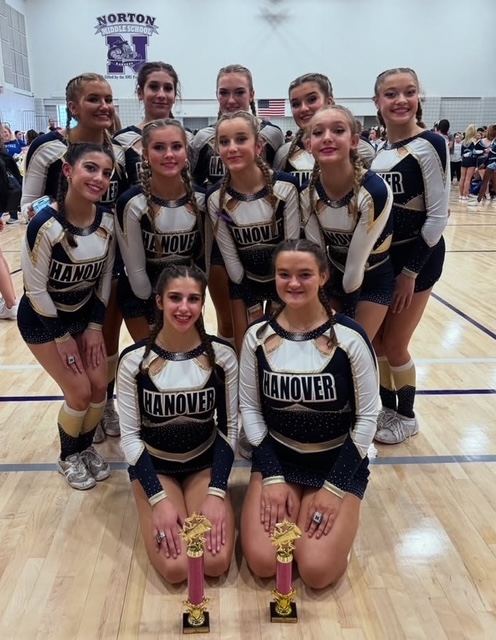
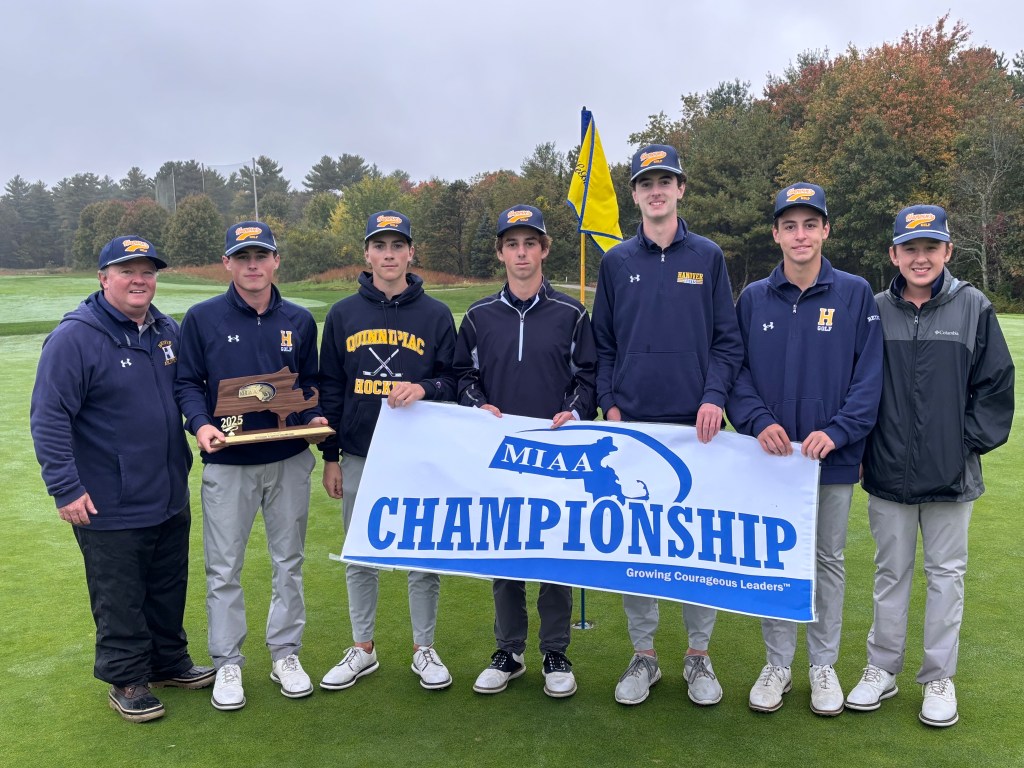
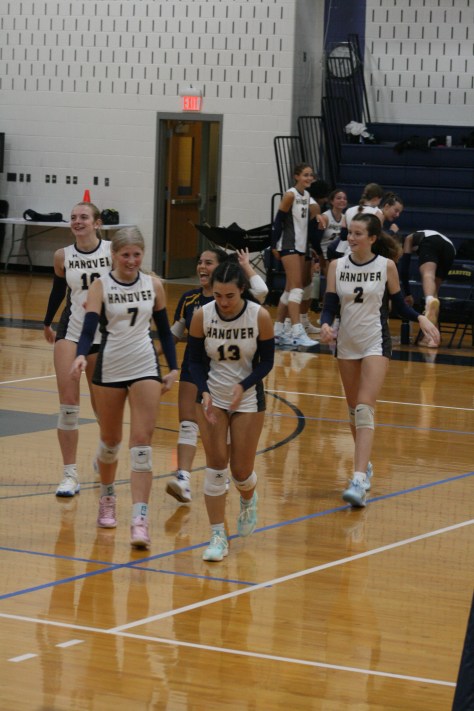
Hanover High School teams have dominated this fall season. Girls soccer ranks fourth in the most recent MIAA state power rankings, boasting an 11-2-2 record. Despite some tough early-season injuries, football has climbed to second in the D5 power rankings with a 4-2 record. Volleyball is sixth with a 15-3 record, highlighted by setter Sadie Chadwick’s milestone of 1,000 career assists against Cohasset on Oct. 10. With 13 wins and 2 losses, field hockey has captured the league championship and a number six ranking in the state. Boys soccer comes in 14th with a 7-4-3 record. Golf claimed the Division 2 South Sectional Championship at LeBaron Hills Country Club on Oct. 14. Competition Cheer kicks off its season with its first contest on Oct. 18, and Cross Country is gearing up for the all-league meet Oct. 25. With strong performances across the board, Hanover High continues to showcase exceptional talent and teamwork this fall. Power rankings and records are current as of Oct. 21

Below are some photos taken of our players and teams so far this season.

Beantown vs. the Bronx: The Red Sox-Yankees Rivalry

By Greyson Potter, ’29

Staff Writer

If you know anything about the Boston baseball scene, you’re probably familiar with our rivalry with the New York Yankees. Intense is an understatement. Sox and Yankees fans (and many players) genuinely despise each other. From the days of Babe Ruth and Ted Williams vs. Joe DiMaggio to the A-Rod era, every generation has had its defining moments in this storied feud. This year, a new chapter was added as the Red Sox and Yankees faced off in the Wild Card round of the Major League Baseball playoffs. The Yankees ended the Sox’s season, only to be eliminated by Toronto. With both teams now out of the running, it feels like the right time to reflect on the rich, 100-plus-year history of this legendary clash and consider where it might be headed next.

This story starts way back in the early 19th century. The Red Sox were a dominant force in the early days of the MLB, winning World Series titles in 1903, 1912, 1915, 1916, and 1918. Many of these championship teams were led by Boston’s star lefty pitcher, who could also hit. His name was Babe Ruth. At the same time, the Yankees were the bottom feeders of the MLB and had no World Series titles to show. But everything changed in 1916, when a man named Harry Frazee, the anti-Christ to Sox fans, bought the team. Frazee was a Broadway producer. His shows were successful when he bought the team, but by 1920, many of his shows had flopped, and Frazee was swimming in debt. He needed a way to pay off all of his bills, so he decided to trade away some of his baseball players in exchange for cash. Fortunately for him, the Yankees owner, Jacob Ruppert, had plenty of money and was very willing to give it to Frazee in exchange for his championship-winning players. So Harry and Jacob met up and talked shop for a while, and Harry eventually decided to sell Babe Ruth to Jacob for $100,000, paid in four installments of $25,000 with 6 percent interest. Little did they know that this would change the course of baseball history forever.

Three years later, the Yankees, led by Babe Ruth and his staggering .393 batting average and 41 home runs, won their first World Series title, kicking off decades of dominance. By the year 2000, the Bronx Bombers had claimed 25 championships. No other team even had double-digit titles at that point. Meanwhile, Boston’s Olde Towne Team took a very different path, breaking the hearts of generations of fans. The Red Sox wouldn’t win another World Series for 86 years, until the self-proclaimed “Idiots” of 2004 finally changed the narrative. The Curse of the Bambino was just beginning.

Babe Ruth won four World Series championships during his time in the Bronx and retired with a staggering 714 career home runs, by far the most in league history at the time. Even after Ruth, the Yankees sustained their excellence. There were the legendary days of switch-hitting Mickey Mantle, and the historic 1961 season when Roger Maris became the first player to hit more than 60 home runs in a single year, finishing with 61. During this era, there wasn’t much of a true rivalry between the two teams. The Yankees were consistently excellent, while the Red Sox were, more often than not, far from it.

But the Red Sox got a beautiful ray of sunshine in 1939, when Teddy Ballgame made his Major League debut against the Yankees. Ted Williams, the man whose one desire in life was to be remembered as the greatest hitter who ever lived, brought something to the Sox that they had not experienced in years: success. During the 1940s and 1950s, the Yankees and Red Sox began to compete more closely. The Yanks were led by Joe DiMaggio, whose brother, Dom, played for the Red Sox. Joe and Ted were the cream of the crop in baseball, with one constantly being compared to the other. Williams had the numbers; DiMaggio had the rings. Teddy hit .406 in the 1941 season, becoming the last player to hit .400 in a season, along with 37 home runs and 120 RBIs. But Joe DiMaggio edged him out for MVP, hitting .357 with 30 taters and 125 RBI. The difference was that while Williams’ Red Sox were 84-70, a respectable record, DiMaggio’s Yankees were 101-43 and went on to win the World Series. So, despite Williams having the better career numbers and being part of the 500 home run club, many argue that DiMaggio was better because he got the championships. In fact, Ted Williams only made one World Series appearance in his entire 19-year career. It was 1946, and Teddy Ballgame had just returned from three years of war service. He won MVP in his first year back and led the Red Sox to the World Series, where they would play the Cardinals. But in an exhibition game just days before the Series, Ted was hit by a pitch, breaking his elbow. He still played in the World Series, but hit a measly .200 with zero extra-base hits and a single RBI. The Sox lost in seven games. Williams would never make it back to baseball’s grandest stage. This was the first time that the Curse of the Bambino struck the Red Sox hard.

The Yankees and Red Sox would not face each other in the playoffs again until 1978, and the stakes could not have been higher. At the end of the season, the Sox and Yankees were tied for first place in the American League East. A one-game tiebreaker was needed. The winner would advance to the playoffs, while the loser would pack their bags for home.

The game would be played at historic Fenway Park in Boston. The Sox had Hall of Famers Jim Rice, Carl Yastrzemski, and Carlton Fisk hitting 3-4-5, while the Bombers had Reggie Jackson in the 4 hole and Goose Gossage at the back end of their bullpen. The Sox took a 2-0 lead into the top of the seventh inning, with starting pitcher Mike Torrez on the bump. Two men were on base, and nine-hole hitter Bucky Dent was at the plate. Dent was a light-hitting, defensive-minded shortstop who had hit a mere four home runs all season long. He got a fastball from Torrez, and he sent it far over the iconic Green Monster to give the Yankees a 3-2 lead. They would go on to win, 5-4. This cemented Dent as one of the biggest villains in Boston baseball history and earned him the nickname Bucky (bleep)ing Dent. The Curse of the Bambino was in full force.

Fast-forward to 2003, and the Red Sox and Yankees were tied at 3-3 in the American League Championship Series. Everything rested on Game 7 in the Bronx. The pitching matchup featured Red Sox ace Pedro Martinez, a historically good pitcher for the team, versus Roger Clemens, the 41-year-old ace for the Yankees in his final season. Clemens had spent years with the Red Sox, including their 1986 World Series loss. Pedro had some of his best stuff that day. He threw seven innings and led his team to a 5-2 lead in the top of the eighth. He was at 105 pitches. Now, the stats showed that Pedro’s performance severely dropped off after 100 pitches. He sent a kiss to the heavens, walking off the mound in the seventh inning, as he always does once he is done pitching. He got all his high-fives once he was back in the dugout, as he always does after a start. But when the eighth inning rolled around, Red Sox manager Grady Little asked Martinez if he wanted to go back out. Martinez wasn’t going to say no; he was too competitive. Grady had a man warm in the bullpen, but despite the numbers saying to avoid this at all costs, he sent Pedro out to pitch the eighth inning.

Grady’s decision would cost him not only his job but also his legacy in Boston. Pedro struggled, and the Yankees tied the game. That was when Grady decided to pull him. The game went to extra innings, and at 12:16 AM, in the bottom of the 11th inning, knuckleballer Tim Wakefield was on the mound for the Red Sox. Wake threw a knuckleball that didn’t knuckle to Aaron Boone of the Yankees, and Boone hit to the midnight moon. Game over. Red Sox lose. Grady Little was replaced by Terry “Tito” Francona as manager.

That offseason, the Red Sox knew they needed to make some changes. But the back-and-forth between them and the Yankees was unlike anything we have ever seen. Pedro was getting older, and the Red Sox needed another ace. Curt Schilling, a World Series champion with the Arizona Diamondbacks, was on the trade market. He was also being pursued by the Yankees, whom he had publicly stated he would love to play for. But Boston general manager Theo Epstein, the youngest GM in baseball history, swooped in, wooed Schilling, ate Thanksgiving dinner with him, and traded for him on November 28.

But Schilling was not the prime target for Boston that offseason. The best shortstop that the game had possibly ever seen, Alex Rodriguez of the Texas Rangers, was on the trade market too. He was the highest-paid player in the history of baseball at the time, but couldn’t even deliver the Rangers a playoff berth. They were looking to get out of that massive deal they gave to A-Rod. The Red Sox had their own elite shortstop, fan favorite “No-mahh” Garciaparra, who had declined an extension with the Red Sox, and they also had the second-highest-paid player in baseball, Manny Ramirez. Manny was an outstanding player, but he could be a prima donna in the clubhouse and never looked like he cared about anything. So Theo met with Alex, and they became very friendly. Alex was charming and charismatic, precisely what the Red Sox needed. A deal was agreed upon between the Sox and Rangers, but the MLB Players’ Union rejected it. Boston had attempted to renegotiate A-Rod’s contract, which the Union opposed. Rodriguez was still in Texas, Manny was still in Boston, and Nomar was unhappy about almost being traded away.

The Yankees made some moves of their own, too, signing big names like Gary Sheffield. But it was not until January that the Yankees would pursue one of the biggest deals in baseball history. In January, Aaron Boone, the man who sent the Red Sox packing in the 2003 ALCS, was playing a game of pickup basketball. He tore his ACL in that game. Now the Yankees were stuck without a third baseman for the whole season. A-Rod was on the trade block, and the Yankees definitely had the resources to pay him. The only problem was that the Yankees already had a shortstop, Derek Jeter. Owner George Steinbrenner and GM Brian Cashman spoke with A-Rod, and he agreed to play third base for the Yankees. The deal was done around Valentine’s Day, 2004. Leadoff hitter Alfonso Soriano was sent to the Rangers, and the Yankees got Alex Rodriguez.

Red Sox fans were devastated. It’s hard not to be when you have the chance to acquire one of the greatest players the game has ever seen at his prime age of 28, then have it slip through your fingers. Still, the Sox did not have a bad offseason at all. They traded for Curt Schilling, who made a scary ace combo with Pedro Martinez. They signed the American League leader in saves, Keith Foulke, to serve as closer. This whole drama would lead to one of the most memorable regular and postseasons in baseball history.

Spring training 2004 arrived, and although it was usually a quiet time, it already felt like September. Garciaparra was clearly upset with the organization, feeling betrayed after they tried to trade him. He was sidelined with a mysterious case of Achilles tendinitis and would end up missing the first 57 games of the season. Manny Ramirez was also upset, with rumors suggesting Pedro Martinez believed Boston was trying to “replace” him with Schilling. What would a Red Sox season be without drama?

The first spring training game for the Red Sox was against the Yankees. The game was a sellout, with hordes of rivals traveling down to Florida for a game that meant nothing, where most starters were going to sit on the bench. The Sox and Yankees would play each other multiple times in spring training, and it would be much of the same, foreshadowing almost every rivalry game that season.

Pedro Martinez was the opening day starter. He had a rocky outing and showed some signs of maybe having to be replaced by Schilling. Nomar did not play, and the Red Sox lost, 7-2. They were up-and-down to start the season, and sulky Nomar, who had been sitting by himself on the bench for over a month and a half, returned to the lineup on June 10th. Sox Nation thought this would provide the team the spark it needed to really live up to its potential, but instead, it only made things worse. Nomar was never a Gold-Glove caliber shortstop, but his defense that season was lackluster. Additionally, he was cold with the bat, his most potent weapon. The team struggled with his sulky attitude and subpar play, and we had a tough June. Finally, in July, Theo Epstein knew something had to be done. So, to the dismay of many of the Fenway faithful, young Theo traded Nomar, the beloved fan favorite for so many years, to the Chicago Cubs. He got first baseman Doug Mientkiewicz and shortstop Orlando Cabrera, two top defensive players at their respective positions that would plug some holes in the Red Sox’ spotty infield defense.

That was not the only memorable event from July 2004, however. On July 24, the man the Red Sox failed to acquire in the offseason helped make a portrait that would be framed in New England dens for many years to come. Bronson Arroyo was pitching for Boston against the Yankees. It had been a pretty chippy game, but it climaxed when Arroyo hit Alex Rodriguez with a pitch. A-Rod was not happy, to say the least, and had some words for Arroyo. Jason Varitek, the Red Sox catcher, did not appreciate what Rodriguez had to say to his pitcher. So he stepped up to A-Rod and punched him in the face with his catcher’s mitt, sparking a benches-clearing brawl. It was a memorable moment that really sparked the Red Sox team and sent them on the right path for the rest of the season.

The Sox were unstoppable after Varitek punched A-Rod. Schilling was as good as advertised, David Ortiz and Manny Ramirez were mashing in the heart of the order, and the defense had been cleaned up. We came very close to catching the big, bad Yankees in the American League East division race. One of our last series of the season was against the Yankees. Pedro Martinez pitched and got struck, resulting in one of his worst outings of the season. Pedro had been shaky against New York all year long. When asked about it post-game, he said, “…I guess I just have to tip my cap and call the Yankees my daddy.” Not the best thing to tell if you ever want to return to Yankee Stadium.

It was now playoff time. October baseball. The Red Sox clinched a Wild Card spot and took on the soon-to-be MVP Vladimir Guerrero and the Anaheim Angels in the American League Division Series. The Yankees had won the AL East and were playing a series against the Minnesota Twins, with soon-to-be Cy Young Award winner Johan Santana. We swept Anaheim, with Big Papi and Manny delivering many clutch hits. New York won their series as well.

The stage was set. One year after Grady Little’s stupid mistake and Aaron Boone’s heartbreaking home run, the Red Sox and the Yankees were meeting in the ALCS. The ace for the Red Sox, Curt Schilling, had hurt his Achilles tendon in the series against the Angels. He tried to pitch in game one of the Sox-Yankees series, but he was essentially pitching off one leg and got beaten up. The Red Sox lost, 10-7. Game 2 was a low-scoring affair, with Pedro Martinez receiving “Who’s your daddy?” chants throughout the game. Red Sox lose, 3-1. Game 3 was just embarrassing. The Yankees pounded the Sox in a demoralizing 19-8 win.

We were down 3-0 in a best-of-seven series. All the Yankees had to do was win one of the next four games, and they would be back in the World Series. No one in the history of Major League Baseball had come back from a 3-0 deficit. Some teams would simply accept that the Yankees are better. But not the Red Sox. Records are made to be broken, right?

Before game 4 in the Bronx, Kevin Millar went around during warm-ups, hyping up his teammates and telling them, “Don’t let us win tonight.” Derek Lowe was on the mound for the Red Sox, and he had been shaky at best during the regular season. But he pitched a solid game and kept his team close. It was 4-3 Yankees heading into the 9th inning. New York had Mariano Rivera, the best closer in baseball history, on the mound. He walked Millar, who was pinch-run for by the speedy Dave Roberts. Roberts did not play much during the season, but he was one of the fastest in the league. He was one of those players who everybody knew was stealing, yet he still managed to get to second. And in this case, everybody did know he was stealing.

Game 5 was very reminiscent of Game 4, with Rivera coming in for the Yankees in the ninth with a 4-3 lead. Again, he blew it, this time on a Jason Varitek sacrifice fly that would score Dave Roberts. The game went 14 innings this time, and Big Papi delivered again, with a walk-off single well into the next day.

Curt Schilling was scheduled to pitch in Game 6, but his Achilles was still hurt. He went to a doctor that morning, who practically stapled his tendon together in an effort to enable him to pitch. Early on in the game, however, whatever was holding Schilling’s ankle together came apart. No bother; Schilling proceeded to go out and deliver a masterful 7-inning effort with a giant blood stain on his sock, going down in Boston lore as the “Bloody Sock Game” that would lead the Red Sox to tie the series at 3-3, heading back to New York.

Game 7 was over as soon as it started. Papi hit a two-run bomb in the first inning, and Johnny Damon hit a grand slam in the fourth to give Boston a 6-0 lead. The Red Sox held on to win 10-3. They were the first MLB team to ever come back from a 3-0 series deficit and win. They had finally beaten the hated Yankees. Unsurprisingly, David Ortiz took home the honor of ALCS MVP.

The World Series, somehow, oddly felt like a formality. Everyone knew the Red Sox were going to win. The Cardinals were the best team in the National League, featuring one of the scariest top four hitters in the MLB, but their pitching was not very strong. The Red Sox swept the team that Ted Williams lost to in his only World Series appearance, with Manny Ramirez taking home World Series MVP honors.

They had finally done it! The Red Sox had reversed the Curse of the Bambino and won their first World Series in 86 years. Many people never even lived to see the Red Sox win a World Series. Most could not remember the last time they won it all, if they were even alive. This title changed a fan base. The team was no longer the pitiful, cursed Red Sox that were always so close, but just not quite there. They were the Red Sox that won the World Series, starting an era of dominance that included titles in 2007, 2013, and 2018. The only World Series the Yankees would win with Alex Rodriguez was in 2009. There would be no more “1918” signs or chants, no more snarky curse remarks from Yankees fans. New York had accomplished arguably the biggest collapse in league history and was thoroughly embarrassed. Somewhere up in the sky, Babe Ruth, the Great Bambino, was smiling down upon Red Sox Nation.

The rivalry has certainly quieted down in recent years. The Sox have won the World Series, but the Yankees haven’t been winning as much. But this year, the Red Sox and Yankees played each other in the American League Wild Card Series. The Red Sox took game one of the best-of-three series in a low-scoring pitchers’ duel between the Red Sox’s #1 starter, Garrett Crochet, and the Yankees’ #1, Max Fried. The Yankees’ inconsistent bullpen lost them the game, though. Carlos Rodon was great for the Yankees in game 2, and the Red Sox pulled starter Brayan Bello in only the third inning. Garret Whitlock, our lights-out setup man, lost us the game, 4-3. Game 3 was sure to be exciting. Winner takes all. Two rookies were on the mound. Conelly Early was the starter for Boston, who had a mere four career major league starts under his belt. Walpole, Mass., native Cam Schlittler was pitching for New York. Schlittler’s fastball was electric that night. He put up one of the best postseason pitching performances ever, becoming the first pitcher to go 8 or more innings with 12 strikeouts and zero walks in a playoff game.

Hopefully, one day soon, the rivalry will be as intense as it was back in the glory days of the early 2000s. Both teams appear poised to be playoff contenders for years to come, boasting exciting players like Roman Anthony for Boston and Aaron Judge for New York. This rivalry is undoubtedly one of the strongest and most brutal clashes in the sports world.

Year Two for Drake Maye: How Has He Improved?

By Luke Curran, ’27

Sports Editor

With the kickoff to Drake Maye’s second year in the NFL, many have begun to consider him an MVP-caliber quarterback. As of week six of the 2025 NFL season, the New England Patriots sit at a record of 4-2, taking first place in the AFC East for the first time since 2019. Maye’s performance has reflected his successful development with the team, highlighting the Patriots’ strategic moves in the offseason. So, the question is, how did he get here?

To begin with, the addition of former Titans head coach Mike Vrabel and Raiders offensive coordinator Josh McDaniels brought experienced leadership to the organization. McDaniels previously served as offensive coordinator for the Patriots under Bill Belichick, while Vrabel was a standout linebacker for the team during the Tom Brady era.

Additionally, the signing of new players such as wide receiver Stefon Diggs and defensive end Milton Williams brought more talent to the lackluster roster on both sides of the ball. Moreover, with the Patriots drafting 4th overall pick Will Campbell, the offensive line significantly improved. Overall, these additions gave Maye better weapons on offense and stronger protection up front, positioning him to take a significant step forward this season.

On Oct. 12, the Patriots’ impressive win over the New Orleans Saints brought even more attention to Maye, as he completed 18 of 26 passes for 261 yards and three touchdowns. He achieved a perfect 158.3 passer rating in the first half of the game, finishing with an overall rating of 140.1 for the game. 

This performance trend suggests that Maye could be on track to contend for the 2025 NFL MVP award, potentially leading this revamped Patriots offense on a deep playoff run. It also marks a dramatic improvement from last season, when the Patriots finished 4-13. While there’s still more to be seen from Maye, his development so far has been undeniably promising.