Tag Archives: politics

Mamdani: The Dawn of Democratic Socialism

By Sophie Bunar, ’27

Staff Writer

Zohran Mamdani was recently elected mayor of New York City, and he’s sharing his progressive ideas with the country. Mamdani proudly describes himself as a democratic socialist, similar to Sen. Bernie Sanders of Vermont and Rep. Alexandria Ocasio-Cortez of New York. So what exactly is democratic socialism?

After President Donald Trump tried to label Mamdani a communist, the candidate became very vulnerable with his political and economic beliefs in public. When CNN’s Erin Burnett asked Mamdani during the campaign if he liked capitalism, he said: 

“No, I have many critiques of capitalism. And I think ultimately, the definition for me of why I call myself a democratic socialist is the words of Dr. King decades ago. He said, call it democracy or call it democratic socialism. There must be a better distribution of wealth for all of God’s children in this country. . . . For too long, politicians have pretended that we’re spectators to that crisis of affordability. We’re actually actors, and we have the choice to exacerbate it, like (outgoing) Mayor (Eric) Adams has done, or to respond to it and resolve it like I’m planning to do.”

Democratic socialism, as described by both Mamdani and Martin Luther King Jr., is a political ideology advocating a socialist economy within a democratic framework. It seeks to achieve a more egalitarian and just society by controlling the economy to benefit the majority, not just the one percent at the top. Democratic socialists support policies like universal health care, higher minimum wages, and worker cooperatives. They strongly distinguish it from both communism, which is seen as authoritarian, and social democracy, which they believe doesn’t challenge capitalism enough.
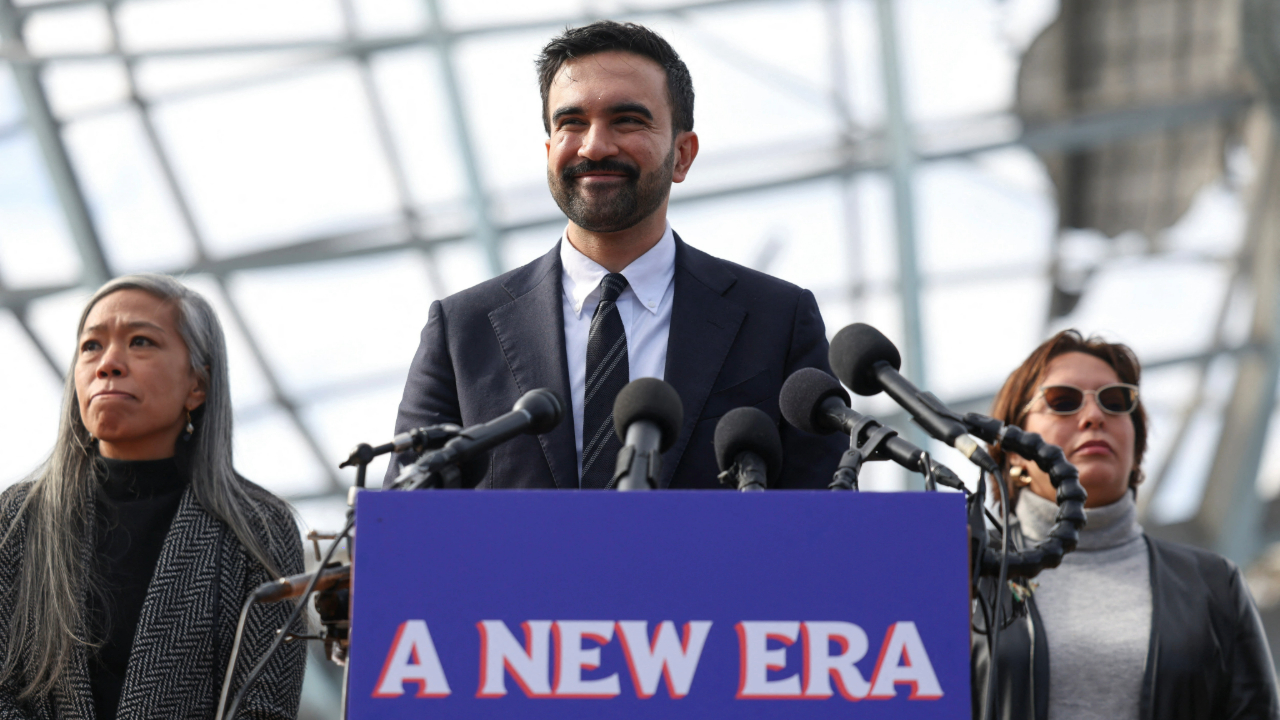
New York City Mayor-elect Zohran Mamdani holds a press conference at the Unisphere in the Queens borough of New York City, on Nov. 5, 2025. (Kylie Cooper/Reuters)

While no country is a pure democratic socialist state, Nordic nations such as Norway, Sweden, Finland and Denmark are often cited as examples that follow many of the ideals. They utilize a mixed-market economy that combines private ownership with a strong social safety net, and they’re known for their comprehensive welfare system, including universal health care. Public services are funded through taxation. Labor unions, as well as labor market policies, reduce conflict between labor and capital. Other countries influenced by democratic socialism include Canada, Germany, New Zealand, Portugal, Belgium, France and the Netherlands.

Despite how beneficial these ideas sound, is America ready for democratic socialism? The U.S. operates under a representative democracy with a capitalist-based economy. Capitalism is a stark contrast to socialism; it features private ownership, free markets and competition, while socialism involves government or collective ownership with a focus on equitable distribution. Capitalism promotes individual economic freedom and innovation through competition, but it can lead to inequality, which is what socialism aims to reduce. However, socialism has potential drawbacks as well. Despite its just basis, it can stifle innovation due to reduced competition and government control. Also, like many “unchecked” economies, it can lead to authoritarianism and gradually devolve into communism. However, under the current administration, many people are asking for either a socialist shift or a mix of both socialism and capitalism.

Mamdani’s own ideals are probably part of the best basis we have when it comes to the modern understanding of democratic socialism. His big policies are all focused on making life more affordable for working people. He aims to:

  • Freeze the rents for one million people in rent-controlled apartments. This means a temporary, legal halt on increasing rent for residential properties, preventing landlords from raising it for existing tenants and sometimes for new ones too.
  • Subsidize New York City buses to make them free to riders, as well as making child care free for New Yorkers.
  • Start a pilot program of one city-run grocery store in each borough to see whether removing the profit motive makes groceries cheaper—a risky arrangement.

    One of Mamdani’s policies is the most ambitious, though: increasing taxes on the wealthiest New Yorkers and on the city’s corporations. In the same CNN interview, Mamdani goes on to say:

“I think the dream at its core is a dream for stability in one’s life. And what you’re saying is that you work hard enough and that you then reap the benefits — too many New Yorkers, and Americans for that matter, are working eight hours and then still feeling like they haven’t made enough money to keep living in the city they call home.”
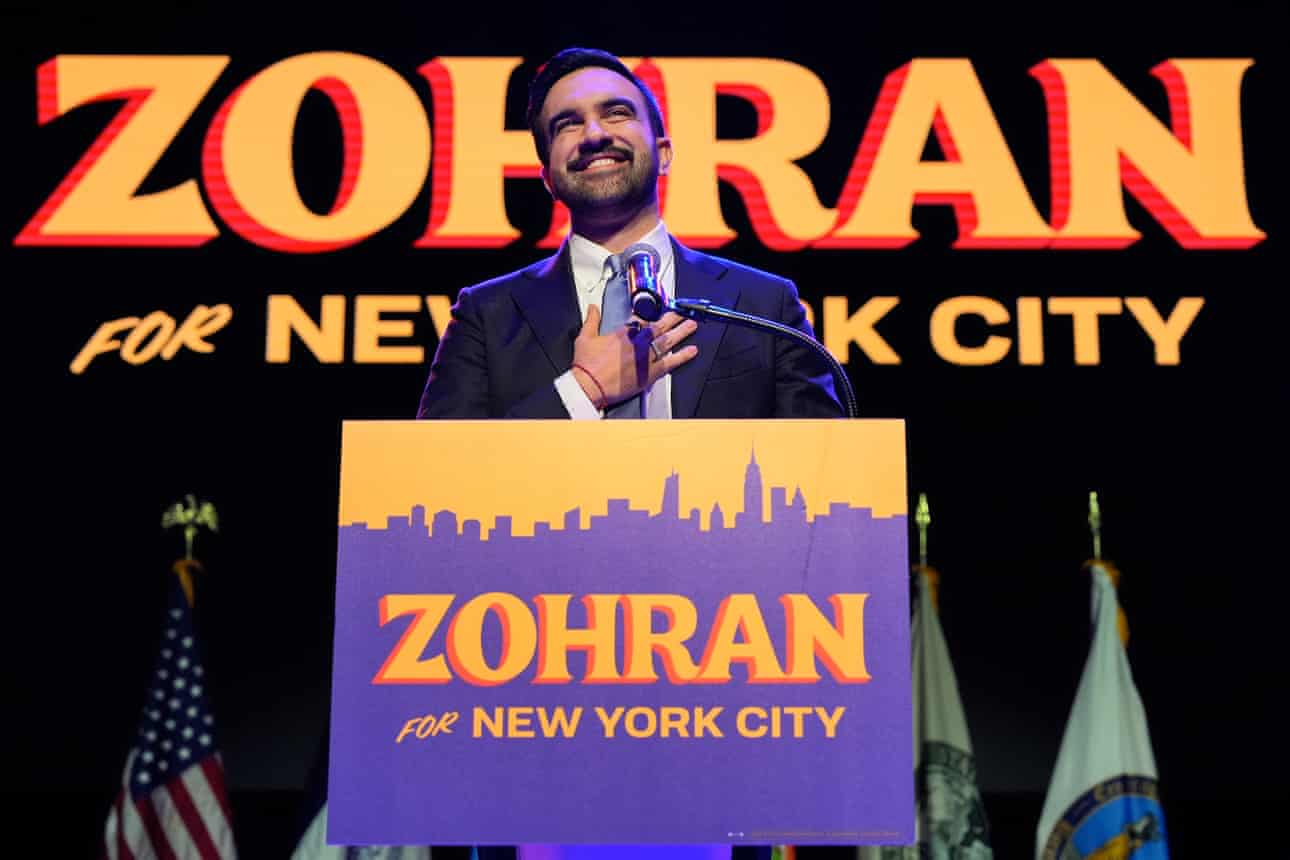
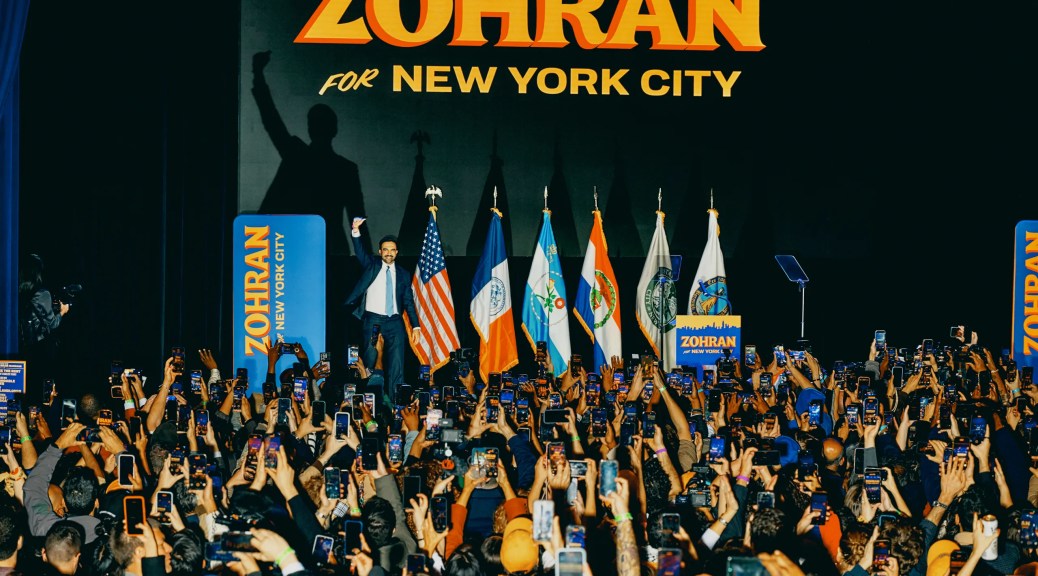
Zohran Mamdani speaks during a victory speech. Photograph: Yuki Iwamura/AP

Works Cited

Campbell, Lucy. “Who Is Zohran Mamdani, New York’s Democratic Socialist New Mayor?” The Guardian, The Guardian, 5 Nov. 2025, http://www.theguardian.com/us-news/2025/nov/04/zohran-mamdani-profile.

“Capitalism vs. Socialism: An Overview | EBSCO.” EBSCO Information Services, Inc. | Www.ebsco.com, 2019, http://www.ebsco.com/research-starters/political-science/capitalism-vs-socialism-overview.

Genovese, Daniella. “Business Leaders React to Zohran Mamdani’s NYC Mayoral Victory.” Fox Business, 5 Nov. 2025, http://www.foxbusiness.com/lifestyle/business-leaders-react-zohran-mamdanis-nyc-mayoral-victory. Accessed 7 Nov. 2025.

Lach, Eric. “The Mamdani Era Begins.” The New Yorker, 5 Nov. 2025, http://www.newyorker.com/news/our-local-correspondents/the-mamdani-era-begins. Accessed 7 Nov. 2025.

National Museum of American History. “Preparing for the Oath: U.S. History and Civics for Citizenship.” Americanhistory.si.edu, americanhistory.si.edu/citizenship/learn/government-basics/11/learn.

Thaywick, Lena. “15 Democratic Socialist Countries and Social Democracies.” HowStuffWorks, 22 Oct. 2025, people.howstuffworks.com/democratic-socialist-countries.htm. Accessed 7 Nov. 2025.

Treisman, Rachel. “4 Things to Know about Zohran Mamdani, Presumptive Democratic Nominee for NYC Mayor.” VPM, Virginia’s home for Public Media, 25 June 2025, http://www.vpm.org/npr-news/npr-news/2025-06-25/4-things-to-know-about-zohran-mamdani-presumptive-democratic-nominee-for-nyc-mayor. Accessed 7 Nov. 2025.

Wolf, Zachary B. “Democratic Socialism, according to Zohran Mamdani.” CNN, 6 Nov. 2025, http://www.cnn.com/2025/11/06/politics/mamdani-democratic-socialism-explained.
The Decline of Mainstream “News”

By Samuel Frattasio, ’27

Opinions Editor

It’s safe to say that many were surprised by the results of the 2024 U.S. Presidential Election. Among those taken aback were left-wing broadcasters from networks such as CNN and MSNBC, who spent months leading up to the election accusing the now-President, along with his family and political allies of various transgressions. While opinions on these accusations may vary, two crucial questions arise: Is such rhetoric necessary? Should broadcasters not strive to maintain impartiality? The evidence suggests otherwise. This perceived lack of objectivity is most definitely contributing to the struggles many mainstream television networks face today. This includes declining ratings and multi-department layoffs. In the case of MSNBC, there is an uncertain future. Their prime audiences are turning to information online, often from the popular social media platform X, formerly known as Twitter, newer outlets, and podcasts.

To understand this phenomenon, we have to address how we got here. The mainstream media, or “Legacy Media,” began in the 1900s, broadcasting from radios. Televisions were introduced in the 1940s. Families across America would gather every evening in the parlor to watch the nightly news. This was when the news wasn’t divisive, before the negative commentary and constant back and forths as seen today. Back then, the news was simple, with straight facts and barely any opinions. Fast forward to the present day, and it seems you can’t turn on the news and just watch the news. It’s ALWAYS negative. As the mainstream media’s prime audiences scatter, they need to find a solution fast or it may be too late.

Is this rhetoric really necessary?

It’s not difficult to research a topic like this. A quick look at a few news programs and the key points become clear. For instance, I recently watched Morning Joe and The Rachel Maddow Show on MSNBC. Both cover much of the same material but with slightly different styles. Yet, they both lean heavily on the same rhetoric. Take Joe Scarborough and Mika Brzezinski from Morning Joe, for example. They’ve spent countless episodes attacking anyone who supports Republican ideologies, only to meet with Trump after the election results were in. Many saw this as an attempt to pander to him or preserve their jobs, further alienating their own audience. As for Rachel Maddow, a seasoned broadcaster and arguably the most popular figure on MSNBC, her nightly show blends current events, pop culture, and political guests. However, she’s been criticized repeatedly for a hypocritical and subjective approach to reporting. Despite trying to cater to her left-leaning viewers, many of them are leaving. It’s clear that people are tired of the constant arguing, the rhetoric, and the misinformation, that’s often found on these networks—and they’re turning elsewhere.

It’s important to recognize that right-wing networks have been equally guilty of bias. Take Fox News, for example. The network has faced its own share of criticism for promoting divisive rhetoric, especially surrounding the 2020 election. However, lately, viewers have been flocking to conservative outlets, and it’s clear that these networks are benefiting from a model that prioritizes partisanship. Whether left-wing or right-wing, the focus on political division and entertainment at the expense of objectivity has become a standard across much of the mainstream media.

Why aren’t broadcasters impartial?

I genuinely believe that most journalists strive to present the facts without letting their personal biases influence their reporting. This is generally true for many centrist networks like CBS, ABC, and NBC, which have historically been trusted for their more neutral coverage. According to a 2020 Pew Research Center study, 67 percent of Americans say that “journalists should aim to be neutral and unbiased in their reporting.” Unfortunately, the same can’t always be said for networks like CNN, Fox News, or MSNBC, where partisanship often colors their coverage. In fact, a Pew Research Center report from 2019 found that 60 percent of Democrats trust CNN, while 60 percent of Republicans trust Fox News, highlighting the ideological divides in modern media. Even within centrist outlets, subjectivity can creep in. Take Kristen Welker, for example, the moderator of NBC’s Meet the Press. Welker has publicly stated that her goal is to present the facts and nothing but the facts, yet, at times, her reporting seems to be influenced by her personal opinions rather than pure, impartial facts. Similarly, Margaret Brennan of CBS’s Face the Nation, and other broadcasters at ABC, have occasionally been critiqued for leaning into more subjective tones, especially when covering political topics.

In my view, it’s impossible to completely escape bias, and some argue that it makes news more entertaining, but in today’s deeply polarized world, can we afford to let personal beliefs dominate the news cycle? In a society already torn apart by division and hostility, the need for impartial, fact-based journalism is more crucial than ever. While no one is perfect, news presenters have a responsibility to set aside their personal beliefs, or at least strive for balance, when reporting the news. It’s not too much to ask. In fact, the public demands it. According to a 2021 Gallup poll, trust in media has plummeted to record lows—only 36 percent of Americans say they have a “great deal” or “fair amount” of trust in the media. This decline in trust can be attributed to growing concerns about bias and partisanship. What’s happening now is that audiences are turning to other forms of media—like podcasts, independent news outlets, and social media—where they feel they can get a more “unfiltered” or “honest” perspective. So, is it too much to ask journalists to put aside their personal opinions and simply present the facts? I don’t think so.

So where is everyone going?

The answer is podcasts, social media, and online news websites. On the popular platform TikTok, news influencer Dylan Page emerged as a leading source for election night coverage. His videos announcing election updates garnered over one million engagements and 6 million views, according to the Columbia Journalism Review. Currently, more than half of U.S. adults turn to social media for at least some of their news, as revealed in a Pew Research study from September. Furthermore, about half of TikTok users under 30 rely on the platform for news, while 79 percent of Instagram users aged 49 and under catch breaking news as it unfolds on the site, according to the Columbia Journalism Review.

Online news is especially convenient for younger generations of voters. In the lead-up to the election, President Trump made a guest appearance on The Joe Rogan Experience, which attracted around 40 million views, surpassing the viewership of last year’s World Series. Similarly, former Vice President Kamala Harris appeared on the Call Her Daddy podcast, amassing over 7 million views. These appearances not only amplified their voices but also led many viewers to cement who they would vote for. It is widely believed that President Trump’s appearance on Rogan’s podcast helped push the President across the finish line with undecided voters.

For mainstream media to stay relevant, they must shift their focus from entertaining to prioritizing facts and accuracy. Since November, many major news outlets have had to make significant layoffs; they should take notes on the simplicity of online media.

Ultimately, I hope for a return to a time when watching the news wasn’t a source of anxiety, when discussions weren’t dominated by shouting matches, and when people could respectfully disagree and still get along.

“The most important thing is to be accurate, to be fair, and to be honest. That’s what you’re supposed to do in this business.”
– Tom Brokaw, former anchor of NBC Nightly News

Do We Still Need the Electoral College?

By Sienna Lamond, ’26

Staff Writer

The vote for president in the United States has never once been determined by the true popular vote but rather by the Electoral College system. When the topic of presidential elections is reinvigorated around Election Day, many Americans wonder why our president is not determined by our votes. Some even choose not to exercise their voting rights because they don’t believe their vote actually counts or matters. In some respects, they’re right.

In 1787, the Constitutional Convention came to the compromise known as the Electoral College. The issue was that nobody could agree on the best way to elect the president. Some wanted Congress to elect the president, and others wanted the people to choose the president directly. So the Electoral College system was born as an odd compromise between delegates from 237 years ago. In this system, a board of 535 electors each cast a ballot in accordance with the majority votes from the state they represent. To win the presidency, a candidate must win 270 of them. Additionally, in 48 states, all of the electoral votes go to only one candidate. For example, if the majority of Ohio votes Republican, all electoral votes would be given to the Republican candidate. This happens even if a decent amount of the state voted Democratic. Only Maine and Nebraska allow the electoral votes to be split.

The number of electors a state is allowed is determined by population. Heavily populated states such as California and Texas have more Electoral College votes than less populated states like Vermont and Wyoming. If you remember back to U.S. history class, this is why the Three-Fifths Compromise in 1787 was so significant. The vast majority of the southern states’ population was comprised of slaves, meaning if the slaves counted as people, the southern states would have more say in the Electoral College and have more representatives in Congress. The Fourteenth Amendment abolished the three-fifths compromise in 1868, which begs the question why do we still need the Electoral College?

In short, we don’t. It’s an antiquated system that deters people from voting and takes the voices away from millions of American voters. The foundation of our country is built on the principle that the people get to control the government. What we have with the Electoral College is a facade of a government elected by the people. According to the Pew Research Center, “More than six-in-ten Americans (63%) would instead prefer to see the winner of the presidential election be the person who wins the most votes nationally,” showing that the majority of Americans also wish to abolish the Electoral College to make their voices heard. Additionally, every other governmental election is determined by popular votes, even the election for the Senate and the House of Representatives, so we know that deciding an election by popular vote works. Why don’t we switch over?

In reality, it’s not so simple. The Electoral College is a part of the United States Constitution, which means we would have to move for an amendment to abolish it. For an amendment to be added to the Constitution, it must go through Congress, both the Senate and House of Representatives. With our Congress significantly divided, lawmakers have tried and failed to pass many bills in recent years. If a movement were made to make an amendment to abolish the Electoral College, it is likely that it would never make it through both chambers of Congress. USA Today writes, “There have been more than 700 federal proposals to change or abolish the Electoral College in U.S. history. . . But getting the remaining states to drop the Electoral College system in favor of the popular vote may be prohibitively difficult, as it would require buy-in from states that benefit from the system.” In all the years the Electoral College has been questioned, very little has been accomplished to change it.

In the past, some candidates have won the popular vote but lost the electoral vote. The most notorious example was the 2016 election between Hillary Clinton and Donald Trump. Clinton won the popular vote by nearly 3 million votes, but Trump won the Electoral College and became president. This is an example of how this system fails the American people. In total, 62,985,106 Americans voted for Trump that year while 65,853,625 voted for Clinton as reported by a New York Times post, a difference of 3 million American voters. Although I disagree with the policies and morals of President Trump, this is not a complaint about him; this is a fault of the system. More people living in the country wanted a certain candidate, and were denied that victory because of the Electoral College, and that statement could go for any candidate that has ever won the popular vote and lost the electoral vote. It’s not only unfair and unjust, it’s un-American and unpatriotic.

The year is not 1787. It is 2024. The world has changed, and we as people have changed. We need to remember the values and ideologies that the United States was originally founded upon: a government for the people, of the people, and by the people. No more Electoral College failures; it’s time for us to make a change and take our country, and our leaders, back into our hands. It is the only way to ensure our democracy will last for years to come. As former President Barack Obama said, “Change will not come if we wait for some other person at some other time. We are the ones we’ve been waiting for. We are the change that we seek.” We are the ones that have the power to make a change for the betterment of our government and our country.

Carrying the Truth about War

By: Michael Sawaya, Jack Nadeau, Malakai Beliveau, Daniel Sierra and Cam Melone, ’26

Guest Writers

“If at the end of a war story you feel uplifted, or if you feel that some small bit of rectitude has been salvaged from the larger waste, then you have been made the victim of a very old and terrible lie,” wrote Tim O’Brien in The Things They Carried, his National Book-award winning novel based on his experiences as a soldier in the Vietnam War. 

Our reading of this book in class motivated us to reflect on the horrors of war and what a soldier would carry on his body and in his heart in order to survive such a traumatic experience. We invited Robert (Bob) Melone, a U.S. military veteran who served in Afghanistan, and father of junior Cam Melone, to join our class and candidly discuss his experience.

“Everyone is human and deserves dignity.”

Robert (Bob) Melone, with his son, Cam, now a junior at HHS.

Mr. Melone always felt the obligation to join the military because his father and grandfather had served. In 1996, he graduated Silver Lake High School and was working at Papa Gino’s in Pembroke. He knew he wanted to go to college and the only way he could afford this was by joining the military. So he joined the National Guard in 1997 and began basic training in Missouri. He was deployed to Afghanistan in 2002 to fight the Taliban and al-Qaeda, two terrorist organizations.

He recalls landing his military plane at Bagram Air Force Base with no lights on, in total darkness, in order to evade the enemy. For the first three months of service, he and his platoon did not have the means to take a shower. Mr. Melone then embarked on a covert operation to locate a shower; he ended up finding one on another Air Force base.

Mr. Melone’s platoon was responsible for blowing up a cache of ammunition and bombs from al-Qaeda and the Taliban. His platoon detonated the enemy’s weaponry high up in the mountains of Afghanistan. The elevation was higher than Denver, Colorado, causing him to suffer from elevation fatigue for the first few days he was there. Mr. Melone found it difficult to breathe in the extreme altitudes of these high mountain ranges as he embarked on these dangerous missions.

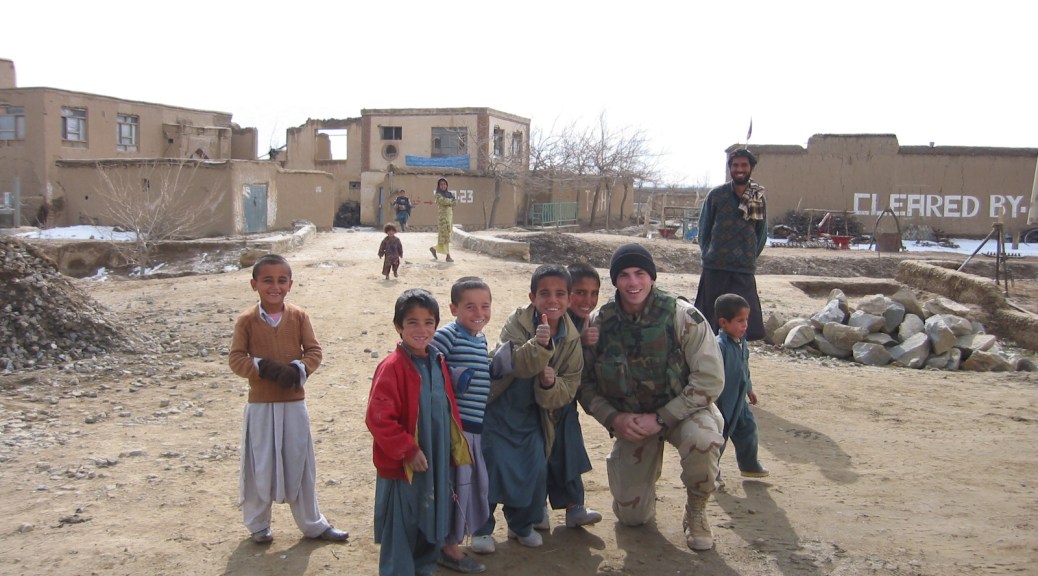
Mr. Melone visits schoolchildren in Afghanistan.

As a combat medic, he made sure his platoon was taken care of properly. Not only this, but Mr. Melone also took good care of prisoners of war (POWs) who were on the side of America’s enemies. He cared for the very people who may have killed him if given the chance. He never lost sight of the humanity in people on the other “side.” For him, it wasn’t about how many people he hurt, it was about how many people he helped. “Everyone is human and deserves dignity,” he said

Overall, Mr. Melone reports that he and his American platoon colleagues were treated well by the Afghans, but he noted that he “wasn’t sure if some were bringing information back to the enemy.” Similar to Vietnam, there were times he did not know who the enemy was. 

The women in Afghanistan wore burqas and were not allowed to speak to American servicemen, Mr. Melone recounted. The Afghan women were only allowed to speak amongst themselves or possibly to female soldiers. The young girls in Afghanistan attended school at the time; however, that is no longer the case. Mr. Melone reflected with regret on how women’s rights deteriorated over time. Since the U.S. withdrew from Afghanistan in 2021, the role of women has declined even further. 

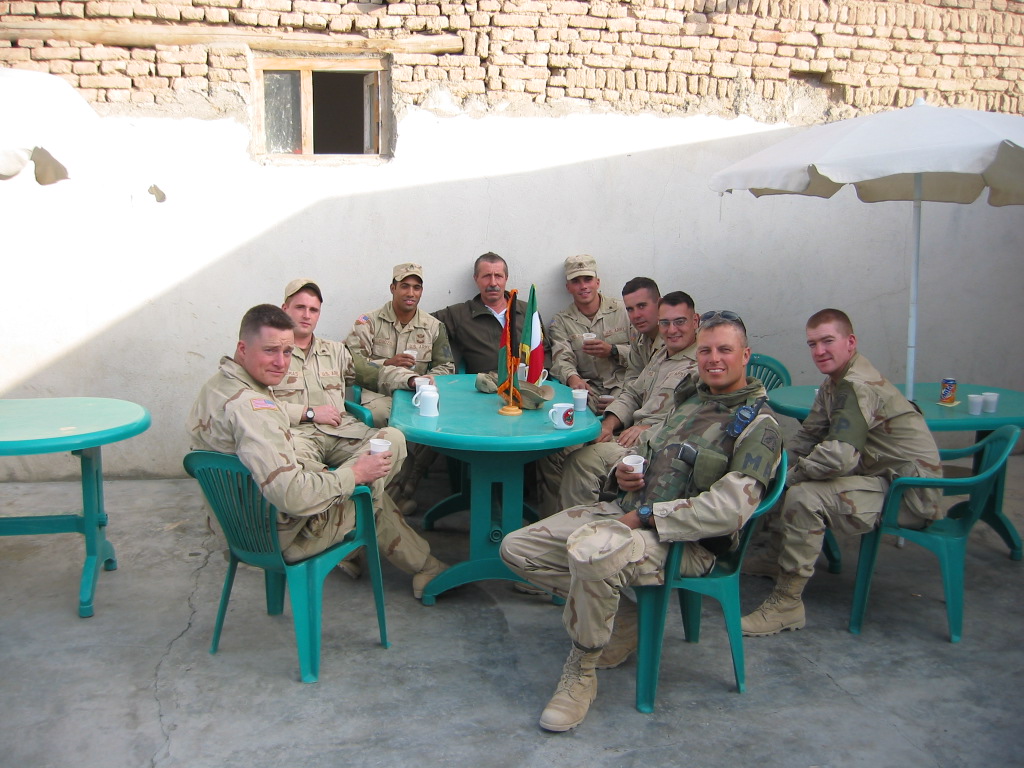
Mr. Melone and fellow soldiers enjoy the Italian platoon’s espresso bar.

Despite being in combat overseas, there were some moments of levity that Mr. Melone looks back on fondly. He remembers that the European troops were better equipped and had more luxuries than their American counterparts. He recalls visiting an Italian military platoon that had set up a full espresso bar. Mr. Melone and his fellow American servicemen indulged in the Italian hospitality and truly enjoyed the excellent quality coffee, espresso and cappuccino. 

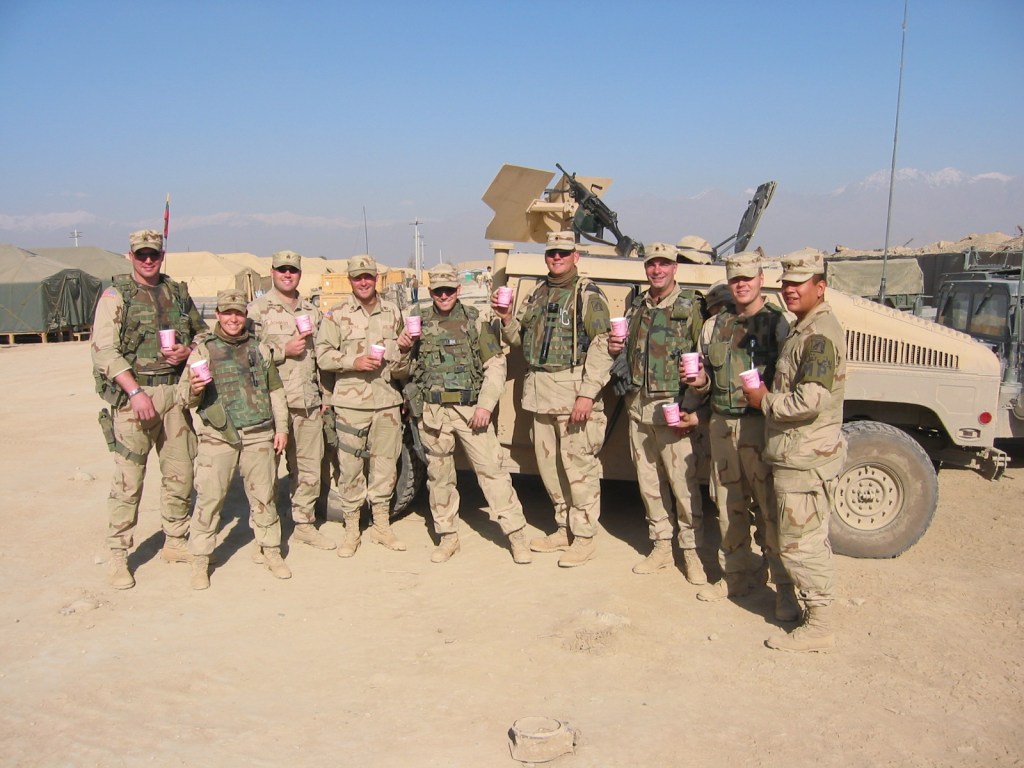
Mr. Melone’s platoon with their MaryLou’s delivery.

As a lover of coffee, this was one of the comforts that Mr. Melone missed most. He recalls writing a letter to the popular coffee chain Mary Lou’s asking them to send his platoon some coffee. Soon, he and his fellow servicemen received a massive supply of Mary Lou’s coffee direct from the South Shore. 

Much like O’Brien recounts in The Things They Carried, Melone met his best friends in the military. They gave each other nicknames and used their sense of humor to deal with the stress and agony of war. 

Also similar to O’Brien’s observations, Melone considered the overall sense of purpose in America’s presence in Afghanistan. At the time, Melone felt that Americans had a strong reason to be in Afghanistan: to free the Afghans from the oppression of the Taliban. Yet looking back, he feels doubt about what the purpose was. He reflected that, when it comes to war, “getting out is way harder than going in.” 

An Afghan child walks his bull on a leash.

In The Things They Carried, Tim O’Brien writes about the tangible and intangible things he and his fellow troops carried with them while at war in Vietnam. Mr. Melone said during his year of service and to this day, he carries the Afghan children. He felt a deep connection to the innocent young lives that were trying to survive in very difficult conditions. He showed a photo of a very young boy walking a bull around on a leash, similar to the way Americans walk their dogs. He cherishes photos of the children of Afghanistan and has several photos framed around his house. 

Physically, he carried a St. Jude prayer card from his cousin Patty that was originally their grandmother’s. This prayer asks God for help during difficult times. He carried this prayer card with him everywhere and it reminded him of his loved ones back home. 

To this day. Mr. Melone carries the powerful emotion and experience with him, and is not afraid to show his vulnerability and how it deeply affected him. We witnessed this when he shared his family legacy of service, his love for the children of Afghanistan, and his love for his own children. 

Ultimately, Mr. Melone is grateful for the opportunities the military gave him and is proud of his service. However, his overall message about war resonated with us all: “Anything that glorifies war is a lie. War is inhumane.” We are sure Tim O’Brien would agree.