Tag Archives: school

Class of 2025: Parting Words

By Jenna Clasby, ‘27 and Sophie Bunar, ‘27

Staff Writers

As underclassmen, we often look to the seniors for advice. Whether it’s which classes to take, which extracurriculars to check out, or just how to get through high school, seniors often have the most valuable knowledge and experience. As this school year comes to an end, members of the Class of ‘25 shared their best pieces of advice for younger students.

“Enjoy the time you have, and enjoy the moment. Live in the present.” – Aidan Boutin.

“Being perfect isn’t needed. You are allowed to make mistakes and you should make them. If you’re stressed about being perfect all the time, you’ll miss all the good stuff.” – Aevyn Brink 

“Don’t take anything for granted, it goes by way too fast so enjoy it.” – Abby Hannah

“You’ll never see these people again.” – April Hamilton 

“Do everything for yourself.” – Alexandra Marinis

“Keep your grades up and you’ll be fine. I also wish I had done more sports and joined more clubs, because it is an advantage of making new connections.” – Ava Curren

“Keep your GPA up and turn in assignments on time.” – Bell Keenan

“Don’t be absent all the time.” – Brooke Barber

“Get involved in as much as you can in high school and don’t be afraid to go out of your own comfort zone. High school goes by fast, and the more you put yourself out there, the more experiences and friendships you’ll create.” – Catherine Reinhart, class president

“Don’t be afraid to get involved and don’t stress yourself out too much.” – Thomas Perkins

“Take notes on Thomas Perkins.” – Cam Scott

“Keep open communication if you are struggling. Your teachers want to help you succeed and not asking for help won’t benefit you in the long run.” – Izzy Latessa

“Don’t feel the need to impress anybody. Be yourself.” – Ryan Shea

“Take risks even when you don’t know if you’ll succeed! Apply for the job or leadership position or group outside of school you want because you never know what could happen!” – Julia Fitzgerald

“Shave your facial hair and get a haircut.” – Tyler Neville

“Spend every minute with your friends! You’re all going separate ways after graduation.” – Casey Labelle 

“True kindness comes from lifting others up without lowering yourself. You’re worthy of standing tall, just as you are.” – Addison Baldinelli

“Give the janitors less work to do.” – Malcolm Beliveau

“My advice is to figure out what you want to do after high school as soon as possible and start working towards that goal as soon as you start your freshman year.” – Connor McCue

“No one expects you to know everything, and it’s okay to ask questions when you’re struggling. Teachers, friends, and family are there to support you” – Ella Brinkman 

“Don’t let drama get to you.” – Kaylee Lupien

“High school isn’t for everyone, find something that you enjoy to do whether it is in school or not and put more time into that.”  – Dylan Clark

“Only try your sophomore and junior years.” – Matt Lombardi

“Work hard, even if you’re unmotivated. Surround yourself with people who motivate you to be the best person you can be.” – Grace Witt  

“Take the right classes. Ask upperclassmen what to take.” – Macklin Ball

“The best advice I would give to younger students is to always keep your head up and don’t get past yourself and just focus on the moment. Be you, not something else.” – Michael Sawaya

“Take classes that are the best fit for you. Don’t pick classes just because they are popular to take.” – Tyler Vincent

“Take advantage of every opportunity, as cliche as it is, you will be a senior before you know it, so enjoy it.” – Sophie Schiller

All in all, advice is important to shape the young minds of underclassmen. It can provide guidance and support which leads to better decision making overall in the future. As underclassmen, we are forever grateful for the advice from our seniors that allows us to better ourselves on our own journey through High School.
Does the MCAS Still Matter?

By Danny, Campbell, ’27

Staff Writer

So I bet most of you are aware of the fact that on November 6th, the people of Massachusetts voted in favor of getting rid of MCAS as a graduation requirement. I personally believe this was a great decision, since it means that students won’t have to worry about not getting their diploma for scoring poorly on it. However, I think we still have to take the standardized tests seriously because of how much they still can affect students and our school.

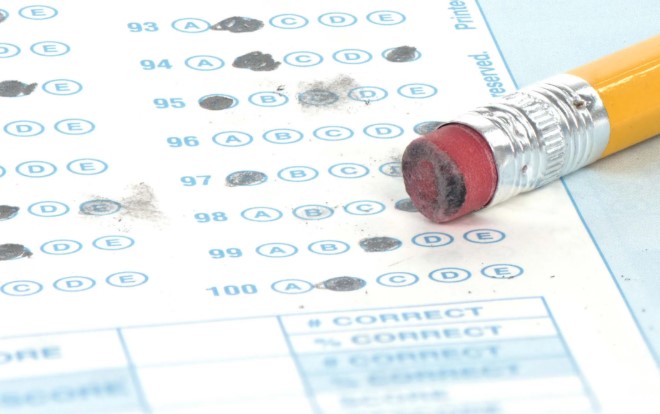
The MCAS, or Massachusetts Comprehensive Assessment System, is a series of standardized tests created in 1993. Starting in third grade, all students take tests in English Language Arts and Math. A Science, Technology and Engineering exam is given in grades five and eight. Civics is administered to 8th graders and biology is given to 9th graders. Passing the tests had been a requirement for a diploma in Massachusetts, while schools used the data to evaluate teaching and learning. After the vote, the graduation requirement has been removed, but schools are still giving the tests to collect information.

But how did this movement to remove the MCAS graduation requirement get onto the ballot in the first place? You see, this movement was started by a mom in Lexington and the Massachusetts Teachers Association because they felt like MCAS was unfair to students who don’t take tests well. The movement was further spread by Adriana Mason and another mom from Hanover who helped to get the word out locally and get the question on the ballot.

One of the main concerns that went into having MCAS as a graduation requirement is the belief that students with special needs are treated unfairly by the system. I can relate to this concern from personal experience; while I was in elementary and middle school, I was given extra support in my classes to address my needs. However, when you are taking the MCAS, you are not allowed to have the same extra support you have had for the entire year. This would cause issues for students, who might have to take the high school tests repeatedly to finally earn a passing grade and qualify for their diploma. Teachers were forced to spend a lot of time each year preparing students for MCAS. It is either that or risk having students unprepared for test day.

Between 2003 and 2024, 400-450 students left HHS without their diploma, according to Mason. This large number has to do with their MCAS grades, and many of the students impacted were students with disabilities. Most students with disabilities already have hard lives, and not being able to get their diploma made their lives unfairly harder. Without a diploma, your job opportunities are reduced. You cannot go to college or into the military, and you cannot become a police officer or firefighter. Thankfully, with this law passing, students who graduated HHS from the 2003-2024 are able to now receive their diploma.

With all of that being said, and with the ELA test taking place at the high school this week, it leads me back to my question, “should we still be worried about the MCAS?” I will say once more that I am beyond glad that this law has passed, and I have NO complaints about this vote. However, as a sophomore, it feels very anti-climactic after being told numerous times since middle school that the 10th grade MCAS was the extremely important one that would determine whether or not I received a diploma. Now, the test feels just like an extra thing to do.

Still, my final verdict is that while MCAS shouldn’t be treated AS seriously as it was in previous years, I do believe students should still try to do well. The test results will be used to check in on how students are doing in school, and to make sure that teachers are successfully providing instruction in important skills. All of this can now be done without stressing out students yearround.

featured image: https://www.boston.com/news/education/2021/09/21/mcas-scores-2021-pandemic/

Budget Woes: The New Face of HHS

By John Owens, ’28

Staff Writer

On the morning of September 3rd, the sun rose to greet the residents in the town of Hanover. Autumn signaled its approach, as leaves danced in the air, swishing and sliding as they fell to the ground.  The turning of the leaf, the changing of the season, symbolized a new beginning for everyone, but especially for those who attend Hanover High School. With the failure of a funding initiative in May, students woke to the blaring of their alarm clocks and the bright light of a new day, along with the realization that their lives have changed for the rest of their high school careers.

Flashback to early May, when there’s a high chance you heard about a potential vote that would determine the “fate of Hanover.” Rumor of the vote spread like wildfire throughout the town, and some students were confused by or unaware of the reason for the vote. On the evenings of May 5 and 6, hundreds of citizens of Hanover gathered in the high school auditorium to voice their opinions about the town budget proposed for the subsequent year. The town was asking for about $6 million in additional funding for multiple departments, according to the town website. If approved, taxes would be raised, costing the average homeowner about $1400 a year.

Residents had to decide whether they would put this proposal to a town-wide vote in a special election. Those in attendance voted in favor of a special election May 18. But on that day, residents worried about higher taxes and rising costs voted by a large margin to reject the tax increase. Town departments were forced to reduce their budgets, cutting down on many programs and job positions.

This would be felt most harshly in the schools, which had asked for about $2.7 million of the additional funds. The school department is responsible for helping students become the future leaders of society. A comfortable and safe atmosphere for students is important for the schools of Hanover to uphold the motto of giving all students the chance “to soar and succeed without limits.” But according to information on the Town of Hanover website, the override failure would lead to more than 25 teachers being laid off, classroom sizes increasing by 20 percent, and electives for students being reduced. Opportunities for teaching and career exploration would decrease, supporters of the override feared, while behavior issues would increase.

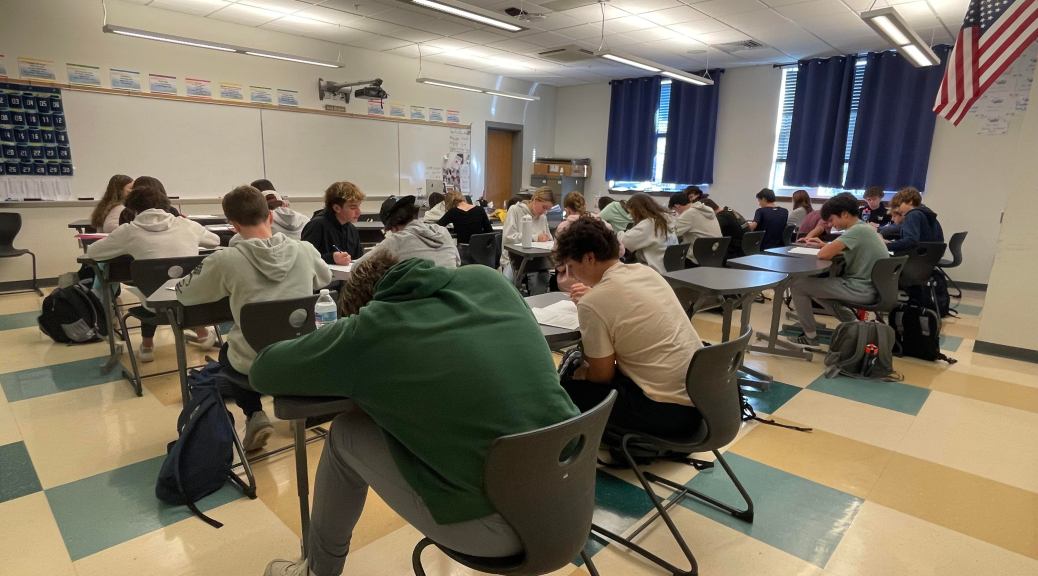
Now that we are a few months into the school year, the wounds inflicted by the override failure have become more evident at HHS. The void left by the budget cuts looms in the empty classrooms that once were used to teach Hanover students, or classrooms bursting at the seams. According to Steve Henderson, President of the Hanover Teachers Union, there are fewer courses being offered at the high school, and the ones being offered are overcrowded. There is also aging technology that cannot be replaced and field trips and extracurriculars that have been canceled. Seniors, in their last year, no longer have the same class choices and opportunities they have grown to expect, he said, and freshmen coming into school have “an uncertain horizon ahead of them.” 

Teachers are unable to spend as much time with students because of larger class sizes and caseloads, and their relationships with students are suffering, Mr. Henderson said. “Teachers are in a very trying position, and will continue to advocate for students.”

The opportunity to collaborate with other students and to create the arts that represent HHS is a gift to many. HHS strives in the arts and thrives when it comes to amazing performances by the chorus, band and drama programs. However, the Fine Arts department has changed because of the override failure. Matt Harden, music teacher and band director, said major impacts from the override include the loss of supplies and programs and the shifting of teachers to courses they have never taught before. The high school also lost its drama teacher, which has greatly impacted the face of the popular Drama program, he said.

“There will be a ripple effect for a long time,” he said. “My goal every day is to limit how much of an impact there is.”

It is necessary to understand the central causes that brought the town to this financial position. According to the town of Hanover website, “similar to many Massachusetts communities, the cost of providing services to the community has outpaced the revenue growth allowed under Proposition 2½ .” This means that the town’s tax revenue – its profits – aren’t keeping up with its expenses. The money in the town’s coffers also has been impacted by the expiration of federal Covid-19 grants and general inflation.

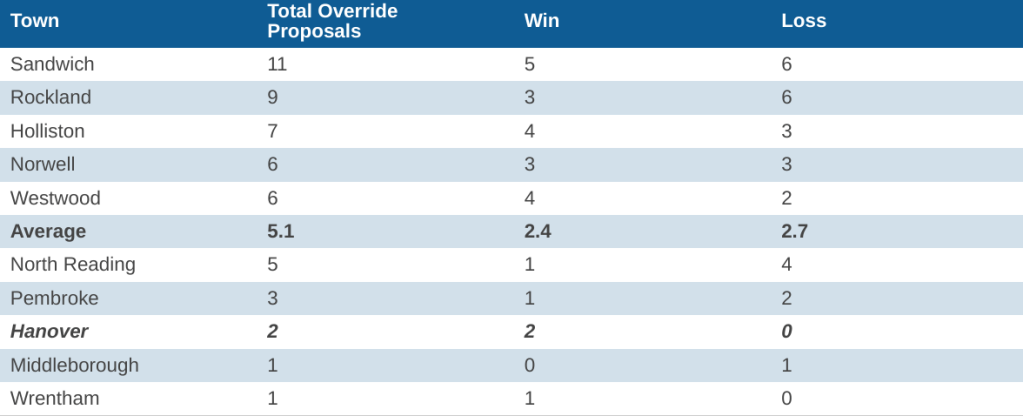
Rising expenses have not only impacted our town, but other comparable towns such as Sandwich, Rockland, Norwell and Westwood. Based upon a Municipal Data Bank, created by the Massachusetts Department of Revenue, towns like ours have asked for an average of 5.1 overrides since 1990 and more requests have failed than succeeded. Sandwich alone has asked for an override 11 times. Hanover has sought two tax overrides since 1990, both of which passed.

Hoping to heal from the wounds being nursed this year, school and town officials are already deep into planning the budget for next year. They are preparing three different budget proposals and pursuing another override vote. The “level funding” school budget would maintain the current level of reduced funding, resulting in more cuts due to rising expenses, according to school officials’ budget presentations. The “level services” budget would include funding to cover those rising expenses to maintain what we have this year. The “restore 24” budget would restore the funding cut last spring, returning many positions and programs that have been reduced. 

If only the “level funding” is approved, officials say, bussing, sports, clubs and course offerings at HHS could be even further impacted. The school we know and love, that the community cheers for on the playing field and on stage, could become unrecognizable. “Our identity is defined by the schools,” said Mr. Henderson.

It is a gift that HHS still maintains its core factors, its students and staff. The relationships that students and teachers have built over the years make HHS a welcoming place. It is hard to imagine what will happen if another override fails.

For more information on the town and school budget: https://www.hanoverschools.org/district/budget-planning