
By Leah Dillon, ’24
Staff Writer
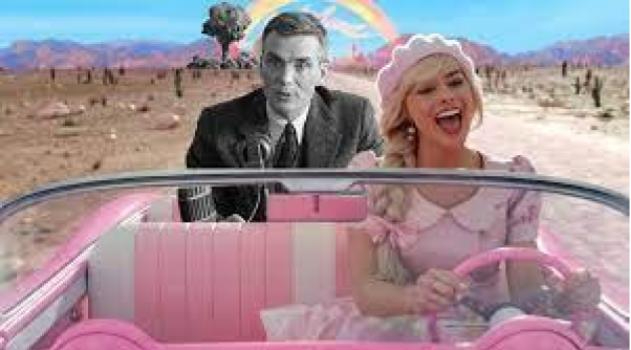
“Barbenheimer,” or the dual release of the polar-opposite films Barbie and Oppenheimer, has been possibly the most unusual trend to sweep the Internet in recent memory. The contrast between the campy and glitter-clad Barbie versus the gritty and dramatic biopic of Oppenheimer seemed to fascinate audiences, who flocked to the theaters en masse to see both films back to back, despite the massive difference in target audience. During my two trips to the new Hanover cinema to see each film, I saw teenage girls and adult men in hot-pink attire crammed into both theaters, hoping to get their fill of the pop culture phenomenon.
But why?

a44627406/barbenheimer-barbie-oppenheimer-movie-experience/
Beyond the obvious irony of sitting in Oppenheimer wearing bright pink and sequins, I think the “Barbenheimer” trend shows some of the long-term social effects of Covid. Between the virus and now the Hollywood writers’ strike, good movies have been few and far between. There haven’t exactly been many opportunities to go to the local cinema in a while. So why not marathon Barbie and Oppenheimer? Even less broadly, I think the opening of the new Showcase Cinema in Hanover also had a significant hand in reviving local interest in going to the movies. Even if your personal interest in both films could be described as ironic at best, there’s a wealth of experience in going to the movies with friends after several years of isolation and re-integration into the world.
As for my personal “Barbenheimer” experience, I went in not expecting very much out of either film, except maybe a good time. I didn’t think of myself as the target audience for either movie, and with the last few years of mostly soulless cash grabs in the cinema (with a few notable exceptions), I didn’t have a reason to expect these to be anything different. While both Barbie and Oppenheimer ultimately left me with mixed feelings, I will say that I feel more positive than cynical, and my expectations for both were thoroughly subverted. Here’s my overall thoughts on the “Barbenheimer” experience.
SPOILERS AHEAD!
Of the two movies, I’ll admit to having higher expectations for Oppenheimer than Barbie. In terms of my personal interest, I expected to like the gritty historical drama much more than something frivolous and in your face (as Barbie undoubtedly was). I dismissed Barbie as one of those “so bad it’s funny” types of movies, ultimately a glorified advertisement. However, the movie managed to rise above the company that conceived it, and in actuality, I liked Barbie considerably more. While I have criticisms of some of the characters and the presentation of some of its themes, it had a lot more substance than I originally gave it credit for, and overall made for a more enjoyable experience.
I haven’t trusted any big blockbuster movie releases for the past several years because of a widespread decline in the quality of movies and other popular culture. Since roughly 2016, theaters have been inundated with live-action remakes, unnecessary and weirdly executed sequels, and obviously soulless cash grabs. Most of the new movies that have come out in the past few years feel like they’ve been written by accountants rather than screenwriters; the trailers for Barbie made me feel like I’d be walking into a 90-minute commercial for Mattel, and to an extent, it was. With Mattel working on the film, and with a marketing budget of $150 million, the fact that Barbie existed to sell products is unavoidable. However, being what it was, Barbie was extremely self aware. Barbie was able to make fun of its source material and parent company without drawing any corporate ire, from criticizing the male CEOs selling empowerment to young girls, to discussing the unlivable expectations promoted to little girls through the dolls (and the potential impact on self esteem), to playing with the absurdity of its own concept. The whole movie is written in an overly snarky and self-aware kind of way, which genuinely impressed me as I walked out of the theater. On top of that, the movie takes the time to tell a layered story and explore existential questions about the human condition — the very last thing one would expect from a movie about Barbie. The movie managed to surpass my disdain for corporate involvement in art by being aware of the product it’s selling and the subsequent impact, while still leaving ample room for an interesting story and relevant themes. Barbie is so far from just a marketing tool; it manages to be funny and borderline absurd, while also telling a mature story of self-actualization, and giving real-life commentary about the detrimental impacts of patriarchal gender roles.
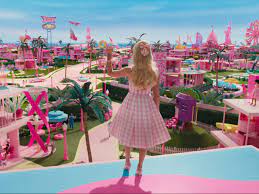
One of the standout aspects of Barbie is its brand of humor. Right from the get-go, the movie makes it obvious that it is not directed at a child audience; rather, it’s for the adults who grew up with the dolls. The whole movie is permeated with both subtle and explicit adult humor, starting with the Kens talking about “beaching each other off,” and escalating to Barbie discussing her non-existent genitalia with a group of pervs on the street. The opening scenes make a point to show the absurdity of human actors in a life-sized manufactured world: there’s no water in the shower or the ocean, the cars are too small, the food is made of plastic. All the Barbies have upturned heels, and flat feet are an object of derision and disgust. Almost none of the world feels believable, but it isn’t supposed to be; it’s all plastic. In writing and screenwriting, there exists this concept called “suspension of disbelief,” which is essentially the audience’s capacity to pretend that the events of the story are really happening. The human mind craves patterns and consistency, and suspension of disbelief is anchored in the mechanics of the pretend world mimicking life and making relative sense. Barbieland does not make sense—and it’s better off for it. The lack of suspension of disbelief contributes to the humor by forcing the audience to continue to think about Barbie as a product and a doll, even when she leaves that mold and ventures into the human world; the awareness also serves as a setup for a lot of the jokes laced throughout the movie. Some of it feels kind of clunky—the “beach you off” scene felt kind of overdone to me, for example—but more jokes landed than not. Even so, the clunky bits felt more campy – in other words, bad enough to be good — than anything else, which worked with the mood the movie was going for. There wasn’t a single moment that I wasn’t having a good time (except for when I lost my wallet in the theater, but I can’t find a way to blame Barbie for that). The movie takes itself just seriously enough to deliver perfectly, and I’ll never get over how perfect Ryan Gosling was as Ken — from his first scene, you can tell he’s having fun with the role. The humor is one of Barbie’s biggest selling points for a good reason, and even my painfully unfunny self got a kick out of most of it.
The acting in Barbie is another standout point of the movie, although it’s a point on which I have mixed feelings. I’ll start off by saying that Margot Robbie and Ryan Gosling were as close as possible to perfect in their respective roles. Ken is undoubtedly the funniest part of the movie, and Margot Robbie’s portrayal of Barbie’s existential crisis was completely unexpected, but brilliant nonetheless. On the other hand, though, America Ferraro’s character and the daughter really didn’t work for me, and a lot of their delivery feels off. I can’t pinpoint why, but all of their lines were delivered really weirdly, and by the time I was at Ferraro’s speech about the contradictory expectations of womanhood, my suspension of disbelief was completely broken (and not in the deliberate way that Barbieland was trying to deliver). I was disappointed that the most surface level points of feminism were delivered as this revolutionary revelation, and her tone of voice during the speech reminded me too much of a cartoon character, or rather somebody reading off a script. This is one of the only bits where I feel like the movie wasn’t as self aware as it could have been. Honestly, since the two most important characters were written and portrayed as well as they were, I suppose I have little grounds to complain about the side characters.
Despite some of its visible flaws in the delivery, the story is one of Barbie’s strongest points, and genuinely surprised me with how well it was executed. Being somewhat of a commercial for Barbie toys, I expected it to be a sort of girl-power, very basic feminist movie. While it delivered that premise on the surface, the way it portrayed the premise was much more creative than I expected. Barbie’s entanglement with the patriarchy was to be expected, but whose idea was it to have Ken teach all the other Kens what the patriarchy is, and to have them engage in a singing battle of all things? Barbie’s existential crisis and the movie’s meditation on the human condition were a very pleasant surprise, and in my opinion, the aspect of the film that elevated it. Some aspects didn’t work for me — I thought the resolution of the mother-daughter relationship problems was poorly done, and kind of dropped in favor of focusing on Barbie’s conflicts, and the first half of the movie prioritized being funny and self aware over story development. However, the second half of the movie and the ending absolutely justify the first half, and the flawed side characters pale in comparison to the characters who are done well, which are most of them.
The other half of the story is the theme, which is roughly the same as the rest of the story; slightly flawed, but mostly very impressive. The implicit themes of this movie are portrayed much better than some of the explicit themes; for example, Barbie touches on the ways that men suffer under the patriarchy, which is almost never discussed in feminist conversation. However the explicit discussion about the contradictions of womanhood falls flat. The existential pondering about death, aging, and what we are made for are wonderfully executed, but the real-world feminist issues aren’t tackled to the fullest extent. I think a part of this is the limits of the medium — screenwriters can only have so much happen in that hour and a half window (unless you’re Chris Nolan) and the Barbie movie tries to juggle it all. It’s only natural that some aspects thrive while others fall flat. It’s the implicit themes that really elevate this movie, and thankfully, those are executed very well.
Overall, Barbie was a fantastic experience. It delivers great humor, engaging characters, and unexpectedly poignant questions for the audience to consider. Barbie is without a doubt one of the best movies that I’ve seen in a while, and will be a pleasant surprise for anyone that ventures to watch it, target audience or not.
Oppenheimer, on the other hand, left me with much stronger mixed feelings. Walking into the film about the “father of the atomic bomb,” I anticipated that I’d like it a lot — I enjoy history and biopics and the like, and knowing my disconnect from Barbie’s target audience, I thought Oppenheimer would resonate with me much more. In actuality, I feel divided on it. I want to say in advance that some of the criticism I could make about Oppenheimer’s content is unfair given what it is — a modern retelling of recent history. The world of fiction is different from the world of reality and of history in that it’s streamlined to be as interesting and coherent as possible. Characters aren’t people, but rather vehicles for themes, and plots follow a structure to keep the audience engaged. Oppenheimer was a real person, and his life wasn’t meticulously planned for an audience in 2023. To expect the story to be consistently entertaining is impossible without betraying the source material of his life and defeating the entire purpose of the film; in this case, that’s not the writer’s job. What the writer has control over is framing, and in that regard, there’s plenty to praise and criticize for Oppenheimer.
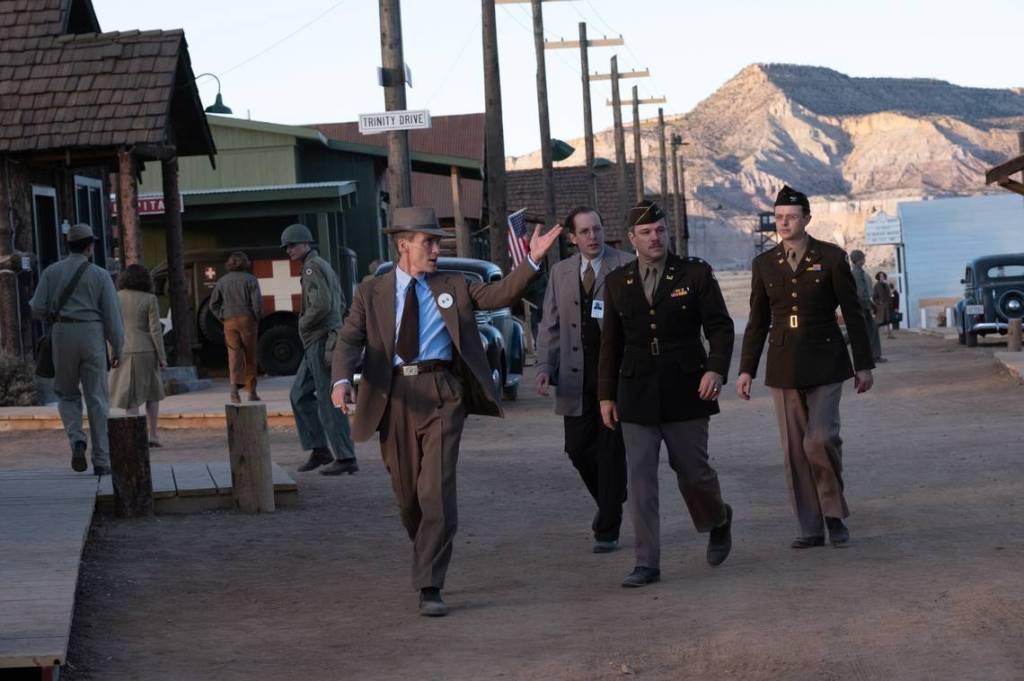
Oppenheimer is just over three hours, and the first and second half of the movie feel like entirely separate films. I’ve never experienced a movie or book that had such a compelling first half and such a lackluster final act. The movie starts out with Oppenheimer’s trial, where he’s charged with having Communist ties in his past. The trial is then used as a framing device for telling the story of his life. The best part of the movie is the dynamic between the past and the present, his actions and the guilt and consequences he faces, all building up to the grand crescendo of the bomb being dropped on Japan. And it’s handled brilliantly: the movement between the past and the present, the growing sense of unease as the plans for the bomb are made, and the brilliant soundtrack and visuals gave the film a constant sense of motion. Even when the content was just men talking in rooms, writing on a chalkboard, making calculations and big science statements far beyond my understanding, everything was infused with this growing sense of tension. The visual design and the soundtrack had a lot to do with this — the music plays for the entirety of the film, except for the abject silence that follows the dropping of the bomb, and scenes of men talking in rooms are often supplemented with visuals from its aftermath; one minute, you’re in the courtroom with Oppenheimer, and in the next, the lawyers are living corpses with their skin flayed off from the radiation. The viewer is allowed to experience the guilt that follows Oppenheimer everywhere he goes, and the dynamic between the past and present really enhances the film. It’s after this dynamic is dropped that I start to have issues with the film.
The last hour and a half of Oppenheimer are entirely dedicated to his trial, and very quickly, everything that made the movie engaging tapers off. The historical biopic becomes a legal drama; the movie about the man who made the atomic bomb becomes a movie about men talking in rooms. The soundtrack, which used to feel impactful, feels like it’s trying to give tension to something lifeless. The many facets of Oppenheimer’s character that the first half of the movie explores so carefully are erased in favor of playing up his guilt. It’s tedious, and lasts for 90 minutes. It didn’t take long for me to lose the thread and any interest I had. The only two reasons I chose not to leave the theater were because I was writing this review and I had spent $17 on the ticket. I was extremely disappointed in the loss of momentum, needless to say, and it sours my impression of the rest of the film. Oppenheimer was a waste of potential.
Despite this, I think “Barbenheimer” was a fun experience overall, and one I would recommend to just about everyone. For anyone who missed the trend, honestly just streamline the experience and watch Barbie; maybe get dressed up in pink and huddle around the TV with a group of friends. I never thought I’d be saying that Barbie is better than Oppenheimer, but here I am typing it. Actual movies aside, it’s nice to be able to go to the theater again and make new experiences with friends. Hopefully, the film industry will see that people respond well to good movies rather than soulless cash grabs, and we the viewers can continue to have more “Barbenheimer” summers in the future.


Great job, Leah. I was also pleasantly surprised by Barbie’s humor and depth. I enjoyed Oppenheimer, especially Cillian Murphy as the lead, and it spurred me to read more about the stuff the movie left out, like the people local to Los Alamos who were forced from their land for the tests or who stayed and got sick after. So many angles to this piece of history
LikeLike
This is very well-written. I also really enjoyed Barbie and surprised with the meanings it contained behind.
LikeLike
This is very well-written. I also really enjoyed Barbie and surprised with the meanings it has behind.
LikeLike