
By Emma Pilsmaker, ’30
Staff Writer
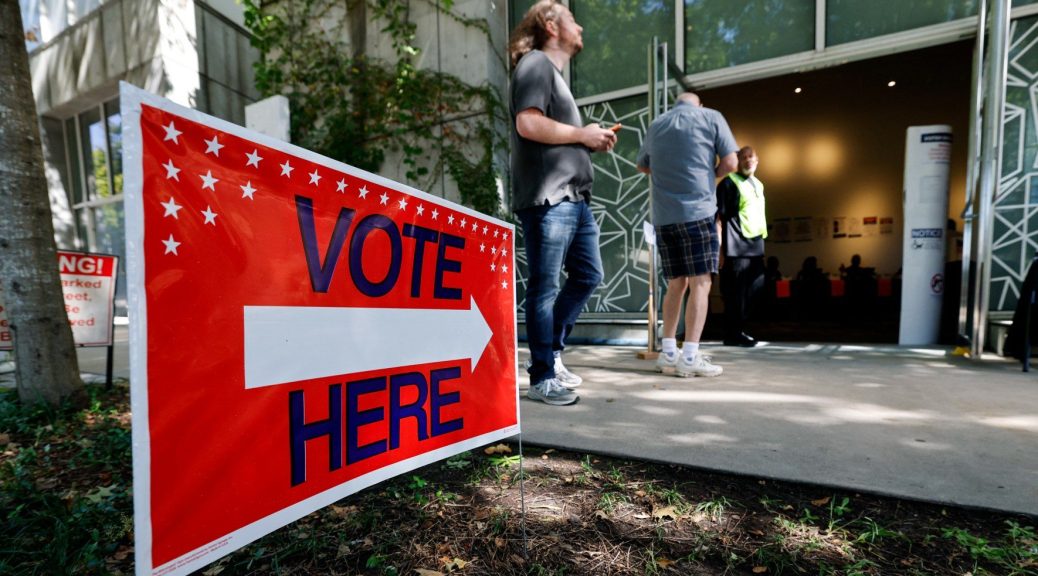
As the country approaches midterm elections Nov. 3, you may be wondering what will happen and what will our government look like after. In the midterm elections, people vote mainly for local positions, state governors and the U.S. Congress. It falls at the halfway point between the four-year General Elections, when the nation votes for president. The U.S. congress is the legislative branch of our government, made up of 435 members of the House of Representatives and 100 members of the Senate. Congress provides checks and balances on the executive branch, which is the president and vice president. The midterm elections are very important because they can create a dramatic change in which party has the most power in the government. Currently, the Republican party holds the office of president as well as a majority in Congress, which means it controls what laws and policies are created.
House of Representatives
In every state, the map is split into districts based on population, and each district has one representative in the House of Representatives. The House of Representatives helps the Senate and the executive branch pass laws. Massachusetts has nine districts and the representatives are Richard E. Neal (1st district), James P. McGovern (2nd district), Lori Trahan (3rd district), Jake Auchincloss (4th district), Katherine M. Clark (5th district), Dan Koh (6th district), Ayanna Pressley (7th district), Stephen F. Lynch (8th district), and William R. Keating (9th district). All are Democrats, and all won their primaries and are favored to win in the midterms against Republican candidates.
The Senate
With two per state, there are 100 Senators who each serves a six-year term. Their job is to vote and write federal laws as well as confirm judges and cabinet members, ratify treaties, and hold trials for impeachment. Democratic Senator Elizabeth Warren, 77, was re-elected in November 2024 and will serve until Jan. 1, 2031. She has held the position since 2013, focusing on economic opportunity, social safety nets and consumer protection. That leaves one seat in contention in the upcoming midterms, with the winner serving until Nov. 3, 2033. Running for it are Democrat Ed Markey and Republican John Deaton.
Markey, 80, is from Malden, Mass. He attended Boston College law school and got his Juris Doctor degree in 1974. He has served 37 years in the House of Representatives 13 in the Senate. Markey currently serves on the Committee of Small Business and Entrepreneurship, the Committee of Commerce, Science and Transportation, the Committee of Environment and Public Works, and the Committee of Health, Education Labor and Pensions.
John Deaton, 59, is from Highland Park, Michigan. He graduated Highland Park High school after previously dropping out. He earned his bachelors degree from Eastern Michigan University and then went on to New England School of Law for his Juris Doctor degree. He has not previously been in the House of Representatives or Senate, but he served in the Marine Corps. He has worked as an attorney and a cryptocurrency advocate.
State Ballot Questions
There are nine questions on the midterm election ballot, which allow Massachusetts citizens to vote directly on laws. The questions seen on the ballot are chosen through citizen-led petitions. Each voter’s household gets a Red Book mailed to them with the information on each question along with differing arguments.
Question 1 is whether the governor’s office and legislators should be subject to the public records law. Since 2026, books, papers, financial statements, and other documents held by government agencies are considered public records and required to be available to any citizen or organization that requests them. But documents held by the state legislature and the governor’s office are exempt from the law. A yes on the ballot would mean more state officials would have to share most of their records, and a no would mean they keep the current exemption. Question 2 is whether the Committee for Public Counsel Services, an organization of public defenders in the state, should have the right to form a union. A yes would mean they can unionize, and a no would mean they can’t. The 3rd question proposes the idea that instead of separate party primaries, all candidates would run together, and the top two candidates would advance regardless of their parties. A yes to this question would be to switch to the top two system, and a no would be to keep our current system.
Question 4 proposes that voters in the election have the ability to register to vote on Election Day. A yes would allow citizens to register on the same day as voting, and a no would keep the advance deadline date. The 5th question on the ballot would change the formula on how the state calculates the limit on tax revenue. Under current law, the state puts excess tax revenue – money not immediately needed in the budget – into a “rainy day” fund for future shortfalls in health care, education or other state budgets. This proposal would limit state revenue in a given year to amount from the year before, with small increases for the average growth of wages and salaries in Massachusetts over the most recent three years. If revenue collected by the state in a given year exceeds the limit, the excess amount would be refunded to taxpayers the following year.
Question 6 would allow the state to use 50 percent of existing sales tax from sporting goods, RVs and golf for the conservation of nature. A yes would mean the government should create such a budget, and a no would mean they shouldn’t. Question 7 would allow singly family homes to be built on lot as small as 5,000 square feet. A yes would allow smaller lots but a no would mean the government should keep the current lot sizes. Question 8 would prohibit the sale of recreational use marijuana. A yes would end the recreational sale of marijuana but keep medical marijuana legal. A no would keep the current law, passed in 2016, to allow recreational marijuana sales.
Question 9 is a referendum on existing firearms laws. The referendum would be whether changes created in October 2024 should remain. The changes include electronic gun registration databases, a ban on assault style weapons, live-fire training requirements in order to get a license, the prohibition of ghost guns, and a requirement for serial numbers for guns. A yes to this referendum would keep the additions and a no would repeal the law.
Why Students Should Care
Even though the midterm elections may not seem as big as presidential elections, they are still important for schools and students around the country. Some high school students will cast their first votes in the midterms, while others will be able to vote in a few years. But regardless, it will be important to know what decisions are made by elected officials. Congress makes policies on school funding, which could be impacted by Ballot Question 5. Question 7 will affect the affordability of starter homes for young adults who get jobs right out of high school. The outcome of Question 6 will impact the futures of our environment, possibly providing more money for clean water and nature preservation for future generations to enjoy. Ultimately, the midterm elections let the ordinary citizens, not just politicians, decide on what laws and rights we have, which is vital in our democracy.

