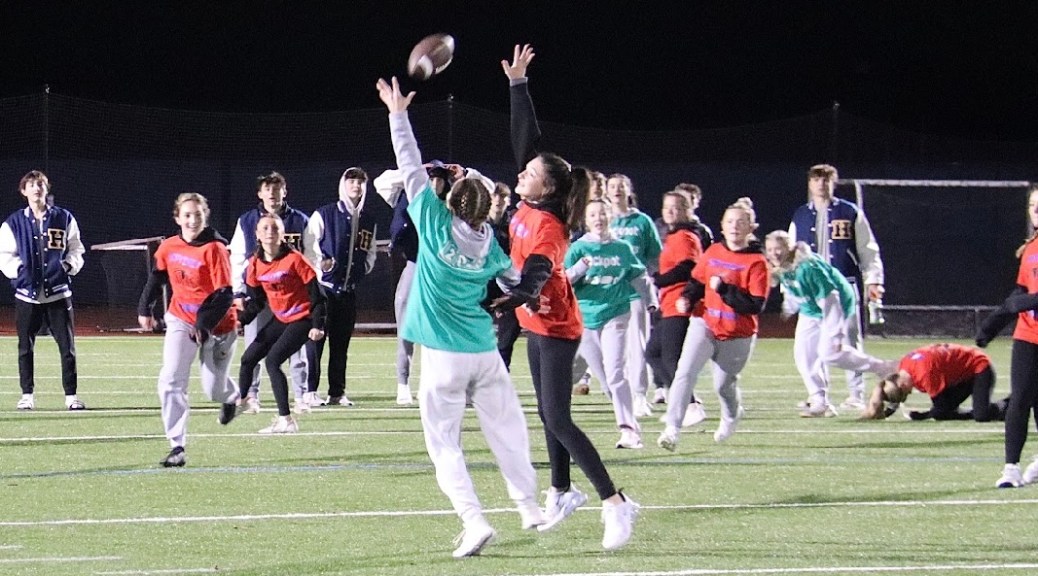
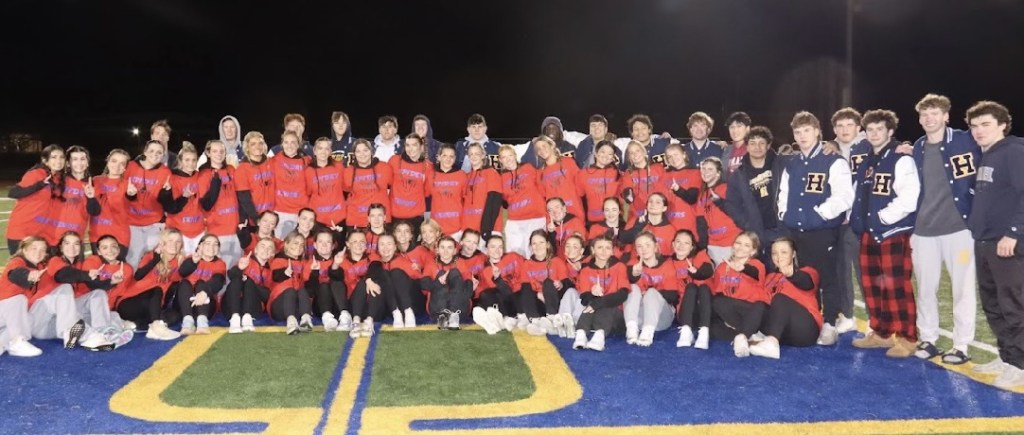
The Powder Puff is a longstanding school tradition where Junior and Senior girls have the opportunity to face one another in a football game, coached by members of the varsity football team. This year’s contest between the “Spidey Seniors” and “Jackpot Juniors” took place near Thanksgiving and was very competitive. It’s become precedent that the Seniors dominate and win every year. However, the Juniors posed a potential threat to this legacy.
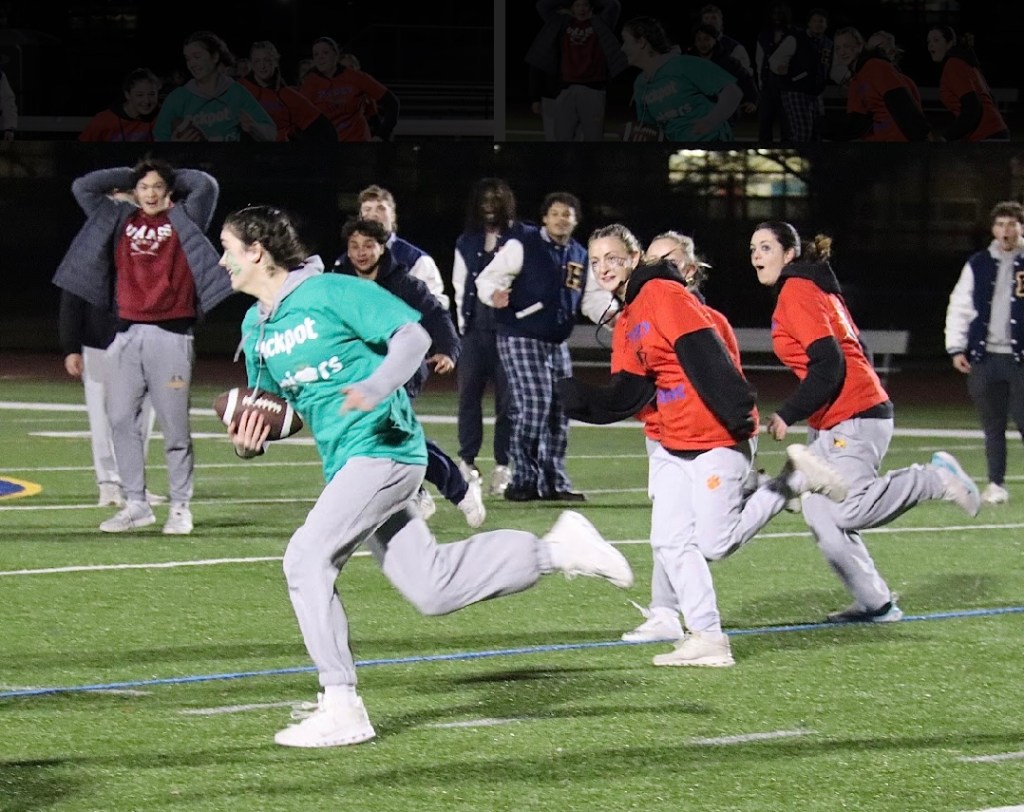
Tess Madden scores for the Juniors.
Tess Madden put the Juniors on the scoreboard first with a touchdown. The Seniors’ shocked expressions made it clear that they had expected the traditional easy victory and were caught off guard. But the Spidey Seniors quickly regained their composure, responding with two touchdowns of their own. The Class of 2025 gained the lead and shifted the momentum in their favor.
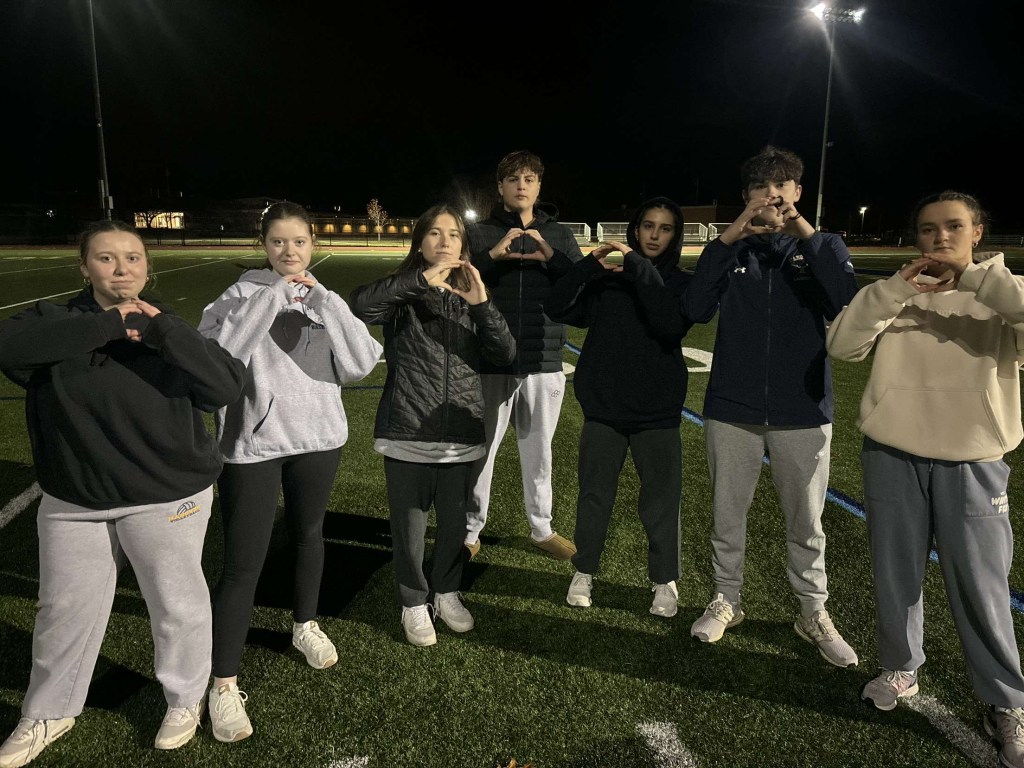
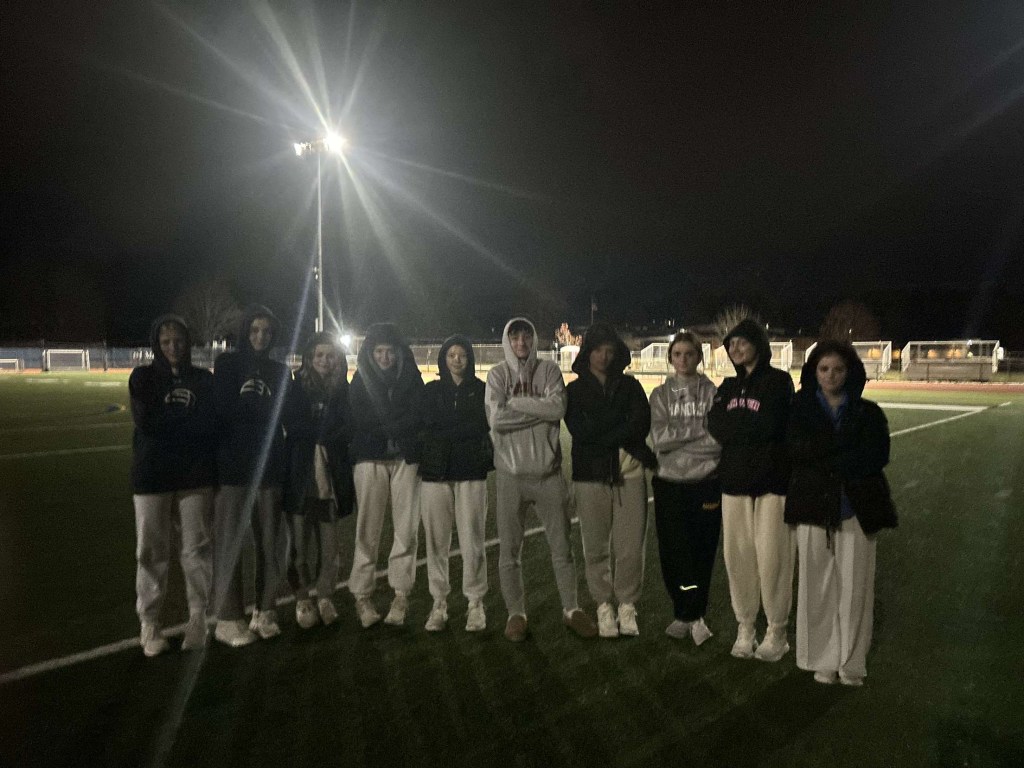
This intense rivalry between the teams was evident by the loud, energetic atmosphere. It was a tight game with lots of calls from the referees which the Seniors were able to capitalize on. Despite not having any formal practice or preparation leading up to the game, the Spidey Seniors were able to turn situations to their advantage. In contrast, the Juniors took a more strategic approach, holding a practice the night before the game. During this practice the Jackpot Juniors created their foundation of plays, lineups, and, most importantly, teamwork. However, the lack of preparation on the Seniors’ part didn’t seem to hinder their performance. When asked if the Juniors should have won, Finley Nadeau, a Class of 2026 running back, simply replied, “Yes,” highlighting the value of her class’s preparation and teamwork.
The Junior O-Line prepares at practice.
The Juniors wide receiver line poses at practice.
Ultimately, the Seniors won the game but the Juniors put up a strong fight. Powder Puff’s meaning extends beyond the final score—it’s an opportunity to strengthen the sense of community within each class. For many, like Hope Miller, a Junior wide receiver, the experience was just as much about the friendships as the competition. She shared that she was “looking forward to playing with her friends,” highlighting the spirit of unity. Powderpuff is a unique experience to branch outside of your circle and make friends within your class.
Spidey Seniors – Class of 2025
Jackpot Juniors – Class of 2026
Check out a photo album and video taken for HPS by Mrs. Monahan:
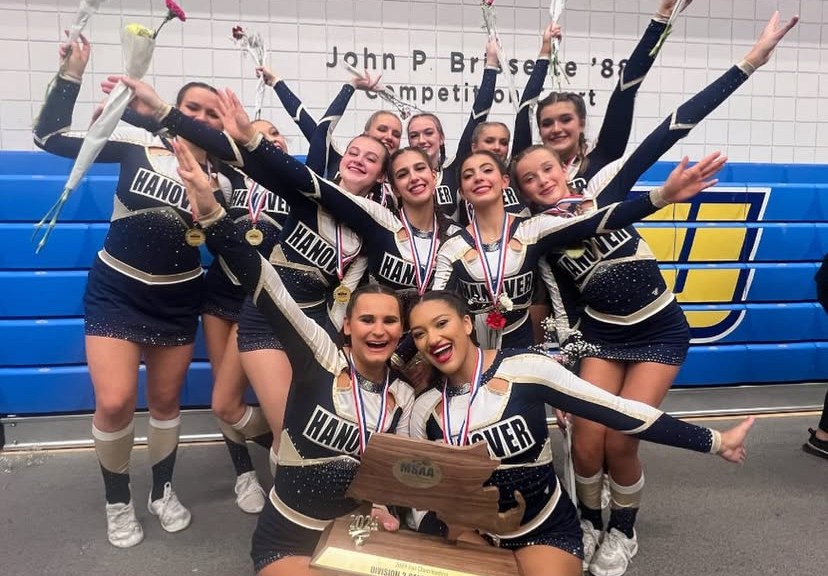
The Hanover High School Competition Cheer team won first place in the MSAA Division 3 State Championship on Nov. 24, the first state title for the team in school history. Their score of 94.7 was 1.5 points higher than the second place finisher and the highest score HHS Cheer has ever received.
En route to the state title, the squad was named Patriot League Champions and event Grand Champions on Nov. 6. They continued their winning streak at the 2024 MSAA South Regional Championship, surpassing their recent scoring record to win that crown as well.
Senior captains Izzy Latessa and Lily Chiappini both agreed that this year was a dream come true. The success of the team comes from more than just an excellent routine; as Chiappini stated, it comes from, “the strong bonds we built and the heart and soul we put into everything we did.”
“Winning states has shown us,” Chiappini added, “that when we believe in each other and want it, we can win it!”
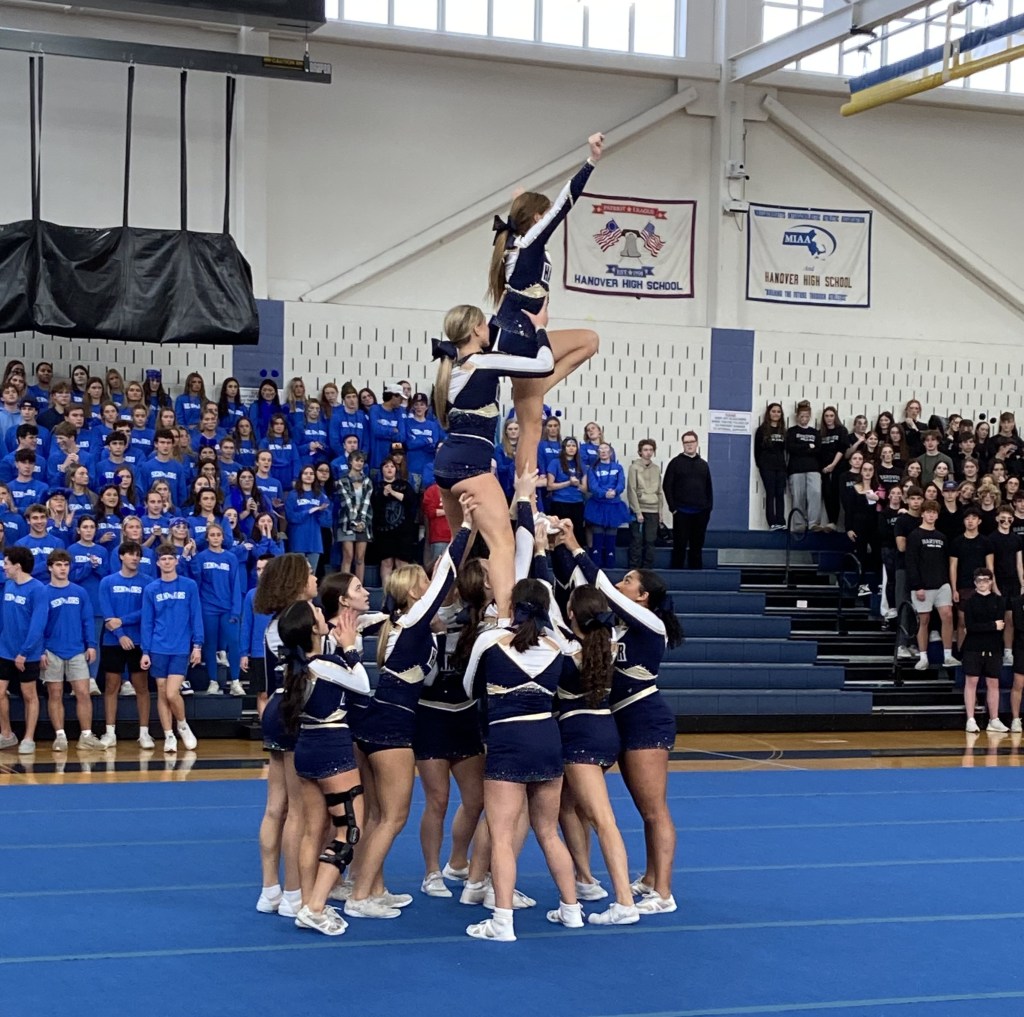
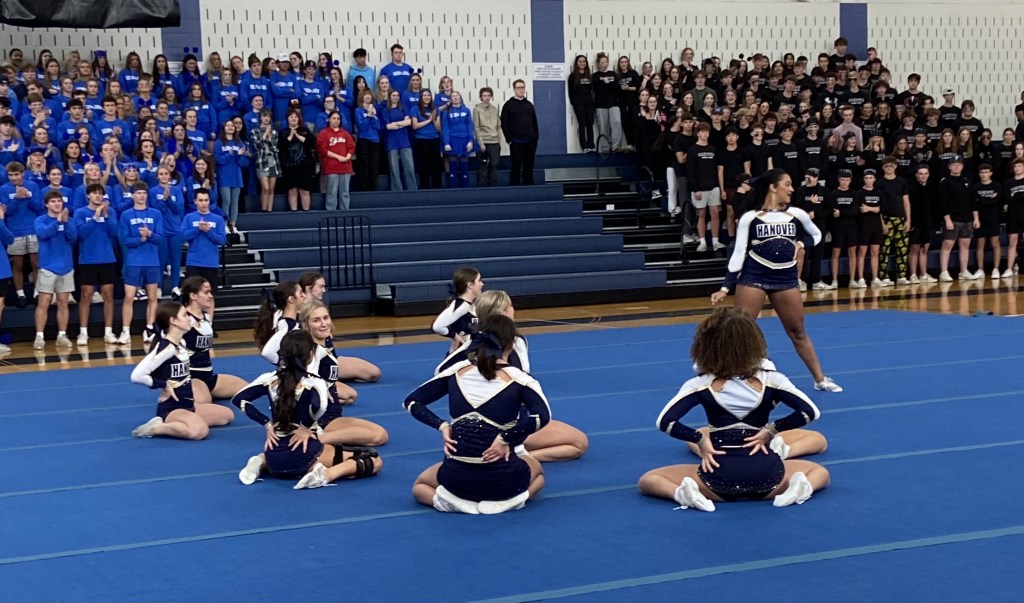
The squad performs during the Homecoming Week pep rally in October.
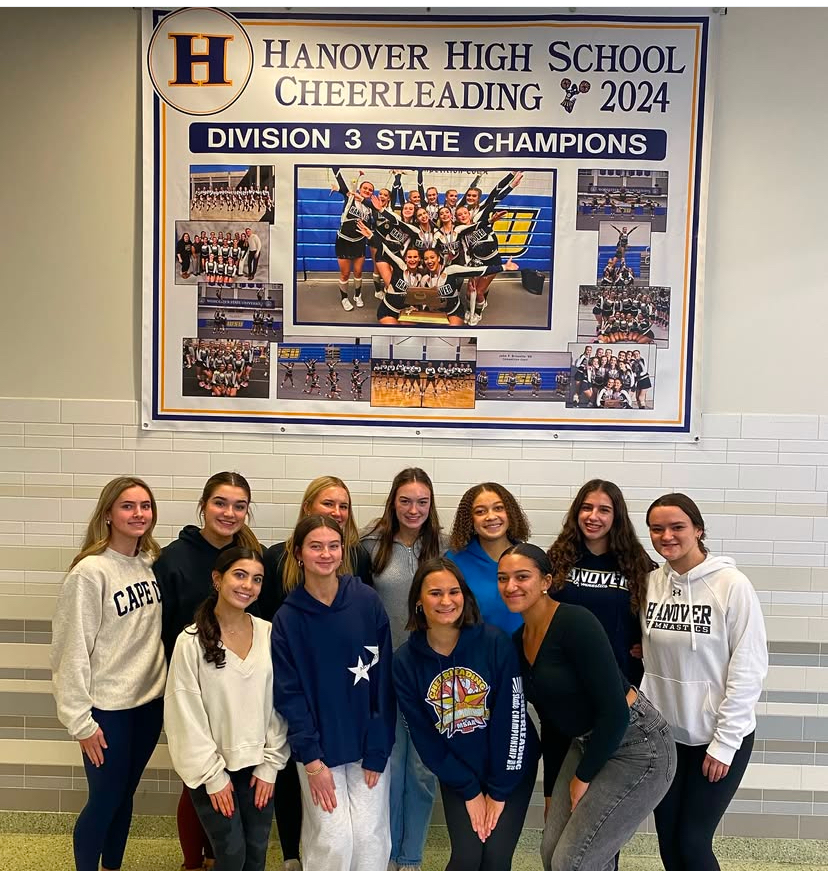
The Competition Cheer team poses in front of the new state title banner in the HHS cafeteria.
“Education isn’t just about feeding the brain. Art and music feed the heart and soul.” ~ Julie Garwood
Art and music surround us, bringing humanity to our computed, monotonous lives. They allow free expression, enjoyable experiences, and even a future career for many. Here in Hanover, we strive to create a place where students can find companionship, acceptance, and invaluable skills. However, with the overwhelming town budget struggles forcing cuts to art and music this year – and threatening more for next year – the voice of our community needs to be louder than ever. To better understand the importance of art and music curricula, I interviewed several educators and students.
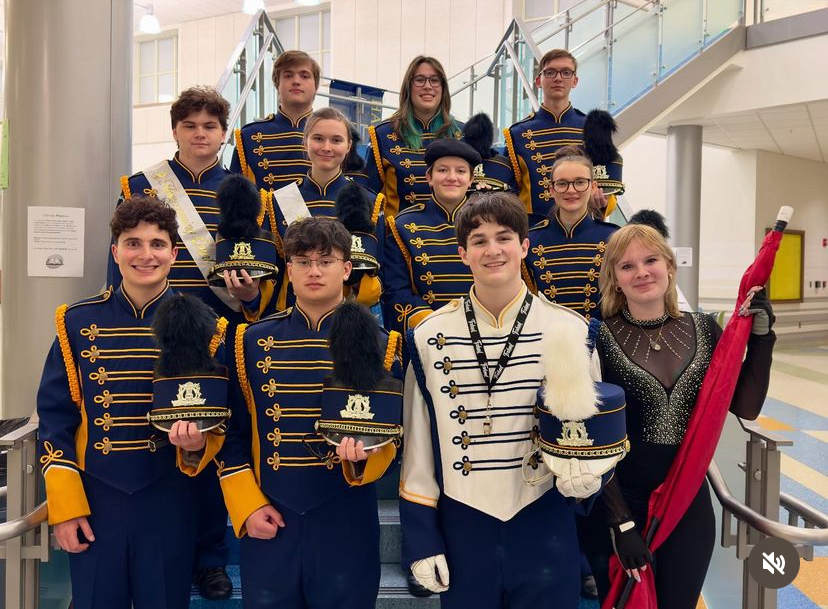
“The arts programs here at Hanover are the most important parts of our public schools,” said Dante Heffron, senior drum major of The Pride of Hanover Marching Band. “These programs provide a sense of belonging for students and also provide a place for students to explore their skills or learn new ones.”
Even if they may not excel in other subjects, many students find their strength and community through the arts. Everybody is different and distinctively skilled, but a group that works together and embraces these differences is what many students need to succeed both in school and in life. Just as Hanover High School band director and music teacher Matthew Harden explained, “Not every young person is an athlete or scholar in the traditional sense; however, music and art speak the language of emotion, connection, and community.” Providing students with a place where they can express themselves on a level that surpasses standardized academics is essential within any school system.
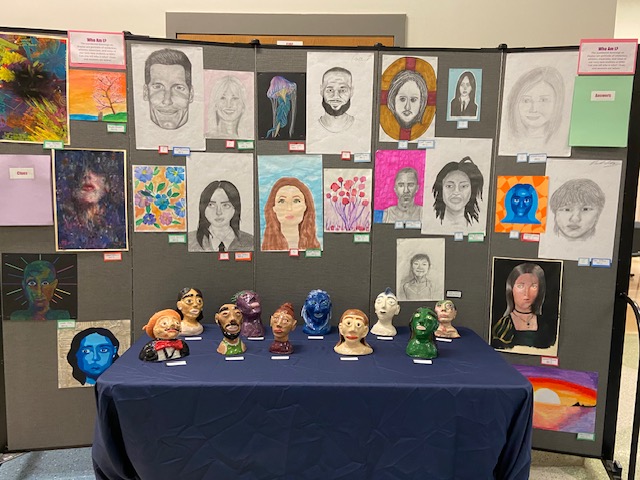
Work created by HHS students in 2D and 3D art courses
The arts are also significant because of their ability to foster community and friendship within educational environments. Many students meet their lifelong friends in school, especially in programs like music and art, which are close-knit and inclusive. “People you meet in your band or in your section of AP Art tend to be people who you become so connected to,” said Sadie Hofford, chorus and music educator. “In VOX and Chorus, I watch students help and support each other every single day in big and small ways.”
Art and music programs are also important because individuals involved in the arts work hard to make sure that people of all races, genders, and backgrounds are welcome and feel welcome. “Art transcends racial, socio-economic, cultural, and political boundaries while also calling upon each artist to reflect on their audience’s backgrounds and interpretation,” commented Mr. Harden, describing the diversity within the arts programs. It is crucial that students feel connection and belonging during their years in school because it helps to stimulate positive social skills and provides relationships that will prove useful in their years after graduating.
Another reason why the arts programs are indispensable in our schools is because of the advancing technology and increasing use of AI in our ever-changing world. “In a world of instant gratification and artificial intelligence, the arts foster long-term investment and dedication,” said Mr. Harden. “The arts challenge us to see the humanity in each other—to find empathy and cohesion amidst apathy and divisiveness.” Because of the influx of artificial intelligence within education systems, people are finding easy ways to complete assignments and pass their classes. However, the arts are some of the few programs where students cannot cheat. They require perseverance, humanity, and diligence. A robot cannot play a song or create a painting that has feelings and meaning behind it; only people can do that.
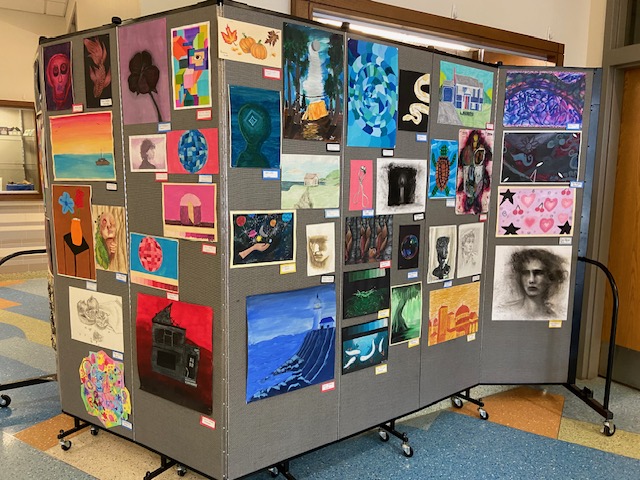
Work created by students in 2D art classes.
Just as technology evolves, our society evolves, oftentimes causing disharmony and even leading to periods when the people controlling the technology thrive while those under them face tribulation. The art community currently is facing immense adversity with the use of AI, stealing from artists, and creating “art” by data-scraping the Internet in order to provide entertainment that can be shared across social media. As Maria-Rita Silva, a sophomore at HHS, said: “In a world where capitalism, materialism, overconsumption, and the lack of creativity have captivated so many lives, we cannot let the arts die, and to deprive Hanover High School of the arts will take away the opportunity to engage in such a beautiful thing from thousands of current and future students.” By cutting or eliminating the arts, one takes away humanity and pure expression, which is far beyond the understanding of computers.
Many may argue that the arts are complicated, time-consuming, and unnecessary, especially during the early years of education. However, they fail to understand that art is humanity’s way of creating a legacy, of solidifying their presence far into the uncertainty that is our future. “It is not suprising to me that at every level we educate our students with visuals, from counting apples in kindergarten to drawing complex organic systems in anatomy. We are, after all, a sight-centered species,” said HHS art teacher Mr. File. “Ever since we began to coalesce into societies, whether in caves or early towns and cities, humans have been trying to create visual evidence they existed. The historical version of ‘File was here’ echoed throughout human existence.”
The arts have always resulted from mankind, starting from the very moment we evolved into what we are. When you observe art such as cave drawings, Beethoven’s symphonies, or Van Gogh’s paintings, one fact remains true: it doesn’t matter what one has, it matters what one gives, and the arts are gifts that influence our society forever. Teaching this in our schools strengthens the interest in and appreciation of art and all that results from it.
As Mr. Harden said, “A comprehensive and sequential education in the arts is essential for a myriad of reasons.” Art provides students with an expressive environment, a diverse community, and unfathomable knowledge of humanity and emotion. To take away the opportunity of participating in such an influential phenomenon from those in any level of education is to take away the individualism and soulfulness that society could use more of.
On the morning of September 3rd, the sun rose to greet the residents in the town of Hanover. Autumn signaled its approach, as leaves danced in the air, swishing and sliding as they fell to the ground. The turning of the leaf, the changing of the season, symbolized a new beginning for everyone, but especially for those who attend Hanover High School. With the failure of a funding initiative in May, students woke to the blaring of their alarm clocks and the bright light of a new day, along with the realization that their lives have changed for the rest of their high school careers.
Flashback to early May, when there’s a high chance you heard about a potential vote that would determine the “fate of Hanover.” Rumor of the vote spread like wildfire throughout the town, and some students were confused by or unaware of the reason for the vote. On the evenings of May 5 and 6, hundreds of citizens of Hanover gathered in the high school auditorium to voice their opinions about the town budget proposed for the subsequent year. The town was asking for about $6 million in additional funding for multiple departments, according to the town website. If approved, taxes would be raised, costing the average homeowner about $1400 a year.
Residents had to decide whether they would put this proposal to a town-wide vote in a special election. Those in attendance voted in favor of a special election May 18. But on that day, residents worried about higher taxes and rising costs voted by a large margin to reject the tax increase. Town departments were forced to reduce their budgets, cutting down on many programs and job positions.
This would be felt most harshly in the schools, which had asked for about $2.7 million of the additional funds. The school department is responsible for helping students become the future leaders of society. A comfortable and safe atmosphere for students is important for the schools of Hanover to uphold the motto of giving all students the chance “to soar and succeed without limits.” But according to information on the Town of Hanover website, the override failure would lead to more than 25 teachers being laid off, classroom sizes increasing by 20 percent, and electives for students being reduced. Opportunities for teaching and career exploration would decrease, supporters of the override feared, while behavior issues would increase.
Now that we are a few months into the school year, the wounds inflicted by the override failure have become more evident at HHS. The void left by the budget cuts looms in the empty classrooms that once were used to teach Hanover students, or classrooms bursting at the seams. According to Steve Henderson, President of the Hanover Teachers Union, there are fewer courses being offered at the high school, and the ones being offered are overcrowded. There is also aging technology that cannot be replaced and field trips and extracurriculars that have been canceled. Seniors, in their last year, no longer have the same class choices and opportunities they have grown to expect, he said, and freshmen coming into school have “an uncertain horizon ahead of them.”
Teachers are unable to spend as much time with students because of larger class sizes and caseloads, and their relationships with students are suffering, Mr. Henderson said. “Teachers are in a very trying position, and will continue to advocate for students.”
The opportunity to collaborate with other students and to create the arts that represent HHS is a gift to many. HHS strives in the arts and thrives when it comes to amazing performances by the chorus, band and drama programs. However, the Fine Arts department has changed because of the override failure. Matt Harden, music teacher and band director, said major impacts from the override include the loss of supplies and programs and the shifting of teachers to courses they have never taught before. The high school also lost its drama teacher, which has greatly impacted the face of the popular Drama program, he said.
“There will be a ripple effect for a long time,” he said. “My goal every day is to limit how much of an impact there is.”
It is necessary to understand the central causes that brought the town to this financial position. According to the town of Hanover website, “similar to many Massachusetts communities, the cost of providing services to the community has outpaced the revenue growth allowed under Proposition 2½ .” This means that the town’s tax revenue – its profits – aren’t keeping up with its expenses. The money in the town’s coffers also has been impacted by the expiration of federal Covid-19 grants and general inflation.
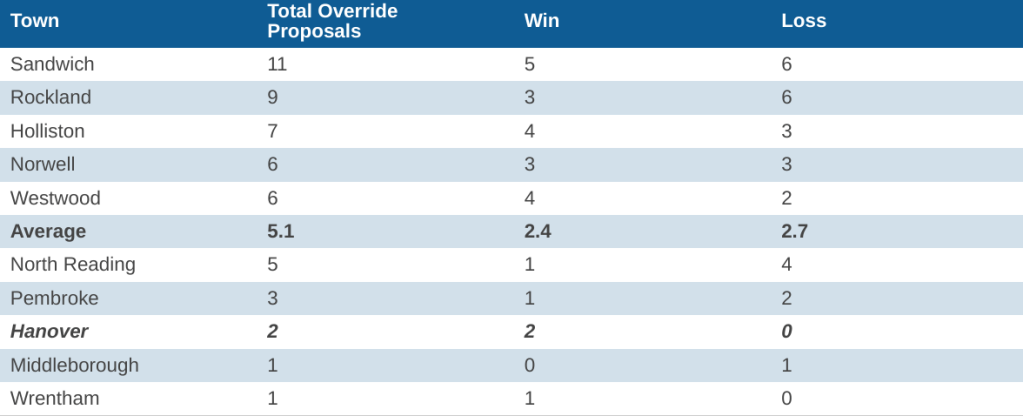
Rising expenses have not only impacted our town, but other comparable towns such as Sandwich, Rockland, Norwell and Westwood. Based upon a Municipal Data Bank, created by the Massachusetts Department of Revenue, towns like ours have asked for an average of 5.1 overrides since 1990 and more requests have failed than succeeded. Sandwich alone has asked for an override 11 times. Hanover has sought two tax overrides since 1990, both of which passed.
Hoping to heal from the wounds being nursed this year, school and town officials are already deep into planning the budget for next year. They are preparing three different budget proposals and pursuing another override vote. The “level funding” school budget would maintain the current level of reduced funding, resulting in more cuts due to rising expenses, according to school officials’ budget presentations. The “level services” budget would include funding to cover those rising expenses to maintain what we have this year. The “restore 24” budget would restore the funding cut last spring, returning many positions and programs that have been reduced.
If only the “level funding” is approved, officials say, bussing, sports, clubs and course offerings at HHS could be even further impacted. The school we know and love, that the community cheers for on the playing field and on stage, could become unrecognizable. “Our identity is defined by the schools,” said Mr. Henderson.
It is a gift that HHS still maintains its core factors, its students and staff. The relationships that students and teachers have built over the years make HHS a welcoming place. It is hard to imagine what will happen if another override fails.
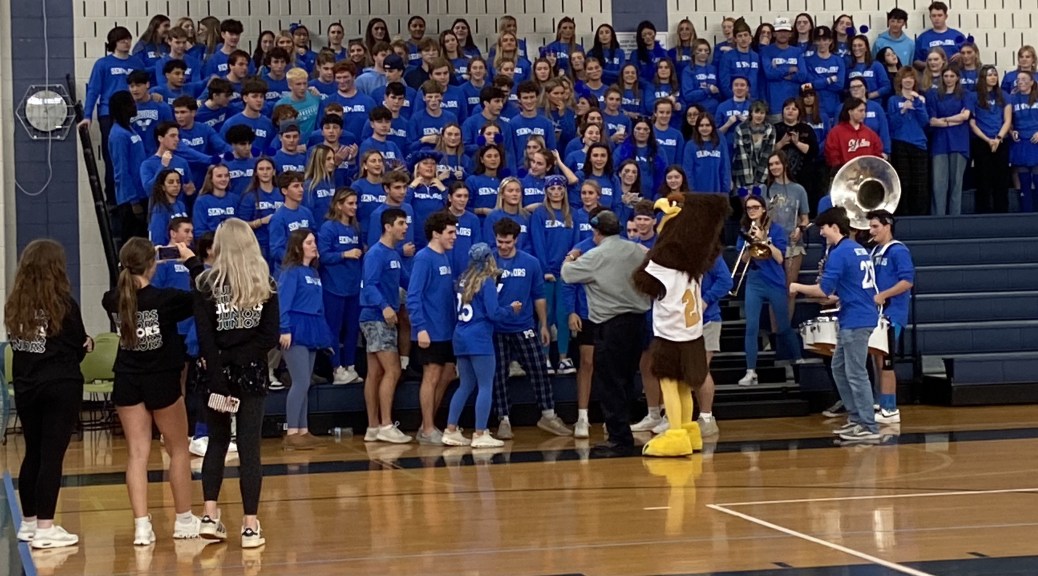
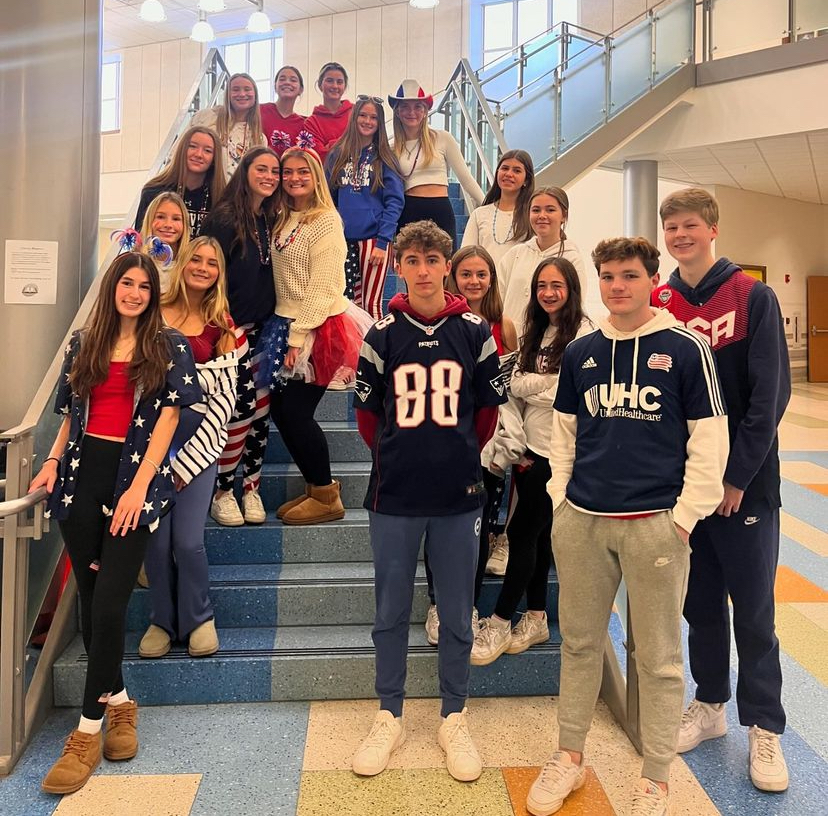
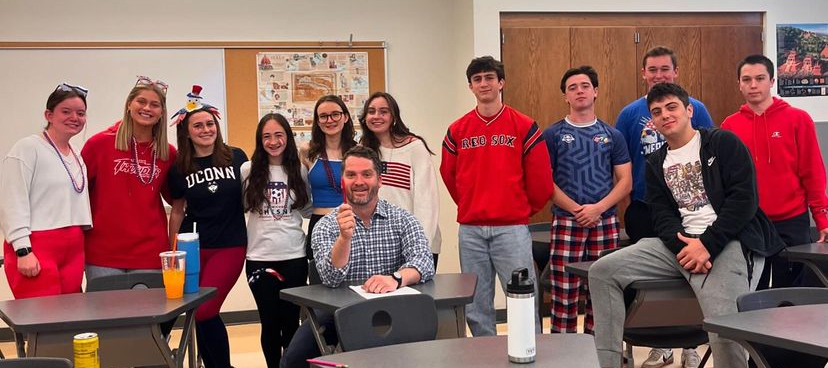
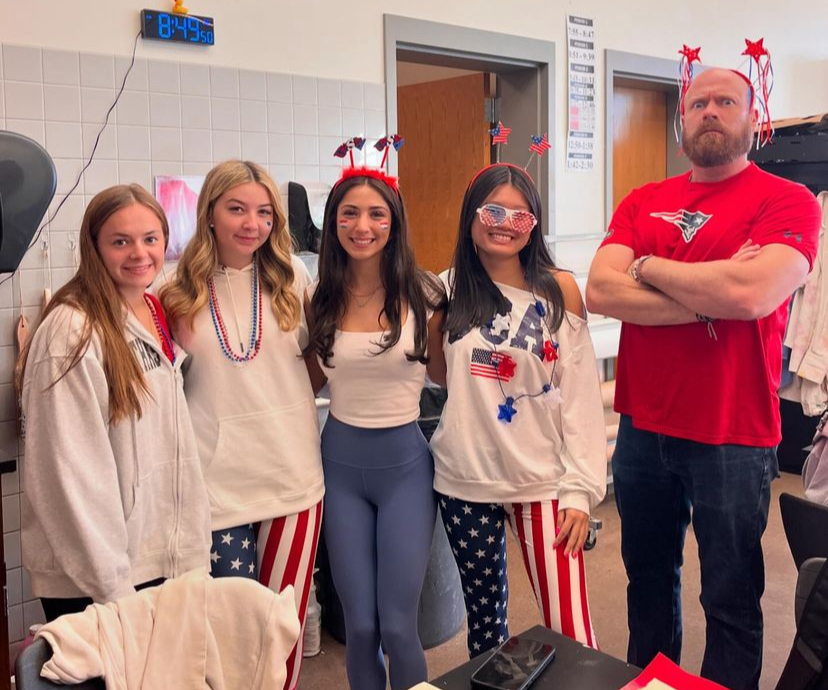
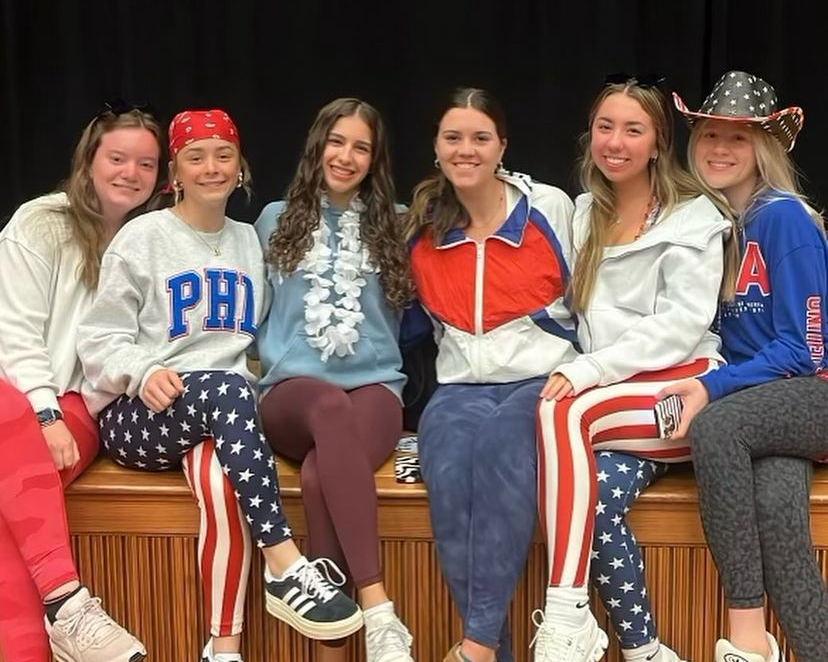
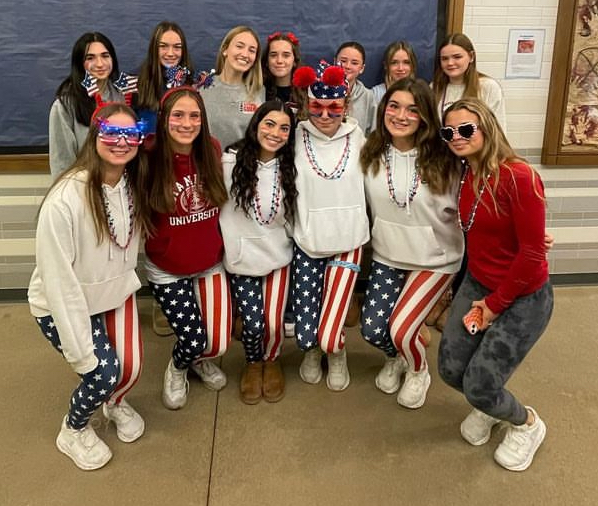
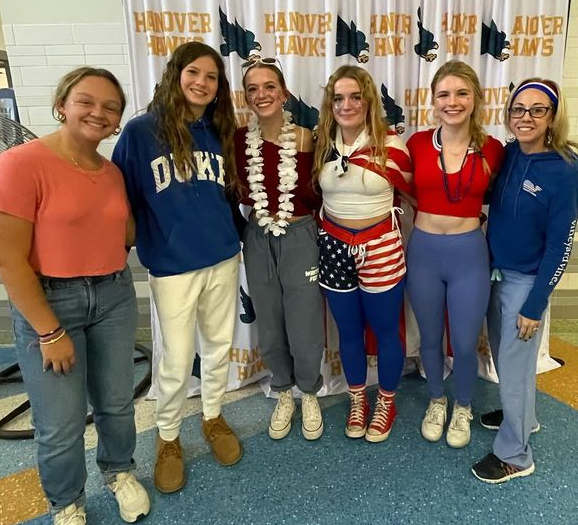
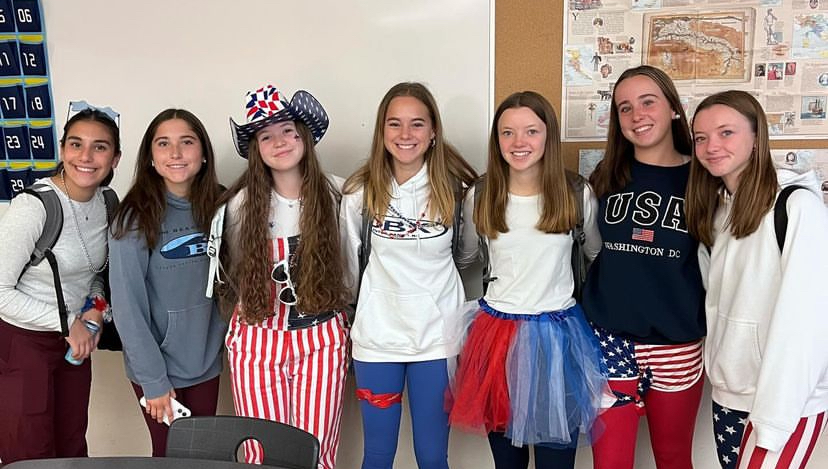
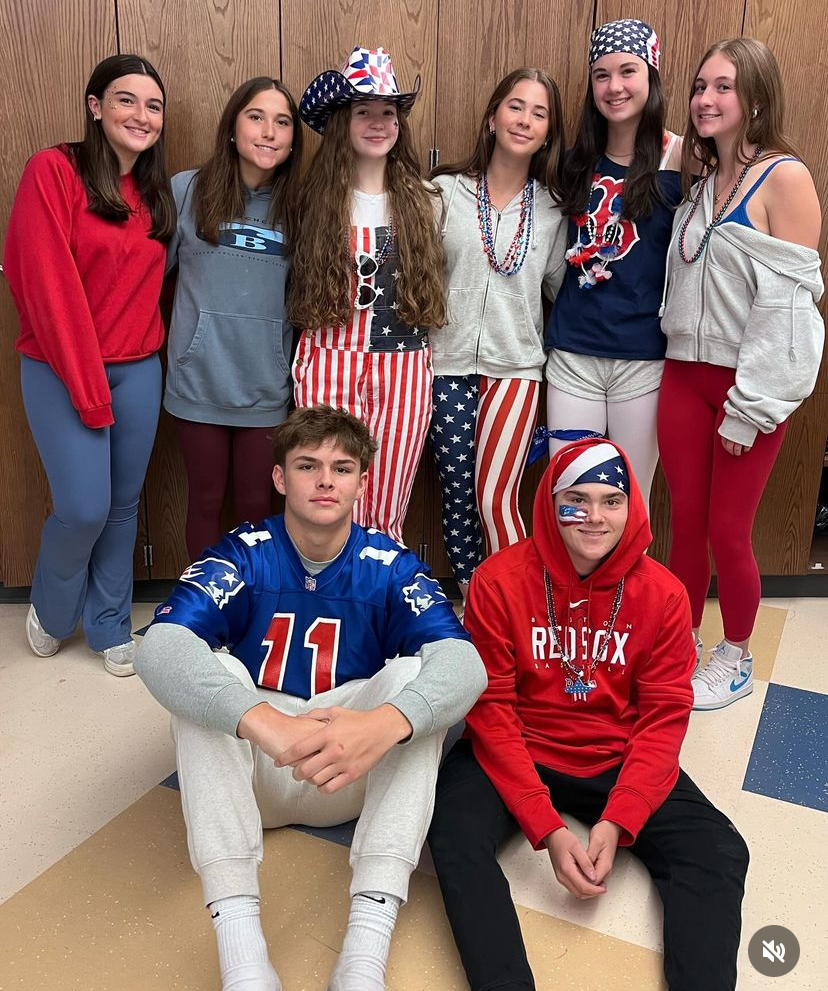
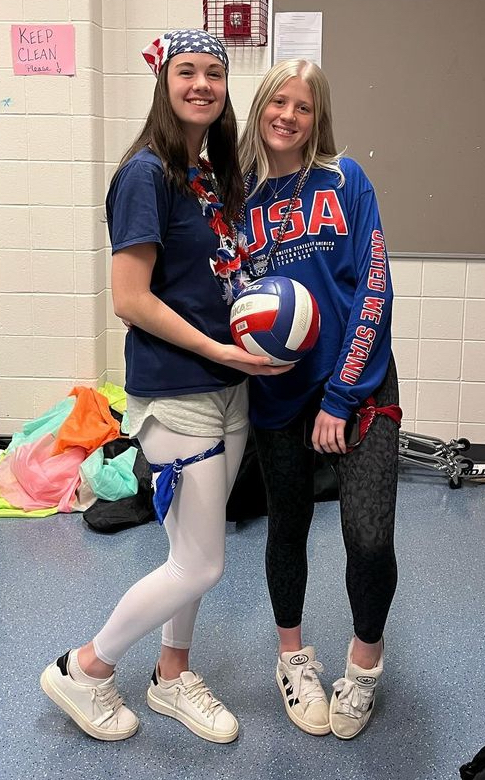
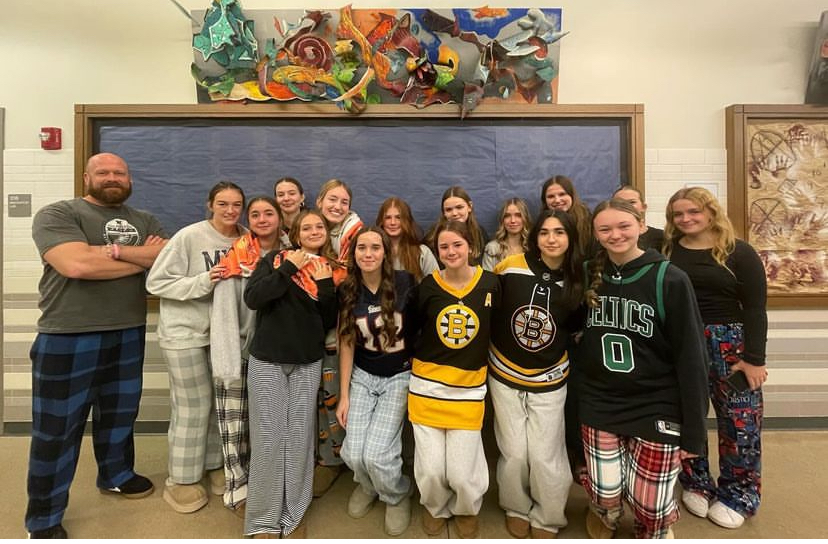
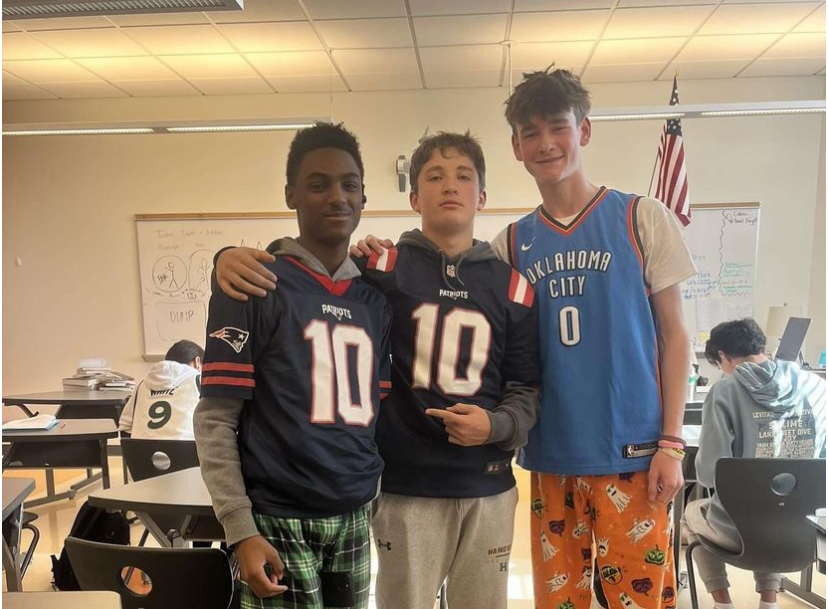
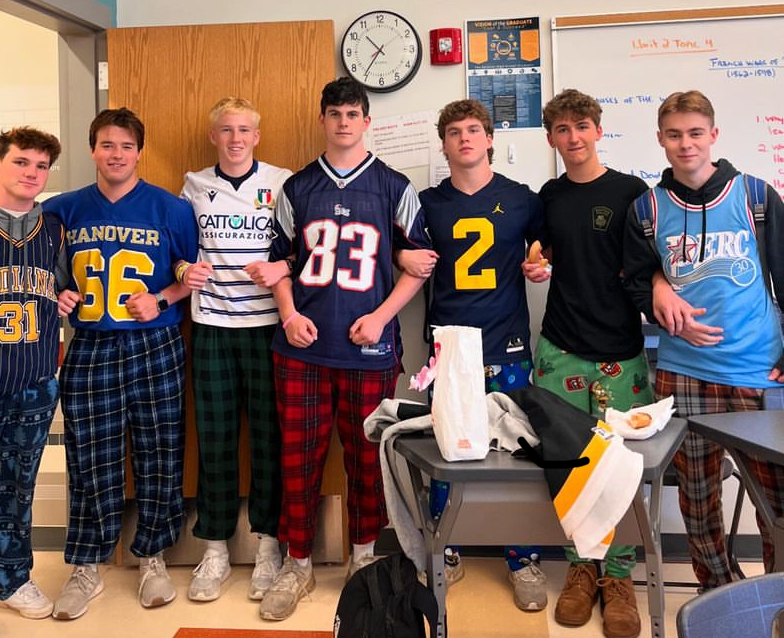
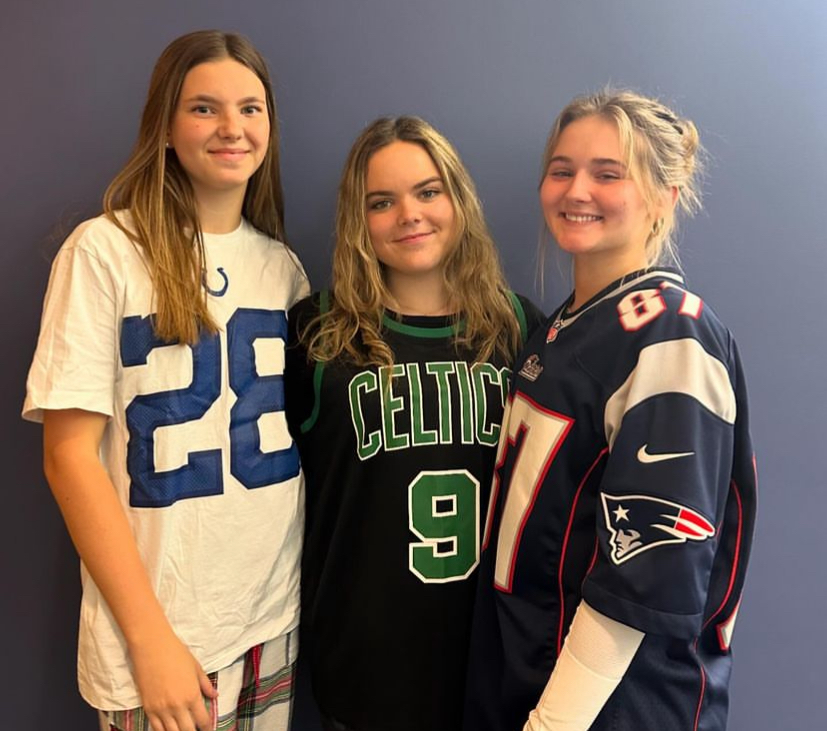
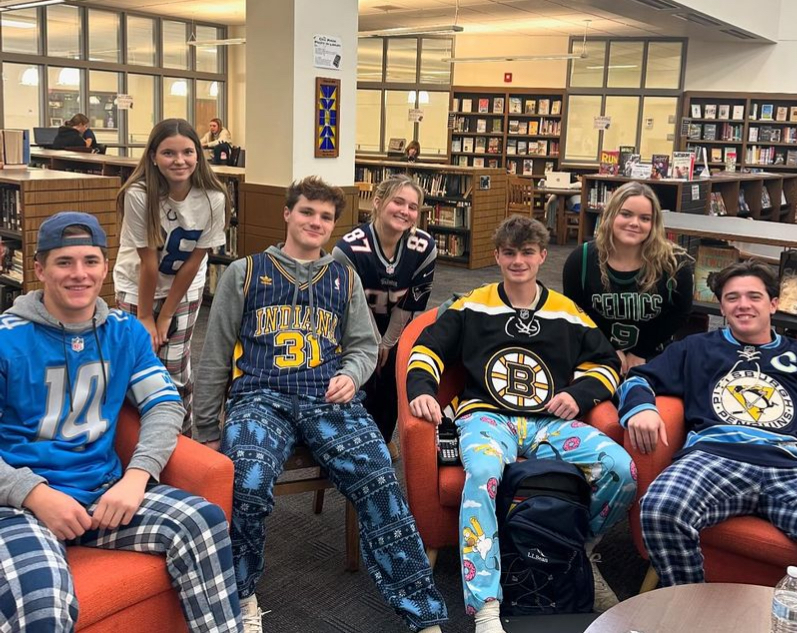
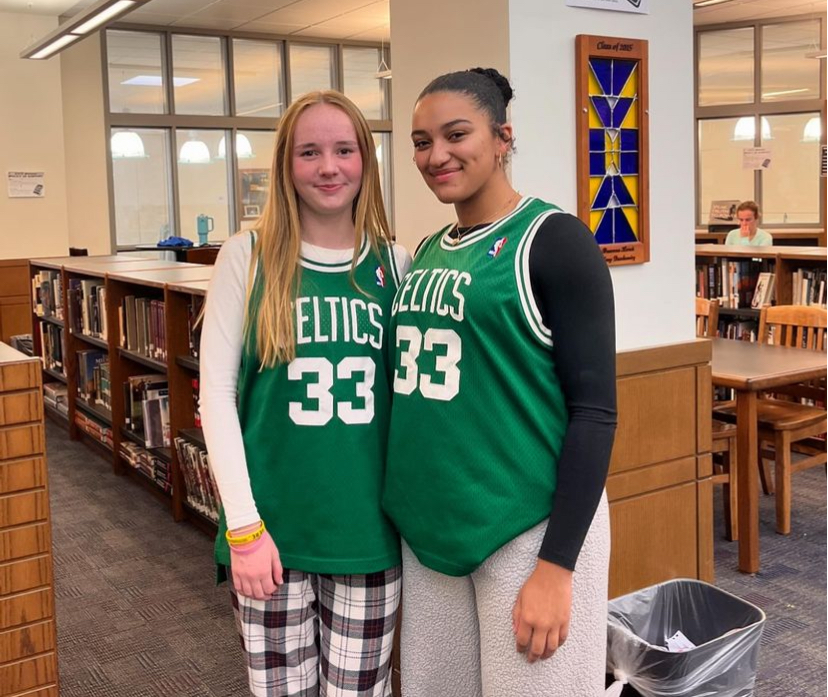
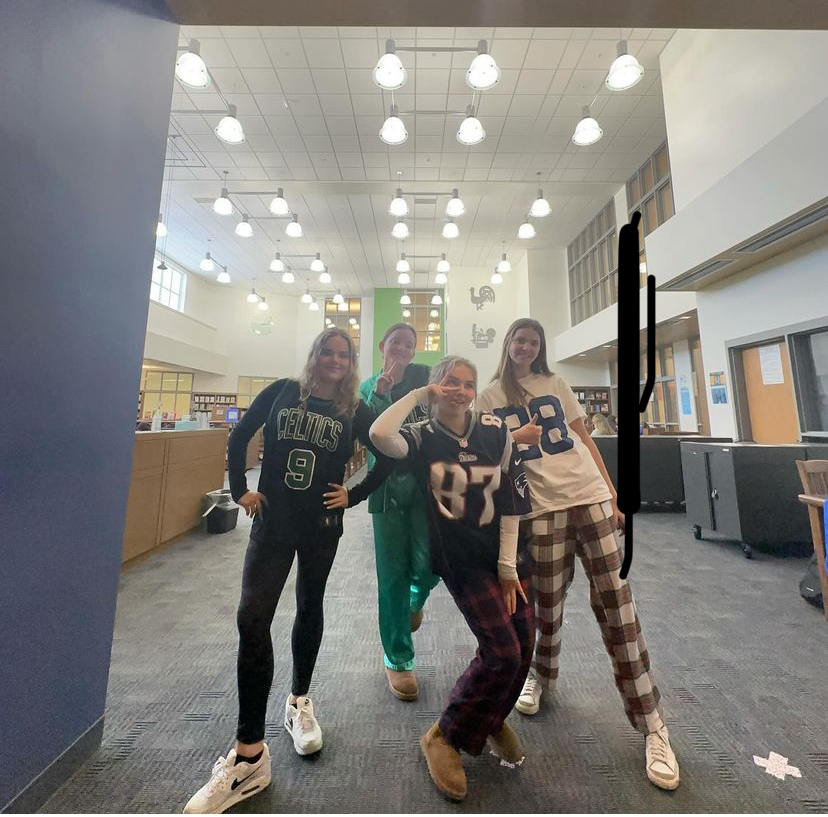
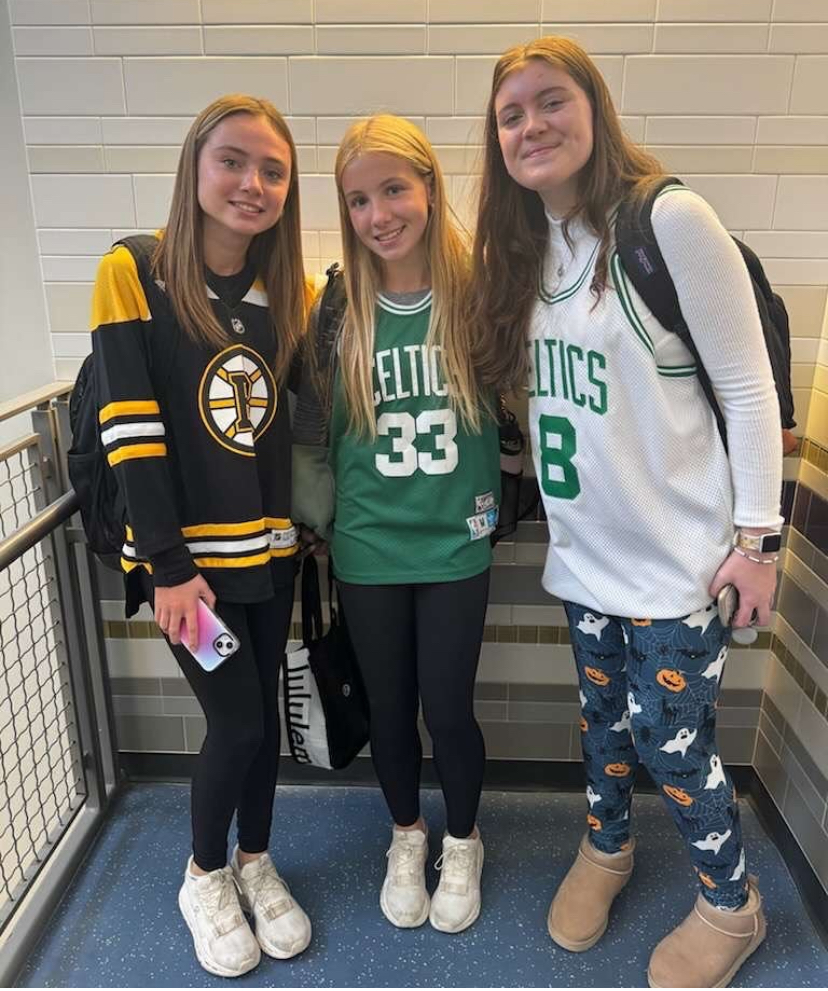
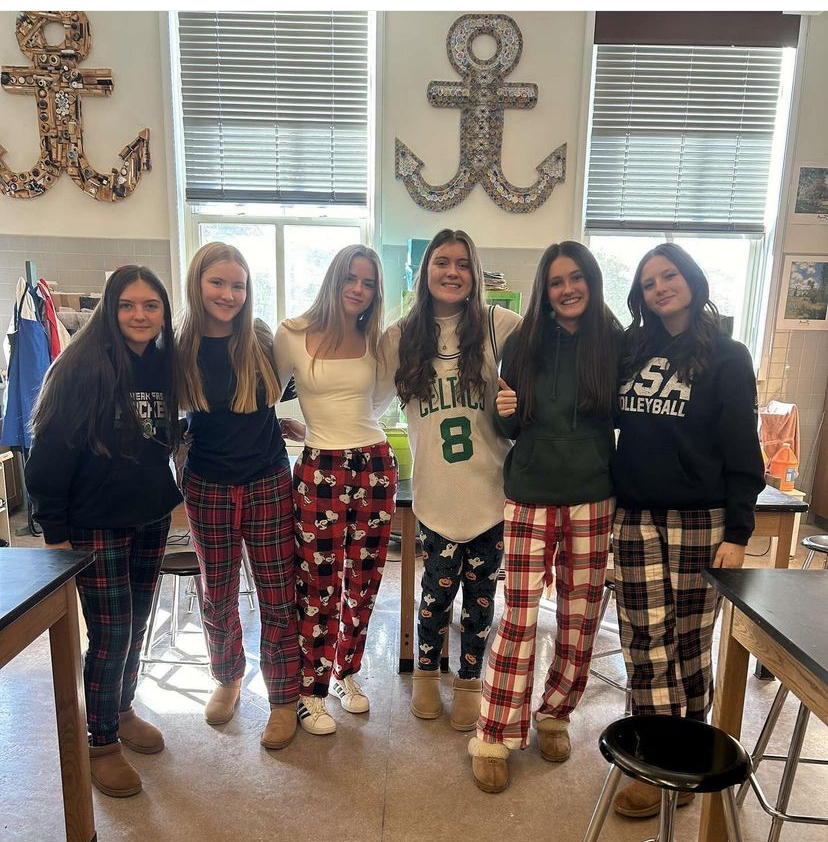
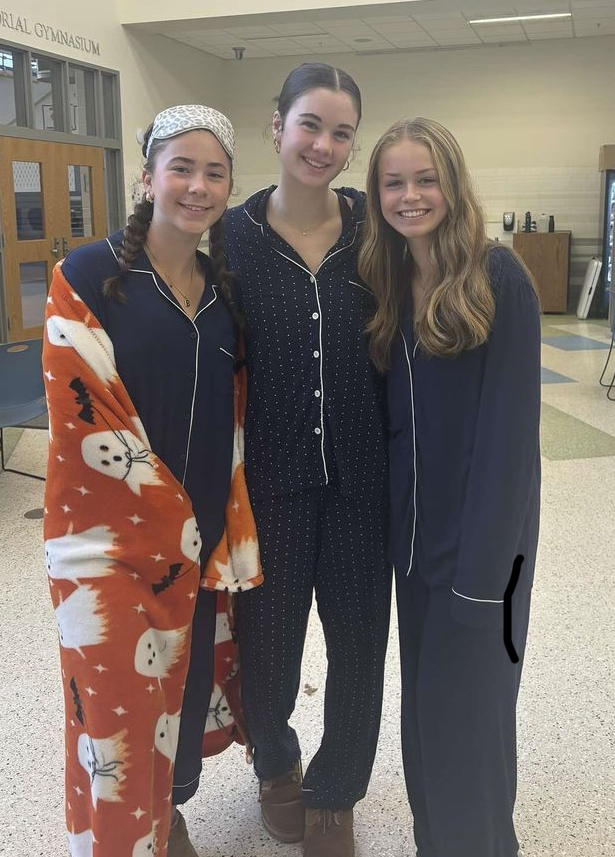
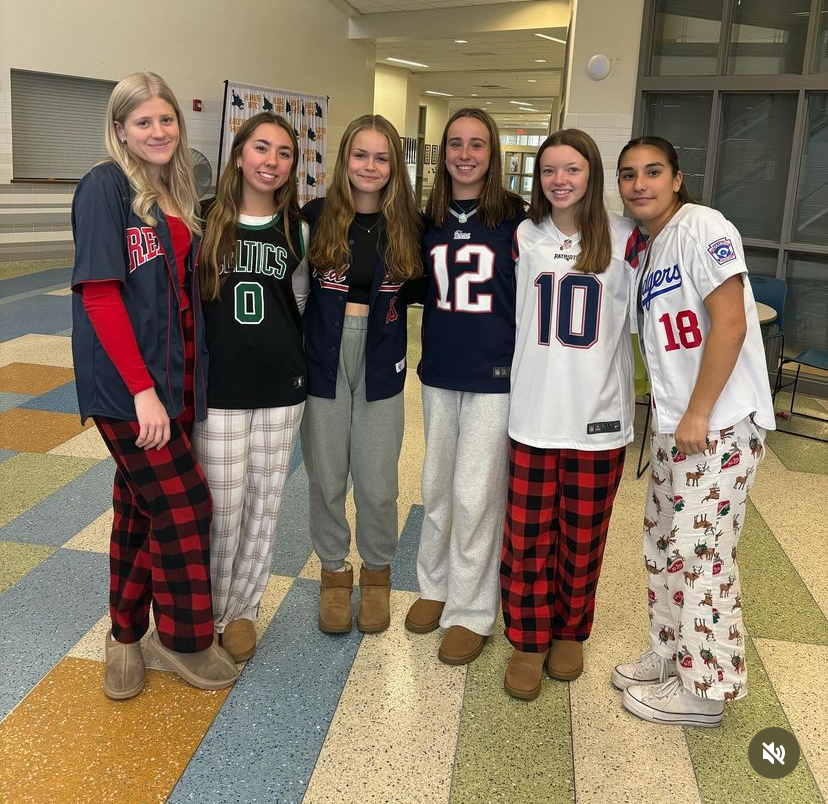
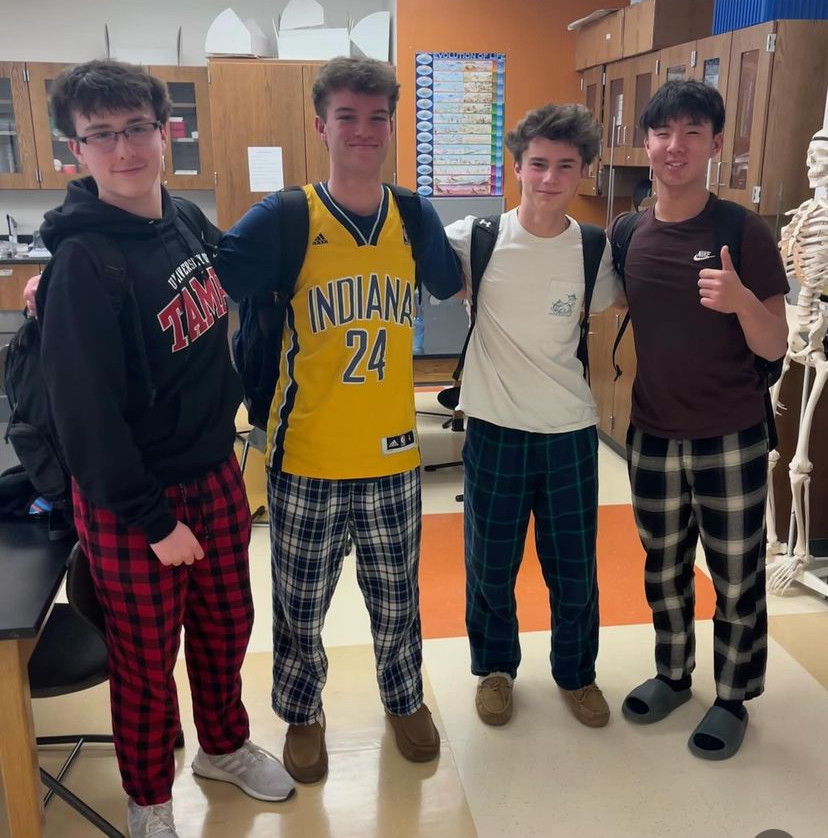
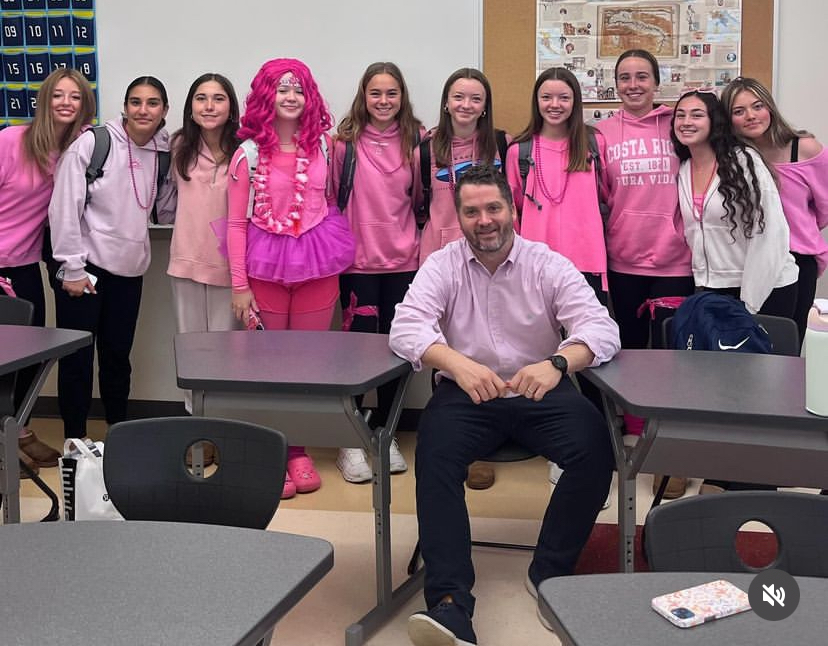
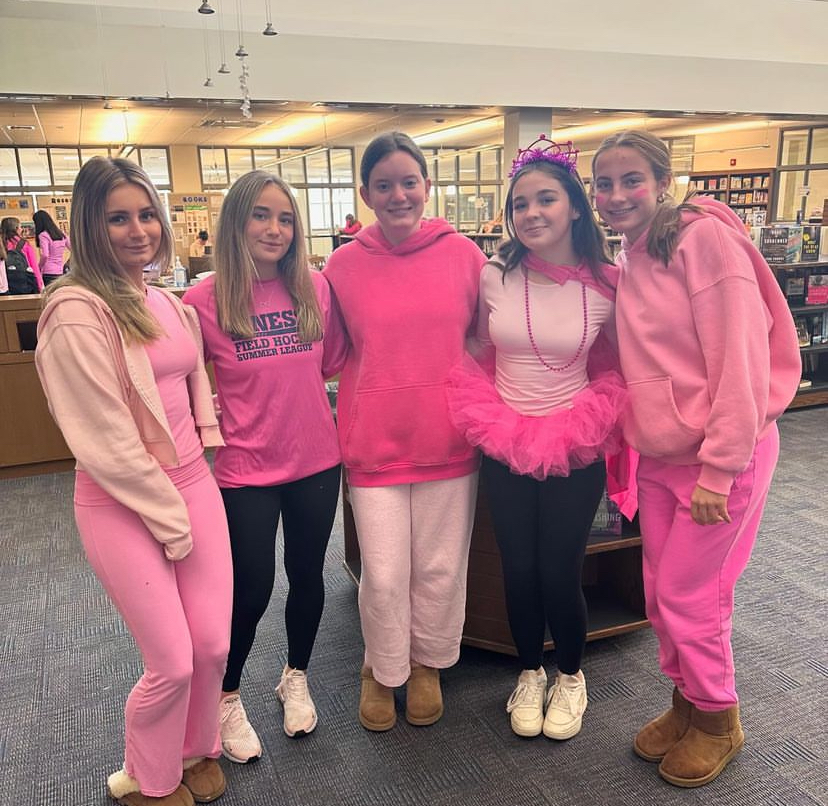
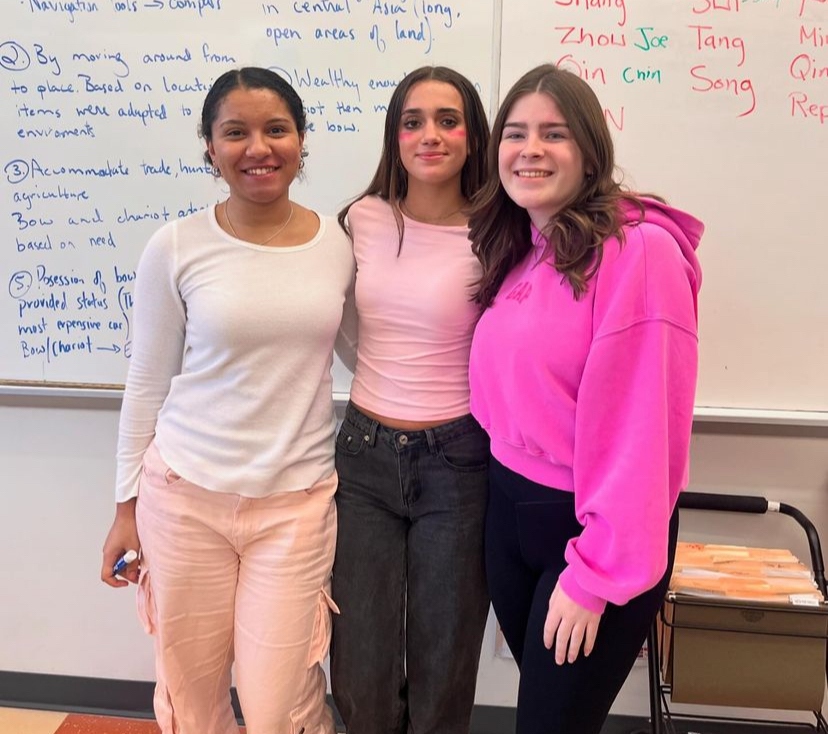
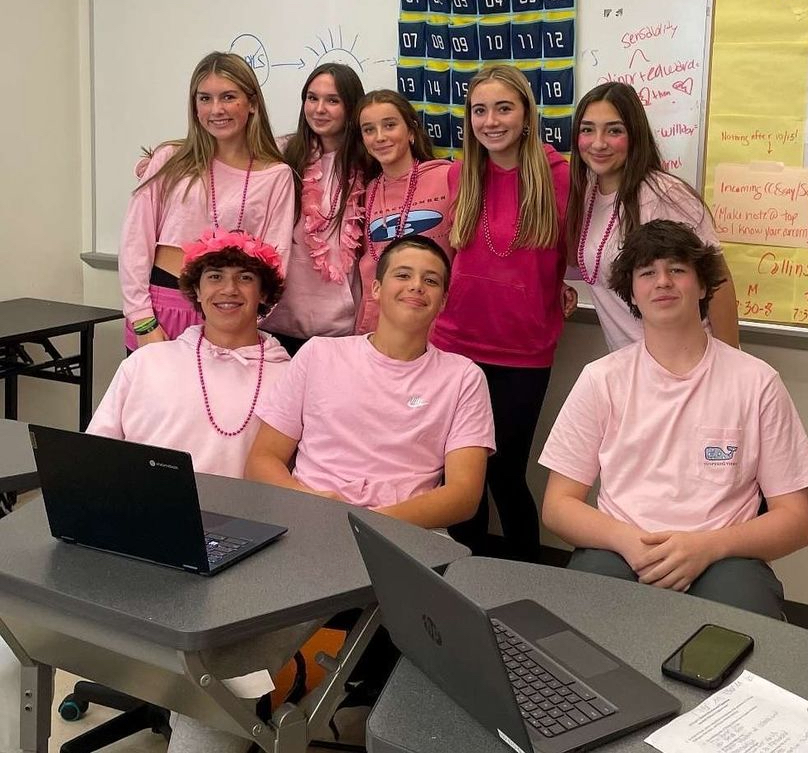
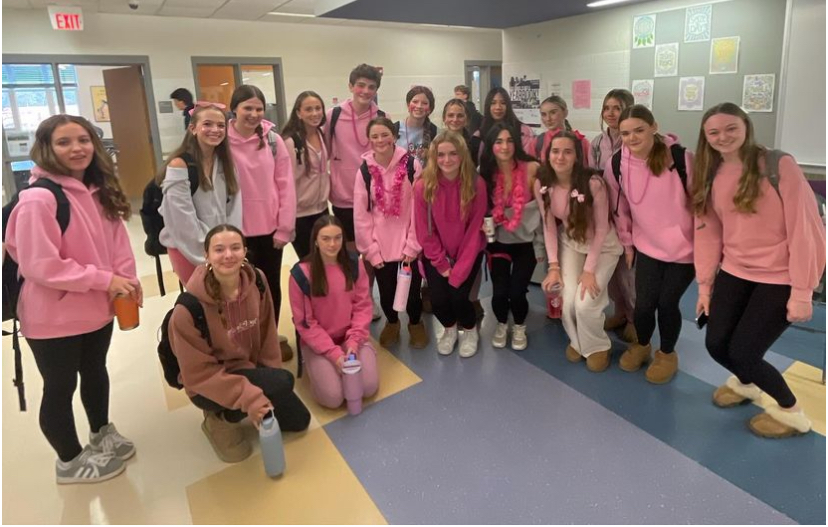
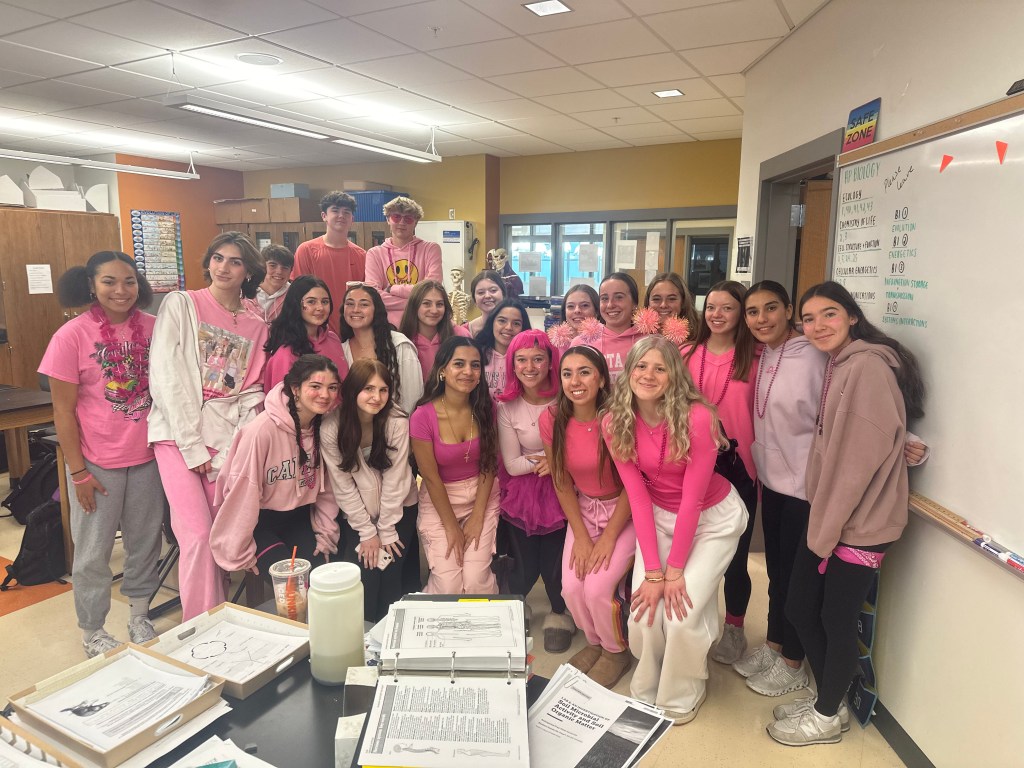
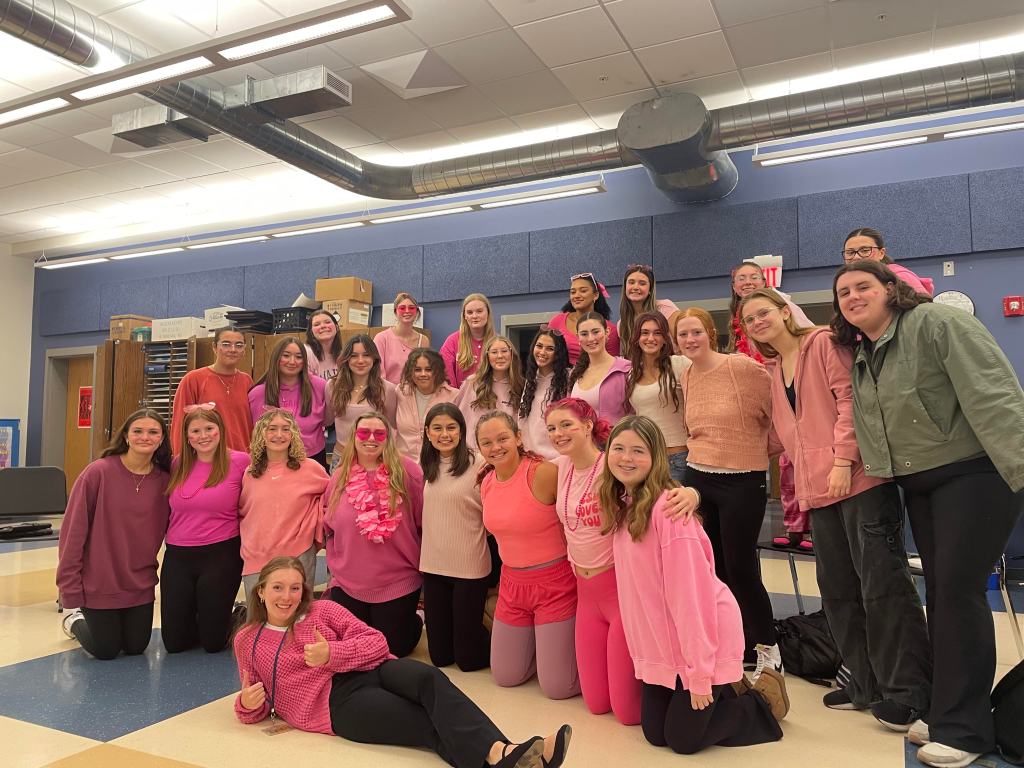
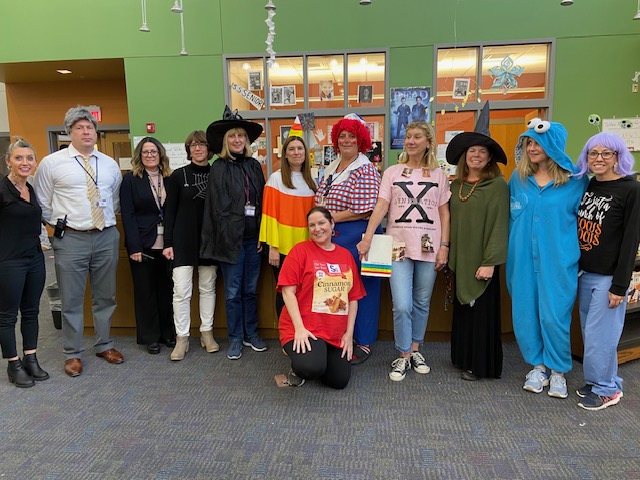
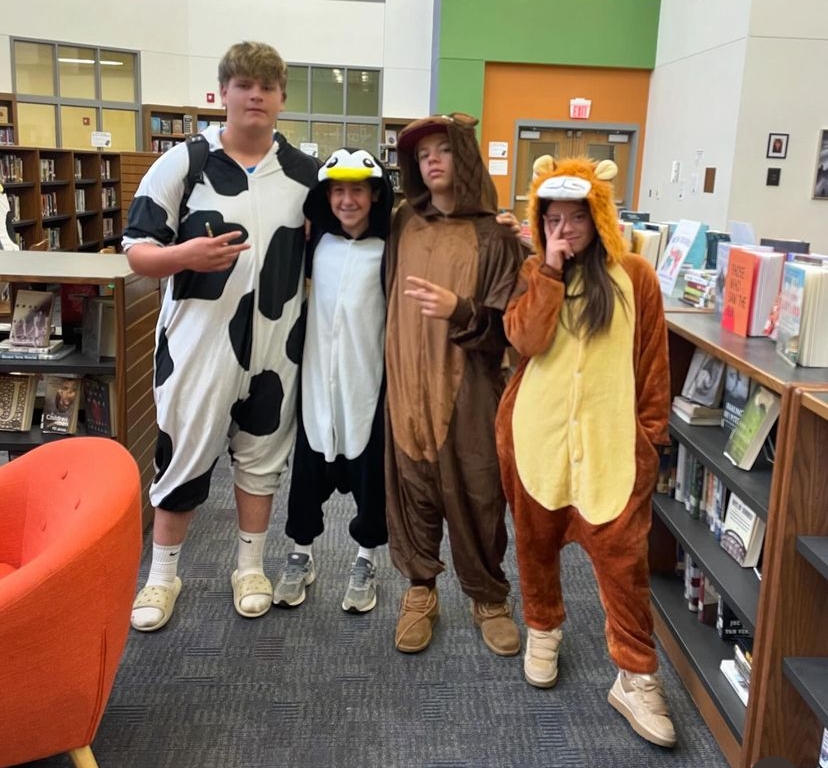
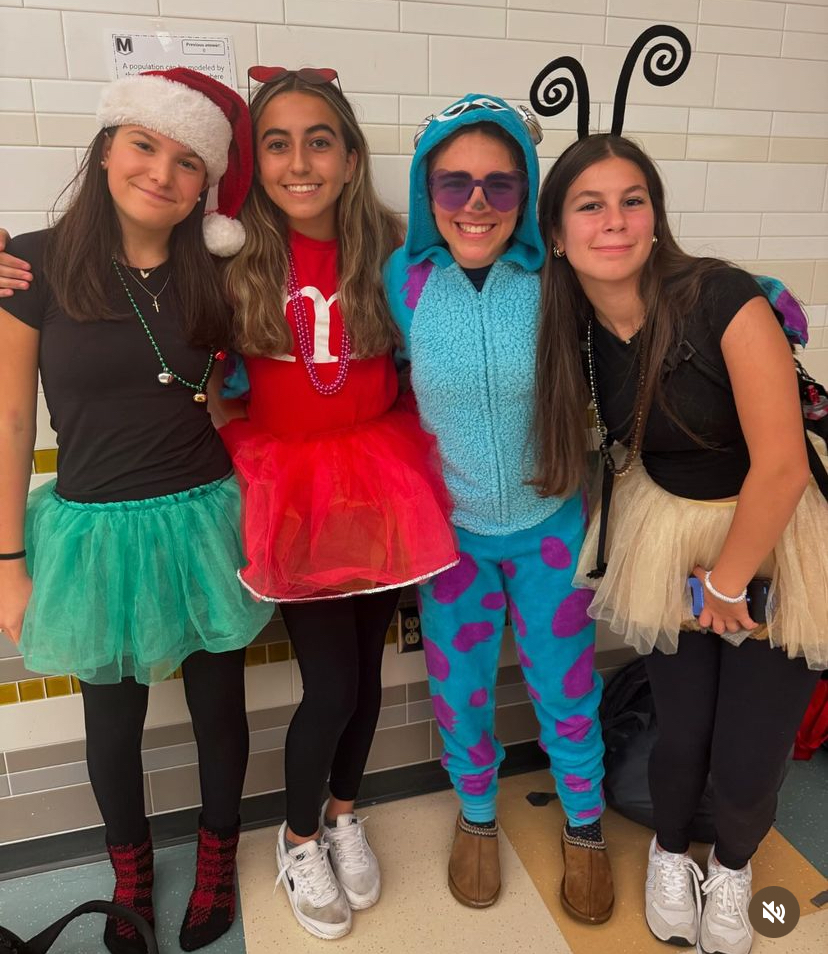
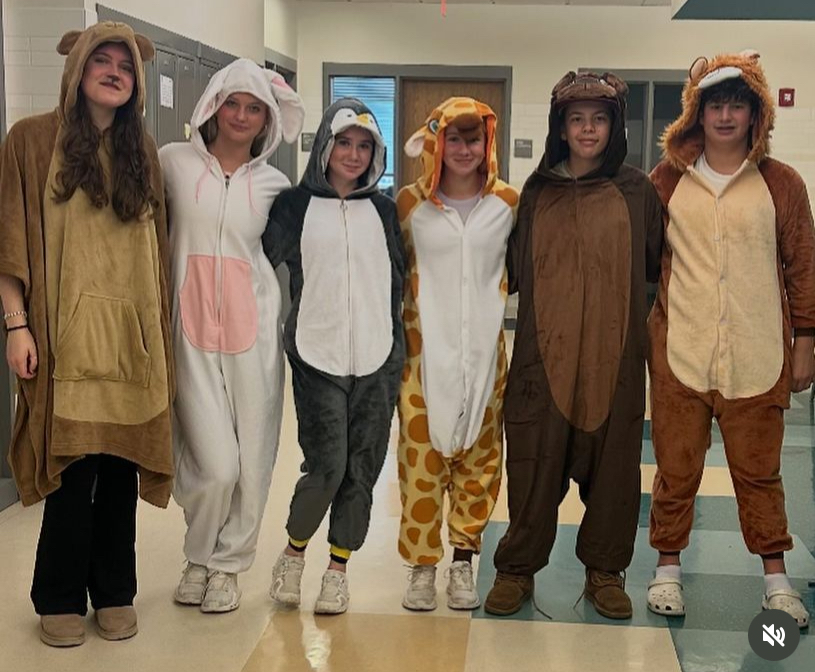
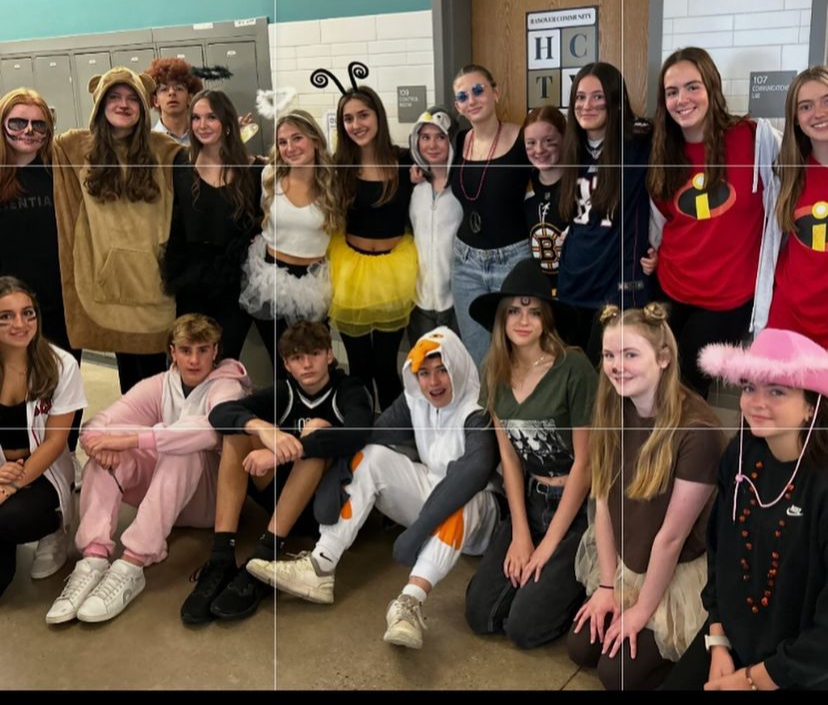
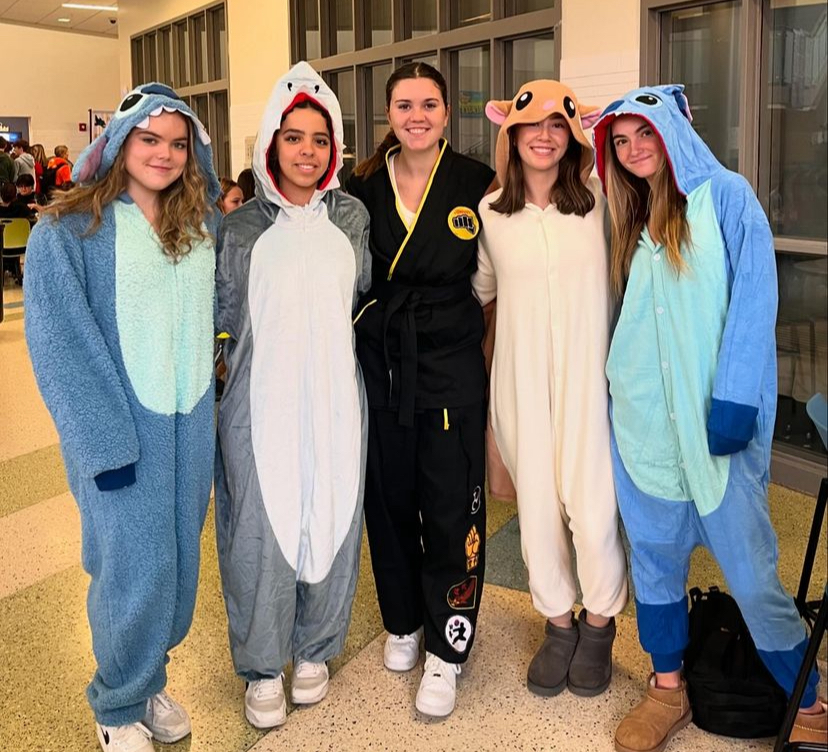
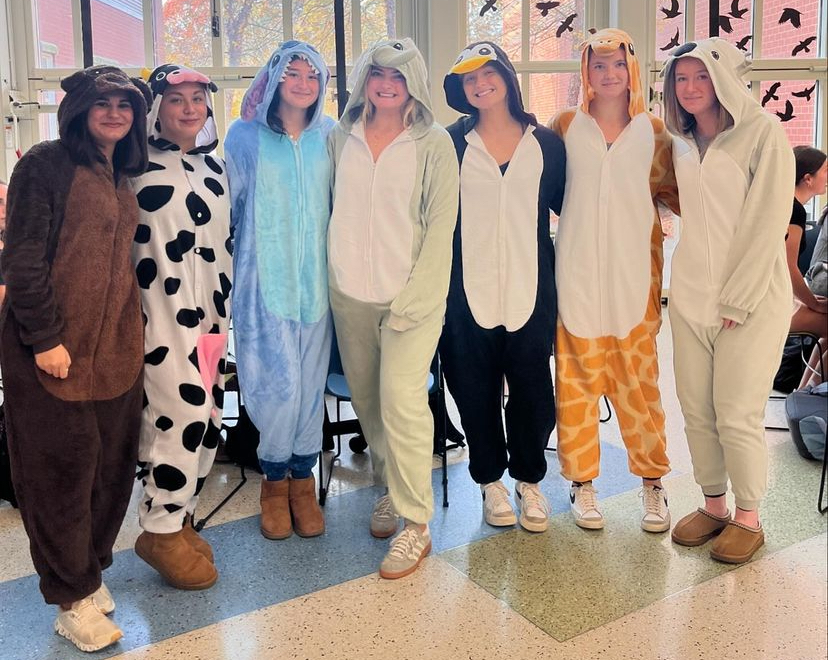
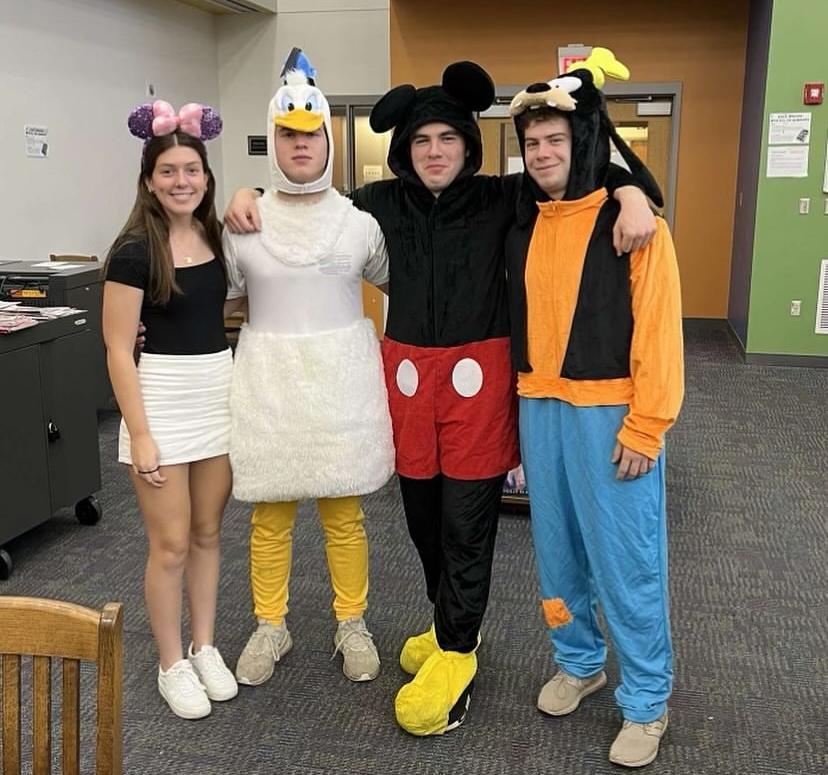
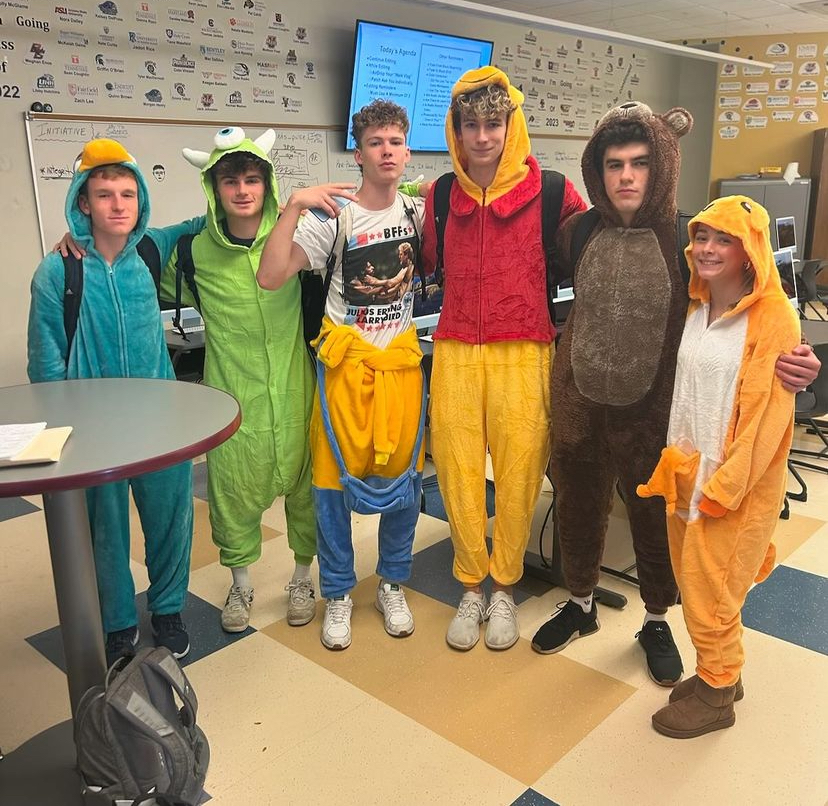
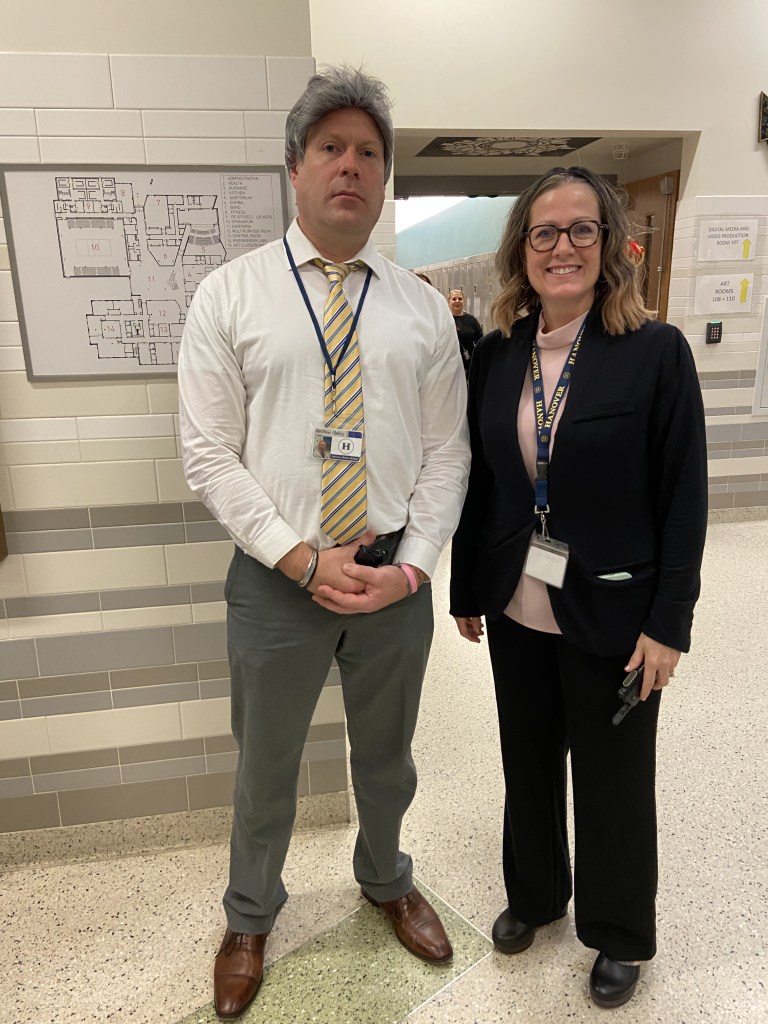
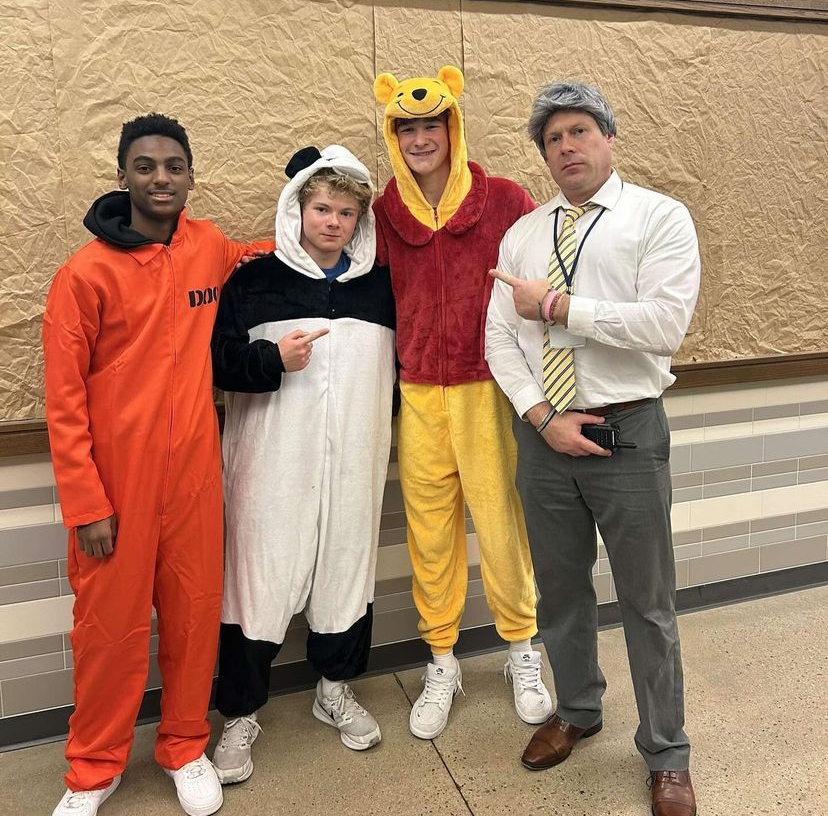
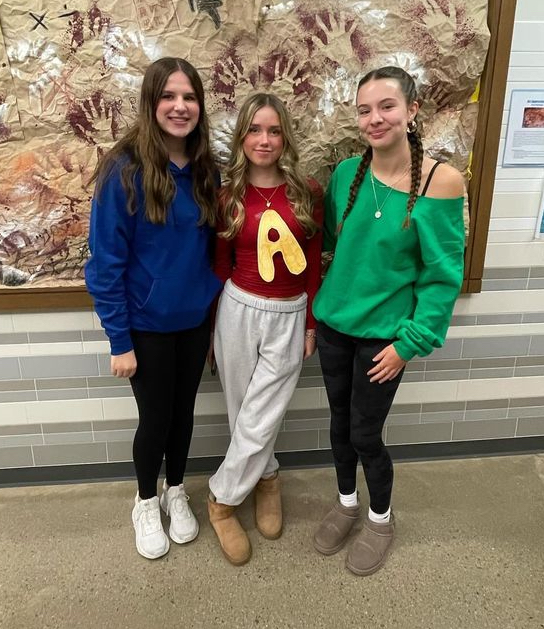
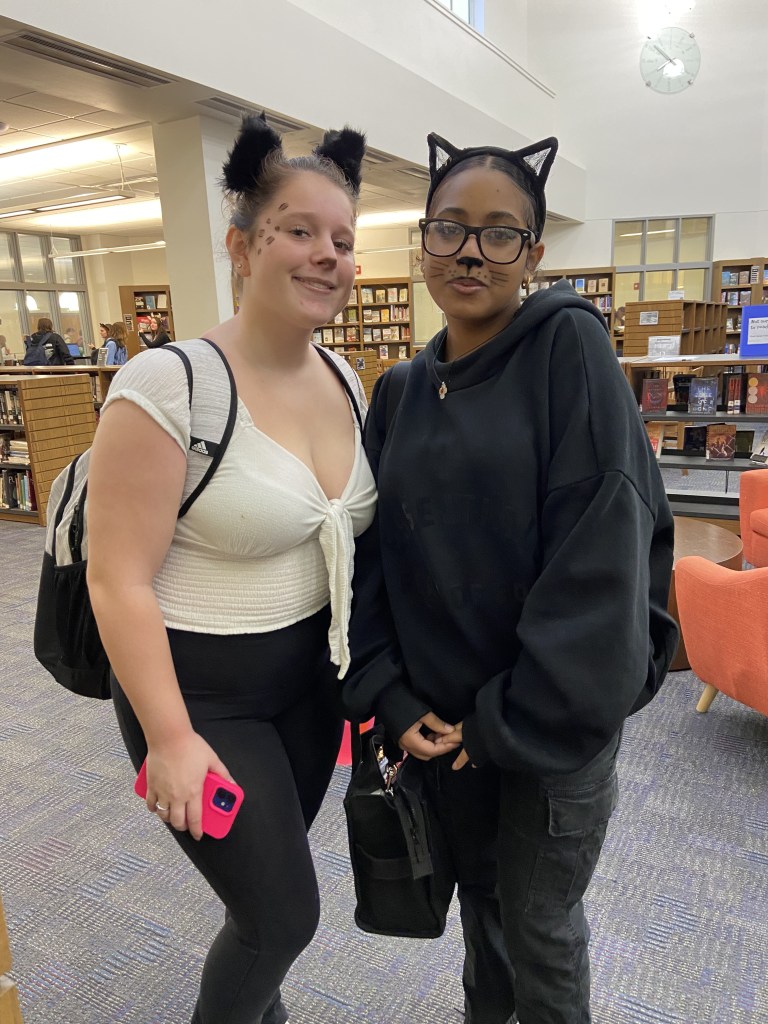
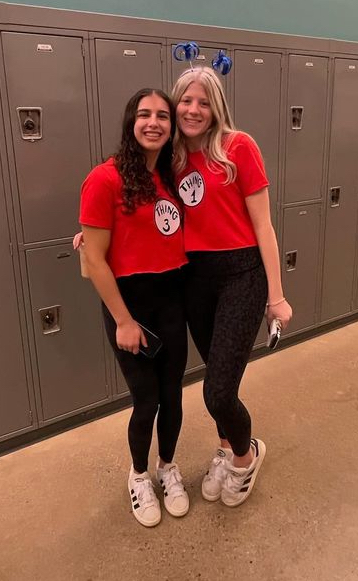
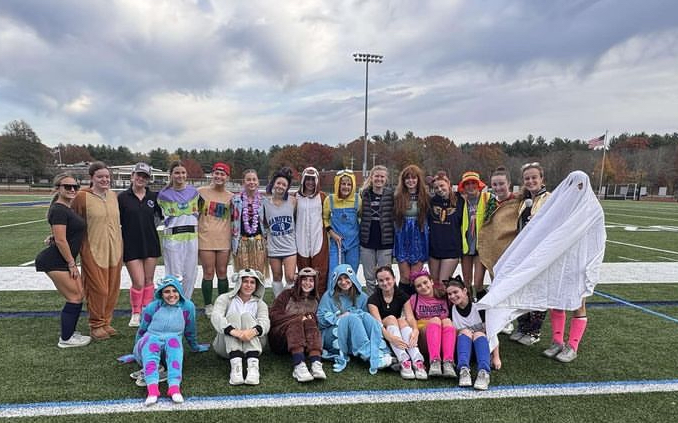
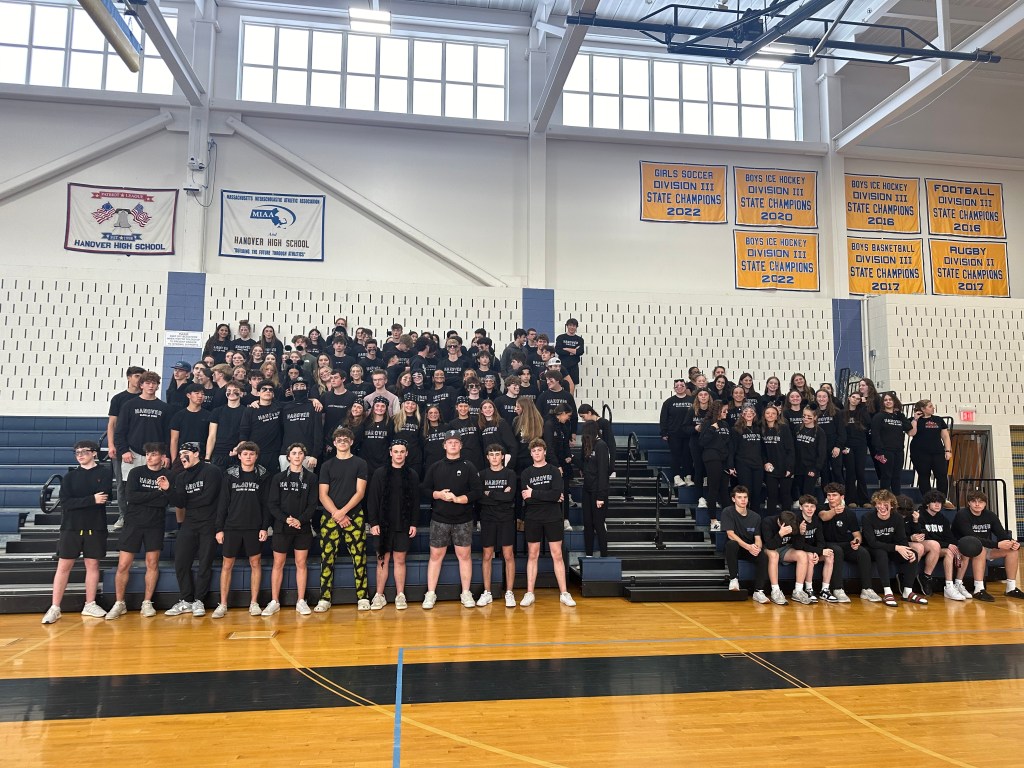
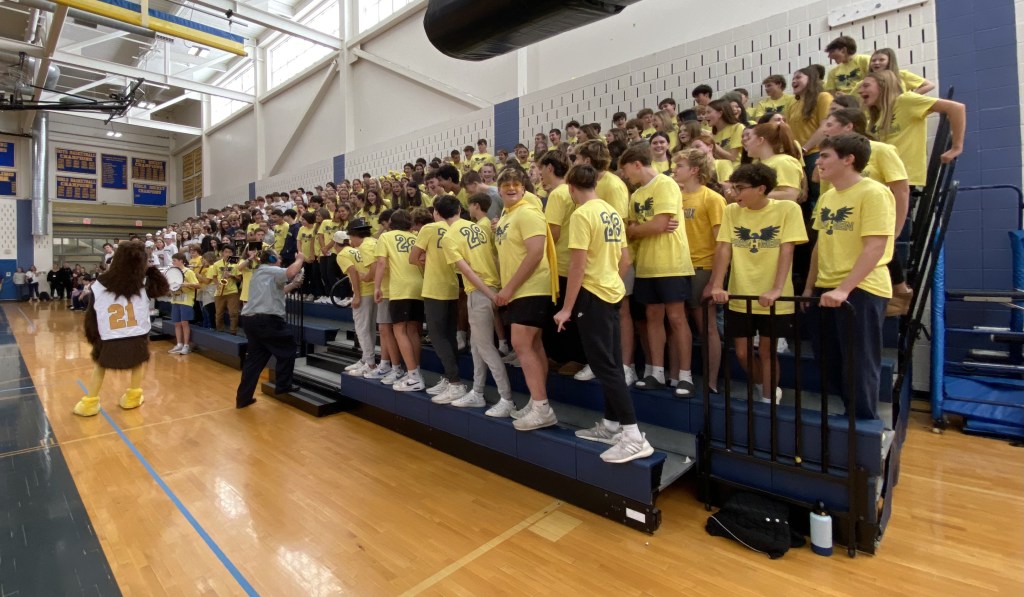
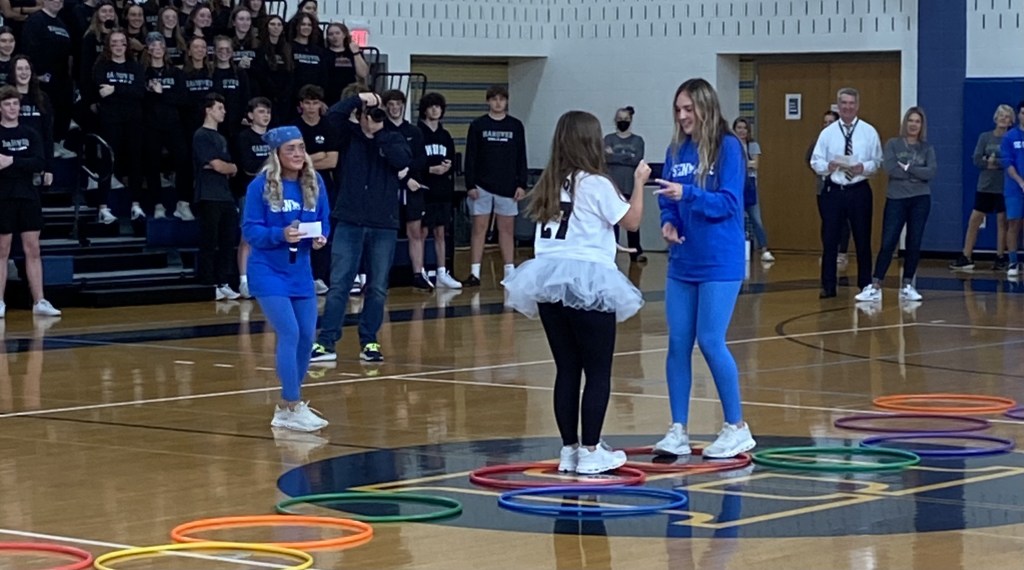
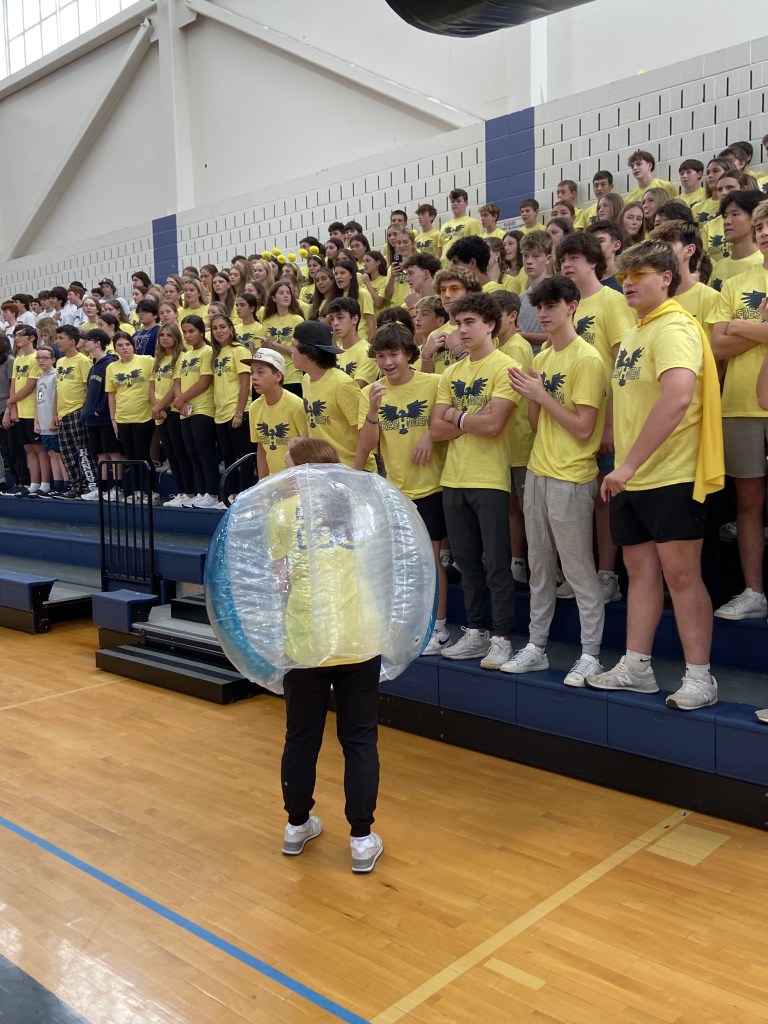
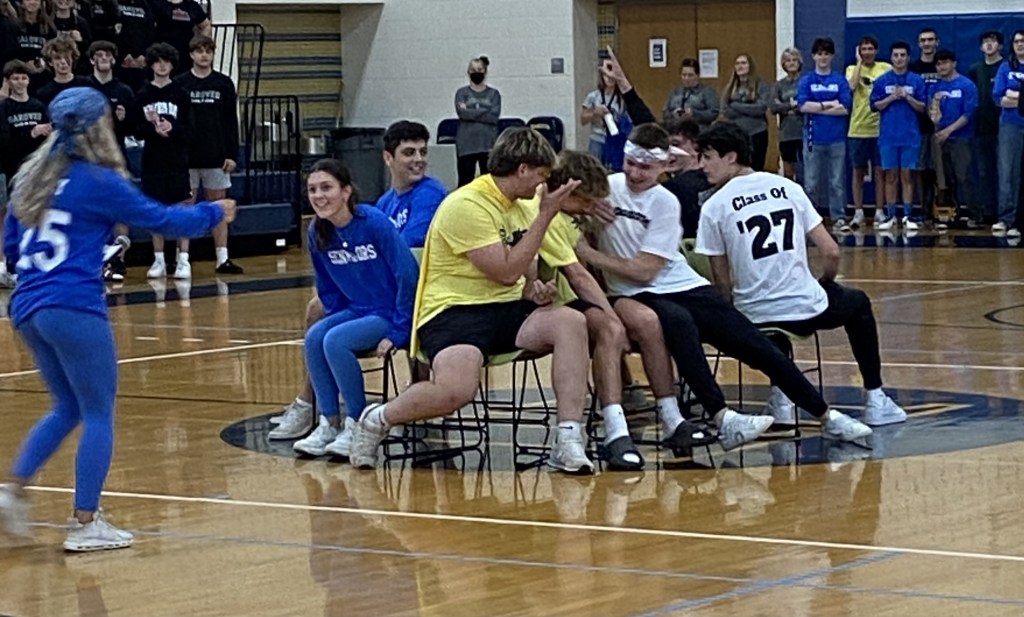
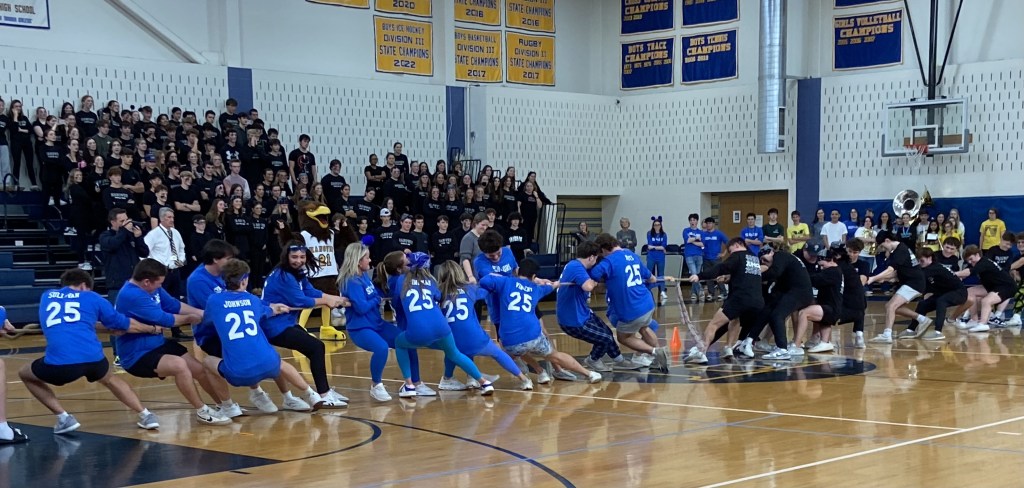
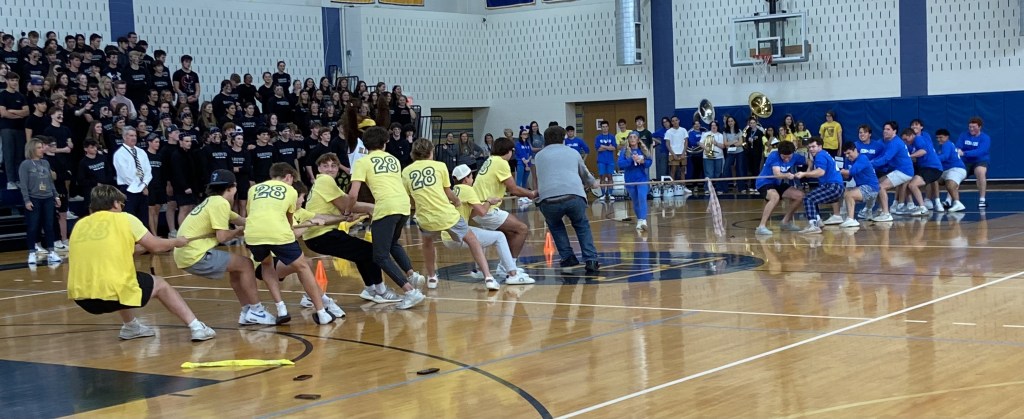
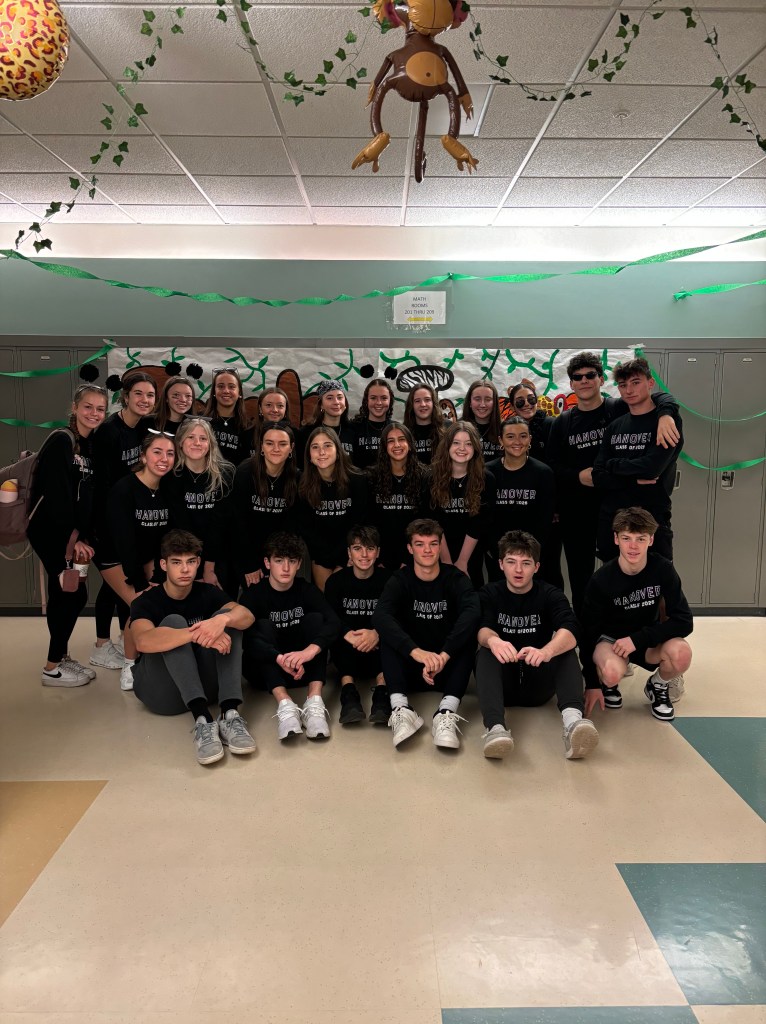
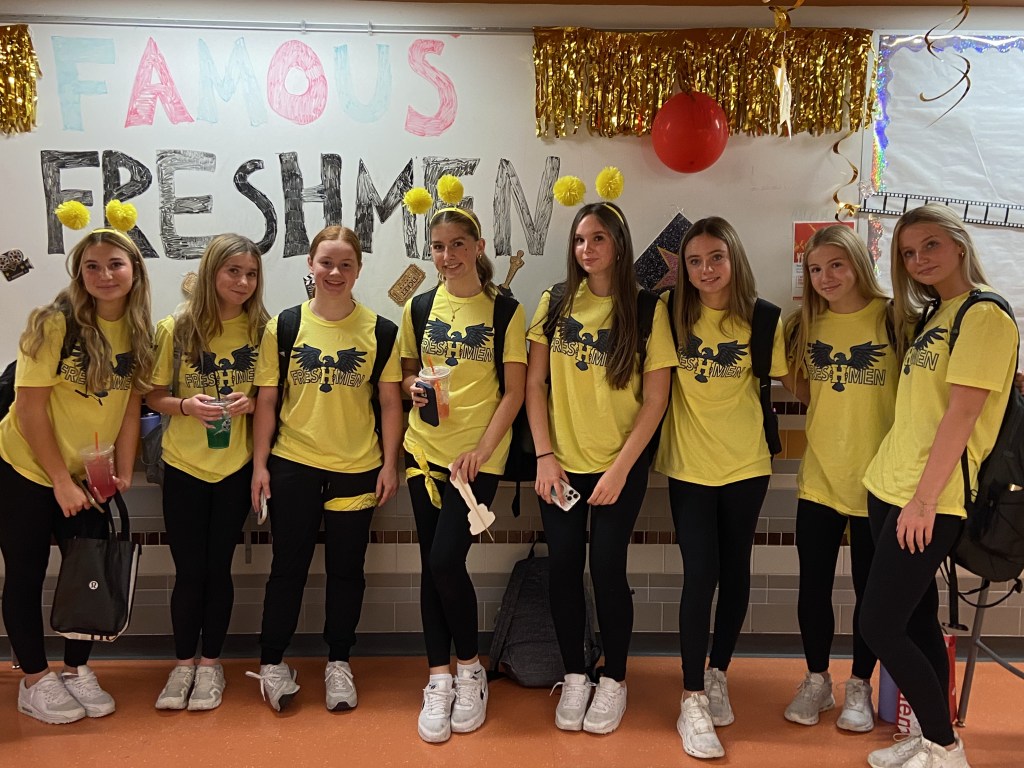
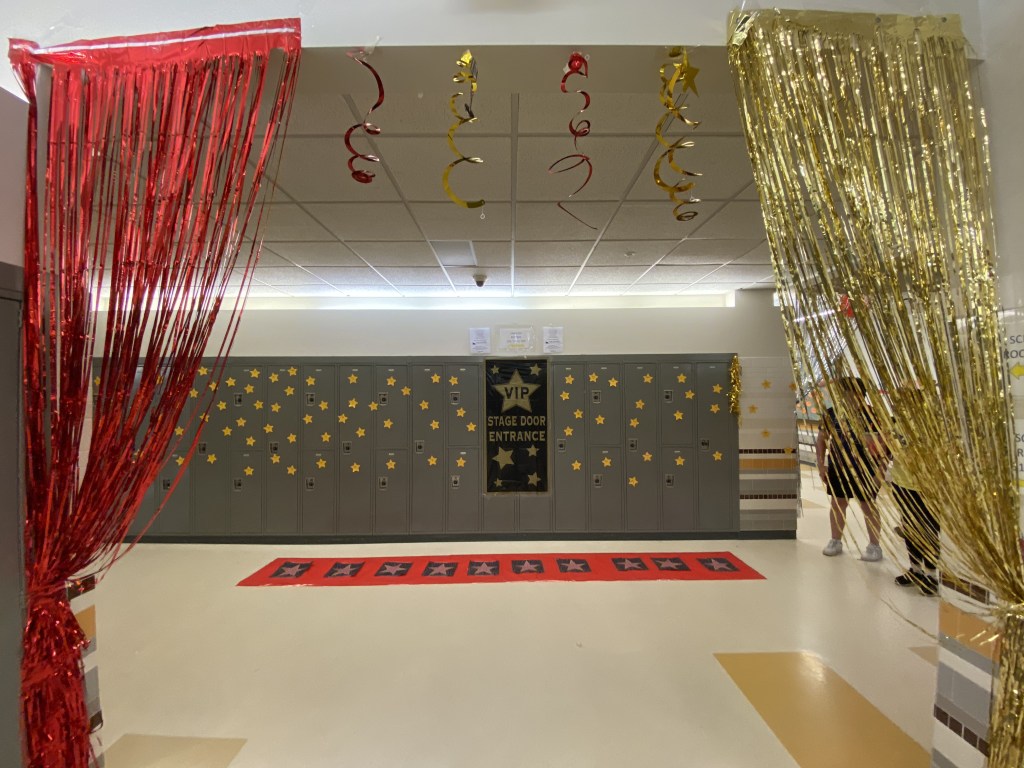
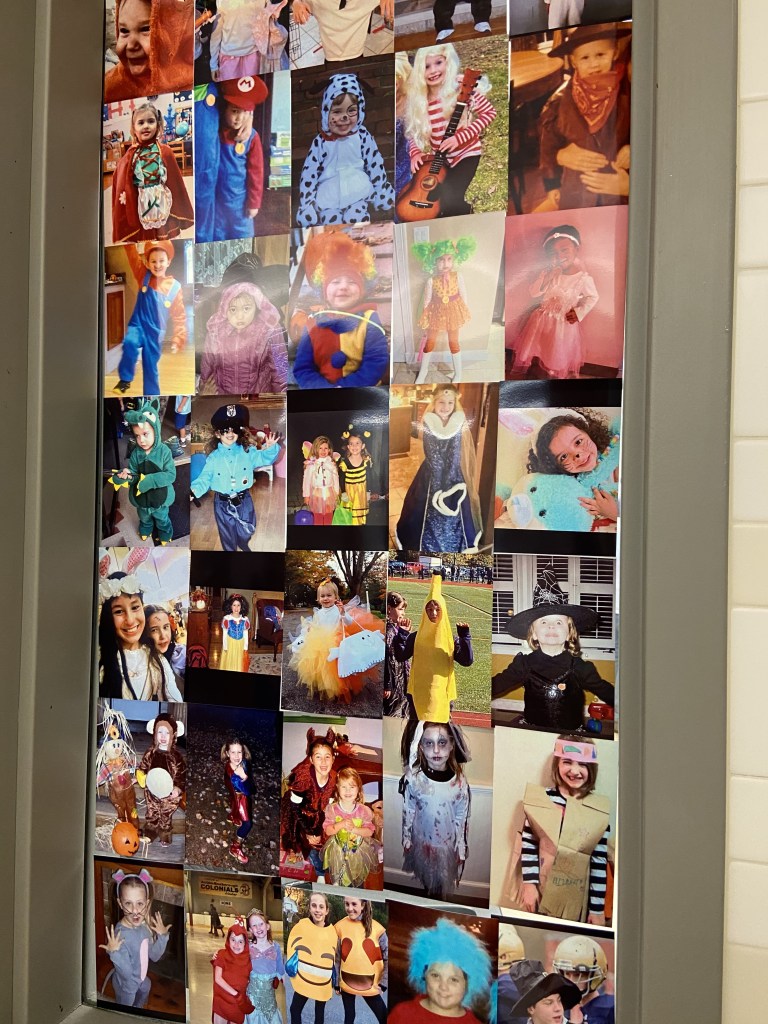
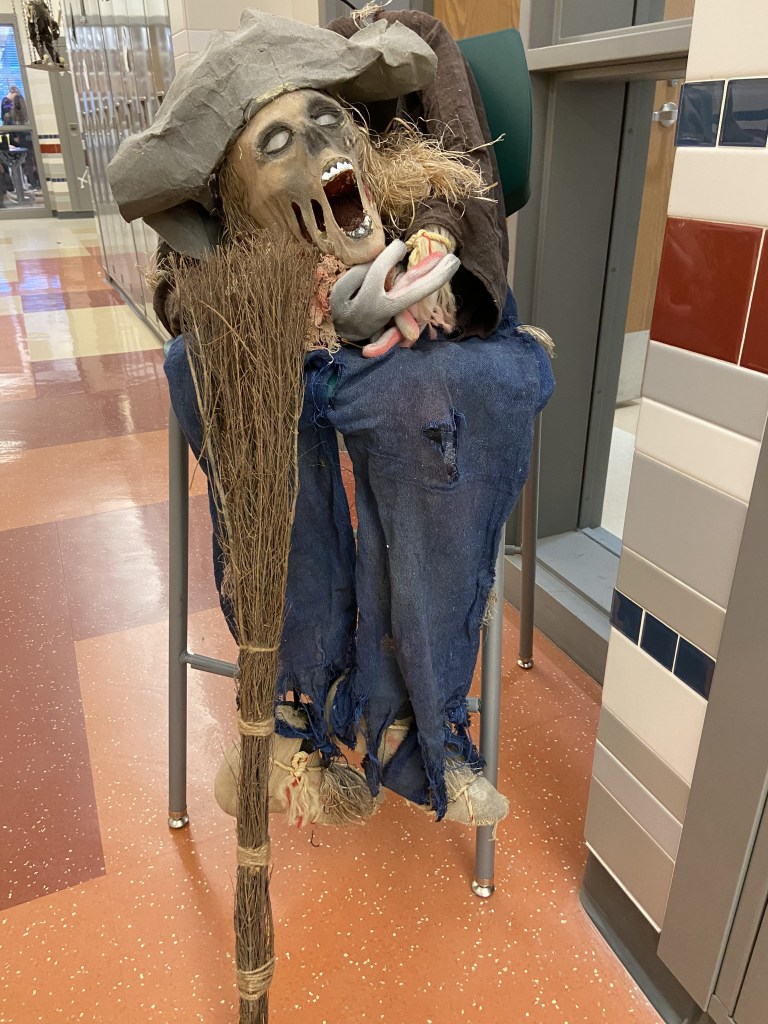
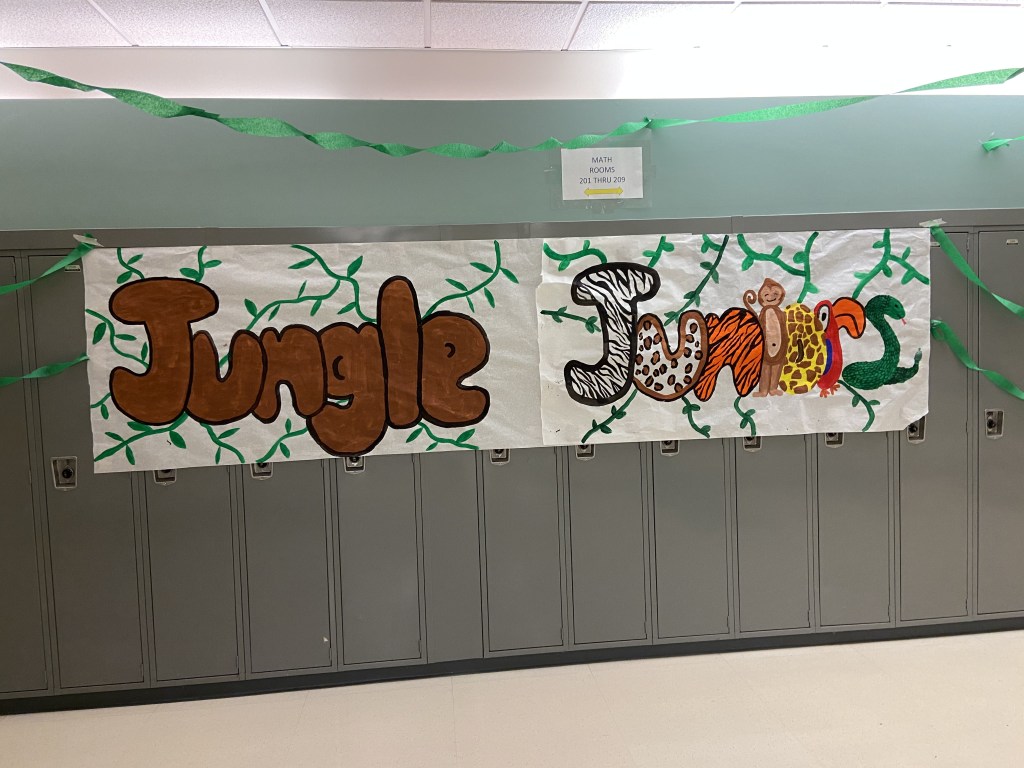
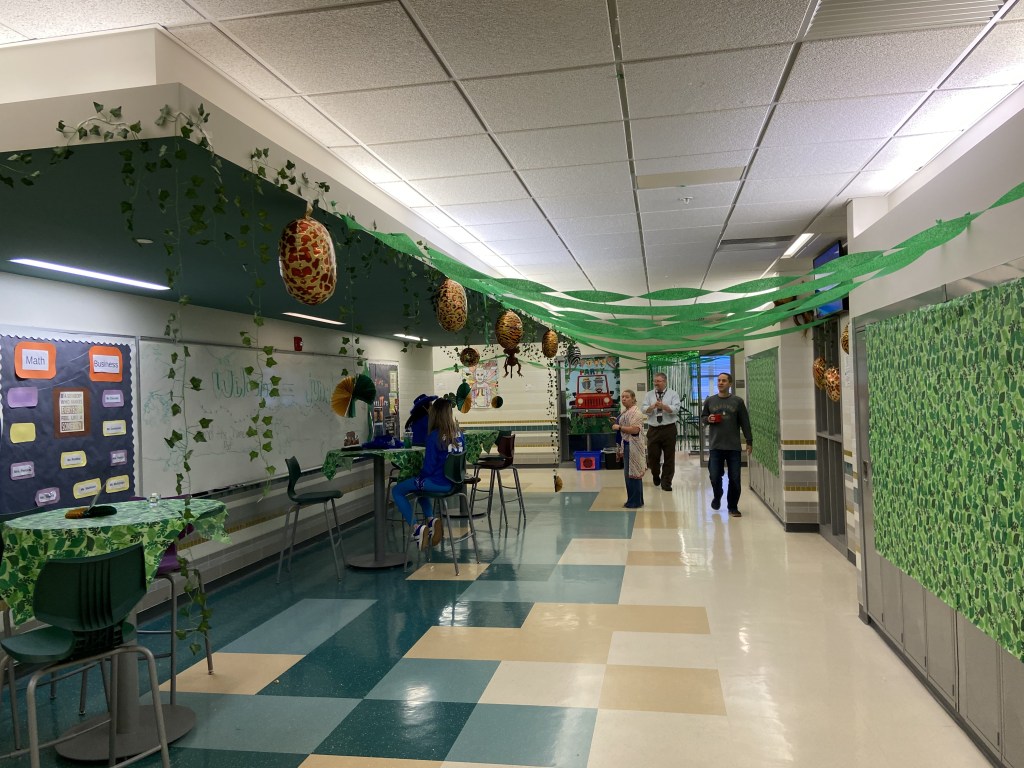
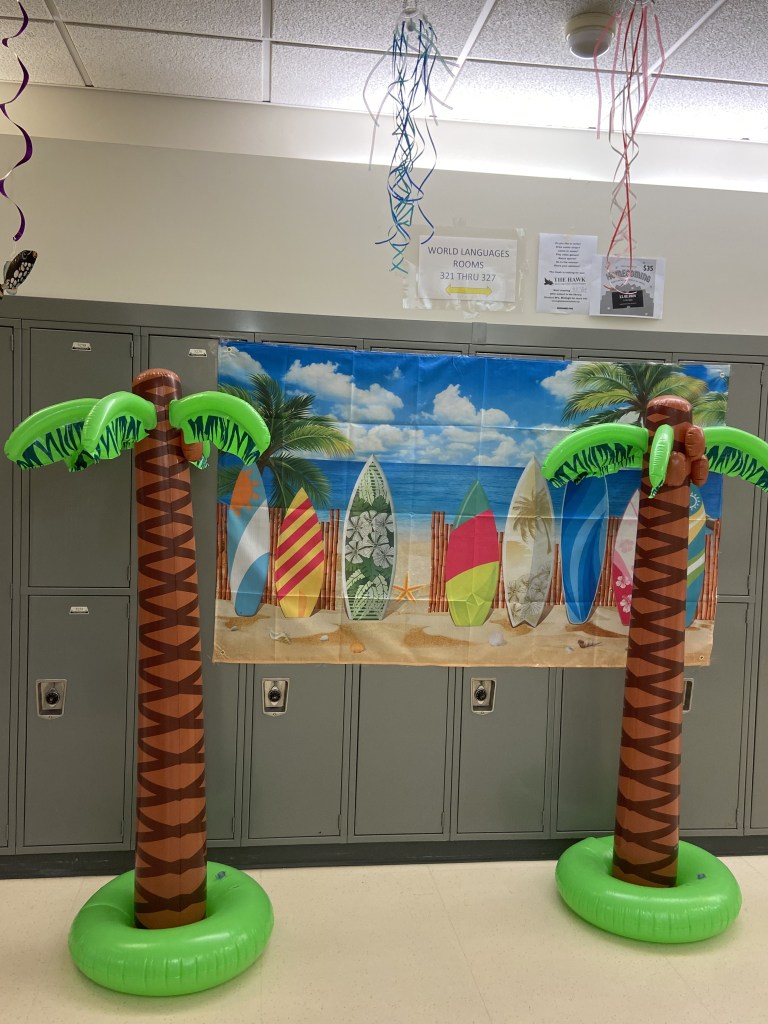
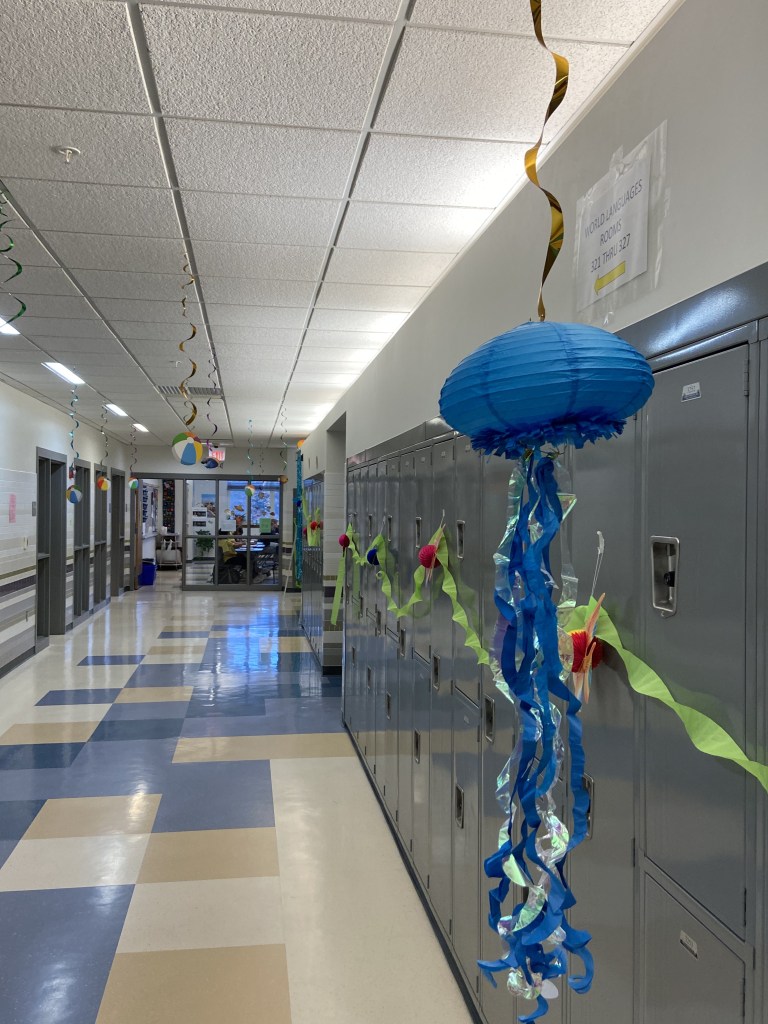
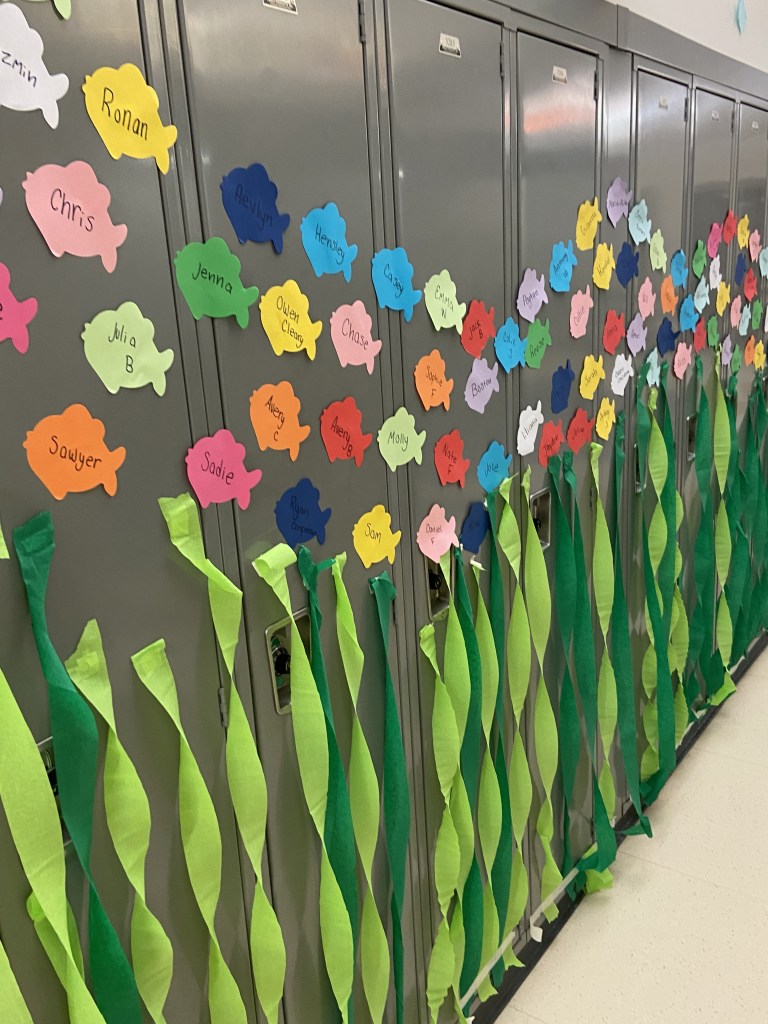
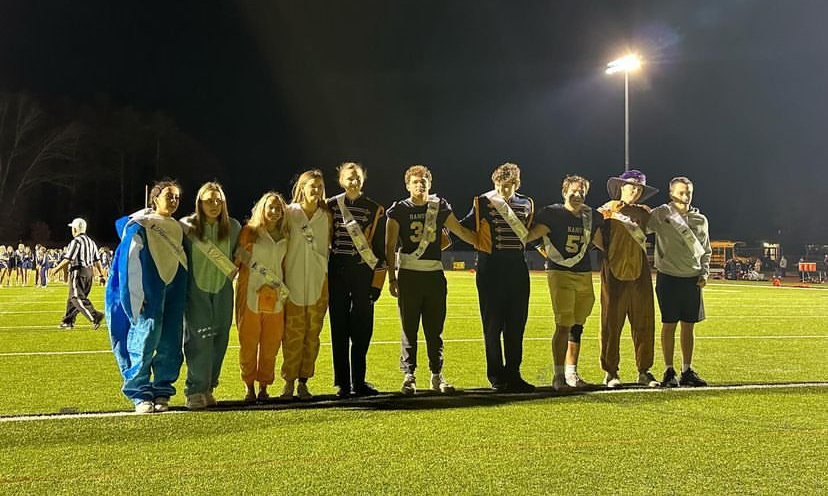
Hanover High students went all in for Spirit Week and Homecoming, held Oct. 28-Nov. 1. The costumes for the four themed days included red, white and blue; jammies and jerseys; ‘On Wednesdays, we wear pink’ from the movie Clueless; and Halloween costumes. The Junior Class won the pod decorating contest with Jungle Juniors, and students wearing their class colors crowded into the gym for a pep rally that featured riotous games and friendly trash talk.
The football team crushed North Quincy High School 42-7 in the Friday night Homecoming game, cheered on by a crowd of costumed fans in the endzone. Seniors Connor McCue and Ava Good were voted Homecoming king and queen at the Saturday night dance, which attendees said was the best in several years.
Click on the pictures to scroll through a larger gallery.
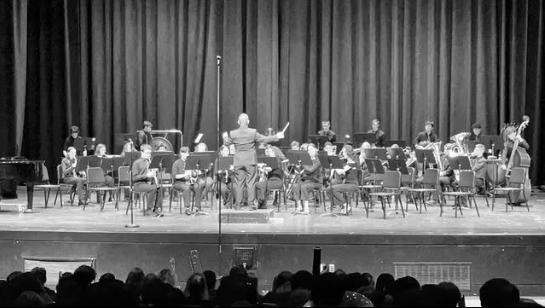
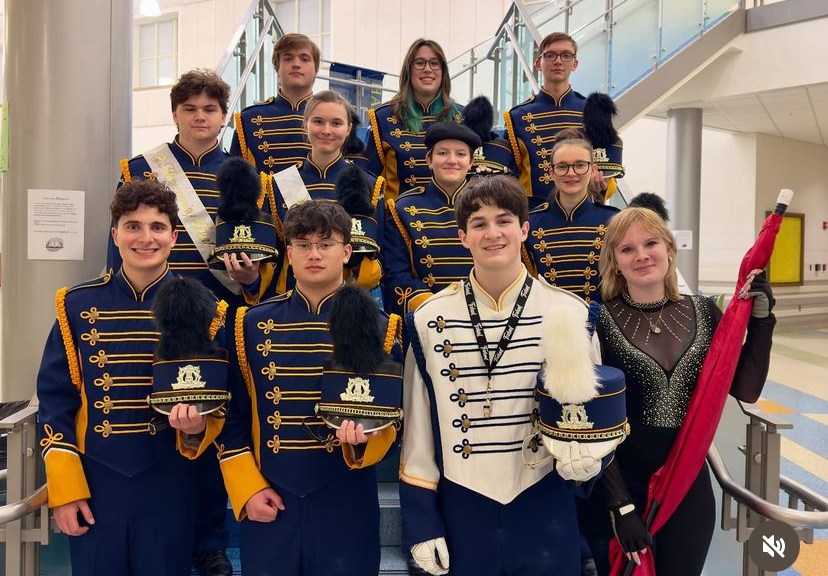
The Hanover High School Cabaret concert, held October 15, transformed the cafeteria into a musical showcase. About 20 participants performed. The Pride of Hanover marching band played its current field show “Chicago,” and Vox displayed its choral talents. Other performances included “Enchanted” by Taylor Swift, sung by Avery Porro and Sophie Frattasio, and “Good Luck, Babe!” by Chappel Roan, performed by Henry Graham and Daniel Freedman. I joined Anna Dillon, Aevlyn Brangan, Ben Smith, Maria-Rita Silva and Luca Ciccolo for “Viva La Vida” by Coldplay. All of the performances were exceptional.
It is a great accomplishment to go in front of an audience and perform. Even after playing for many years on stage, it can still be nerve racking, but everyone did a great job. Some were even brave enough to play a solo. I talked to several of the performers to learn more about the atmosphere for the musical arts at HHS. I love performing in front of a crowd, whether it’s at a football game or a concert. It is fun and exhilarating, even though it can fill me with worries. But it’s all worth it when you see everyone supporting you and cheering you on.
“Before my first game, I was nervous but then I realized that I did good,” said Tory Jara, a freshman. “I feel very proud of myself after my performances due to all of the hard work that I put in everytime.”
Many band students believe, and I agree, that one of the best parts about being in band is showing what we can accomplish together. We all have to come together to make the band what it is and it takes teamwork. Another great thing about band is all of the friends you make. Going to class first period every morning with all the people I love is a great feeling, and everyone there shares a common passion, music! As a freshman, I wasn’t sure what to expect from high school band, but I very quickly realized that while I liked being in band before, I now love it. I am starting a new chapter that helped make the overall move to high school a little easier.
“The people you meet are amazing and they make you feel like you are part of the team,” said freshman Layla Ali. Music makes you come out of your shell and learn to communicate without words, she added.
The opening of the 2024-2025 NFL season for the Eastern American Football Conference has been slower than anticipated. Many of these teams’ unpleasant starts have left the rest of the season up in the air. Despite their sluggish starts, each franchise still has goals it hopes to achieve. Here’s what’s happening.
While the New England Patriots rebuild under a new and revamped offense, the New York Jets have looked to showcase a promising starting lineup for the season. The Miami Dolphins have been torn apart by injury and continue to fight for consistency. However, the Buffalo Bills have exhibited the most success, asserting dominance over the league and displaying a talented roster.
Throughout the uncertainty, the AFC East has shown licks of success and improvement, signing new players and filing career extensions as the trade deadline approaches. According to a report from NFL.com, the New York Jets, led by current HC Jeff Ulbrich, successfully acquired star wide receiver Davante Adams from the Las Vegas Raiders on October 15. Another crucial division move occurred recently, according to CNN.com, when Amari Cooper was traded from the Cleveland Browns to the Buffalo Bills.
The new additions and changes for these teams have improved the overall status of the division as the league approaches weeks 10 and 11. The current division standings in the AFC East show the Bills at the top with a steady 7-2 record. The Patriots, Dolphins and Jets lag behind with just three wins apiece.
In short, the AFC East has shown potential, even with an unfavorable start to the season. Through much discipline, these teams have the potential to develop every day for the remainder of the 18-week season.
The vote for president in the United States has never once been determined by the true popular vote but rather by the Electoral College system. When the topic of presidential elections is reinvigorated around Election Day, many Americans wonder why our president is not determined by our votes. Some even choose not to exercise their voting rights because they don’t believe their vote actually counts or matters. In some respects, they’re right.
In 1787, the Constitutional Convention came to the compromise known as the Electoral College. The issue was that nobody could agree on the best way to elect the president. Some wanted Congress to elect the president, and others wanted the people to choose the president directly. So the Electoral College system was born as an odd compromise between delegates from 237 years ago. In this system, a board of 535 electors each cast a ballot in accordance with the majority votes from the state they represent. To win the presidency, a candidate must win 270 of them. Additionally, in 48 states, all of the electoral votes go to only one candidate. For example, if the majority of Ohio votes Republican, all electoral votes would be given to the Republican candidate. This happens even if a decent amount of the state voted Democratic. Only Maine and Nebraska allow the electoral votes to be split.
The number of electors a state is allowed is determined by population. Heavily populated states such as California and Texas have more Electoral College votes than less populated states like Vermont and Wyoming. If you remember back to U.S. history class, this is why the Three-Fifths Compromise in 1787 was so significant. The vast majority of the southern states’ population was comprised of slaves, meaning if the slaves counted as people, the southern states would have more say in the Electoral College and have more representatives in Congress. The Fourteenth Amendment abolished the three-fifths compromise in 1868, which begs the question why do we still need the Electoral College?
In short, we don’t. It’s an antiquated system that deters people from voting and takes the voices away from millions of American voters. The foundation of our country is built on the principle that the people get to control the government. What we have with the Electoral College is a facade of a government elected by the people. According to the Pew Research Center, “More than six-in-ten Americans (63%) would instead prefer to see the winner of the presidential election be the person who wins the most votes nationally,” showing that the majority of Americans also wish to abolish the Electoral College to make their voices heard. Additionally, every other governmental election is determined by popular votes, even the election for the Senate and the House of Representatives, so we know that deciding an election by popular vote works. Why don’t we switch over?
In reality, it’s not so simple. The Electoral College is a part of the United States Constitution, which means we would have to move for an amendment to abolish it. For an amendment to be added to the Constitution, it must go through Congress, both the Senate and House of Representatives. With our Congress significantly divided, lawmakers have tried and failed to pass many bills in recent years. If a movement were made to make an amendment to abolish the Electoral College, it is likely that it would never make it through both chambers of Congress. USA Today writes, “There have been more than 700 federal proposals to change or abolish the Electoral College in U.S. history. . . But getting the remaining states to drop the Electoral College system in favor of the popular vote may be prohibitively difficult, as it would require buy-in from states that benefit from the system.” In all the years the Electoral College has been questioned, very little has been accomplished to change it.
In the past, some candidates have won the popular vote but lost the electoral vote. The most notorious example was the 2016 election between Hillary Clinton and Donald Trump. Clinton won the popular vote by nearly 3 million votes, but Trump won the Electoral College and became president. This is an example of how this system fails the American people. In total, 62,985,106 Americans voted for Trump that year while 65,853,625 voted for Clinton as reported by a New York Times post, a difference of 3 million American voters. Although I disagree with the policies and morals of President Trump, this is not a complaint about him; this is a fault of the system. More people living in the country wanted a certain candidate, and were denied that victory because of the Electoral College, and that statement could go for any candidate that has ever won the popular vote and lost the electoral vote. It’s not only unfair and unjust, it’s un-American and unpatriotic.
The year is not 1787. It is 2024. The world has changed, and we as people have changed. We need to remember the values and ideologies that the United States was originally founded upon: a government for the people, of the people, and by the people. No more Electoral College failures; it’s time for us to make a change and take our country, and our leaders, back into our hands. It is the only way to ensure our democracy will last for years to come. As former President Barack Obama said, “Change will not come if we wait for some other person at some other time. We are the ones we’ve been waiting for. We are the change that we seek.” We are the ones that have the power to make a change for the betterment of our government and our country.
By: Michael Sawaya, Jack Nadeau, Malakai Beliveau, Daniel Sierra and Cam Melone, ’26
Guest Writers
“If at the end of a war story you feel uplifted, or if you feel that some small bit of rectitude has been salvaged from the larger waste, then you have been made the victim of a very old and terrible lie,” wrote Tim O’Brien in The Things They Carried, his National Book-award winning novel based on his experiences as a soldier in the Vietnam War.
Our reading of this book in class motivated us to reflect on the horrors of war and what a soldier would carry on his body and in his heart in order to survive such a traumatic experience. We invited Robert (Bob) Melone, a U.S. military veteran who served in Afghanistan, and father of junior Cam Melone, to join our class and candidly discuss his experience.
“Everyone is human and deserves dignity.”
Robert (Bob) Melone, with his son, Cam, now a junior at HHS.
Mr. Melone always felt the obligation to join the military because his father and grandfather had served. In 1996, he graduated Silver Lake High School and was working at Papa Gino’s in Pembroke. He knew he wanted to go to college and the only way he could afford this was by joining the military. So he joined the National Guard in 1997 and began basic training in Missouri. He was deployed to Afghanistan in 2002 to fight the Taliban and al-Qaeda, two terrorist organizations.
He recalls landing his military plane at Bagram Air Force Base with no lights on, in total darkness, in order to evade the enemy. For the first three months of service, he and his platoon did not have the means to take a shower. Mr. Melone then embarked on a covert operation to locate a shower; he ended up finding one on another Air Force base.
Mr. Melone’s platoon was responsible for blowing up a cache of ammunition and bombs from al-Qaeda and the Taliban. His platoon detonated the enemy’s weaponry high up in the mountains of Afghanistan. The elevation was higher than Denver, Colorado, causing him to suffer from elevation fatigue for the first few days he was there. Mr. Melone found it difficult to breathe in the extreme altitudes of these high mountain ranges as he embarked on these dangerous missions.
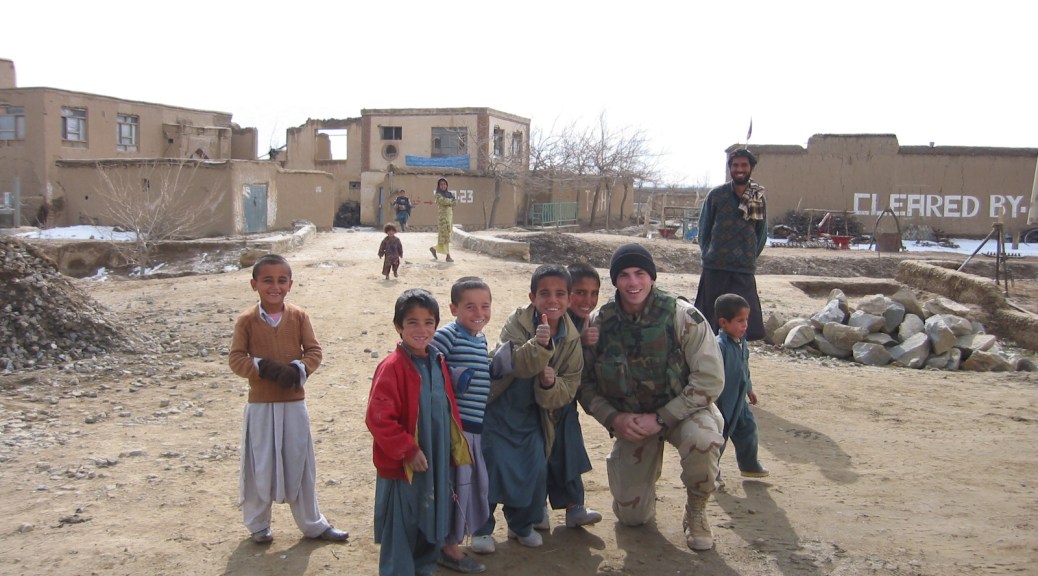
Mr. Melone visits schoolchildren in Afghanistan.
As a combat medic, he made sure his platoon was taken care of properly. Not only this, but Mr. Melone also took good care of prisoners of war (POWs) who were on the side of America’s enemies. He cared for the very people who may have killed him if given the chance. He never lost sight of the humanity in people on the other “side.” For him, it wasn’t about how many people he hurt, it was about how many people he helped. “Everyone is human and deserves dignity,” he said
Overall, Mr. Melone reports that he and his American platoon colleagues were treated well by the Afghans, but he noted that he “wasn’t sure if some were bringing information back to the enemy.” Similar to Vietnam, there were times he did not know who the enemy was.
The women in Afghanistan wore burqas and were not allowed to speak to American servicemen, Mr. Melone recounted. The Afghan women were only allowed to speak amongst themselves or possibly to female soldiers. The young girls in Afghanistan attended school at the time; however, that is no longer the case. Mr. Melone reflected with regret on how women’s rights deteriorated over time. Since the U.S. withdrew from Afghanistan in 2021, the role of women has declined even further.
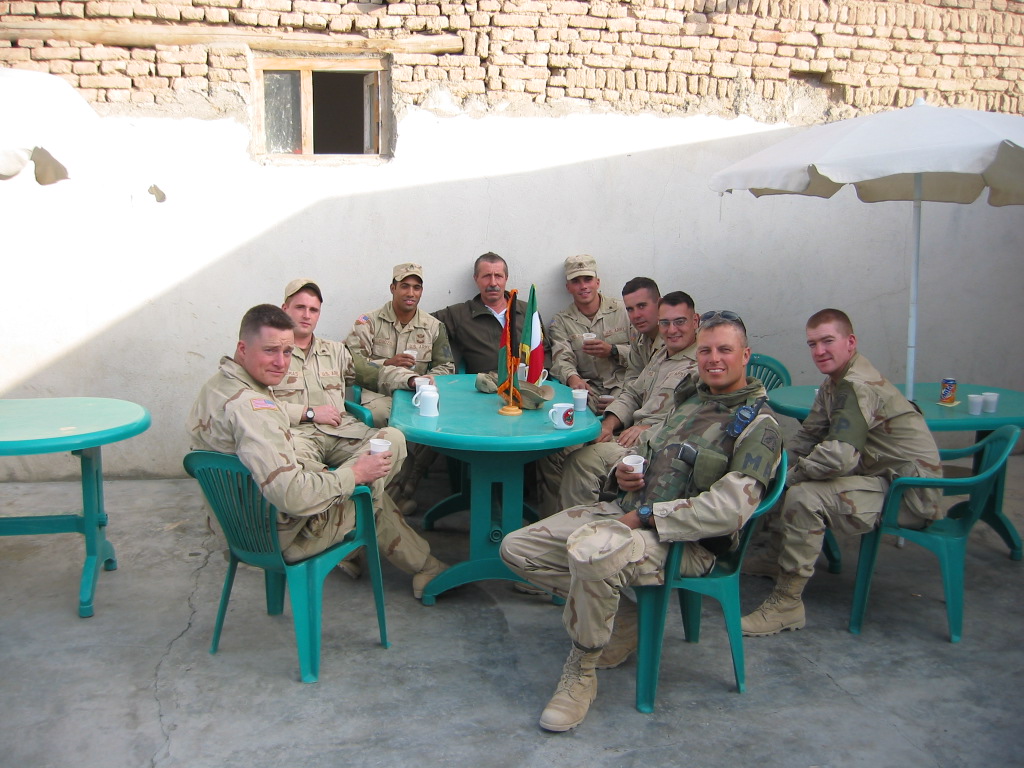
Mr. Melone and fellow soldiers enjoy the Italian platoon’s espresso bar.
Despite being in combat overseas, there were some moments of levity that Mr. Melone looks back on fondly. He remembers that the European troops were better equipped and had more luxuries than their American counterparts. He recalls visiting an Italian military platoon that had set up a full espresso bar. Mr. Melone and his fellow American servicemen indulged in the Italian hospitality and truly enjoyed the excellent quality coffee, espresso and cappuccino.
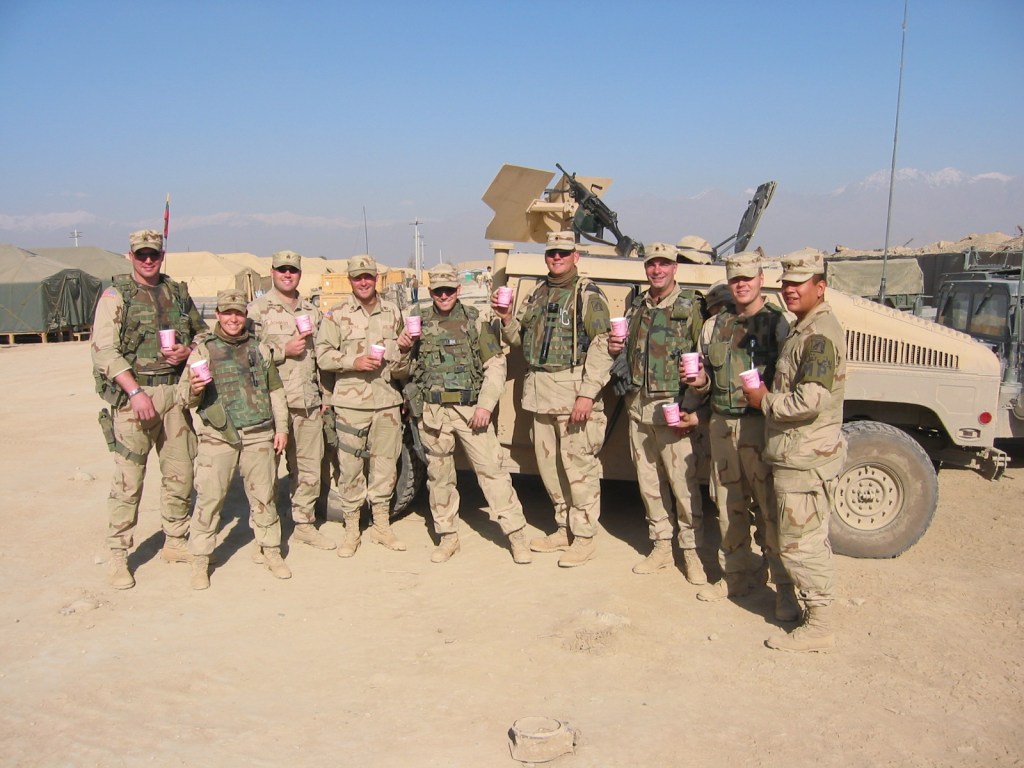
Mr. Melone’s platoon with their MaryLou’s delivery.
As a lover of coffee, this was one of the comforts that Mr. Melone missed most. He recalls writing a letter to the popular coffee chain Mary Lou’s asking them to send his platoon some coffee. Soon, he and his fellow servicemen received a massive supply of Mary Lou’s coffee direct from the South Shore.
Much like O’Brien recounts in The Things They Carried, Melone met his best friends in the military. They gave each other nicknames and used their sense of humor to deal with the stress and agony of war.
Also similar to O’Brien’s observations, Melone considered the overall sense of purpose in America’s presence in Afghanistan. At the time, Melone felt that Americans had a strong reason to be in Afghanistan: to free the Afghans from the oppression of the Taliban. Yet looking back, he feels doubt about what the purpose was. He reflected that, when it comes to war, “getting out is way harder than going in.”
An Afghan child walks his bull on a leash.
In The Things They Carried, Tim O’Brien writes about the tangible and intangible things he and his fellow troops carried with them while at war in Vietnam. Mr. Melone said during his year of service and to this day, he carries the Afghan children. He felt a deep connection to the innocent young lives that were trying to survive in very difficult conditions. He showed a photo of a very young boy walking a bull around on a leash, similar to the way Americans walk their dogs. He cherishes photos of the children of Afghanistan and has several photos framed around his house.
Physically, he carried a St. Jude prayer card from his cousin Patty that was originally their grandmother’s. This prayer asks God for help during difficult times. He carried this prayer card with him everywhere and it reminded him of his loved ones back home.
To this day. Mr. Melone carries the powerful emotion and experience with him, and is not afraid to show his vulnerability and how it deeply affected him. We witnessed this when he shared his family legacy of service, his love for the children of Afghanistan, and his love for his own children.
Ultimately, Mr. Melone is grateful for the opportunities the military gave him and is proud of his service. However, his overall message about war resonated with us all: “Anything that glorifies war is a lie. War is inhumane.” We are sure Tim O’Brien would agree.
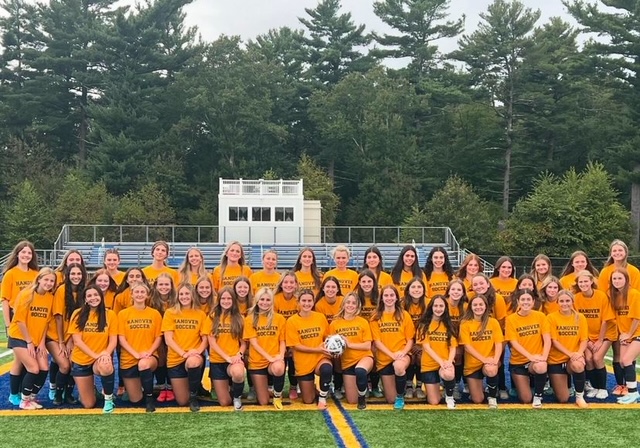
There is no doubt that Hanover Girls Varsity Soccer has had amazing seasons. They won the Division 3 state championship in 2022 and made it to the state finals in 2023. But with the graduation of many seniors, this year’s team is facing a rebuilding season.
Led by senior captains Callie Baldwin, Hannah Geary and Sophie Schiller, the 2024 team has gone 7-4-1 in its first 12 games, and was ranked 8th in the Oct. 8 MIAA state power rankings. In an interview with The Hawk, Baldwin, Geary and senior Savannah Draheim agreed the 2024 team has had a slow start and is trying to find its rhythm.
The team started the season with a tie and a loss, won the next five games and then lost two back to back before winning the next two. The rollercoaster season can be attributed in part to the loss of nine seniors to graduation, including goalie Natalie Mutschler. Despite the girls’ struggle to find their groove, there have been bright spots. Junior Maelyn Foley was named a Boston Globe Eastern Mass Player of the Week on Sept 25 for scoring one goal in a 2-1 league win against Silver Lake and two in a 2-1 defeat of North Quincy.
When asked their goals for this year, Draheim said, “We want to win the league, but have to beat Scituate on senior night.” That big game is scheduled for Oct. 22 at 6:30 pm.
When the team won the state championship in 2022, it was the first title in 20 years. The 1-0 loss to Norwell in the 2023 title game was a heartbreaker after an exciting tournament run.
The regular season ends Oct. 25. Schedule and scores can be found on Arbiter Sports or by following Hanover HS Athletics on X, formerly Twitter.
























 The Hawk