Tag Archives: featured

Senior Spotlight: Highlighting Members of the Class of ’26

By Bradlee Dowling and Sienna Lamond, ’26

Editor in Chief and Staff Writer

This year, The Hawk will profile some of the truly special students in the Class of 2026. Each issue, we’ll ask several seniors about their Hanover High School experience to get to know a little bit more about them before they head off into the world. The chosen seniors showcase excellence, whether as a team captain, award winner, club leader, or academic achiever. Read our previous profiles at Senior Spotlight.

Samuel Light

Samuel Light has lived in Hanover his whole life, and over the years he’s built a very impactful high school experience. Sam has always loved athletics; he started out playing basketball and baseball in elementary school, and those sports have stuck with him ever since. Even now, he’s just as involved and says that going to games or playing in them himself has been one of his favorite parts of school. 

High school also has given Sam the chance to explore other parts of his life. Over the past few years, he’s grown a lot closer to his religious beliefs and has become much more involved in church activities. In fact, he took that passion one step further by starting the Bible Club at HHS. 

Looking back, Sam says one thing he misses about elementary and middle school is simple but nostalgic: “playdates.” Beyond that, he’s found things in high school that really stick out. Academically, he’s loved engineering and names Mrs. Collins as one of his favorite teachers. “She cares, and she shows it,” he says.

Outside of class and sports, Sam has also developed some unexpected skills. He runs a lawn mowing business, which he says has helped spark his interest in the business world. His dedication to work – whether on the court, in class, or mowing lawns -has earned him recognition as well. One of his proudest achievements is winning the Wayward Award for Sportsmanship from the MIAA. That meant a lot to him, because it’s completely about how you carry yourself, not just the score or stats.

When it comes to reflecting on high school, Sam’s favorite year is either freshman or senior year. He says both brought different experiences that helped him grow. If he could do it all over again, he admits he would spend less time complaining and more time appreciating the moment. “I’d take my time with stuff,” he says. “There’s no point in stressing about little things. You just gotta enjoy it.”

For Sam, the biggest lesson from his time at Hanover is clear and straightforward: “Hard work actually does pay off, working hard is actually worth something.” With college on the horizon and plans to study business, Sam is taking that lesson – and all the skills, friendships, and experiences he’s gathered – with him into the next chapter of his life.

Shane Mahoney

Shane Mahoney has been part of the Hanover community since first grade, when he moved here from Rockland, and much of his time in school has been shaped by the activities and interests he has stuck with over the years. 

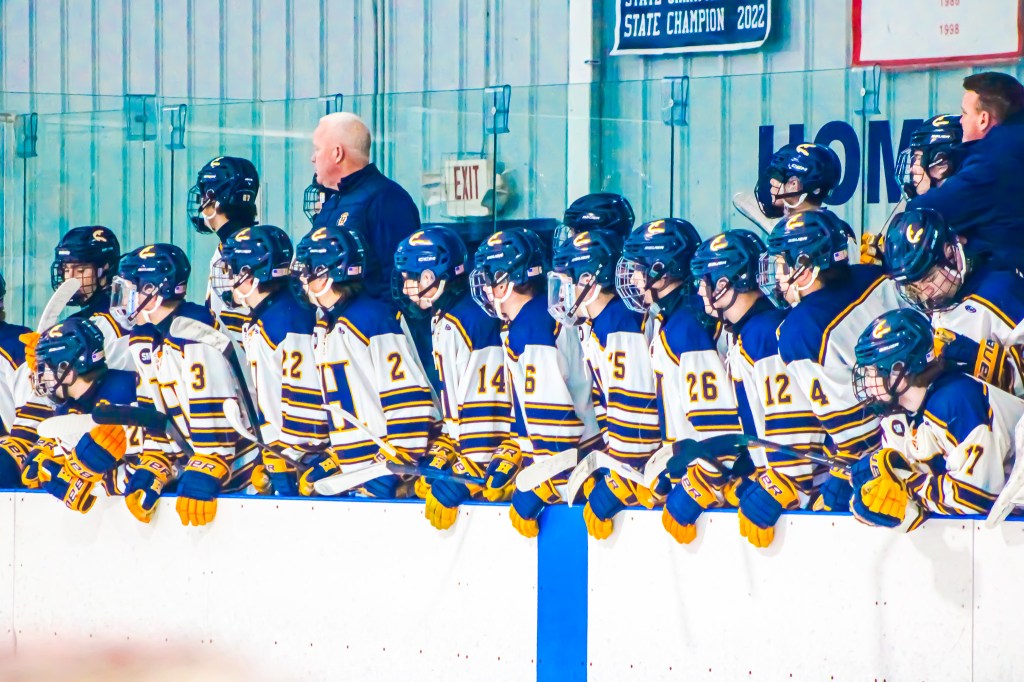
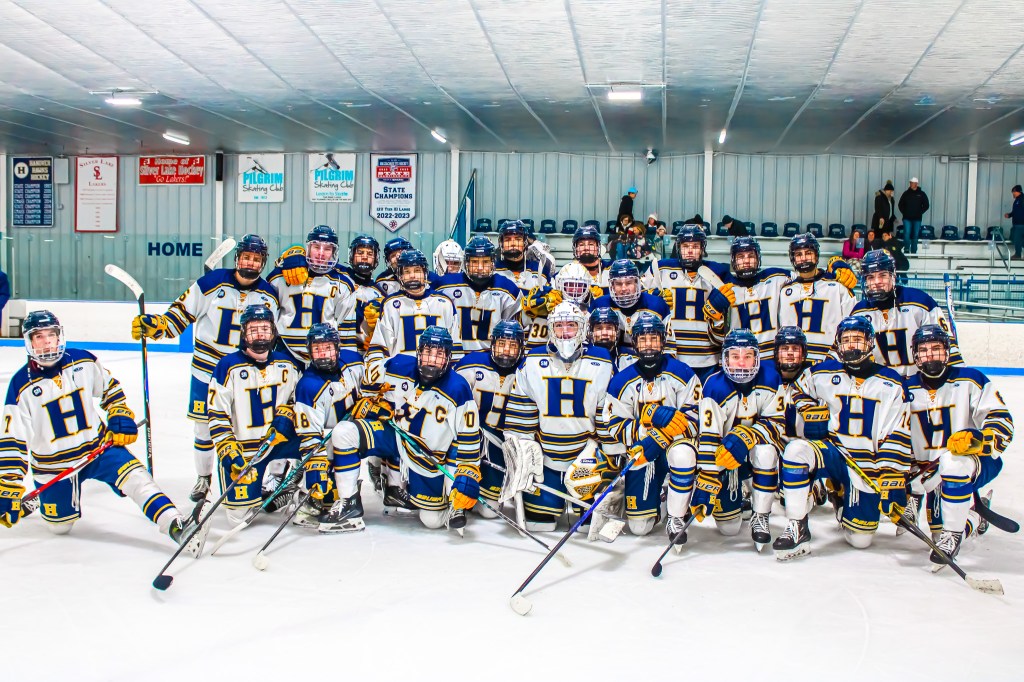
One of the most prominent activities in Shane’s life is hockey, a sport he began playing at a young age and continued throughout high school. His dedication to the sport paid off when he became a hockey captain, an accomplishment he says he is especially proud of. While hockey has always been important to him, Shane also discovered a new passion in high school – lacrosse – which he says became one of the best activities he has participated in. 

Academically, Shane’s favorite class has been English, particularly with Mrs. Cotter. He explains that he enjoyed the class because “I always find it interesting,” and because it allowed him to focus on writing, research, and open-minded discussions. He appreciated being able to “come up with your own answers and be able to argue,” which made the class feel really engaging and meaningful.

Outside of sports and academics, Shane has interests that many people may not know about. One of these is playing the guitar, which he completely taught himself. Looking back at his four years of high school, Shane says senior year has been his favorite (so far), because it has allowed him to feel more comfortable and confident. If he could go back and do high school over again, he says he “wouldn’t stress about little things,” explaining that “in the grand scheme of things, enjoying yourself is much more important.”

After high school, Shane plans to attend college in the Midwest, where he hopes to study management. Reflecting on his time at Hanover, Shane says the biggest lesson he has learned is to stay true to yourself. “Be yourself, express who you are,” he says, adding that he “would like to see people try to be themselves more.” As he prepares to graduate in a couple months, Shane leaves Hanover with lasting friendships, meaningful experiences, and a mindset focused on confidence and enjoying the moment.

Charlie Campbell

Charlie Campbell started school in Hanover in kindergarten and has lived here his whole life. Throughout middle and elementary school, he played hockey and lacrosse. He says, “they are my favorite things to do,” and still plays them today.

In high school, Charlie started playing football. He has played now all four years, “which has been awesome to be part of.”
In elementary and middle school, Charlie’s grandparents used to pick him up from school, “and I miss that a lot.”

His favorite classes have been history with Mr. Perry, video production with Mr. Patch, and precalculus with Mr. Boutin. “[Mr. Perry] made history fun to learn and that was something I didn’t love before,” Charlie says. “[Mr. Patch] gives us the chance to be creative,” he explains, “and…math is my favorite subject and I like the way [Mr. Boutin] teaches it as he helps a lot.”

Charlie’s favorite school activity has been playing for the lacrosse team.

Charlie plans on attending college to study business. He believes that high school has influenced his choice, “by recommending colleges to me that I could succeed at.”

One accomplishment he is proud of is being named captain for the lacrosse team for his senior year. Congrats, Charlie!

Outside of school, Charlie referees for youth lacrosse and youth hockey games. He used to work at Brothers Bar and Grill as a busser as well, though he doesn’t anymore.

His favorite year in high school has been sophomore year, “because of the teachers I had that made the year fun, the seniors were a great group that year.” And perhaps the biggest detail from that year, “my (football) team made it to Gillette Stadium that year which was an unreal experience.”

If he could restart high school from the beginning, Charlie, “would try much harder in my classes.” He also wishes that he spent more time not worrying about things that truly didn’t matter in the end.

If he had to take away one lesson from all of high school, it would be, “to always live in the moment and cherish every moment because high school goes by very quick.”

Should We Still Use the Death Penalty?

By Ryan Costello, ’27

Staff Writer

The death penalty is one of the most controversial and troubling punishments in modern society. While some argue that it provides justice to victims’ families or prevents future crimes, a deeper look shows that capital punishment fails in many ways.

One of the strongest arguments against the death penalty is the possibility of executing innocent people. Courts and juries have made mistakes. The Innocence Project, a nonprofit that works to exonerate people who are wrongly convicted, claims that since 1973, more than 190 people in the United States have been sentenced to death, often after spending decades behind bars for crimes they did not commit. DNA testing and improved investigative techniques have proven there can be many errors in the legal system. Once someone is executed, there is no way to correct such a mistake. No judicial system can reverse such a permanent punishment.

Another argument is that it is more expensive and more time consuming to use the death penalty than to sentence someone to life in prison. The death penalty is more expensive than life in prison because death penalty cases require longer trials, more lawyers, and years of appeals. Housing inmates on death row also costs more due to higher security needs, ultimately costing an average of $1 million taxpayer dollars per inmate. An inmate can sit on death row for as long as 20 years.

Some people believe that the death penalty is beneficial because it holds people accountable for their heinous actions and provides justice to victims and their families. While there may be some truth to this, the negatives hold more of an impact.

That is why the 27 states where capital punishment remains legal should do away with the procedure. The cost, in terms of taxpayer money and potentially life-ending mistakes, is too high to pay.

Featured image: https://d.newsweek.com/en/full/326540/rtr3hrgi.jpg

Fall Sports Roundup: Cheer and Golf Make History

By Luke Curran, ’27

Sports Editor

The fall season of Hanover High sports was one to remember. Every team qualified for post-season tournaments, with all seeded high enough to host home games. All teams earned MIAA Academic Excellence Awards, and the Athletic Department secured the MIAA District 9 Sportsmanship Award. Notably, our Golf Team captured Hanover’s first-ever MIAA Division 2 South Sectional Championship — a historic accomplishment for the school. And Competition Cheer won the state title for the second consecutive year, the first back-to-back titles since 1976.

Read on for more about the outstanding achievements of our fall teams. Photos are courtesy of HHS athletics.

Competition Cheer

This year, our competition cheer team had significant success. Led by senior captains Morgan Curtis and Natalie Frank, the team won the state title for the second straight year, the first back-to-back titles since 1976. In addition, they earned first place at the Pumpkin Patch Invitational on Oct. 18 and the Think Pink Invitational on Oct. 25. They also won the Patriot League Fisher Division Championships on Nov. 6. They placed first at the South Regionals on Nov. 16, earning the grand champion title and achieving the highest score in school history. Finally, they attended States in Worcester on Nov. 22 and won for the second consecutive year.

Golf

The Hanover golf team was the champion this year, posting a 14-3 regular-season record. They won the MIAA D2 South Sectional Championship on Oct. 14, with the team +36 in very challenging conditions and solid scores from their four captains: senior Joe DaCosta (+7, T6), senior Cam Melone (+9, T10), junior Owen Crowley (+9, T10), and senior Cole Madden (+11, T19). This was Hanover’s first sectional Golf title; the team finished second in 2014. The team excelled all season, with Madden carding an 80 (+9) for a T17 finish.

Football

Led by senior captains Brandon Errico, Sebastian Brown, Peter Clarke, and Max Johnson, the team went 5-3 in the regular season and earned the No. 3 seed in the D5 tournament. In the round of 16, they faced the Weston Wildcats on Nov. 17 and won at home, 46-14. They advanced to the round of 8 on Nov. 14 against the No. 6 seed, Archbishop Williams, where their season ended in a close 28-26 home loss. Finally, they played their 59th-year Thanksgiving game on Nov. 27 against Norwell, achieving a blowout win with a final score of 49-8.

Boys Soccer

The boys soccer team also had great success this season, earning the #12 seed and posting a 9-6-3 regular-season record. Senior captains Ryan Mutschler and James McDermond led the team and beat #21 Blackstone Valley RVT 3-0 in the round of 32 on Nov. 4. Following this win, they advanced to the round of 16 on Nov. 8, losing 4-1 to Chicopee.

Volleyball

The girls volleyball team advanced far this season, led by senior captains Tess Madden and Dylan Poirier. They finished the regular season 17-3, with setter Sadie Chadwick recording her 1,000th assist. They entered the MIAA Division 3 round of 32 on Nov. 1 as the #6 seed, facing the #27-seeded Medway and beating them 3-1. They then advanced to the round of 16 at home on Nov. 4, where they lost 3-2 to Newburyport.

Field Hockey

Field hockey posted a 13-3 regular-season record, with senior captains Katie Jones, Jameson Bryan, and Grace Gilligan leading the #7 seed team to a 5-1 win against the #26-seeded North Reading in the round of 32 at the MIAA Division 3 playoffs. On Nov. 4, they advanced to the round of 16 at home against Lynnfield, where they lost 2-0. The team showed dominance this season, finishing as Patriot League Fisher Division champions.

Girls Soccer

This year, the girls’ soccer team, led by senior captains Anna Egan, Maelyn Foley, and Abby Kajunski, dominated in the regular season with a 13-3-2 record. They entered the round of 32 as the #5 seed on Nov. 5 and lost at home to East Bridgewater, 1-0.

Cross Country

The cross-country team performed well this year, with the boys finishing 1-4 and the girls 2-2. The boys’ team was led by captains Leo Galvin, Joe Lynch, Dean Gomes, and Drew Keith, while the girls’ team was led by Sawyer Bradford. At the all-league meet on Oct. 25, Ben Willis finished 18th out of 100 varsity runners and was named league all-star, and runner Mae Evans finished 15th out of 79. In their final meet on Nov. 8 at the Division 2 state tournament, Hanover competed at the challenging Northfield Mountain course, with the top seven boys and girls on the team competing. Seniors Leo Galvin (18:47.2) and Willis (18:50.93), and juniors Bradford (23:50.09) and Hazel Blum (24:16.05) were HHS’ top finishers. The team achieved significant success and strongly represented Hanover this fall.

Fall Musical Combines Improv, Audience for Unique Hit

By Siena Oliver, ’27

Opinions Editor

Hanover High School’s 2025 musical production was a huge hit! Rehearsed during the fall, and performed three nights before Thanksgiving, The 25th Annual Putnam County Spelling Bee starred 19 Hanover High School students, with help from many more in the crew and the musical pit (cast, crew and pit lists in photo gallery below).

This musical, as its name suggests, is a comedic and highly dramatized take on an average school county spelling bee. Premiering on Broadway in 2005, it follows six children, each with different quirks and backstories, and three adults throughout the duration of the Bee. While there are several things that make this show unique, even in the world of musical theatre, one notable difference is its use of timing and setting. While many musicals have stories that span days or longer in just one show, The 25th Annual Putnam County Spelling Bee seems to happen in real time. There are no time skips, set changes, or aging characters. The musical lasts just under two hours, and so does the spelling bee it depicts. This, along with the remarkable level of audience interactivity and cast improvisation, allow audience members to feel especially present when attending the musical.

In addition, and perhaps most uniquely, the show is always changing, and even includes volunteers who are participating the the Bee in real time. Every single production of The 25th Annual Putnam County Spelling Bee will vary greatly, even those preformed by the same cast and crew from night to night. This is because the show relies heavily on both the actors’ improvisation and audience volunteers. At the beginning of each performance, four volunteers are called up to the stage from the audience. They, in many cases, have no formal acting experience whatsoever. These volunteers are welcomed to the stage, then treated like every other “contestant” (actor) in the Bee. As the show goes on, the characters, along with the audience volunteers, are given words to spell in front of the crowd. Improvisation is utilized by the onstage actors when the volunteers are called up to spell a word, and to determine their reaction depending on if the word is spelled correctly or not.

As a member of the cast for the HHS production, this show was a one-of-a-kind experience. Seeing the musical come together for opening night, and be received so well by each of our audiences, was such a treat. The 25th Annual Putnam County Spelling Bee is a hilarious yet touching show that incorporates elements I had not previously seen in a musical. Being a part or this production and connecting with the amazing cast, crew, and pit members, is an experience I will never forget.

Maverick Langill, who has worked behind the scenes of many HHS shows and was part of this crew, shared a similar sentiment. “Even though at times it was stressful, it was an amazing show to be part of. I would work crew for this show every year if I could.”

Click on the images below to enlarge.

Should Cell Phone Hotels Be ‘Closed’?

By Danny Campbell, ’27

Staff Writer

Most likely, everyone has an opinion about the Hanover High School student cell phone policy by now, since we’re into its second year. To minimize distractions, the handbook restricts students from using cell phones in class without the teacher’s permission. Most teachers require students to place their phones in the classroom “phone hotel” (better known, in my opinion, as the “prison”), or keep them in student backpacks. This is enforced with varying levels of strictness depending on the teacher. The policy, implemented by district administration and approved by School Committee, is part of a state and nationwide trend toward restricting cell phone use in schools. I personally think the cell phone “hotels” are a waste of time. They not only show distrust of students, but also could lead to safety issues.

In the last few years, cell phones have become a major part of our lives, and nearly everyone in the United States now has a phone that they use frequently. I can almost guarantee that you – the person reading this page – have spent large chunks of time only on your phone, letting a platform like YouTube, TikTok, Instagram or games consume hours of your day. Many have fallen victim to it, admit it! This is why school districts across the country started limiting or restricting cell phones in school. The Massachusetts legislature is considering a bill this year to ban students from using cell phones and other personal electronic devices during the school day. Most teachers think that getting rid of the phones in class will automatically make the students pay more attention to them during their lessons. Other supporters of the policies feel limiting phones will reduce bullying and improve students’ mental health.

But we need to note three things about these arguments. First of all, NOT every single student in the school is tied to their cell phone! This is a very big thing that I feel people completely ignore when discussing whether or not to restrict phones. There are students who only bring their phones to check the time, text important people during their downtime, or keep in contact with their parents during school hours. So restricting our only form of outside communication is very unfair for those of us who barely take them out.

Secondly, the policy can cause safety problems during an emergency. Imagine that a fire or some other catastrophic event happens that could lead to school being evacuated. If students are as attached to their phones as administrators seem to think, the first thing they’ll do in an emergency is try to get their phones from the “hotel.” This could cause injuries and a delay in getting students out of the building quickly.

Finally, having to put phones in a classroom “hotel” makes it possible for students to forget them when the bell rings for dismissal. This means students have to interrupt their next class to come back and retrieve them, or wait until the next day to pick them up if school is over. It could even lead to theft of the often expensive devices.

I think a better approach to the cell phone issue would be to teach students how to use the technology responsibly. This could be taught in a unit for middle school health class, during Mrs. McHugh’s library sessions, or through auditorium presentations like the ones we have about topics like drug abuse and lockdown drills. Students need to be taught the benefits of moderating screen time to take care of their mental health. If we can do this, there won’t be the need for phone “hotels.”

Community Service Opportunities Through Clubs

By Charlize Coviello, ’29

Staff Writer

Community service is an action, performance, or a “hands-on” activity by an individual or group without compensation, whose effort will directly benefit others. Taking part in community service activities are a great way to both connect with and benefit your community.

At Hanover High School, students are required to perform 10 hours of community service per year for a total of 40 hours before graduation. In this way, students remain active in their community for all four years. However, students interested in applying for membership in the National Honor Society are required to have 40 hours by the beginning of junior year. NHS is an organization that highlights academics, leadership, service and character and is a great way for motivated students to give back to their community. Whether students are aiming for NHS or just trying to meet the yearly service requirement, there are many clubs that can help.

One way HHS students can serve their community is by going to Dirty Works, a gardening and sustainability club run by Mrs. Curtis and Mrs. Curley. Dirty Works meets every Thursday after school from 2:30-3:30 in room 110. Students who attend meetings recycle old K cups from staff coffee machines, plant and maintain the courtyard gardens, and make HHS look more beautiful. Every session includes one hour of community service. If you are interested in Dirty Works, contact Mrs. Curtis at kcurtis@hanoverschools.org or just show up!

Another option is to join Lifesavers Club, which holds blood drives to provide the Red Cross and Mass General Hospital with much-needed supplies. The club also holds food, clothing and toiletry drives to benefit community organizations that serve those in need. Volunteering for these events counts as community service. It’s run by Nurse Nee and Mrs. LeVangie, who you can see in the nurse’s office for more information.

The focus of Green Team is to educate the school community about recycling in the classroom and at home. Members meet after school on Wednesdays to empty recycling bins around the school to lessen the trash that we produce. You receive community service every time you help. The club is run by Ms. Byron in Guidance; email kbyron@hanoverschools.org to learn more.

Outreach Club provides opportunities for students to brighten the days of the elderly citizens, veterans, women in shelters, homeless people, and more. This club typically meets on Tuesdays at 7:20 once or twice a month in the library. Some recent things done by this club were bingo nights, Valentines and Easter care packages for the Meals on Wheels program, and math nights at Center and Cedar School. The club is run by Mrs. Parry and Natalie Frank, who you can reach at rparry@hanoverschools.org and nfrank26@hanoverstudents.org.

Tomorrow’s Teachers is a club designed to help students explore a career in education. By providing students with a realistic understanding of teaching, the club encourages students to think seriously about a future career. By joining this club, you can volunteer for opportunities to work with children, along with receiving community service. You can email advisor Mrs. Abban to learn more at dabban@hanoverschools.org.

The Eco Club is a group that enhances students’ knowledge on climate change, sustainability and environmental issues. The club focuses on environmental causes important to members, works to spread awareness in our school, hosts fundraisers and helps at local beach and town cleanups. Contact Mr. Patch for more info at mpatch@hanoverschools.org.

Be Better Movement helps promote a positive and inclusive school environment for all students. It meets every other Friday morning and performs occasional community service like greeting students at the other schools and holding special events. It is run by Mrs. Byron, who can be reached at kbyron@hanoverschools.org.

Animal Care Club meets one Thursday a month after school in room 305 to plan animal fundraisers and volunteer opportunities. This month, the club is running a holiday pet drive for Buddy and Friends in Pembroke. They will have more volunteer opportunities in the new year. If you want to join, email advisor Mrs. Hughes at ahughes@hanoverschools.org or student advisor Audrey Martin at amartin27@hanoverstudents.org.

Finally, Mrs. Foster in the main office sometimes has info on community service possibilities. Check in with her and remember to always listen to announcements in the mornings as well about new community service opportunities!

Be sure to check out my next article on why hair gets more prone to be affected by static in the winter time!

The Great Alcatraz Escape

By Michael DeLuca, ’29

Staff Writer

I’m sure you have heard of Alcatraz, aka “The Rock;” a prison where the worst of the worst were sent; a prison located on an island in the middle of the fast-moving, freezing-cold San Francisco Bay; a prison that was made to be inescapable. Well, maybe inescapable is the wrong word.
One night on June 11, 1962, brilliant mastermind Frank Morris and brothers John and Clarence Anglin were able to do the impossible: escape Alcatraz. But how did they do it? And what happened after they did?

Background
 
First built as a fortress and military prison in the 1850s, Alcatraz became a federal maximum-security prison in 1934. The 22-acre island prison housed notorious criminals like gangster Al Capone before closing in 1963 because it was too expensive to maintain. The surrounding saltwater was corrosive to the prison’s concrete walls. While open, it was the site of more than a dozen unsuccessful escape attempts, with most prisoners stymied by the remote location about 1.5 miles from the closest land.

Morris, born on September 1, 1926, arrived at Alcatraz in January of 1960. He was sent there for a 14-year sentence after being convicted of bank robbery. Prior to his time at Alcatraz, Morris was able to escape multiple other prisons as he was highly intelligent and very resourceful. Shortly after Morris’ arrival, John Anglin was transferred to Alcatraz. Born on May 2, 1930, Morris was serving a 35-year sentence for bank robbery. A few months later, in January of 1961, John Anglin’s brother, Clarence, joined them. Born May 11, 1931, Clarence Anglin faced a 15-year sentence for bank robbery and multiple prison escape attempts. There was another prisoner, Allen West, born March 25, 1929, who was involved in the escape, but his attempt was unsuccessful. The four men all knew each other from other prisons. They were conveniently in adjoining cells and could communicate regularly and plan their escape.

Frank Morris, Clarence Anglin, John Anglin

The Preparation
 
So exactly how did they escape their cells? Well, each prison cell had a small vent at the bottom of the back wall. The men came up with the idea to pry out the vent, and widen the preexisting hole, as the normal hole was way too small for any of them to fit through. At night, the gang used modified spoons and a homemade drill made from a vacuum cleaner motor to slowly chisel away at the wall around the hole. As you can imagine, they didn’t want anyone to notice what they were doing or hear their digging. Morris came up with an idea.  Every night from 5:30 to 7, the prisoners had music hour, so during this time one of the men would loudly play an accordion to cover up the noise. Another man would keep watch to make sure that no guards noticed anything. This indeed worked and after several months each man had successfully carved out a big enough hole for him to climb through. 

Due to the routine room inspections done on the prisoners’ cells, the gang needed a way to cover up the holes they were making. They stole paint from the art room and used cardboard, soap and notebook covers to make a fake wall that perfectly matched the vents they carved out.  The result was brilliant, and the guards never suspected a thing.

The fake wall used to cover the hole behind the vent

On the other side of the vent, within the prison wall, was a very small corridor where there were numerous pipes. The pipes acted as ladders for the men to climb up and led to an area above the cells. This is where the men planned on doing all of their work to escape and store their materials.  The only problem was the entire front half of the area had cell bars on it, making it visible to any guard. So what would they do? Well, Morris only knew about this spot because he had a job painting the ceilings and sweeping the floors there. He was able to maneuver a plan to cover the bars with blankets in order to hide their work.  Morris came up with the clever idea that every time he would sweep there, he would sweep some of the dust out the cell bars and onto the guards’ polished hallway below. When the guards started complaining of the mess, he suggested the solution to cover the bars with blankets so the dust couldn’t fall through. Morris did this job as slowly as possible so the guards would keep the blankets up there until the day the gang could finally escape. Every time the men would climb up, they would have to make as little noise as possible, as any tiny noise would echo throughout the entire cell block, alarming the guards. But the men were very skilled and did not make any loud noises, and the guards never caught them.  

Every night, a guard would walk the cell block hall to check in each cell to make sure nobody was out of bed.  If a guard walked past the cells of Morris, West, and the Anglin brothers and saw that they weren’t there, an alarm would be triggered and a search would begin. That is where possibly the most genius part of this whole escape comes into play. The four men crafted fake heads using a combination of soap, toilet paper, concrete dust, toothpaste and paint, again stolen from the art room, to make highly realistic heads that matched their own.  They would put the fake heads in their beds and make it appear that the men were sleeping.  For the hair of the heads, they used real human hair. One of the Anglin brothers had a job at the prison barber shop and would secretly collect the fallen hair to put on the fake heads. The heads took months of hard work, and the result was astonishing.

The fake heads created to fool guards doing cell checks.

Finally, the men had to find a way to overcome the hardest part of their escape, traveling across the fast-moving, freezing-cold San Francisco Bay. Now you know that Morris was highly intelligent, so he researched sea survival books from the prison library. Morris looked into how life vests were made, and he came up with the idea to steal multiple rain coats, and glue them together to create life vests and a raft. The men ended up stealing over 50 rain coats and glued them together using waterproof glue that indeed made life vests and a raft! But they needed a way to inflate them. Remember the accordion from earlier? They modified it, transforming it into a homemade pump. As the final detail, the men built simple paddles using plywood and screws. 

One of the life vests made from stolen rain coats

The Escape

The day had finally come for the four men to escape, June 11, 1962. But the men did not just pick any random day. You see, the San Francisco Bay current was highly unpredictable and would not just take the men to shore every day. If they weren’t careful, the current could bring the men anywhere in the ocean. But Frank Morris knew this. He again used the books in the library to study the current and figure out the perfect day that the current would bring them directly to shore, and that day, he figured out, was June 11. But it would still be challenging. 

So the night had come, the guards had called “lights out” and it was the time for the men to escape. Each man took out their fake head and positioned it in their bed to make it appear that they were asleep. Then they took out their fake vent to escape their cell. Remember earlier how I said Allen West was unable to escape? Well, this was because on the night of the escape, his vent got stuck and when he couldn’t remove it, Morris and the Anglin brothers left him behind. The three men climbed up to the platform where they had been storing their materials and picked up their raft, life vests, and paddles. The men climbed to the roof of Alcatraz and scaled the prison walls, perfectly navigating them in a way that no guard towers would be able to spot them (Morris had been studying the outside of the prison for weeks to figure out the perfect route). Next, they climbed down the rocky island to the cold bay, put on their life vests, and then climbed into the raft and rowed away. They were finally free.

The Outcome

What happened next is unknown. Officials back then speculated that the three men drowned in the bay, but no bodies were ever found. The FBI eventually talked to West about the plan and he gave extensive information, getting time off his sentence for cooperating, but the information was not enough to figure out if the three men made it to shore. There were reported sightings of the men in the years after, and rumors they made it to South America, but none of that was ever confirmed. So what do you think? Do you think they drowned in the bay or froze to death? Or do you believe they made it to freedom? If anyone were to successfully complete an escape from The Impenetrable Rock, it would definitely be the Anglin brothers, and the brilliant mastermind, Frank Morris. 

The History of Christmas Traditions

By Gabriella DeLuca, ’27

Staff Writer

Christmas—the holiday of evergreen trees, gift giving, Santa Claus, and carols—is a celebration that captures both the beauty of winter and the joy of being with the ones you love. Celebrated around the world, from countries ranging from the United States to Germany, Christmas traditions are truly a hallmark of the winter season. But where did these beloved holiday traditions come from? And why do we still celebrate them today?

The origins of Christmas are intertwined with various religious and cultural traditions from around the world. In the Christian faith, Christmas is the celebration of the birth of Jesus and his bringing of salvation, hope, and love to earth. Christmas also coincides with the winter solstice and incorporates pre-Christian traditions, some that date back as far as two millennia.

December 25th aligns closely with earlier pagan holidays, particularly the Roman celebration of Saturnalia, which likely influenced the development of many Christmas traditions that are still celebrated today. Saturnalia, observed between December 17th and 24th, was a celebration of the winter solstice practiced by the pagans (polytheistic Romans) to honor the sun god, Saturn. Romans believed that the cold season was a sign that the sun had grown ill and weak, and that the lengthening of daylight that began after the winter solstice symbolized its gradual recovery and eventual return of springtime. During this Roman festival, all social hierarchies were overturned and the pagans throughout Ancient Rome came together to celebrate the winter solstice. This celebration was characterized by feasting and gift-giving, customs that strongly resemble modern Christmas traditions. The gifts exchanged and the foods shared symbolized hope for a prosperous spring harvest in the coming year.

How To Celebrate Saturnalia Like A Roman | DigVentures
A typical Saturnalia feast celebrated with food, drinks, games, and conversation.

Another festival that inspired the modern Christmas traditions was Yule. Yule was a celebration of the winter solstice and renewal of light, similar to the pagan festival of Saturnalia. This 12-day celebration is believed to be one of the oldest winter solstice festivals in history with origins tracing back to the Norse and German people of northern Europe. One of the hallmarks of this festival was the burning of the Yule log, a celebration that is still popular in Europe today, although in a different form. The original Yule log was an entire tree trunk that was burned for 12 days to welcome the return of the sun and the rebirth of light. The burning of the log was believed to symbolize the cleansing of the old year’s hardships and good fortune for the spring ahead. Today, in France and other countries in Europe, it is a common practice to bake a roulade-style cake decorated with berries and holly to look like an ancient Yule log.

The ancient tradition of Yule Log at Christmas ~ – RANDOM Times •
The burning of the ancient Yule Log during the twelve-day Yule celebration.

Christmas Traditions

Today we celebrate Christmas by decorating Christmas trees, writing letters to Santa, singing carols, and decorating our homes with mistletoe and holly, traditions reminesent of those practiced by people many centuries ago.

Christmas Trees

Pagans were the first to use evergreen trees and plants to decorate their homes and brighten spirits during the winter solstice. Evergreen was believed to represent fertility and a new life amidst the darkness of winter. Decorating their doors and windows with evergreen boughs reminded the Romans of the green plants that would grow again when summer returned and the sun regained its strength. The Ancient Egyptians also filled their homes with green palms and papyrus reeds during their mild winter season to symbolize the triumph of life over death.

The modern decorated Christmas tree began as a German tradition and was first brought into the home during the 16th century. The Germans, Romans, and Celts brought greenery indoors during the winter to encourage the return of the sun during the dark winter months. This practice was spread across the Atlantic Ocean and brought to the Americas during the 18th century by German soldiers during the Revolutionary War.

It is widely believed that the 16th-century Protestant reformer, Martin Luther, was the first to add lighted candles to a tree. Stories suggest that while walking home one winter evening, Luther was amazed by the sight of the stars twinkling among the evergreen trees. To replicate the scene for his family, Luther brought a tree into his house and decorated its branches with lighted candles.

The modern decorated Christmas tree and the popularity of this tradition has been linked to a 19th century illustration of Queen Victoria and the British royal family standing with their Christmas tree during the winter season. This image, sketched in the Illustrated London, significantly boosted the popularity of the Christmas tree and led to the further spread of the tradition.

Where Did Christmas Trees Come From? - How Queen Victoria & Prince Albert  Made a Holiday Tradition
1848 illustration of Queen Victoria and German Prince, Albert, standing with their family around a decorated Christmas tree.

The Legend of Santa Claus

It would be hard to imagine Christmas without Santa Claus. During the winter season, the image of Santa Claus can be seen almost anywhere, from Coca-Cola bottles, to real-life experiences where children can meet Santa and tell him their Christmas wishes.

Today, Santa Claus is thought of as the jolly old man in a red suit with a white beard who brings toys to all the good children on Christmas Eve. However, the story of Santa Claus can be traced back hundreds of years to a monk named St. Nicholas, known for his generosity and gift-giving. During the 4th Century in modern-day Turkey, St. Nicholas dedicated his life to helping the poor and the sick, giving away all his inherited wealth to those in need. Over the course of many years, St. Nicholas became recognized as the most popular saint in Europe and known worldwide as the protector of children. Today, St. Nicholas is celebrated with a feast on December 6th, the anniversary of his death.

Victorian Santa: 10 High Res Watercolor Jpgs, Junk Journaling, Scrapbook,  Crafts, Card Making, Digital Art, Christmas, Vintage Christmas - Etsy
Common depiction of the modern Santa Claus.

Mistletoe & Holly

Decorating with mistletoe and holly is a well-known holiday tradition, but did you know that these plants’ history dates back hundreds of years?

Holly was a sacred plant for the pagans as they associated it with Saturn, the god of the sun and agriculture. During Saturnalia, the pagans would exchange wreaths made from holly for good luck. Over time, the practice of decorating with holly became a tradition, and even today homes around the world are often seen decked out with greenery during the Christmas season.

Have you ever wondered where the tradition of kissing under the mistletoe stemmed from?

There are many theories to the origin of this holiday tradition. The ancient Greeks and Romans believed mistletoe to have healing powers, curing everything from ailments such as epilepsy to poisoning. The Greeks and Romans also used mistletoe as a symbol of peace, reconciling with their enemies under it to symbolize to the end of warfare.

The tradition of kissing under the mistletoe is also commonly traced back to Norse mythology. According to an ancient myth, the god Baldur was prophesied to die an untimely death, prompting his mother Frigg, the goddess of love, to seek protection for him. She traveled throughout the natural world, and secured promises with all the plants and animals to not harm her son. However, Frigg forgot to secure an oath from mistletoe, causing Baldur to be invulnerable to all living things with the exception of mistletoe. With knowledge of this vulnerability, Loki, the god of mischief, was able to kill Baldur using an arrow made from mistletoe. In some versions of this legend, the gods later restored Baldur to life, and in her great delight, Frigg declared mistletoe a symbol of love and vowed to bestow a kiss upon all those who passed beneath it.

Adding to the mythology, this one-of-a-kind Christmas tradition is often credited to Washington Irving, a notable American author who wrote about the tradition of kissing under the mistletoe in his acclaimed novel, The Sketch Book. Eventually this tradition became a romantic custom of the Christmas holiday.

Kiss me sweetheart! A brief history of mistletoe. - Gastown
Kissing under the Mistletoe became popularized during the Victorian Era in England.

Exploring the history behind Christmas reveals a rich tapestry of culture and stories that have evolved over time. Whether you celebrate Christmas, Hanukkah, Kwanzaa, or any other holiday, the traditions we practice today are woven together from centuries of history, offering diverse ways to celebrate life, light, and being with the ones you love.

Going Back to Childhood With Goosebumps

By Abby Lynch, ’29

Staff Writer

I bet that most people have read R.L. Stine’s Goosebumps by the time they’ve gotten to high school, but I don’t think you’re ever too old for them. Stine wrote the original 62 books in the series in the 1990s. But since then, the series has been re-issued, spun off and made into movies countless times. They’re the first scary stories for many children, and even fun to read when you’re older — and harder to scare. Here are a few of the books that I’ve read recently:

Diary of a Dummy: This book was a fun adventure to read. It involved Slappy, the evil ventriloquist’s dummy found in many stories, and two other characters. The other characters found Slappy’s Diary which contained the dummy’s different thoughts. The diary also had clues to find a treasure of gold. The book showed Slappy in a better light than previous books he has been in, which might make readers see him a little differently. Overall the book was really good.

Bride of the Living Dummy: This was a really funny read. The book is about Slappy finding a supposed love, so instead of one dummy making trouble for the main characters, it’s an evil doll and a dummy. I really liked reading this book because it showed what happens to Slappy’s victims when he wins. There were also many funny interactions between characters both bad and good.

Slappy’s Tales of Horror (graphic novel): This book has multiple stories including some of the classics like Night of the Living Dummy, The Werewolf of Fever Swamp, A Shocker on Shock Street, and Ghost Beach. This was also a fun read since I actually got to see some of the characters from classic Goosebumps. After every story, Slappy talked to the reader, acting like a funny, but scary friend.

Slappy, Beware!: This book was interesting to read because it explained some of Slappy’s backstory. One surprising thing about this story is that Slappy lost, even though in most of the stories he usually wins. It was a great read and learning about Slappy’s backstory was really fun.

Why Federal Cuts Could Change The Face of Education

The Department of Education is at risk of being dismantled after the President signed a March executive order to reduce national debt and limit federal overbearance on schooling. Following this action, the Supreme Court allowed the current administration to fire more than 1,000 government employees – half the department’s workforce. The Department of Education is responsible for billions of dollars in student loans and funding for public schools, which allows millions of American students to get their education. The department also enforces civil rights laws that protect many vulnerable students. What will the future look like for students?

“We are going to be returning education, very simply, back to the states, where it belongs…”

President Donald Trump, Executive Order 14242, “Improving Education Outcomes by Empowering Parents, States, and Communities”

The President claims eliminating the Department of Education will not take away from “K-12 students, students with special needs, college student borrowers, and others who rely on essential programs.” However, according to the executive order, quite the contrary will happen: those involved with the department will continue their affairs as usual, but educational authority will be restored to the states. The department costs more than $10 million per year to run, according to President Trump, an egregious amount for an office that “does not educate anyone.” In addition, he points to reading and math scores which he claims are near historic lows across America, with over 70 percent of 8th graders nationwide below proficient. This is further proof, the President argues, that the current federal Department of Education is not working.

But the department manages a significant amount of money, including $1.6 trillion in student loan debt. President Trump claims the loans will simply be managed by another federal department: Treasury, Commerce or the Small Business Administration. Critics of the plan fear there will be delays or disruptions to loans that will interrupt or terminate borrowers’ educational plans. And the department is responsible for enforcing civil rights laws in federally funded schools, including anti-discrimination laws protecting vulnerable populations. Just this month, according to the Associated Press, officials have had to rehire dozens of workers from the department’s Office for Civil Rights to handle a backlog of discrimination complaints (more than 200 were laid off in the spring). How will these matters be processed without the federal department? In addition, the department funds special education services for students with disabilities and foreign-born residents, including immigrants, refugees, asylum seekers, and more. This helps all parties receive an individualized education suited to their needs. Critics of the executive order argue that eliminating the department will affect the quality and equality of education.

According to conservatives, there is a trend of “indoctrination” of liberal ideologies within the American education system. For example, there is significant public backlash against alleged incorporation of subjective topics into college curricula, such as a professor’s personal take on the current administration, how they believe politics could be improved, and criticism of viewpoints that are not their own. This perceived agenda in an educational environment is a significant motivator for Trump’s executive order to eliminate the department as a sort of reform and reprimand. But by taking away the department, significant funding for public schools disappears, along with legal protections, and that loss negatively affects teachers and students alike.

Despite President Trump’s executive order, Congress would need to approve the elimination of the department, and that would require the cooperation of Democratic lawmakers in addition to proponents of Trump. Many Americans wonder whether it is likely that such a bill could pass, and there are potential constitutional and moral concerns from both sides. Multiple federal laws relating to education, such as those protecting people with disabilities, would need to be reevaluated to ensure no federal authority is breached in this process. Teachers unions, parent groups and other education advocates are fighting the move in court.

Many Americans continue to debate this issue and the implications of a future without the Department of Education: What does this mean for oversight of local educational agencies? What happens to federally funded educational programs? What about the billions in higher education grant funding? 

Works Cited

Babinski, Leslie. Policy 360 Episode 165 with Leslie Babinski. sanford.duke.edu/sites/default/files/165_Transcript_Leslie_Babinski.pdf. Accessed 14 Oct. 2025.

“Educational Resources for Immigrants, Refugees, Asylees and Other New Americans.” U.S. Department of Education, 2015, http://www.ed.gov/teaching-and-administration/supporting-students/educational-resources-for-immigrants-refugees-asylees-and-other-new-americans.

Faguy, Ana. “What Does the US Education Department Do – and Can Trump Truly Dismantle It?” BBC, 15 Nov. 2024, http://www.bbc.com/news/articles/c79zxzj90nno.

“Improving Education Outcomes by Empowering Parents, States, and Communities.” Federal Register, 25 Mar. 2025, http://www.federalregister.gov/documents/2025/03/25/2025-05213/improving-education-outcomes-by-empowering-parents-states-and-communities.

Preede, Ken. “Abolishing the Department of Education: Can It Happen and How Would It Impact Schools?” Parkerpoe.com, 2024, http://www.parkerpoe.com/news/2024/12/abolishing-the-department-of-education-can-it-happen-1.

School, Sanford. “Explainer: What Dismantling the Department of Education Really Means [Podcast].” Sanford School of Public Policy, 24 Mar. 2025, sanford.duke.edu/story/explainer-what-dismantling-department-education-really-means-podcast/.

Trump, Donald. “Improving Education Outcomes by Empowering Parents, States, and Communities.” The White House, 20 Mar. 2025, http://www.whitehouse.gov/presidential-actions/2025/03/improving-education-outcomes-by-empowering-parents-states-and-communities/.

U.S. Department of Education. “Statement on President Trump’s Executive Order to Return Power over Education to States and Local Communities.” U.S. Department of Education, 20 Mar. 2025, http://www.ed.gov/about/news/press-release/statement-president-trumps-executive-order-return-power-over-education-states-and-local-communities.

Walker, Tim. “How Dismantling the Department of Education Would Harm Students | NEA.” Nea.org, National Education Association, 4 Feb. 2025, http://www.nea.org/nea-today/all-news-articles/how-dismantling-department-education-would-harm-students.