
By Greyson Potter, ’29
Staff Writer
Three months into the 2026 MLB season, the Red Sox were an embarrassment to the city of Boston. Well below a .500 record, the Sox were out of playoff contention with injuries mounting and multiple contracts they could offload at the trade deadline. The team had fired longtime manager Alex Cora, along with the hitting coach, bench coach, and third base coach. Even the Fenway Faithful had lost their faith, with the Sox having the worst home record in baseball. The icing on the cake was an unsightly series loss to the Colorado Rockies, a team that has been the bottomfeeders of the league for multiple years now. Promising young second baseman Marcelo Mayer got hurt in the series finale, adding to a list that already included ace Garrett Crochet, leadoff hitter Roman Anthony, and shortstop Trevor Story. All were severely underperforming, and all ended up with IL stints much, much longer than expected.
Then came a four-game series with the New York Yankees. The Sox headed to the Bronx an abysmal 14 games below .500, while the Yankees were sitting comfortably atop the American League at 48-31, even without slugging superstar Aaron Judge. One team was the obvious favorite.
But the Red Sox did the unthinkable. They went to New York and swept the Yankees in four games in the House that Ruth Built.
The day after that last game, I was at my barbershop, doing what I usually do: talking about sports. Obviously, any Red Sox-Yankees series is news, especially when we sweep them. Especially when we suck like we did, and when the Yankees were so much better than us. I made a comment to my barber, saying, “Hey, we swept the Yankees. Sox are finally turning it around.” We both laughed, and my barber said, “Don’t get your hopes up, Grey.” It was just a quick, sarcastic comment. Never in a million years did I expect myself to be right.
Since then, the Sox went from the doormat of Major League Baseball to clinching a playoff spot. So how did this team do it? A lot of things went wrong, and then a lot of things had to go right.
Managerial Changes
Just 27 games into the 2026 season, the Red Sox were sitting at 10-17 with the team severely underperforming, and the light at the end of the tunnel was anything but visible. Garrett Crochet, the only real competitor to Tarik Skubal for last season’s AL Cy Young award, was having some uncharacteristic struggles. He had a revolting outing against the Minnesota Twins, letting up 10 runs in less then two innings, then proceeded to let up five in his next start. He finally had a good outing, where he twirled 6 scoreless innings against the Orioles, and the Sox won by a decisive 17-1. A dark cloud of an elbow injury to Crochet loomed over the win, but it was thought to be not too serious. The Red Sox front office added to the panic that evening, relieving manager Alex Cora of his duties, along with bench coach Ramón Vázquez, hitting coach Pete Fatse, assistant hitting coach Dillon Lawson, third-base coach Kyle Hudson, and Major League hitting strategy coach Joe Cronin. They also tried to reassign game planning and run prevention coach Jason Varitek to a new role in the organization, but he declined and left with the others. Triple-A manager Chad Tracy was brought up to replace Cora, whose seven years with the Red Sox included a World Series ring with the best team of all time in 2018.
Red Sox Nation had some mixed feelings about the firing. Obviously, sending a World Series-winning manager out the door is going to cause some backlash, but Cora had been losing some steam among the fan base for a year or two. He still, of course, had his faithful followers who said the 10-17 start had nothing to do with him (my mom included – she adamantly believes the bad start and the turnaround have nothing to do with Cora or Tracy). Such a terrible start would ease the criticism of the firing, coupled with the fact that the team was just looking flat, without any energy.
There wasn’t an immediate turnaround when Chad Tracy took over. It took about two months for the team to start its magical run, and the Cora supporters certainly looked right during those two months. Like they say, however, good things take time, and that certainly showed.
Chad Tracy turned out to be the perfect person to unite the clubhouse. There was a noticeable shift from the feeling of a young team that was sad and sulking from losing so many games, to an energized clubhouse that just looked like they were having fun. And Tracy’s game management was unbelievable. He always was able to pull the right pinch hitter off of the bench to get a key hit, and he embraced small ball. Bunts, hit-and-runs, aggressive base running, and just putting the ball in play became key to the Red Sox success, and Tracy was the one pushing the buttons for a team that was playing baseball the way it was intended to be played.
Underperformance Reversal
During this past offseason, which was very controversial, the Red Sox signed playoff ace Ranger Suárez and traded for Sonny Gray and Willson Contreras from the Cardinals, Johan Oviedo from the Pirates, and Caleb Durbin from the Brewers to replace one-and-done third baseman Alex Bregman (who should have been here if it wasn’t for ownership refusing to give him a no-trade clause. Don’t get me started.). These moves were supposed to turn the Red Sox into an elite run-preventing, contact-hitting team.
However, neither of things were happening early in the season. The pitching was letting up lots of runs and Garrett Crochet, Sonny Gray, and Ranger Suárez all spent time on the IL, while Oviedo got hurt in Spring Training. And the offense was no better. I think the second- and third-grade teams I umpire for in the spring could have scored more runs than the Sox at that point.
Jarren Duran, Trevor Story, Roman Anthony, and Caleb Durbin all had batting averages under .200, and that’s just off the top of my head. Durbin took the most heat of the group, though. People had been up in arms about letting Alex Bregman walk out the door in February, and seeing his replacement having a batting average starting with a .1 only made things worse. I myself was the self-proclaimed president of the Caleb Durbin Hate Club.
But that Yankees series changed everything. The pitching only let up more than three runs in the one extra-innings game of the series, when they let up four, and the offense got rolling.
Since that series, Ceddanne Rafaela has evolved his game greatly, becoming one of the league’s premier two-strike hitters and being way better about getting himself in good counts. Coupled with his stellar defense, he looked like a dark horse AL MVP candidate for a couple months. Willson Contreras became the leader of the team, with his burning passion for the game rubbing off on everyone else and his career-best home run pace setting the tone. Sonny Gray set a career-low ERA of 2.72 and tied for the league lead with a career-best 18 wins. Payton Tolle, who was called up in April after spending about a month with the team at the end of last season, evolved into a multi-pitch strikeout artist, Rookie of the Year candidate, and probably one of the two or three most loved athletes in the current Boston sports scene. But nobody saw the Durbin turnaround coming, not from a mile away. Since June 1st, about three weeks before the Yankees series, Durbin has hit .279 with 12 homers and 42 RBI’s in 100 games. He went from being benched by the manager to a key middle-of-the-order bat for the Sox, and played Gold-Glove caliber defense at the hot corner all the while. The list goes on and on. The Red Sox were finally playing how they were supposed to.
The Rivalry
We all wonder how this massive turnaround came about. What inspired it? In my mind there are really two reasons for it. One is The Rivalry. You know which one. Coming in to Yankee Stadium, just about everybody in the city of Boston had given up on the team, and losing a series to the hated Yankees would be a sucker-punch to the face for the already wounded Red Sox Nation. Even if you somehow still believed, you were grasping at straws, and this series was the only straw left to grasp.
For a player, this was probably your last straw as well. I would imagine it’s hard to have to hear how much your team sucks every day. If the Sox lost this series, pretty much everyone was condemning them to the seller’s fate at the Trade Deadline, which at the time was about a month away.
Being a “seller” at the MLB trade deadline is a term reserved for the most depressing teams in the league. Being a “seller” is when a team “sells” off all of their quality players, usually in exchange for prospects, in hope that the team will be competitive in two or three years. Doing this means that your team is so bad that you have basically zero hope of making the playoffs by July. Teams like the Red Sox at the time were the best teams to be sellers at the trade deadline. They had promising young talent (Roman Anthony, Marcelo Mayer, Payton Tolle, Connelly Early, etc.) that gave them hope for the future, but they also had veteran pieces that were playing well for a bad team, and on short contracts (Willson Contreras, Sonny Gray, Aroldis Chapman). These veteran pieces are the best assets to sell off, because they can make an immediate impact for a team that wants to contend for a World Series.
Thankfully, the Red Sox avoided this fan-crushing fate. How? By sweeping the Yankees. Of all the good teams the Red Sox could have had a season-changing, 4-game sweep against, I think it was destiny for it to be against the Yankees. As a fan, nothing excites me more than a matchup with the the greatest rivalry in sports. As a player, I would think they get the same feeling, especially this team, who added a little gas to the flame before the season.
Sonny Gray, in his introductory zoom call with the Red Sox, spent a little time talking about his time with the Yankees. He was not very fond of it. He said he never wanted to go there when he got traded, and once he was there, he hated every second of it. Obviously, Red Sox fans loved to hear that. Aroldis Chapman also talked about his time with the Yankees over the off-season. He said he would rather retire on the spot than be traded to the Yankees.
Around the time of the season-altering series, when there was speculation starting about the Red Sox selling and Chapman being a prime trade candidate, he also demanded an apology from Yankees GM Brian Cashman about the events of his previous tenure with the team before he would ever be traded there. Who knows? Maybe Sonny and Chappy, two guys who have been in the game for years and years, rounded up the guys before the series and had a little pep talk. Maybe they didn’t want to have the white flag waved on their season because their current team got embarrassed by the team they hated playing for.
This players-only meeting idea is just something I would like to believe, not something there is any evidence of. Still, even if this didn’t happen, I refuse to believe that playing that the feeling of sweeping the bitter-rival Yankees had nothing to do with this turnaround.
Venezuela
This is the other emotional spark that caused this team’s turnaround, in my opinion. The Red Sox have very deep ties to the country of Venezuela, with Willson Contreras, Wilyer Abreu, Ranger Suárez, utility man Andruw Monasterio, and at the time catcher Carlos Narváez all hailing from there. Around the time the Yankees series was wrapping up, there were some devastating earthquakes in Venezuela. Thousands of people were dead or missing, countless had lost their homes, and the country was in disaster. Obviously, it was a really hard time for anybody who has ties to Venezuela, and it was no different for the players. There was worry about the safety of family members and friends. It was extremely difficult.
I believe these Red Sox players used this tragedy as fuel. They started playing for their country, and I have evidence for this one. In the series after that Yankees sweep, the Sox were playing the Nationals at Fenway. Willson Contreras, in the bottom of the first inning of that series opener, crushed a 421-foot, 3-run bomb to set the tone. He took it a step further by flipping his bat 15 feet into the air, turning to his dugout, and screaming, “Venezuela! My home!” When he got back to the dugout, he sat on the bench and broke down in tears for several minutes.
This kind of passion, this energy, this love for the game and his country is what Contreras brought to the Red Sox, aside from his massive Green Monster pull-side power. He took a tragedy in his home, and grief that many of his teammates shared, and ignited a flame in this team with it. He could have sat down and grieved, but instead, he set the tone every day, and dared his team to match his love for the game. And they did just that.
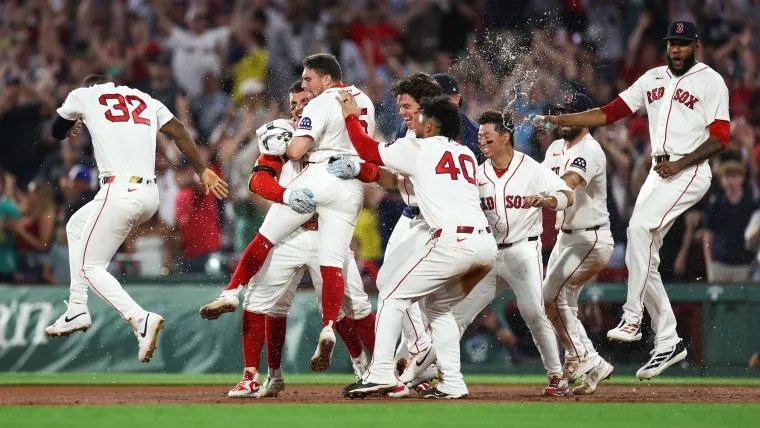
All of a sudden, the Sox were having fun playing baseball. They were hustling, diving, giving 110 percent effort on every play, and smiling. And everyone was doing it. Willson, Wilyer, Ceddanne, Duran, Durbin, Monasterio, Nick Sogard, Anthony Siegler, and almost everybody else got big hits. Mickey Gasper got called up from Triple-A, barely expecting to play, and put up the second-highest OPS in a single month. Ever. The list: Barry Bonds, Mickey Gasper. 7 home runs in 13 games, with 10 walks to only 2 strikeouts. Nobody could get anything by Mickey Bonds.
And the pitching was there too. Sonny, Ranger, Payton, and Jake Bennett all came out and shut opposing teams down. Chappy and Garrett Whitlock came out of the pen and locked down the 8th and 9th, per usual. Tyron Guerrero, after years out of the big leagues, comes out and starts pumping 102-mile-per-hour sinkers down the pipe from his terrifying 6-foot-8 frame. The list goes on and on. Everybody did something for the Red Sox.
This all resulted in the greatest turnaround in the history of baseball. They went on a 15-game win streak to tie an 80-year-old franchise record. They won 27 of 30 games. Reeled off another 9-game win streak. Won 32 of 37. Finished with the best record in baseball after the All-Star Break. First team to finish above .500 and make the playoffs after losing at least 32 of their first 78 games. Ever. All because this team refused to quit.
Playoffs
Now it’s playoff time. As Chad Tracy said, “You stared impossible in the face . . . you beat it back and said, ‘The hell with that, we’re going to the playoffs.’ ” And they did.
Unfortunately, the Red Sox magic seemed to fizzle out in September, and that carried into the playoffs. They played a highly-anticipated Wild Card matchup against the Yankees. The Yankees had the second-best record in the American League, the Red Sox the third. It seemed as close as close as could be, and there was added drama with the way the Red Sox turned around the season starting against the Yankees.
Both teams carried elite pitching, starting and out of the bullpen. The Red Sox planned to throw lovable Payton Tolle game 1, MLB wins co-leader Sonny Gray game 2, and playoff ace Ranger Suárez game 3 if they needed it. The Yankees were responding with Walpole, Mass., native and Red Sox villain Cam Schlittler lined up for game 1, Max Fried following in game 2, and Gerrit Cole in a potential game 3. The Sox had the best bullpen ERA in the majors this year; the Yankees had the second best. The Sox offense had stumbled into the playoffs, averaging the least runs per game in the majors in the month of September. The Yankees, however, did not have Aaron Judge. They responded by stacking their roster with hitters for all situations, and all of them could slug. They had the least amount of pitchers on their roster in the 3-game Wild Card era.
Through the first five innings of Game 1, the pitching came as advertised. In the bottom of the fifth, Payton Tolle was on the mound, having completed 4 2/3 innings and throwing only 83 pitches. With one of the best fastball hitters in the league, Scituate native Ben Rice, coming up to the plate, Chad Tracy came out to pull Tolle, a fastball-heavy pitcher. Even though Rice hammers fastballs, this is still an inexplicable move.
Making things even worse, his replacement, Erik Miller, has been awful for a month. He came in and immediately let up a home run to Rice. From there, the bullpen continued to let up runs, and the offense was nowhere to be found as Cam Schlittler threw a career-high 117 pitches and the Red Sox lost, 9-0. Roman Anthony had to leave the game after only two at-bats, and the Red Sox only got a runner to second base once.
The next game started out similarly, with the starting pitchers, Gray and Fried, dealing on the mound. With two outs in the fourth inning, Sonny had only given up one run (sound familiar?), and he had runners on first and third with a mere 70 pitches. For some reason, Chad Tracy made his way to the mound and called on none other than Erik Miller to face lefty Cody Bellinger. Usually, a lefty pitcher versus a lefty hitter is an advantage for the pitcher, but Bellinger is one of the best left-on-left hitters in baseball.
Miller proceeded to let up two runs, and the bullpen again blew the game while the Red Sox failed to score until the 6th inning on a Willson Contreras home run, which broke a scoreless playoff innings streak of over 20 dating back to last postseason. The Sox lose, 9-2.
Even though they got embarrassed in the playoffs, there is still a lot to be grateful for this past season. Three months in, it was painful to sit and watch a Sox game. This turnaround was the most unprecedented thing I have ever witnessed in my entire life. They went from the lowest possible point of rock bottom to the highest of all highs in a few weeks. It was unthinkable. If you had told me the Red Sox were going to make the playoffs in early June, I would have called you crazy. To experience something as remarkable as this turnaround, with the energy and passion that every single player had on that team, was nothing short of special, and something I will never forget.
featured image: https://sports.yahoo.com/articles/numbers-red-sox-turned-around-170055135.html

