

The commemoration of the Sept. 11 terrorist attacks have passed, but as we held a moment of silence for those who died that day, I wondered how much do students really know about what happened. To adults my age, it’s not history; it’s something we lived through and will never forget. And being in the Boston area, where two of the planes originated, many of us have connections to someone who was directly impacted by that day. But if you’re a freshman, you likely weren’t even alive; if you’re a senior, you may have still been in diapers. In both cases, you may have little understanding of the events beyond what’s been covered in history class.
That’s where media comes in, the countless documentaries, news specials, fictionalized reenactments and books hoping to shed some light on the story. Since I personally still have a hard time looking at pictures or video of the planes slamming into the World Trade Center, I naturally head toward books to help me not just understand, but to remember and, even after all this time, to grieve.
Unfortunately, for years, I couldn’t find any good books about what happened (and this is a librarian talking!). There were children’s books, inspired by a fireboat that helped rescue survivors in New York or a general push toward kindness and tolerance. There were adult books, dense tomes trying to follow the paper trail toward the attackers and their financial backers. There were books that recorded survivors’ testimonials, chronicled the hero dogs that helped dig through wreckage for body parts, or recounted the devastating effects on soldiers who fought in Afghanistan and Iraq during the seemingly endless War on Terror. There is a great novel, Extremely Loud and Incredibly Close by Jonathan Safron Foer, about a boy trying to make sense of his father’s death in the attacks, but at 368 pages, it scares some students away.
Then I found Towers Falling by Jewell Parker Rhodes. Set in the boroughs of New York City ten years later, the book follows 10-year-old Deja in her struggle to understand why her father went “crazy” after Sept. 11, why he can’t hold a job and the family must live in a cramped homeless shelter. In school, her classes memorialize the attacks, but don’t really understand the ramifications, the effects still rippling through people’s lives. With the help of her friend Ben, whose father served in the military, and Sabeen, who has been bullied for being Muslim, Deja uncovers her family’s long-held secret. She finally understands why her father is the way he is.
Although this book is geared for middle schoolers (grades 4-7 if you read the reviews), I bought two copies for the HHS Library. Sure, the main characters are younger, but I think many of us can relate to their confusion over something that adults feel was life-changing but is mere ancient history to them. When I read about Pearl Harbor or Vietnam, I feel the same sense of detachment that young people may feel about 9/11. This novel can help students explore and process their feelings about the attacks, and the memorial services that come every September. It’s done without being overly graphic or unnecessarily somber, and I would recommend that every HHS student devote the few hours it would take to read this short novel.
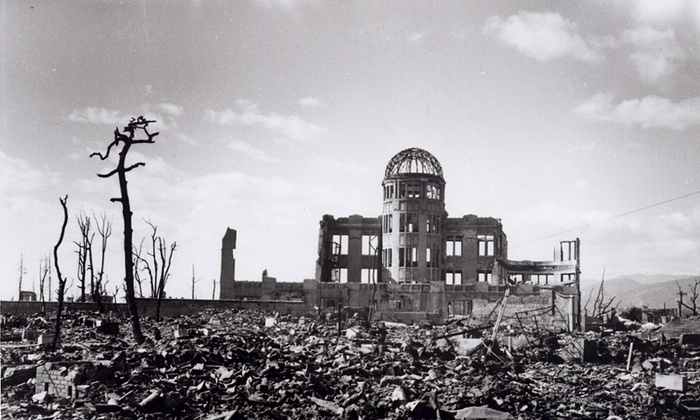
 made, there always seem to be another story to tell. To Hell and Back: The Last Train from Hiroshima by Charles Pellegrino recounts the dropping of two atomic bombs on Japan. Most of us know the basic details, which are often wrapped up in whether the US was right to unleash the nuclear age in an effort to end the war. This book doesn’t get bogged down in that debate. Instead it paints – in vivid scientific, physical and emotional detail – the impact on the cities and people devastated by them, that day and in the months and years since. The stories of Japanese survivors are heartbreaking, especially those who fled after the first bombing and sought safety in the city that became the second target. Can you imagine living through one bomb – a bomb that incinerated your family on the spot, flattened entire neighborhoods and left thousands with horrific burns and radiation poisoning – only to endure it again a few days later? For many people, survival was a matter of inches: a person shielded by a wall or tree may have survived while someone standing steps away was vaporized. The author follows a handful of survivors, much as John Hersey did in his 1946 book Hiroshima, as well as other notable participants such as the pilots who dropped the bombs. While Hiroshima is a powerful book, To Hell and Back goes farther and digs deeper. The 2015 edition uses modern language, making it feel less dated than Hersey’s book, but it also has the benefit of following up with eyewitnesses who lived into the ’90s and 2000s. It was powerful to read how the bombings continued to haunt the survivors, many fighting until old age for a ban on nuclear weapons and an end to war.

 The Hawk