Category Archives: Opinion

College Preparation: How Soon is Too Soon?

As a current junior, I am confident I can speak for the rest of my classmates when I say that college is one of the many things constantly running through our minds. Teachers, parents, and guidance counselors have been pushing college preparation guides at us basically since we walked through the doors on the first day of school . . . stressing that it can never be too soon to start getting ready to make what could be seen as the most important decision in our lives. But when it comes to choosing your future career and college, can such a decision really be narrowed down at barely 17 years old?

I know that a few months ago, I could barely set my mind on what I wanted for lunch each day, nevermind nail down a concrete future. And with that said, seeing college brochures pile up in my mailbox and e-mails pouring in from hordes of schools I’d never even heard of truly made me want to just pull the covers over my head and hide from the idea of college instead of embracing it. Posters advertising various career programs line the hallways at school, and college informational guides are splayed out everywhere you can imagine. It’s hard enough to focus on high school these days, with the immense amount of work and important assignments introduced to us each day, let alone let your mind wander to the distant future where colleges and careers are concerned. Yet according to many of the adults in our lives, we should be putting thought into the college process as often as we can.

Flashback to September and October — back to the days of the college mini fairs. For three consecutive Tuesdays, representatives from many colleges across the New England area set up smartly decorated tables throughout the cafeteria, fanning out informational booklets and laying out pens for hopeful students to give out their personal information. And then hundreds of juniors and seniors were herded into the cafeteria and, for the next 20 minutes, were expected to mill about and find their potential academic calling. Immediately, the indecisive student in me became overwhelmed by the chaos of the crowded cafeteria, and I scurried around collecting a brochure from each and every school available, worried that the one school I miss could be the one destined for me. And three mini fairs later, I now had an entire milk crate filled with informational booklets and brochures from more colleges than I could name offhand. But they were still just that — a crate full of brochures. I still could not single out among them the one college I was dying to attend. And in the months following, guidance counselors set to work, scheduling assemblies and appointments to help each of us juniors pinpoint the career path right for us. My parents also took on a fair share of the work, sitting me down and showing me documentaries about student loans and scheduling college visits over school vacations. And I can’t forget about the teachers — they all somehow manage to incorporate the word “college” into the curriculum even when it seems to have no relevance to the matter at hand.

The first few months of junior year seem to be more geared toward college prep than anything else. As soon as you step into eleventh grade, you are rocketed into a world of college lectures and online statistics, and the pressure is on for you to find your educational calling. There’s no doubt that this introduction to the college search is stressful. Adults and peers are constantly asking the question, “have you figured out where you want to go to school yet?” And until now, I would always answer tentatively. “Not really, I’m still looking!” Because the truth was, I hadn’t figured it out. Figuring out what you want to do for the rest of your life and which college is going to take you there is a hard decision. Probably the hardest one I’ve had to make yet. But the real question is, are the efforts put forth by guidance counselors and parents helpful in this decision? Do their informational strategies help ease this stress-inducing process?

After months of college fairs, relentless emails, and parental pressure, I can finally say that I’ve begun to narrow down my college decision, finally beginning to see the career destined for me. And why? Because for the past few months I’ve been surrounded by nothing but ideas: ideas about college, ideas about careers, ideas about my future. Ideas that really helped me brainstorm and figure out my decision without even thinking about it, really. Months ago, back in September, I was annoyed by all of the college information being thrown at me by the guidance department. But now I realize that because I was introduced to that information, and especially because I was introduced to that information so soon, I was able to narrow down my decision quicker than I ever would have if not informed. The truth is, for these past few months my brain has been quietly working, quietly sorting through all of the information gathered from college letters and brochures and preparing me for this big decision without me even realizing. And though I’m not sure exactly where I’m going and what I’m going to do when I get there, I’m definitely a few steps closer.

Many of you juniors out there might know exactly what you’re meant to do. Many of you might be figuring out one step at a time, like I am. And for those of you who have absolutely no clue where you’re going, don’t worry. You’re not alone. But whether you realize it or not, you’re much more prepared for the college decision than you know. All of the efforts of the guidance department have not been for nothing. Though it seems like college is all anyone is pushing at you right now, you will be thankful once you finally figure out what college is right for you. College is undoubtedly one of the biggest decisions of our lives. And though it may seem silly to start thinking about something so distant in the future, the truth is that it really never is too soon to start planning. Graduation is coming whether you’re ready or not. When you finally figure out where you want to apply, it will no doubt be because of the hard work of those around you.

Let’s Hash It Out: Should Marijuana Be Legal?

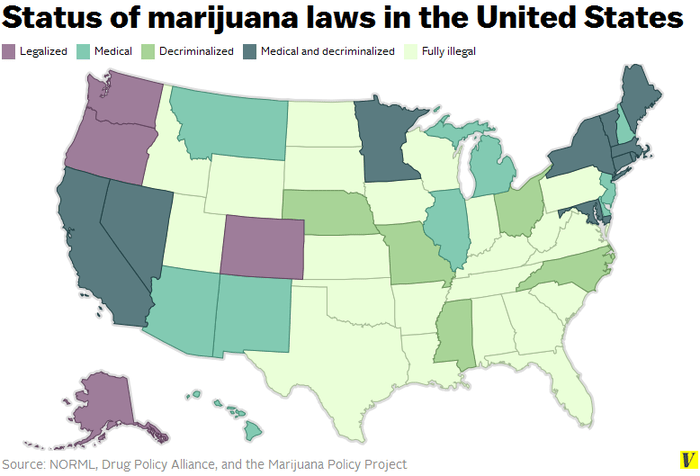
Marijuana is always a tricky subject to tackle. More often than not, there will be smoked-out hippies defending it and middle class suburbanites attacking it. As some states have  voted to legalize it, and others have softened laws about its use, I was looking for some unbiased information on whether or not marijuana is “healthy” for use.

Now that raises the question: what is healthy? Health is defined as “the level of functional or metabolic efficiency of a living organism” (thank you, Wikipedia). So I will be judging the herbage on whether or not it meets that criteria.

Right off the bat, it is smoke going into your lungs so it’s a carcinogen. That means it can cause cancer. Scientists are still arguing over whether inhaling marijuana smoke is more or less dangerous than sucking in cigarette smoke, but either way, it can’t be healthy for you. Frequent use of the drug can also irritate or damage your lungs and increase your heart rate by 20-100 percent shortly after smoking. So that most likely isn’t beneficial to your health.

By using marijuana, you gain a sense of euphoria and an out-of-body experience. This is likely why it is the most commonly used illegal drug in the U.S., according to the Partnership for Drug-Free Kids.   Chronic use of the drug during your teen years can result in loss of memory, lowered IQ, inability to concentrate, increased depression and loss of motivation . . .  so, definitely not healthy. I did say, however, “chronic use.” Proponents of marijuana cite studies that have suggested these side effects are lessened in recreational or light use of the drug. Of course, then you get into the sticky situation of determining what should be considered “chronic” and what is “recreational.” According to the National Institute on Drug Abuse, chronic use is defined as smoking marijuana 27 days out of 30.

But then I discovered thanks to DrugWarFacts.org that there has never been a recorded overdose-related death caused by the mean green. I assumed that thanks to lung damage, cancer or loss of IQ, someone would have died from years and years of use of it. This isn’t the case. Many  states including New Hampshire, New York, California and Massachusetts have legalized medicinal marijuana. Medicinal marijuana is utilized to help people in extreme pain and suffering such as cancer patients. It eases their pain, and since it probably isn’t going to kill them (there’s a reason you’ve never heard of medicinal crack), they smoke it. In Colorado, Washington, Oregon and Alaska, the drug has been completely legalized, and their mortality, murder and injury rates have not gone up (if anything, the food service business has gotten a boost).

Marijuana walks the fine line between being classified as a drug for good reason (remember all those side effects) and being able to truly help people in pain. It is fairly non-addictive. I believe that it’s not the drug that hurts people, it’s the people who hurt the drug’s reputation. People are dumb, let’s face it, and they are most certainly dumb enough to think they’re okay to use a mind-altering drug every day or drive while under the influence. No surprise. But there are some  times when using the drug can be relatively safe or even medically beneficial. Alcohol is legal and that hurts and kills a lot more people than marijuana.

MCAS or PARCC? I Choose “None of the Above”

Every year since third grade, the months of March and May have meant only one thing: MCAS. For two or three days in each month, students in classrooms across the state sit in silent rooms for hours and muddle their way through the thick, professional packets. Reading passages with questions to follow, the dreaded five-paragraph essay, and math diagrams to solve are the most prominent memories I have of these long spring afternoons. MCAS is not very difficult if the teacher has taught the curriculum well, and students are often given practice packets for months leading up to the big day. In fact, it is not uncommon for a few kids from each grade to achieve a perfect score on the English or Math tests. MCAS is long and painful, but very doable for most students.

Last year, change began to take place in the seemingly immovable system. My English class was selected to take part in the pilot test of the brand-new PARCC exam. There is no better surprise than getting told you got lucky enough to take part in even more standardized testing! In all seriousness though, taking this new test was interesting in that we got to see what the MCAS will become. The PARCC test is different in that it is entirely online, including all readings, drawings, diagrams and open responses. It took a while to get used to the new interface, but once I had the hang of it, the exam was basically just a computerized MCAS. I felt that the readings were more advanced and questions more analytical than MCAS, but overall, there were no major changes to the world of statewide tests.

So, which is better (or should I say, less painful), MCAS or PARCC? My answer: neither. MCAS is helpful in that it introduces students at a young age to the concept of standardized testing, and PARCC combines testing with the use of technology which cuts back on our environmental footprint (and makes my inner Prius driver very happy). But what do these tests really accomplish? Sure, they help track that students in Massachusetts are being taught what they should be under the curriculum, but there are other, more beneficial ways of accomplishing this. I feel that the standardized tests taken by elementary, middle andhigh school students should resemble the SAT or ACT. Rather than asking questions about what an author meant by certain phrases or how to find perimeter and area, the tests should focus on vocabulary, critical thinking, and logic to get students used to thinking in this way. These two tests in the long run are much more important to individual students since they play a large role in college admission. If the MCAS or PARCC were treated like an early version of the SAT for younger grades, students would be starting to think in terms of this test years before they even have to take it. Rather than having to spend hundreds on private tutors or classes to prepare for the SAT and ACT like many families do each year, the school system could provide this service all the while checking to see if schools are teaching what they need to. I’m not saying we should do away with standardized testing, I’m simply advocating that we reinvent it.

Je Suis Charlie: Even If I Don’t Agree with Magazine, I Support Free Speech

There were three aspects of the recent shooting at Paris magazine Charlie Hebdo that frightened me.  The first being the initial shock that arises from learning of a terrorist attack, the feeling of sadness and vulnerability.  The second wave of fear was the realization that this was not just another assault, but a direct attack on free speech, an ideal that embodies individuality, creativity, expression and knowledge.  The third wave was one I had experienced before, the fear of a ripple effect.  I worried that the incorrect presumption that this catastrophe was an act of the Islamic religion would only spawn more hate, creating the very thing that had spurred this event.

It is a sad but true fact that everyone our age has experienced this emotion, the slightly disoriented feeling that arises when you learn about a recent terrorist attack.  I can recall it clearly after the Boston Marathon bombings.  It is a upsetting feeling, realizing the lives lost and the many injured.  It is also rather confusing.  I think it is difficult to entirely comprehend how people can harbor so much hate for others. I mean, we hear of things like this relatively frequently and we understand that these kinds of things happen. Yet it is still difficult to cope with, when one deeply examines the fact that something drove these men to such hate, that they believed wholeheartedly that these journalists do not deserve to live anymore.  Accompanying this confusion is the immediate fear that terrorism is crawling closer to you and your family.  This feeling was painfully apparent at the Marathon, but I still feel it in over the Parish attack, thousands of miles away.  Although they were not attacking America, they were attacking journalists, the human representation of free speech and, as guaranteed by the First Amendment,  a value on which our culture was built.

I do not agree with the cartoons published by the magazine Charlie
Hebdo.  I would say that they portray Islam in a derogatory way.  This poor depiction is not exclusive to Islam; the magazine has insulted all walks of life including America and friendly European countries. However, no matter how much I dislike their content, their editors have the right to publish the material.  As much as we roll our eyes at a rude cartoon, a wild proclamation from Time magazine, or an image of Dzhokhar Tsarnaev on the cover of Rolling Stone, these are byproducts of freedom of speech.  Although we can fiercely disagree with some things that are published (or most things), without freedom of speech we would lose the many world-changing articles, poems, songs, books and speeches that have been created.  We would feel alone in our selves, losing the song that captures our exact emotion.  We would lack inspiration, never hearing that speech that urges us to do more. Without the freedom to express ourselves we would not form different opinions, we would not challenge opposition, we would not overthrow tyranny, we would not fight for what we believe in, and we would not have the ability to profess our truth.  To take away freedom of speech would be to smother the passion that is inside every one of us.  The attack on Charlie was an attack on freedom of speech and the only way to encounter this is to fight back.  I do not mean fight back in the traditional sense, but to use the gift of speech to fight against terror and encourage hope.

As I had mentioned, the last wave of fear that came over me was the fear of a ripple effect.  I will use Boston as an example again.  I hated coming back to school after this catastrophe because I hated listening to my classmates talk about Muslims.  It was not all my classmates, but enough to trouble me.  I heard derogatory things said about the people who practice this religion. I am sure this was just people speaking from a hurt place, saying things that they did not really mean, but this is only a small example of a terrible phenomenon.  If allowed to fester, this hate, this feeling of being attacked or harmed, can turn into something so much more. Although the act was deranged, the terrorists who attacked Charlie believed they were retaliating against the phallic-faced image of Mohammed that the magazine released.  I fear that this hate will continue, that our society will have caught this feeling and turn it around on the people who practice the same religion as these terrorists.  This was not the crime of an entire faith, but the crime of some sad, sick men. In fact, many devout Muslims condemned the attack and any terrorists who use violence in the name of their faith.

Ridding oneself of hate is not an easy task, but it is something that we all must strive for.  As difficult as it is, we cannot allow the fear of this terrorism to affect us any further. In order to combat it, we must carry on, professing love in all ways possible and hoping that it can spread.

Join Clubs With Your Interests, Not College Apps, In Mind

A common theme with all of our latest articles is the fact that 2015 is a new year with new opportunities. One of those opportunities is to evaluate where exactly you stand in life. Is it where you want to be? Or are you perfectly happy and content with the person you are right now? Most people people I know would answer “yes” to the first question and are always striving toward the elusive goal of self improvement. What better way to start off 2015 than by fully taking advantage of all of the opportunities that HHS has to offer?

You have four years here and at a basic level you have two options on how to spend them. One option is to choose to whine and complain about everything that doesn’t go your way. This option is exercised whenever you hear people grumble and grouse over doing work in class. I know far too many people who take that option and it’s honestly quite depressing for me to hear.

The other option (and the most favorable one) is to realize that you have the opportunity to become a better person and improve yourself during your years as a high school student. You are stuck here for about 40 hours a week so you might as well make the best of it. The best way to meet that goal is to become involved in HHS wealth of extracurricular clubs and activities. Most people I know are involved in at least a couple of them.

But joining an activity just to list it on your college applications isn’t enough.  I would encourage everyone to take the next step and ask themselves why they involved in the activities that they have chosen. Too many people fall into the trap of selecting activities due to the perceived value of them to college admissions boards. No matter how many times it has been debunked, the misconception remains that you have to be involved in everything in order to have a shot at college. Or even worse, that you have to be in the right clubs. This leads to an unfortunate issue of people attending meetings but not really being too engaged. In such a case, both the person and the club in question are being hurt. The person is wasting their time and the club finds itself starved of talent or energy and it ends up dying. That is an end result that, as a senior, I have seen far too often and heard earfuls about from plenty of other people. It is a situation we as a student body should resolve to prevent in 2015 and going forward.

I really encourage everyone to look at their extracurriculars and ask themselves whether it is the best use of their talents. To continue doing an activity you have no passion for is doing a disservice to everyone involved. Don’t overextend yourself to create a grand resume of activities. Find something you’re really interested in and commit to it.

That being said, News Club is always looking for new writers and we encourage anyone to come our meetings in the Library on Wednesdays. If nothing else, you’ll see me there ;).

I Dare You to Read This

Aahhh, winter break: a time to gather with family, exchange tokens of love and affection (or the gift card you think your second-cousin might be least likely to trade for cash at the CoinStar machine), stay up late and sleep in! Luckily, I did all of those things during our recent respite, but also something else that makes me giddy. I got to read!

Now, I know, some of you might think I’m a nerd because I like to read. Or you might believe I do it because it’s my job. But honestly I’ve been a reader for as long as I can remember mainly because I like to escape. While growing up, losing myself in a book was the easiest way I knew to escape my siblings’ quarrels, my parents’ woes and the general angst that accompanies adolescence. Today, I read to forget about the bills that need to be paid or the stress at work (stress,  you may ask? Only in a theoretical sense, of course. I could never be stressed here!).

Teachers often talk about how reading expands your mind, exercises your brain and exposes you to new points of view. I believe all of that is true. Reading improves your vocabulary, makes you a better writer, and allows you to experience things vicariously that you could not in real life (that killer avalanche on Everest? the boy wizard’s battle against the evil bad guy? the sappy romance of a teenager with cancer? been there, done that, from the safety of my couch) But I also feel that reading is just fun — as much fun as going to a movie or whiling the hours away playing Trivia Crack.

Groucho Marx (Google him) once said “Outside of a dog, a book is a man’s best friend.” (Wisely he added, “Inside of a dog, it’s too dark to read.”) Too many students here at HHS tell me they don’t like to read or, more simply, they just don’t read. It breaks my heart. They’re missing out on so much . . .  academically, emotionally, spiritually. I’m serious! Not reading is as detrimental to your being as staying home alone every Friday night watching Wheel of Fortune, smashing your fingers in the car door or eating too many Big Macs.

Sure, it takes a little work (although in my opinion not as much as figuring out how to maneuver the WiiFit obstacle course so you don’t repeatedly get knocked in the head). And yes, even I have times when I’d rather watch Tosh.0 or countless repeats of The Big Bang Theory. But the benefits of reading are worth it. New experiences, good stories, a chance to escape whatever ails you in real life. It doesn’t matter if you choose War and Peace (again, Google it) or Entertainment Weekly online, if you settle down with a thick hardcover or a hundred-page paperback, just read. Vow to read one online article a day, or one book a month. Read in directed study or after you snarf down lunch or while you’re waiting for practice. Read!

If you don’t, you’ll make this baby panda cry.

The Law is Not Your Enemy

I respect the enforcers of the law immensely. Everyday they go out into this crumbling world and face the chance of death. Nothing is certain in their field. People are insane, and anything can happen. At least soldiers know that they face the gamble of death because they are in a war zone. But considering that the world has become  a place  with bombs blowing up civilian buildings and bullets shattering the silence of locker-filled hallways, we are living in a war zone, and that hurts to say. What hurts even more is our generation’s unwarranted hatred for police.

We hate them because they are doing their jobs. Why? Committing a crime is illegal, correct? Just because you feel it shouldn’t be, doesn’t mean it isn’t. That is just plain selfish. We know this is true but, as kid, we don’t like to admit defeat. But because police cuff, arrest, and book people for doing stupid things, the people who get nailed hate them. Those people then spread their dislike and it spreads to other people and, suddenly, an army of youths hate the men and women with badges.

I did as well until I sat down and thought for a second. Someone asked me, “Why do you dislike the cops since you seem so impassioned about it?” and I didn’t have an answer. That’s one of the few times where public opinion had influenced me so much that I didn’t have a real thought of my own. Of course there are cops who could be a bit kinder. But it’s hard to be nice when the people you deal with are equally hostile. If you do something stupid, you will be punished. Get it through your head. If you are going to do something bad, do it right and don’t get caught.

What’s worse is that the cops we see prominently on the news are  the trash that abuse their powers because they can. They are weak and do not deserve a badge; they deserve the cuffs they place on others. I have no idea if Micheal Brown’s death was justified. There are too many variables and too many loose ends. Regardless, his death doesn’t justify looting and  rioting. If people were truly angry about his death, then there would be no plundering and burning cars, there would be love and mourning in the streets. Some use these opportunities to push their own agendas, and they don’t even have a badge.

Eric Garner was murdered. There are no ifs, ands or buts, the man was choked to death on the street while being recorded and screaming “I can’t breath.” He didn’t get up from that choke hold, nor would he ever get up again. Was there ever any punishment for the officer who killed him? No. Does this mean that all officers are ruthless meatheads who get away with murder? Of course not. Yet because of this man’s actions, people believe that all cops are like this. We always remember the bad because it burns and hurts, which are stronger feelings than good. It pains me to say but it’s true.

What I’m trying to say not only applies to the boys in blue, but to everyone as a whole. We must keep the bad in our minds but we can not let it control us. Cops help people every single day they’re on duty. Some have risked their lives for the safety of the people so keep that in mind next time you feel like a big boy and call a cop a pig. Not only do you look like a tool, but you have no idea what that officer has been through.

Cops are not here to hurt us. But many feel they are here to hurt cops. Just this Saturday, two New York City cops were executed by a man “avenging” Gardner. What point or twisted justice do these murders serve? Absolutely none.

We live in a world where because one idiot screws up, all in that group are punished. We see one in a group as representing everyone: cops, whites, blacks, Asians. Grouping is a sin that people commit all the time and it must end. Do not hate cops because others told you too, do not hate cops because one cowers behind his mark for strength, do not hate cops. Thank you.

How to Prepare for the Holidays

We all know that cozy holiday feeling you start to feel as soon as you finish your Thanksgiving dinner. Not your post-dinner stomachache, but CHRISTMAS FEVER! I don’t know about you, but I find myself OBSESSED with the idea of Christmas. From the homemade gingerbread houses, to the scent of pine trees, to the kids telling “mall Santa” what they want to wake up to on December 25th. Everybody prepares for the holidays in different ways, but these are a few of my favorite things to do in preparation for Christmastime.

1.) Hang up some Christmas lights! Whether it be in your room, or on the outside of your house, make sure everybody knows you’re ready for Santa to make an appearance.

2.) Make a special  treat to enjoy with family and friends! I know that I already ‘attempted’ to make some peppermint bark . . . but it’s all about having fun, right?! Look up some cool recipes for gingerbread, candy cane cookies, holiday brownies, and all sorts of fun holiday treats!

3.) Listen to some Christmas music! Senior Nick Ricciarelli just loves “listening to all of the songs on the Michael Buble holiday CD!” Other students, like Padraic McDonough and James Woods enjoy Mariah Carey’s hit, “All I want for Christmas.”

4) Shop for Secret Santa. Candy, gift cards or warm fuzzy socks all make great presents for your friends and family. The mystery of the exchange just adds to the fun. Who knows me well enough to buy me dark chocolate!! Who in the world thought I would like a leopard-printed snuggie?!

So , there you have it. Some tips to help you prepare for, and survive, this holiday season. Merry Christmas, everyone!


Black Friday Becomes a Holiday Tradition for Some Families

Black Friday has become nearly as prominent in America as the holiday that it follows.  It has become rather like a holiday itself.  It takes up almost as much advertising as Christmas.  When I return to school after the break, I am just as likely to be asked where I went shopping as I am asked where I went for Thanksgiving.  It is only a matter of time before the production company that created the movies Valentine’s Day and  New Year’s Eve will create a film entitled Black Friday.

Unlike a real holiday, where folks look forward to time at home, Black Friday specializes in taking people out of their homes.  Millions of retail workers are made to cut short or miss out on their Thanksgiving festivities in order to prepare their stores for the massive event.  It not only forces people to leave their families on a holiday weekend to work, but it drives countless others to finish their turkey early and drive to the nearest Best Buy.  As Black Friday hours begin earlier and earlier each year, often starting on Thanksgiving Thursday, it encourages shoppers to place their Christmas shopping ahead of the traditional American Thanksgiving plans.  With these things in mind it appears as if Black Friday is Armageddon  to those traditional Brady Bunch type families: placing consumerism above family values.

On the other hand, what is Black Friday if not another activity for your family during the holiday season?  It may not be traditional or idealistic, but more and more families every year don matching T-shirts and charge into Target like the Pats into Gillette.  Personally, I have not experienced this but I imagine that I would definitely bond with my family if we were  out to claim or wrestle  the last iPad mini out of the hands of our competitors at Walmart.  Perhaps these families can  become closer through this kind of activity than they would in reciting what they are thankful for over their best china dishes.  All I know is that the closest  I ever felt to my family over the holidays was when we watched the first two seasons of The Office together, spending hours at a time laughing.  This is not the most traditional way to get close to one’s family, but it is my favorite way.  So who is to say that Black Friday can’t provide a bonding, if not traditional experience to a family?

How the Election Results will affect YOU

On November 4, nationwide and in Massachusetts, democracy was put in action as elections were held and changes in our government were made. Here’s how those results are going to affect you.

Governor

Republican Charlie Baker defeated Democrat Martha Coakley to become the next governor of Massachusetts. He won with a 67.3 perent margin in Hanover and carried the rest of southeastern Mass. except for cities. No surprise there as Hanover and the South Shore are typically very conservative. I’m sure most of your parents are happy with his victory and he will enact policies that appease his core supporters while trying to appear moderate.

Secretary of State

Bill Galvin will remain in office after dominating his over-matched republican foe, he received 57.8 percent of the votes in Hanover but most places he won more than 60 percent of the vote. He has been in office for awhile so h’es nothing too new to this state and isn’t going to cause some big change.

Attorney General

Democrat Maura Healey won Martha Coakley’s spot as Attorney General of Massachusetts. Again, as a Democrat, she isn’t a candidate that is well-received by the South Shore and we’ll see how she does. Martha Coakley certainly had her fair share of botched cases. Healey will be somewhat similar to Coakley. She did not win Hanover, only geting 46.3 percent of the vote.

Auditor

Suzanne Bump won state auditor in a position that high schoolers will hear very little about. She did lose the to the republican candidate in Hanover, getting 43.6 percent of the vote. Honestly, this office is not as relevant an office compared to others. She’s the one who makes sure our government spends its money the right way.

Treasurer

Deb Goldberg won the treasurer position, taking over for Steve Grossman. She had a closer race than some of the others, and got beat badly in the South Shore. She only received 38.6 percent of the vote in Hanover. Recently, the treasurer position has been a jumping ground to other positions, as both Steve Grossman and Tim Cahill have made bids for governor from that position. We’ll see what her ambitions are and hope she does a good job. Since the treasurer oversees the state’s cash savings, debt and investments, it is an important position

U.S. Senate

In a quiet race, Ed Markey won the senate seat he took from John Kerry after Kerry was made secretary of state. Markey,  a liberal’s liberal, won Massachusetts with ease. He didn’t do as well in the South Shore, only gathering 44.6 percent of the vote in Hanover. He is a big Democrat and hardly represents the interest of the South Shore, but that’s nothing new in Massachusetts senate seats.

9th Congressional District

The 9th congressional district holds Hanover and a lot of the South Shore and Cape Cod. It is a region a Republican could and should win. But John Chapman didn’t run that hard of a campaign and Democrat Bill Keating won another term in office. Keating has done a decent job down in DC, and he still only got 47.2 percent of the vote in Hanover. It’s a republican-controlled house, so what he wants accomplished will not be easy for him.

Ballot Questions

Question 1 won with ease, meaning the gas tax cannot be indexed with inflation but rather must be set by real people. The Yes vote had 63.7 percent in Hanover.  Question 2, the bottle bill, was a massacre.  Hanover had a 83.4 percent No vote. The bottle tax will not be expanding and things will remain as they are right now.  I hope you like to gamble, because Question 3 was defeated by a decent margin. That means the casino act will not be repealed so casinos will be built in Springfield and Everett as well as a slot parlor in Plainville. In Hanover it was a 63.2 percent NO vote. For Question 4, earned sick time lost by a slim margin in Hanover, getting a 48.95 percent Yes vote. Statewide, it passed and will mandate changes in the way sick time is handled by companies, small and large.

Nationally

Tough time for the Democrats, as the Republicans kept control of the House of Representatives and won the Senate. Things are going to get prickly in Washington, and it is my personal opinion that the gridlock we’ve been seeing is going to continue as conservatives do their best to beat up Obama and Democrats filibuster their way to salvaging some of their accomplishments.

Locally

Hanover’s own Rhonda Nyman lost to Norwell native and Republican David DeCoste for the state representative seat. Since it was by a mere 45 votes and provisional ballots finally counted today, the margin may have gotten closer. She has until 5 o’clock on Nov. 13 to request a recount. In other races, Tom Kennedy retained his state senator spot and Marc Pacheco the other. Matt McDonough of Marshfield, a Democrat who had maybe the largest overall sign at HHS that Tuesday, won Plymouth Country Register of the Probate. Sandra Wright of Bridgewater, a Republican, won Plymouth Country Commissioner.