

Everyone knows today’s school system has its flaws. From the piles of homework, to the hours of sitting for too many periods crammed into one day to the reinforced ban on food in the classrooms, there seem to be complaints about every aspect. So in recent weeks, when school administrators visited several classes to give students the chance to voice their concerns, there were some resounding answers. Below is what I heard from students, along with my own opinion, on several issues that popped up in discussions repeatedly.
Homework
As always, the overbearing subject has been treated with opposition; students to a large degree wish it was eliminated altogether, made optional, or at least held to a minimum. It can be argued that if you know a subject well, you have no need to practice it. Proponents of homework, though, argue that it reinforces schoolwork or teaches you what you can’t get in class. Studies on the effectiveness of homework on learning have shown highly varying and controversial results, and during class discussion this was reflected. Each student had a different idea on how outside work should be handled, but for the most part, students were hostile toward it. To me, at this point in time, optional homework seems most helpful to the full school community. For those like me who need it to reinforce our studies, it will remain a helping hand. But for the students who don’t need that extra help, the massive time slot taken by homework would be more valuable if used to extend and explore other interests.
Personalization
This intriguing topic could have drastic results if implemented properly. Many students share the belief that a way to personalize school would be to cater to their interests by reading topic-specific books for English or eliminating core subjects that don’t seem relevant to what they want to do. For example, an engineer and a historian need drastically different learning courses to take them on their way to success. Why should either take, say, a foreign language? And why should someone who wants to be a playwright have to take chemistry? On the other hand, the question arises that if a student wants to change careers in the future, could narrowing their field of study in high school come back to hurt them? Letting students elect out of the core courses would allow an infinitely more concentrated learning path, but would eliminate the chance that students may find a new interest if they had taken the classes required now by law. For me at least, I totally shifted my stance on history classes in two years, and I don’t know if taking away that option is right. Whether the school customized pathways similar to college “majors” or eliminate core courses, more teachers would be needed — which brings up a question for another time: how much should teachers be paid?
Interestingly, as a quick vote in class showed that some students if given the choice would remain on a general path incorporating multiple subjects, while others would personalize greatly. Students oriented towards STEM (Science, Technology, Engineering and Math) were generally fixed on one- or two- subject paths, while those interested in arts and humanities preferred the multi-subject path.
Personalizing certain classes while maintaining the five required subjects — English, foreign language, history, sciences, math — would give a more customized workload. For example, assigning work for each class concerning topics each individual found interesting would allow students to be intrigued where they weren’t before. Someone interested in dance, for example, could learn about its evolution throughout the course of history, and read technique books in English class to exercise those two cores.
Length of the School Day
With the change to school start time implemented this year, there has been a lot of debate. Does the later start really reduce tardiness and give students more energy? Are any benefits worth the price of ending the school day later, which sometimes interferes with jobs and extracurricular activities? Many students feel the day should be shorter; block periods could help with that as students would have fewer subjects to concentrate on during each day. Additionally, going to a four- or five-day cycle, as the middle school does, could allow for a more even spread, and possibly fewer periods per day. I’m really really exhausted by last period each day, partly due to how much lunch I eat and partly from how long I’ve been sitting. Maybe changing the school day’s length could help. Or, as some suggest, bigger breaks can be placed between periods, allowing time to stretch, snack, move, talk, or whatever you need to keep yourself going.
Teachers & Teaching
The way the new school building is structured can have an impact on how teachers are able to work together. While the old building had wings for each subject so teachers of the same could coordinate, the new one is structured by grade. Although this was originally done to help students become more of a priority, it ends up hurting everyone as effective lesson plans, organization and ways to meet up become increasingly hard to manage. Some teachers don’t even have their own classrooms. Why take a helpful system and instead of improving it, replace it with a worse one? This new downside for teachers hurts everyone, and reverting the way the school is organized could help both student and teacher groups.
The last topic is teaching; how it should be done. As the old belief goes, everyone has a different way of learning, be it reading, writing, hearing, speaking, drawing or more. How should this be handled? Should there be more interactive classes, more movement, more time outside? Should all teachers be required to incorporate more diverse lessons, no matter what their style has been for years? Or do students benefit from interacting with varied personalities and teaching styles, like they will in college and the workplace?
What do you think?
 This past Friday, the Curry 3 was unveiled in San Francisco, set to release on October 25th. Under Armour’s popularity has skyrocketed along with the Curry shoes over the past few years. Stephen’s first signature model, the Curry 1, retailed for $120. The Curry 2 retailed for $130, the 2.5 $135, and the upcoming 3 will be $140. The Curry line is one of the best-selling players’ sneaker lines out right now. Presumably, the popularity of the brand will only increase when the Golden State Warriors, seemingly the most overpowering team in basketball history, begins its season on October 25th. Stephen will receive more press than ever and should drive up the stock of Under Armour substantially.
  The Hanover High golf team has had tremendous success over the past two seasons. The team had a strong roster of upperclassmen in 2014 and 2015 and finished each season with a 15-1 record. But this season, the team only has three veteran players. Despite its youth, the
 The sectional playoff, which will be held next Tuesday, consists of 10 teams; the two schools with the lowest scores move on to the state final.
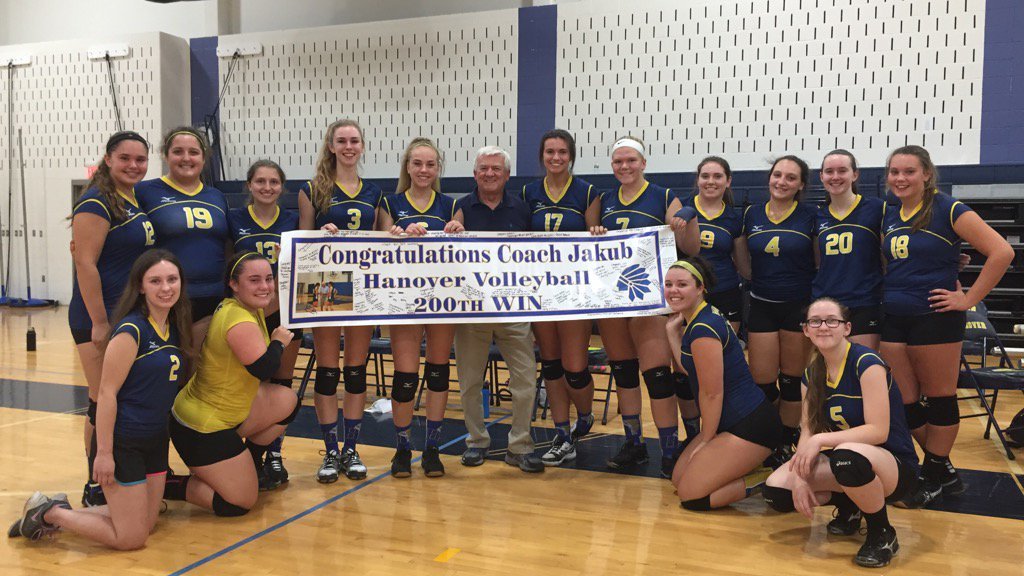
 Led by senior captains Meaghan Raab, and Haley McCusker, and junior Captain Taylor Scott, the team has had some great games against tough competition. They won a set in a challenging 3-1 loss against a strong Quincy High School team, which not every team can do. They pushed the match against Silver Lake to 5 sets, making their opponents sweat before losing 3-2, and they played well in Monday’s 3-0 loss to Pembroke.
 One of the team’s biggest celebrations this season came Sept. 12, when Coach Dave Jakub had a great victory. He reached 200 wins in his volleyball coaching career with a 3-1 win over Norwell.


 The Hawk