When I was in junior high, growing up in upstate N.Y., I was a rabid Mets fan. I watched every game that was televised, yelled at the screen, wrote fan mail to the players. My mood rose and fell with the team’s success. Then, one day, the Mets traded away my favorite player and it my beloved baseball became nothing more than a business. I would never be a follower of pro sports again.
In spite of this (or because of this?!), I ended up marrying a sportswriter who constantly surfs between any and every sport that’s on. He also introduced me to ESPN’s 30 for 30 series, a collection of documentaries about moments and people in sports history that the network began to celebrate its 30th anniversary. At first glance, I had no interest in watching more sports. But I quickly learned that the series is about so much more than players and games. It shines a light on our culture, through the lens of the athletes and teams we follow. I’ve learned so much about the value, and pressure, we place on team sports at every level and about the role sports play in different parts of the world. How we play, worship, market and demonize sports reveals a lot about who we are. I would recommend the series to everyone, “sports fan” or not.
Here are a few episodes I really enjoyed:
Playing for the Mob:
This episode comes from our backyard and deals with the point shaving controversy at Boston College in the late 1970s that found
basketball players tangled up with the mob. This was a riveting story of wiseguys, including Henry Hill and Jimmy Burke, made famous by the movie Goodfellas. It’s also an example of how young athletes can be tempted by big bucks, whether it’s through recruiting incentives or, in this case, payoffs for keeping the score down in a game.
Of Miracles and Men: If you think you know the full story of the U.S. Olympic hockey triumph over the powerhouse Soviet team in 1980, this episode will make you think again. The classic moment in sports history has always been categorized as a battle between good and evil, democracy and communism. Yet, as the show reveals, the members of the Soviet hockey team were outstanding players molded into a formidable squad by a legendary coach. The Russian team routed the Americans in an exhibition the week before. Perhaps that makes the “Miracle on Ice” even more powerful. But I was saddened by the stories of the Russian players, who returned home not as heroes but in shame. No matter how many games they won in the rest of their careers, their defeat in the Olympics overshadowed it all. If you’re a real hockey fan, you’ve got to feel for them.
Doc & Darryl: This one hurt. Pitcher Dwight “Doc” Gooden and outfielder Darryl Strawberry were the stars who led the New York Mets to the 1986 World Series championship. Fans expected that both players, young and seemingly unstoppable, would be part of a dynasty for the next decade. But their battles with addictions derailed what should have been Hall of Fame careers. When I was a kid, I’d heard about their problems, but looking back on the years they lost due to drugs and alcohol — and seeing Gooden, more than 20 years later, still struggling — was devastating. So much wasted potential. Was it the pressure of playing in the spotlight? Too much money and fame too young? Regardless, it’s heartbreaking, and all too common.
The Best that Never Was: From a small, impoverished town in Mississippi, Marcus Dupree was one of the best high school running backs that the country had ever seen. Colleges went to great lengths to recruit him, and when he signed with Oklahoma in 1981, it was predicted that he was on his way to being the youngest winner of the Heisman Trophy and a star in the NFL. But things didn’t work out that way; a series of injuries derailed his path and he wound up back home and demoralized at only 24. His struggle to redeem himself and make another try for the NFL is inspiring.
Pony Excess: Southern Methodist University was caught in a recruiting scandal in the 1980s that led to the yearlong suspension of the football program and more than a decade of repercussions. Even today, the program struggles to be successful. Hearing about the lengths that college coaches and boosters went to secure top recruits – cars, cash, girls – and realizing that SMU was far from the only offender made me think again about college sports. It’s big business, with football and basketball especially raking in major revenue for schools. Is it fair to put this value, and pressure, on young athletes? Or do they deserve a piece of the pie that they’re bringing in?
The Two Escobars: In Colombia, soccer was a national pastime but didn’t become an international success until Pablo Escobar and other drug kingpins lent their financial support. The episode details the rise and fall of Escobar, the country’s national team, and a star player, Andres Escobar, who was killed in the crossfire of the drug wars. The show gives a lot of insight into the drug trade of the 1980s, how it affected Colombia as well as the United States. It also highlights how sport can be a lifesaver for poor and hopeless youth.


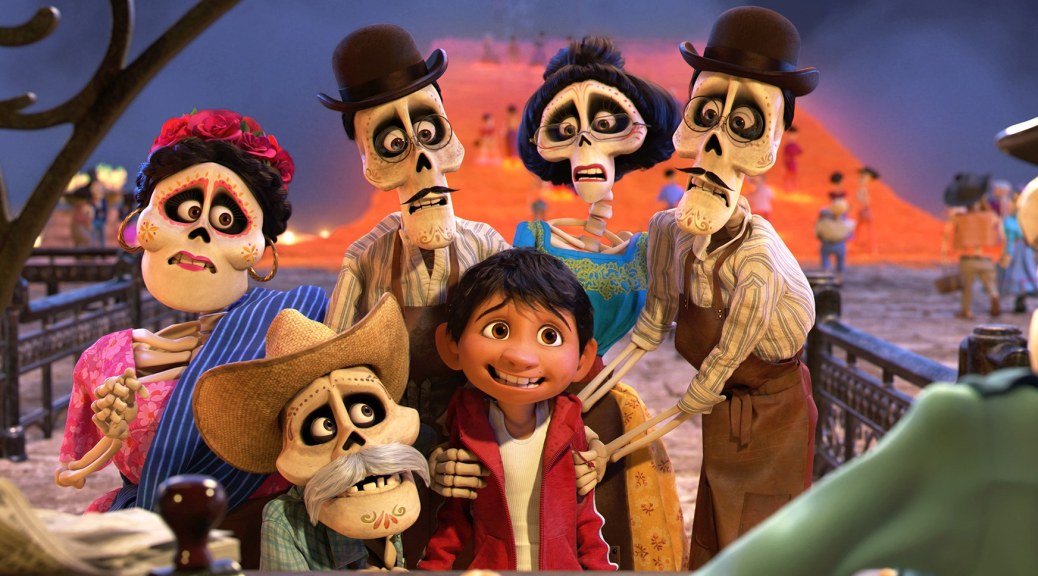


 My personal favorite movie of 2017 was Coco, directed by Lee Unkrich and co-directed by Adrian Molina. Set in Mexico City, this Pixar-animated film is about a young boy who loves to perform music. However, the boy’s great-great-grandfather left his wife and children years earlier in order to pursue a career in music, causing the entire family he left behind to take a stance against music for generations. Conflicted, Miguel embarks on a quest in the Land of the Dead to locate his great-great-grandfather. Coco is a celebration of music, family, and loyalty and is brought to life with beautiful and colorful animation.

 Into the Water by Paula Hawkins
 Turtles All the Way Down by John Green
 My personal favorite read of 2017 was The Peculiar Sadness of Lemon Cake by Aimee Bender. Though this book was not published in 2017, I highly recommend adding it to your reading list. The story is about a young girl named Rose who can taste the subconscious emotions of other people in the food that they cook for her. This novel explores the hidden, deeper feelings that humans keep just below the surface of everyday life and conversation.
 Obsidio (The Illuminae Files, #3) by Annie Kaufman



 The Hawk