- Peter Bell, Composition
- Dan Butka, Concert Band
- Madison Carroll, Chorus
- Bridget Fairweather, Chorus
- Kyle Knight, Chorus
- Mikenzie Matheson, Chorus
- Joe Mignosa, Composition
- Erica Perry, Concert Band
- Jameson Sheridan, Chorus
- Jake Sledziewski, Concert Band
- Fred Trankels, Chorus
Category Archives: News
The Modern Role of the Pledge of Allegience
“I pledge allegiance to my Flag and the Republic for which it stands, one nation, indivisible, with liberty and justice for all.”
More than a century ago, a minister named Francis Bellamy wrote this pledge for a popular magazine to honor the 400th anniversary of Christopher Columbus’s discovery of the New World. His pledge was published on September 8, 1892 in The Youth’s Companion and was put into public practice around the country the next month when millions of children recited it in school in honor of Columbus Day. Interestingly, Bellamy intended for his pledge to serve as a statement of national allegiance for any country. Also fascinating is that the 1892 Pledge of Allegiance was originally meant to unite the citizens of the United States who had been engaged in the Civil War only 30 years before.
That the Pledge of Allegiance was once meant to unify the American public is particularly ironic in the present day as the Pledge has become a symbol of conflicting opinions within the country. Some argue that saying the Pledge in schools goes against the American principle concerning freedom of belief, while others argue that saying the Pledge is an important gesture of respect for the country. Additionally, since the phrase “under God” was added to the Pledge in 1954, public opinion has been divided over whether this religious reference clashes with the American principle of separation of church and state. In order to form an opinion on these issues and the role of the Pledge that students across America say every day, it is revealing to look further into the history of our country’s statement of national allegiance.
After Bellamy’s Pledge was recited nationally on Columbus Day in 1892, it became a popular saying at schools, public events, and even Congress. Since its introduction, however, the Pledge has been revised in numerous ways, often for political reasons. In 1923, for example, the National Flag Conference changed the phrase “my flag” to “the Flag of the United States” in order to make certain that American immigrants would be pledging allegiance to their new country rather than their former nations.
Perhaps the most controversial revision to the Pledge was made in 1954 when Congress added “under God” to the Pledge. This revision was prompted by the urging of various Americans, including those in the Catholic-affiliated group, Knights of Columbus. Behind the decision to reference religion in the Pledge was the desire to reject the atheist communist movement in Russia at the time. To justify his approval of this revision, contemporary President Dwight D. Eisenhower stated: “In this way we are reaffirming the transcendence of religious faith in America’s heritage and future; in this way we shall constantly strengthen those spiritual weapons which forever will be our country’s most powerful resource in peace and war.”
Over the years, several cases have been taken to state and federal court concerning the use and wording of the Pledge of Allegiance. In the 1943 ruling, West Virginia State Board of Education v. Barnette, the Supreme Court established that it is a breach of the first and fourteenth amendments to compel individuals to say the Pledge. In 1998, Florida man Michael Newdow sued his local school board for the reference made to religion in the federally accepted Pledge, and continued to fight for a removal of the “under God” phrase until his case reached the federal Ninth Circuit US Court of Appeals in 2010. However, at this point, the court ruled that the Pledge does not explicitly say that the US government itself supports monotheistic religion. In 2014, the Supreme Judicial Court of Massachusetts affirmed that the Pledge does not conflict with separation of church and state, arguing that it does not undermine the rights of atheists because the phrase “under God” represents national loyalty rather than religious endorsement.
Though some Americans have argued against modern use of the Pledge of Allegiance, judicial rulings have established a firm place for it in schools and other public places. By law, no individual is required to say the Pledge. However, is there social backlash for those who refuse to say it? Millions of American citizens recite the updated version of Bellamy’s 1892 Pledge every day, perhaps without truly reflecting on why it was written and the agendas of those who have altered it. In a time where there is so much division in the country and a resurgence of nationalistic fervor in some political groups, it is important to question and analyze the role of long-established national customs in the modern world.
Works Cited
CNN Library. “Pledge of Allegiance Fast Facts.” CNN, Cable News Network, 24 Apr. 2017, http://www.cnn.com/2013/09/04/us/pledge-of-allegiance-fast-facts/index.html.
Greene, Bob. “The peculiar history of the Pledge of Allegiance.” CNN, Cable News Network, 23 Dec. 2013, http://www.cnn.com/2013/12/22/opinion/greene-pledge-of-allegiance-salute/index.html.
Independence Hall Association. “The Pledge of Allegiance.” Ushistory.org, Independence Hall Association, 4 July 1995, http://www.ushistory.org/documents/pledge.htm.
Jones, Jeffrey Owen. “The Man Who Wrote the Pledge of Allegiance.” Smithsonian.com, Smithsonian Institution, 1 Nov. 2003, http://www.smithsonianmag.com/history/the-man-who-wrote-the-pledge-of-allegiance-93907224/.
HHS Shows Its Spirit!
Click on the picture to enlarge
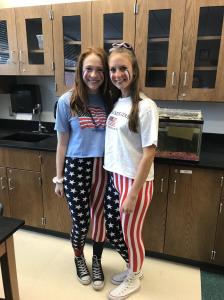
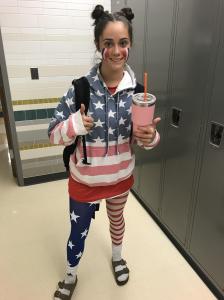
The week started off with a very patriotic “Merica Monday.” Students dressed in their best red, white and blue apparel. What a great way to kick off the week!
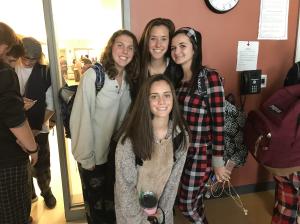
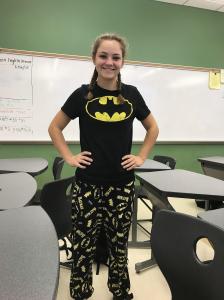
Tuesday’s theme was Pajama Day! Everyone enjoyed wearing their PJs to school, and most people wished we had more than one pajama day in the school year. It was so comfy!
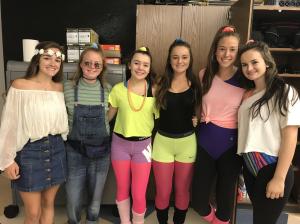
On Wednesday, students dressed for Decade Day and the school saw every decade possible. So many fun and creative outfits!
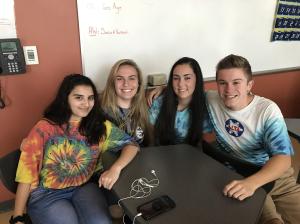
On Thursday, the theme was Tie Dye Day! What a great way to represent inclusion week in the school.
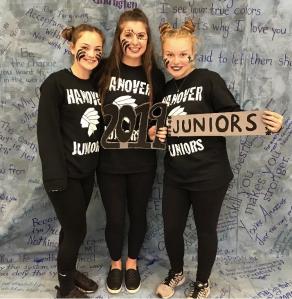
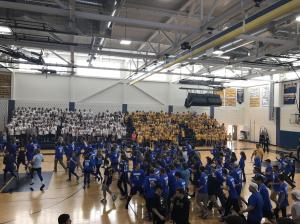
To wrap up Spirit Week 2017, we had Class Color Day. The seniors were blue, juniors wore black, sophomores dressed in white, and freshmen wore yellow. We concluded with a pep rally and everyone represented their class so well!
2017 Homecoming
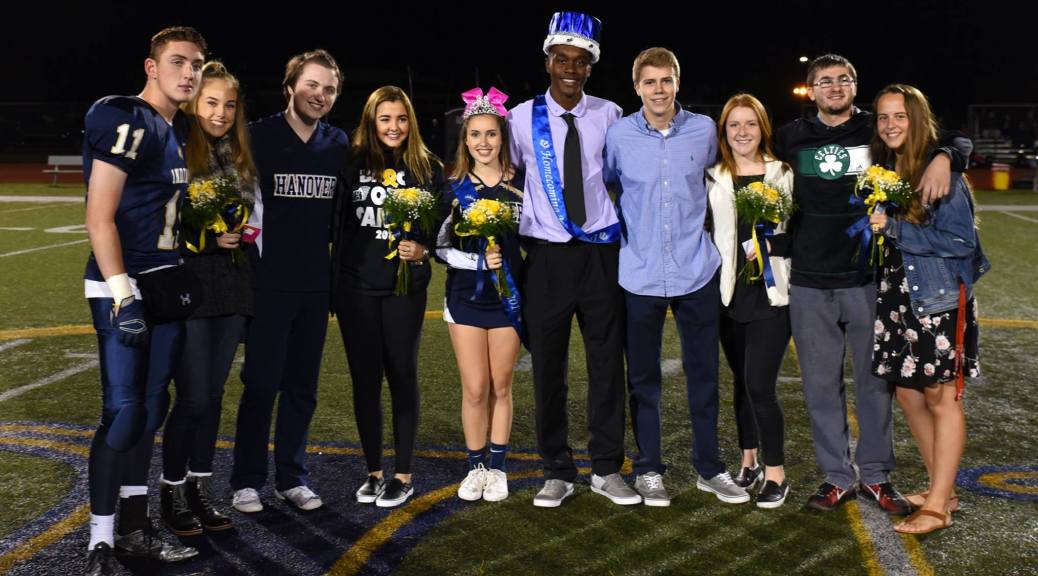
Every year, Homecoming is one of the most highly anticipated events of the year at Hanover High School. This year was no exception. The weekend of events features football, performances by the marching band and cheerleaders, a party for staff and families and, of course, the dance.
Events kicked off with the Hanover Huddle and football game Friday night. Victor Costa and Katie Halpin were voted Homecoming King and Queen by the senior class. The football team beat Pembroke, 14-13.
Organized by the Student Council, the Saturday night dance proved to be a fun and entertaining night. The music was provided by Hanover High School’s very own, Aidan Burke. Students were able to take photos in the cafeteria against a backdrop created by Mrs. Curley’s Partnership in Art classes to celebrate Inclusion Week. This special week, held this year to coincide with Spirit Week, focuses on making all students feel they are an important part of the school community.
All grades were able to attend the dance for a fee of $30 and all students were required to take a breathalyzer test before entering the dance. Students had a great time and had minor suggestions such as using the whole gym to have more room and to having more teachers at check-in in order to cut down the time of students waiting in line. The wide majority of students said that they had an extremely fun night and that they can’t wait until they get to go again next year.
Photos by Mr. Steve Ryerson. You can find more, plus videos of Vox and cheerleading performances, on the Hanover Schools social media pages.
French Exchange Students Visit HHS
For some, Friday the 13th can be a bad omen, but for Hanover High School, it will be an exciting opportunity to meet students from across the Atlantic. More than 20 French exchange students will be arriving to stay with families in Hanover and learn about American culture. Later in the year, students from Hanover will get to travel to France and stay with the exchange students’ families.
This program was created in the last few years and has been well-received, having been approved by the town. The French students will visit sites like Plimouth Plantation, Salem and the city of Boston. They will also attend classes with their host students, so expect to see them in the halls the next few weeks.
The exchange is coordinated by Madame Dhomee and fellow Hanover French teachers Mrs. Youngsworth and Mrs. Greene. There are four main benefits to this program: educational, personal, historical and political traditions, and practical. All of these benefits combined turn out to be a great learning experience for all involved when it is critical for people in our world to have an understanding of others and compassion for all.
Students Seize Chance to Take College Courses
How do you say hello in American Sign Language? How do you argue a point convincingly? These are just a couple of the questions that many Hanover High School students are investigating this year. Thanks to a new partnership with Massasoit Community College, students have the opportunity to take courses at the college level for both high school and college credit. Two of these classes, American Sign Language and Philosophy, have already proven popular among Hanover students.
For senior Nick Jones, American Sign Language provides a chance to explore his avid interest in linguistics. Right now, in fact, Nick is studying six languages: American Sign Language, Spanish, French, Mandarin Chinese, Russian, and English. Learning ASL is unique, Nick said, because the language is composed of hand movements rather than verbally spoken words. In addition, ASL involves expressing oneself with the eyes as well as with the hands to convey meaning.
Nick’s ASL class has about 25 students, and runs Mondays, Wednesdays and Fridays at the high school. (Students have directed studies the remaining days) The teacher, Glenna Caliendo, was born Deaf, but is both verbal and very skilled at reading lips, according to Nick. She also wears a cochlear implant and is thus able to discern sounds around her. Unlike the majority of Deaf adolescents, Nick explained, Ms. Caliendo attended non-Deaf public schools growing up, meeting with a speech pathologist until the age of 18 and learning to read lips. Actually, it was not until college that Ms. Caliendo became familiar with ASL. Nick has already learned much about the language from Ms. Caliendo, including grammar and vocabulary, and he has also learned about the culture of the Deaf community.
“Unlike most people, I was aware that there was a Deaf community, but I didn’t know a lot about it,” Nick said. “They also don’t consider being Deaf a disability, and neither do I. They are truly like everyone else. They just can’t hear. But that benefits them in the sense that they are exposed to this entirely new culture that will embrace them with open arms.”
In the future, Nick looks forward to learning more vocabulary as well as performing skits in ASL at the end of the school year. Already Nick has been able to use what he has learned to communicate with and assist a Deaf person at a job outside of school.
Like the ASL course, the Philosophy class runs three days per week at the high school, and includes 12 students. For senior Lauren Gelly, philosophy has long piqued her interest.
“I took a philosophy mini course over the summer and AP Gov last year and I was excited to revisit the topics of logic and structured argument,” she said.
Lauren enjoys learning under her current teacher, Joshua Cabral, who has helped the students learn how to debate and ponder important philosophical questions. According to Lauren, the course has taught her more about herself and her peers. The class offers a unique learning opportunity as she is in class with a group of people with whom she normally doesn’t interact, she added.
Philosophy students have already talked about how to form solid arguments and about stream of consciousness. Right now, they are concluding their study of logic and how to frame an argument. Lauren’s favorite topic so far has been learning how to disprove someone else in an argument.
Lauren, Nick, and the other Hanover High School students enrolled in American Sign Language or Philosophy seem to have already learned much valuable information that they can use in high school and in the outside world. The partnership with Massasoit, which will include courses later this year in ASL 2 and Creative Writing, is part of the HHS Connect initiative, according to Principal Matthew Paquette.
Everything New from Apple’s iPhone Event
Above: Apple CEO Tim Cook Announcing Apple’s Latest Products
iPhone 8 and 8 Plus – No, there’s no 7S

As the successors to the iPhone 7 and 7 Plus and a cheaper alternative to the iPhone X, the iPhone 8 and 8 Plus bring a new design. Made with a glass back like previous iPhones, the new iPhone no longer has an aluminum body. The new glass back finally allows the iPhone to support wireless charging — but it can still be charged via the usual lightning cable if you don’t want to shell out the cash for the wireless charging pad (sold separately). Hopefully, though, this glass-backed phone fares better than the shatter-prone iPhone 4 and 4S of the past. This new design makes the new iPhones both thicker and heavier, although not by much.
Also new with the iPhone 8 is the A11 “Bionic” chip (Your best guess as to what “Bionic” means is just as good as mine). For the average user, just know this is 25 percent faster than the iPhone 7 and will remain fast for the next few iOS updates. The camera on the iPhone 8 also gets an upgrade, now taking better pictures in low light, with an improved flash that no longer leaves the background dark.
The iPhone 8 also bumps up the base storage size from 32gb to 64gb, which is good considering Apple raised the price of the iPhone 8 and iPhone 8 Plus $50 and $30 respectively. It comes in Silver, Space Gray, and Gold (No more Rose Gold, Jet Black, Matte Black, or Red). Overall this new iPhone feels more like an iPhone 7S than an iPhone 8, but it’s still a worthwhile upgrade if you’re in the need of a new phone. This also highlights the problem for Apple: iPhones have gotten so good, you rarely need a new one. Apple seems to have a solution to this problem and it ends in “X.”
iPhone X – Yup, seven ate nine

Yes, it’s pronounced “ten” not “x,” and yes, it’s $999. When the iPhone 8 and 8 Plus weren’t matching the rumors, Apple released the last trick it had up its sleeves. Marking 10 years of the iPhone, Apple says the iPhone X is the future, now. This iPhone, which was years in the making, is probably the biggest change to the iPhone since the iPhone 6 in 2014. Featuring an edge to edge screen which eliminates the iconic home button, it’s a bold move for Apple. Users now swipe up from the bottom of the screen to mimic the function of the home button. Also gone with the button is Touch ID. Formerly Apple’s default method of device unlocking, Touch ID is being replaced by the similarly named Face ID facial recognition system. Face ID is supposed to be 20 times more secure than Touch ID– and much easier to use. Now the user only has to look at the iPhone to unlock it. Apple says it should work even at night or if you put glasses on; just don’t have a twin. It can, however, tell the difference between you and a picture of you with depth sensors, so rest assured, nobody will use a family photo to get into your iPhone. Face ID seems to be a much easier way of unlocking your phone, but we’ll have to see how reliable it is when the phone is released in early November.
The biggest change with the iPhone X is that its screen is now OLED. This means blacks are deeper, colors are more vibrant, and battery is better (The pixels of an OLED screen are actually off when showing the color black). Since the screen is almost edge to edge, it puts a plus-sized iPhone screen in the body of a regular sized one. The body of the iPhone X is also glass-backed like the iPhone 8, but to differentiate between the two, the iPhone X has polished stainless steel around the edges. It can also be differentiated from the iPhone 8 by its vertical dual cameras, which Apple claims are its best yet (the second camera being for 2x zoom). Unfortunately though, the iPhone X only comes in two colors, Silver and Space Gray, which seems boring considering Apple has been releasing new colors for the iPhone almost every year. It’s also both thicker and heavier, but most people will probably enjoy the greater battery life (2 hours more than the iPhone 8).
While this iPhone finally brings a huge change to the lineup, the X has one drawback. The$999 price tag is much more than Apple customers are used to paying, and its at the top of the phone price range. It’s a big risk, since people will either see the value in the new technology, or Apple will learn it just outpriced its average customer.
Everything Else – But wait, there’s more

Apple also released a Series 3 Apple Watch, and a new Apple TV that plays 4K content. The latest watch now can be used with or without your iPhone nearby, since it features its own cellular connection (identified by its red Digital Crown button). Apple also announced the arrival of iOS 11, which was released last Tuesday with changes to the iPad and redesigns to Control Center, Notification Center, and core apps like the App Store, News and Siri.
HHS Teacher’s Trip to Kenya is Life-Changing
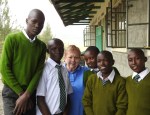
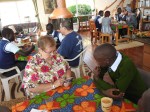
Have you ever thought about what it would be like to travel to Africa? Recently, one of Hanover High School’s very own teachers, Ms. Marilou Hall, took a mission trip to Kenya with a small group from her church. Ms. Hall and the others who traveled with her donated money, supplies, and their time to a local school. They also visited a nearby hospital and explored the area of Kenya in which they stayed. Here is what Ms. Hall had to say about her trip:
Where shall I begin? My Vision Venture Mission Adventure to Kenya was a once in a lifetime experience, but I have no doubt that I will return. It all began in April of 2015 when a new pastor at my church mentioned that he was planning a trip to Kenya and asked if anyone else would be interested. I sarcastically looked at the friend sitting next to me and said, “Shall we go?” Her response was a wide-eyed, “NO!” I just put the idea away. But God had a different plan for me. I could not stop thinking about what the pastor had said. I came up with all kinds of excuses, such as age, money, risks, and family concerns for my safety, yet I was still feeling that I had heard a “call.” So, from May of 2015 until January of 2017 we made preparations and did lots of fundraising for support for our Mission. Through amazing support from church members, family, and friends we were able to raise almost $15,000 dollars for St. Andrew’s Tarabete Secondary School in Naivasha, Kenya.
St. Andrew’s is a private Christian school in a desperately poor section of Naivasha. The area is called Kasarani. Approximately 30,000 people live in this area where there is no electricity or running water. For the people in Kasarani, life is difficult. The people, mostly the women, have to walk about two miles to draw water from a bore-hole, which is a deep well. Also, though Kenya is the largest exporter of flowers to Europe, there is nowhere near enough jobs for those who need them. As a result of so much unemployment, the slum area increases and conditions worsen. The desperation leads to increased alcoholism, drug abuse, domestic violence, and crime. The living conditions we saw were deplorable. Large families live in single-room, tin shacks with no furniture and NEVER enough food. In addition, the government of Kenya is very corrupt and bribery is a constant. There is very little public education in Kenya. Even the government schools require tuition. Most of the people in the areas outside of the cities cannot afford to provide food for their families, much less pay tuition.
This is where our work began. Our team of seven people was housed at Eagles Wings in Naivasha (I HAD to ask why there was no apostrophe in Eagles, but I still do not understand the explanation…when in Kenya!). The mission center was the home of Greg and Deb Snell, who have been missionaries in Naivasha for over 20 years. They are totally devoted to the people of Kenya. Our group worked at St. Andrew’s for 10 days. We cleaned and painted several classrooms and installed chair rails. I discovered that I am NOT a great painter!
More importantly, we had a great deal of time to spend with the 400 students. The team had brought gifts for the school along with a very generous donation. We brought pens, pencils, T-shirts, soccer balls, ball pumps, and 10 computers. You would have thought we had given them each a brand new car.
St. Andrew’s has no electricity or running water, so water must be brought in every day. Despite these circumstances, the students who attend St. Andrew’s were incredible. They come from desperately poor families and live in deplorable, unsafe conditions, yet they are joyous and grateful for the opportunity of an education. They walk over three miles to get to the school, which is at the top of a very rugged and dusty dirt road. They are proud of their school and themselves. They know that they are the lucky ones. All of the students speak English, Swahili, and their own tribal language. English is used in all classes. The classrooms are concrete rooms, totally bare, other than chalkboard paint on one wall. The only book they have is a Bible. They carry 17 notebooks (a huge expense for them!). We were there for the first two weeks of school. They jumped right into academic work. I was able to sit in on several classes and learned so much from the students. The classroom is virtually silent, except for the teacher’s voice. The students listen intently, taking notes on their own. Toward the end of the class, the teacher puts notes on the board for them to copy, if they need them.
These students are intense, committed, enthusiastic learners. I was humbled by the respect these young people showed for their teachers, their friends, and themselves. Between their classes the students would come to visit us, asking questions, sharing their stories, and wanting to help us.
In addition to our work at St. Andrew’s, we visited the local hospital, where government doctors were on strike because they had not been paid for more than 18 months. Two missionary doctors were staffing the hospital to the best of their ability. The lines of ill and injured adults and children were heartbreaking; way too many people have died during this time. We also went to a private Christian primary school which is also an orphanage. I left my heart there. We were able to work with a couple of different groups of students from St. Andrew’s at Eagles Wings to Bible Studies and could offer opportunities for further education.
We had some time for “touristy” things, as well. We visited a Giraffe Center where we got up close and personal with several giraffes. They are HUGE animals! Their heads are immense, to say nothing about their tongues! GROSS! We went to a Baby Elephant Orphanage where we saw more than 20 young elephants. We were able to feed them and play with them. I even adopted one of them. Her name is Dolly. They will send me monthly pictures and updates about her until she is ready to be released into the bush!
For the last few days of our trip we were fortunate to be able to go on a safari. We traveled about five hours north of Naivasha to Laikipia County to Suyian Soul. Suyian Soul is a beautiful, serene, and peaceful spiritual sanctuary on a 49,000 acre ranch. We were treated like royalty. We went on several game rides and walks. The animals were magnificent. We were up close and personal with animals like lions, hippos, camels, Cape buffalo, warthogs, and some of the most spectacular bird life in the world. It was a magnificent experience. However, one week after we left this oasis, groups of tribal invaders attacked and burned this special place to the ground. This was a result of a great drought and the need for grazing land for the tribe stock. The owners of Suyian Souls were in negotiations with the tribal leaders to provide them with use of grazing land at no cost to the tribes, but apparently the tribal issues were more important than the land being made available to them. Animals were slaughtered, guests terrorized, staff left without employment, and one of the invaders killed. My prayer is that Suyian Soul will be restored so that others may enjoy it.
My time in Kenya has made me much more aware of all the blessings we in America take for granted, including, at the very least, water, shelter, and adequate food. My life has been forever changed. My hope for the future of Kenya lies in the youth making a difference. They have so much to overcome, yet they are all devoted to making real change.