Category Archives: News

RAD Training Gives Students Self-Defense Skills

Someone in the United States is sexually assaulted every 98 seconds, according to to the Rape, Abuse & Incest National Network (RAINN), an American organization that works to stop sexual violence (2018). Not only that, the highest percentage of victims of sexual violence are aged 18-34 (RAINN 2018). Therefore, knowing how to defend oneself against sexual assault is not just a helpful precaution, but a skill set that is becoming increasingly important.

In December 2017, Hanover High School piloted a Rape Aggression Defense (RAD) Training program to offer female students the opportunity to learn how to defend themselves. Nearly 20 students reported to the gym during school hours for several days to receive training in self-defense from gym teachers and the Hanover Police Department. There will be another training program from March 13th to 15th to offer more students the chance to learn how to protect themselves.

Before bringing the program to Hanover, the HHS PE/ Wellness staff and local resource officer John Voelkel underwent comprehensive training to become certified in female physical defense, according to Mrs Bostwick and Mrs. Della Croce. The objective of the training is “to provide students with self defense knowledge (knowledge is 90% of self defense education) and skills so that if they are ever faced with a situation they will have a variety of escape and counter options at their disposal,” the teachers said. RAD was started at the high school primarily to protect students against sexual attacks. Mrs. Bostwick and Mrs. D added that the program helps bring the community together by involving the Hanover Police Department, and that the training expands the PE/ Wellness curriculum in an important way. Not only does this program prepare women for the future, it is also free of charge.

Though the types of defense strategies are kept confidential to protect the participants of the training, Mrs. Bostwick and Mrs. D. said the defense will help students to feel more capable and ready for whatever might happen in the future. They explained that the training not only teaches physical strategies for protection, but it also grants each participating young women self confidence in knowing that she can protect herself if necessary: “Perhaps one of the best benefits is self-reliance, knowing that you have this inner strength to protect yourself,” the teachers explained.

Kristen Nguyen, an HHS senior who participated in the December RAD training, described how she now feels confident not only in her ability to defend herself while living on a college campus but also in life after graduation. Kristen would recommend the program to other students. “I feel like it’s generally good knowledge to know how to keep yourself safe for college and beyond,” she said. “RAD in general was a welcoming experience to those who might be a bit nervous, and it was fun but also educational.”

In a world where sexual assault statistics are alarmingly high, knowing how to defend oneself provides the confidence and skills to feel safer and more prepared in any situation.

Click here for more information on RAD

Unified Basketball Photo Gallery

The Hanover High School Unified Sports program brings together Special Education students and peer mentors to play soccer, basketball, and kickball together against other area high schools.

Click the link below to view a gallery of photos from the Feb. 13 game, Hanover vs Abington, originally published on WickedLocal.com.

http://abington.wickedlocal.com/photogallery/WL/20180223/NEWS/223009994/PH/1?start=2

For more information, contact adviser Allyson Gately at agately@hanoverschools.ord.

Technology News of 2017

People Mourn the Loss of the  Headphone Jack: After Apple removed the headphone jack from its latest iPhone in early 2017, people argued whether it was a beloved, crucial feature or a relic of the past. Many felt that removing it and forcing the use of an adapter was unnecessary, while others were ready to embrace the future of wireless headphones. Overall, it seems the public has adjusted and the headphone jack is on its way out.

Digital Assistants Make Themselves at Home: In 2015, Amazon created the smart speaker with its digital assistant Alexa, and since then, the idea has taken off. The adoption rate of these devices – which stream music, search the Internet, and control other in-home devices with simple voice commands – doubled in 2017 and is increasing steadily into 2018.  Alexa remains the most popular, but other companies are trying to catch up. Google released a miniature version of its Home in October and Apple is going to release its HomePod at some point soon. Overall, it shows how technology is leaving our pockets and making itself at home in our living rooms.

Net Neutrality is No More: Mid-December marked the end for Net Neutrality,  the law that prohibited Internet providers from varying  speeds for different websites. Republicans argued the law limited the  competition which could lead to cheaper Internet plans. Democrats insisted that, without the law,  Internet providers have too much power and could slow down or impose fees on websites.  It’ll be interesting to see how the Internet changes in 2018.

Trump Embraces Twitter: Throughout President Trump’s first year in office, he’s made consistent – and controversial – use of Twitter. Trump prefers to communicate directly with the people instead of relying on what he calls “fake news.”  It is a huge change for an American president to rely so heavily on social media. Trump supporters love his straight talk, but critics say his unfiltered tweets are a danger, At one point, people even claimed Trump should be banned from Twitter for breaking its terms of service by “bullying.” Twitter responded that banning world leaders would be wrong, since Twitter is a way for them to reach so many people.

Equifax Hack Leaves Millions at Risk: September was not a good month for credit check company Equifax and its customers. Hackers accessed the personal information of 143 million Americans, including names, addresses, and social security numbers. This reminded us that no technology is truly secure –although the head of security at a company safeguarding millions of American’s information probably should have more than a music degree.

 Image result for apple low batteryApple Stumbles Through Battery-Gate: Sneaking into the news in the last week of 2017, it was discovered that Apple was slowing down iPhones that have older batteries. This came after years of talk about Apple and “planned obsolescence.” The company released a statement saying they only slowed down phones with older batteries to prevent the phones from unexpectedly shutting down. They insisted the problem could be fixed by replacing the phone’s battery, and offered to do it at a discount.  If Apple had only been honest from the start, the company would have avoided tons of bad publicity.

John Logan Talks to Hanover Students about Magic

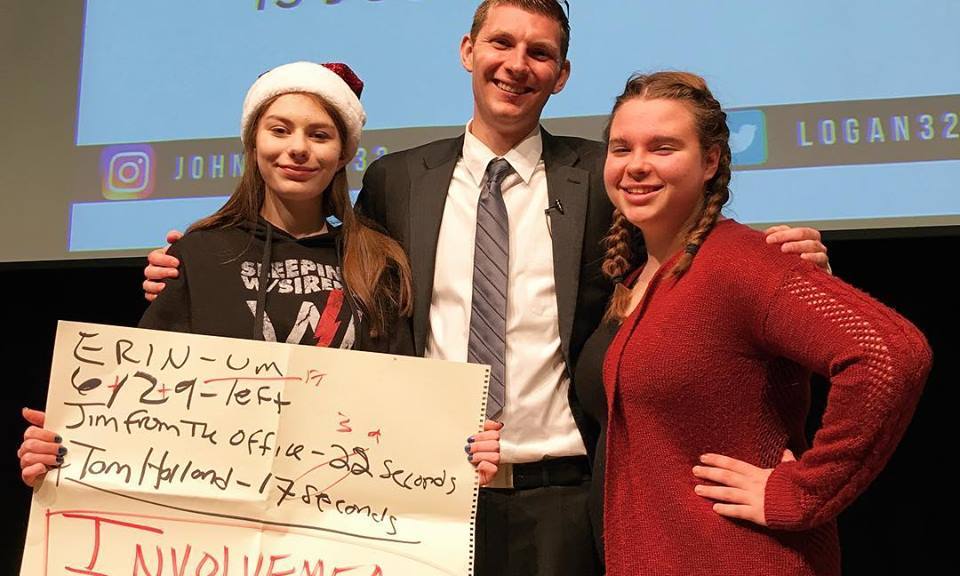
Being a magician is not much different from being an entrepreneur, New England Patriots magician John Logan told Hanover High School students in a presentation Dec. 19. Logan, who graduated from Hanover High School in 2012, has since accomplished impressive feats such as earning a degree from Bryant University, publishing a book called “The Perfect Illusion: Life,” and developing his many skills performing magic.

During his time on stage, Logan related the role of the magician to the role that each Hanover student will one day take on– that of thinking like an entrepreneur. Both the magician and the entrepreneur must think of solutions to problems, share their ideas with an audience, and revise their ideas based on feedback. Regardless of the career that students will pursue, Logan explained that all of these skills are important to successful problem solving.
In order to illustrate his point, Logan performed magic tricks demonstrating the steps in the process of developing an idea. By starting with a simple trick and ending with a trick that involved many variables, Logan showed how an idea can be revised and expanded.

One of the first tricks that Logan performed was a card trick, calling a student up to the stage to select a card from a deck and correctly guessing the one card that she had chosen. By the end of the show, Logan’s tricks showed how to both involve the audience and use many different factors to perform an elaborate trick. Logan’s last trick was the most complex, using the input of over five students. First, he called up two students to the stage and asked for a digit in each of their phone passwords. Logan then asked several volunteers in the audience to call out their birth dates. Finally, Logan asked the students on stage to compute the phone digit and birth date numbers in a designated way, resulting finally in the number 121917– the exact day of Logan’s performance on December 19, 2017.

One of the most incredible tricks that Logan performed involved his seemingly magical ability to guess the first word on a random page in a lengthy book. First, Logan asked one student in the audience to take a book of her choice. He then asked another student to randomly select a page number for the first student to flip to in the book. After the first student saw the first word on the selected page, Logan then tried to guess what it could be by observing the first student’s body language. He observed clues such as whether she moved right or left and asked her questions about her various personal preferences, such as her celebrity crush. Miraculously, Logan arrived at the correct word with this information alone.

Like all magicians, John Logan never explained exactly how he was able to perform his tricks. However, throughout his performance Logan stressed one unifying point that holds for magic and life in general. He explained that in order to think creatively, it is important to remind oneself that what seems impossible may well be possible. He expressed that though it may have seemed impossible to know the destination of an airplane flying overhead just 10 years ago, it is now possible to know this information in a matter of seconds with Siri. In the same way, Logan’s tricks may have seemed impossible but are in fact feasible. Both inventions like Siri and convincing magic tricks begin with one idea and are developed step-by-step into something that once seemed unimaginable. Relating magic to entrepreneurship and creative thinking, Logan was able to teach Hanover students about solving future problems of all kinds.

Students Hit High Notes at Competition

HHS sent its largest group in years to the Massachusetts Music Educators Association Southeastern District Senior band, orchestra, chorus, and composition competition. While all students performed very well at the Nov. 18 audition, according to music teachers Mr. Harden and Mr. Wade, the following earned a high enough score to be accepted into the ensembles:
  • Peter Bell, Composition
  • Dan Butka, Concert Band
  • Madison Carroll, Chorus
  • Bridget Fairweather, Chorus
  • Kyle Knight, Chorus
  • Mikenzie Matheson, Chorus
  • Joe Mignosa, Composition
  • Erica Perry, Concert Band
  • Jameson Sheridan, Chorus
  • Jake Sledziewski, Concert Band
  • Fred Trankels, Chorus
Madison, Mikenzie, Bridget, Erica and James earned a top score on their respective instruments/voice parts and qualified to audition for All-State.  Peter and Joe will have an opportunity to present their original musical compositions at the All-State conference as well.
Congratulations, everyone!

The Modern Role of the Pledge of Allegience

“I pledge allegiance to my Flag and the Republic for which it stands, one nation, indivisible, with liberty and justice for all.”

More than a century ago, a minister named Francis Bellamy wrote this pledge for a popular magazine to honor the 400th anniversary of Christopher Columbus’s discovery of the New World. His pledge was published on September 8, 1892 in The Youth’s Companion and was put into public practice around the country the next month when millions of children recited it in school in honor of Columbus Day. Interestingly, Bellamy intended for his pledge to serve as a statement of national allegiance for any country. Also fascinating is that the 1892 Pledge of Allegiance was originally meant to unite the citizens of the United States who had been engaged in the Civil War only 30 years before.

That the Pledge of Allegiance was once meant to unify the American public is particularly ironic in the present day as the Pledge has become a symbol of conflicting opinions within the country. Some argue that saying the Pledge in schools goes against the American principle concerning freedom of belief, while others argue that saying the Pledge is an important gesture of respect for the country. Additionally, since the phrase “under God” was added to the Pledge in 1954, public opinion has been divided over whether this religious reference clashes with the American principle of separation of church and state. In order to form an opinion on these issues and the role of the Pledge that students across America say every day, it is revealing to look further into the history of our country’s statement of national allegiance.

After Bellamy’s Pledge was recited nationally on Columbus Day in 1892, it became a popular saying at schools, public events, and even Congress. Since its introduction, however, the Pledge has been revised in numerous ways, often for political reasons. In 1923, for example, the National Flag Conference changed the phrase “my flag” to “the Flag of the United States” in order to make certain that American immigrants would be pledging allegiance to their new country rather than their former nations.

Perhaps the most controversial revision to the Pledge was made in 1954 when Congress added “under God” to the Pledge. This revision was prompted by the urging of various Americans, including those in the Catholic-affiliated group, Knights of Columbus. Behind the decision to reference religion in the Pledge was the desire to reject the atheist communist movement in Russia at the time. To justify his approval of this revision, contemporary President Dwight D. Eisenhower stated: “In this way we are reaffirming the transcendence of religious faith in America’s heritage and future; in this way we shall constantly strengthen those spiritual weapons which forever will be our country’s most powerful resource in peace and war.”

Over the years, several cases have been taken to state and federal court concerning the use and wording of the Pledge of Allegiance. In the 1943 ruling, West Virginia State Board of Education v. Barnette, the Supreme Court established that it is a breach of the first and fourteenth amendments to compel individuals to say the Pledge. In 1998, Florida man Michael Newdow sued his local school board for the reference made to religion in the federally accepted Pledge, and continued to fight for a removal of the “under God” phrase until his case reached the federal Ninth Circuit US Court of Appeals in 2010. However, at this point, the court ruled that the Pledge does not explicitly say that the US government itself supports monotheistic religion. In 2014, the Supreme Judicial Court of Massachusetts affirmed that the Pledge does not conflict with separation of church and state, arguing that it does not undermine the rights of atheists because the phrase “under God” represents national loyalty rather than religious endorsement.

Though some Americans have argued against modern use of the Pledge of Allegiance, judicial rulings have established a firm place for it in schools and other public places. By law, no individual is required to say the Pledge. However, is there social backlash for those who refuse to say it? Millions of American citizens recite the updated version of Bellamy’s 1892 Pledge every day, perhaps without truly reflecting on why it was written and the agendas of those who have altered it. In a time where there is so much division in the country and a resurgence of nationalistic fervor in some political groups, it is important to question and analyze the role of long-established national customs in the modern world.

Works Cited

CNN Library. “Pledge of Allegiance Fast Facts.” CNN, Cable News Network, 24 Apr. 2017, http://www.cnn.com/2013/09/04/us/pledge-of-allegiance-fast-facts/index.html.

Greene, Bob. “The peculiar history of the Pledge of Allegiance.” CNN, Cable News Network, 23 Dec. 2013, http://www.cnn.com/2013/12/22/opinion/greene-pledge-of-allegiance-salute/index.html.

Independence Hall Association. “The Pledge of Allegiance.” Ushistory.org, Independence Hall Association, 4 July 1995, http://www.ushistory.org/documents/pledge.htm.

Jones, Jeffrey Owen. “The Man Who Wrote the Pledge of Allegiance.” Smithsonian.com, Smithsonian Institution, 1 Nov. 2003, http://www.smithsonianmag.com/history/the-man-who-wrote-the-pledge-of-allegiance-93907224/.


HHS Shows Its Spirit!

Click on the picture to enlarge

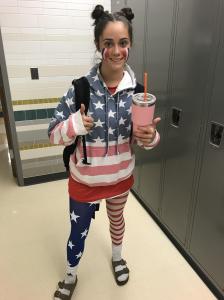
The week started off with a very patriotic “Merica Monday.” Students dressed in their best red, white and blue apparel.  What a great way to kick off the week!

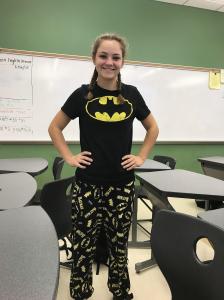
Tuesday’s theme was Pajama Day! Everyone enjoyed wearing their PJs to school, and most people wished we had more than one pajama day in the school year. It was so comfy!

On Wednesday, students dressed for Decade Day and the school saw every decade possible. So many fun and creative outfits!

On Thursday, the theme was Tie Dye Day! What a great way to represent inclusion week in the school.

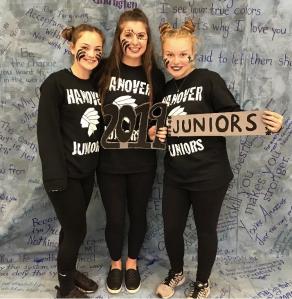
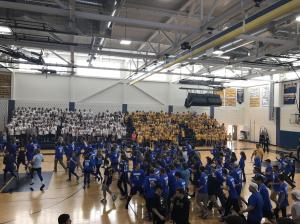
To wrap up Spirit Week 2017, we had Class Color Day. The seniors were blue, juniors wore black, sophomores dressed in white, and freshmen wore yellow. We concluded with a pep rally and everyone represented their class so well!


2017 Homecoming

Every year, Homecoming is one of the most highly anticipated events of the year at Hanover High School. This year was no exception. The weekend of events features football, performances by the marching band and cheerleaders, a party for staff and families and,  of course, the dance.

Events kicked off with the Hanover Huddle and football game Friday night. Victor Costa and Katie Halpin were voted Homecoming King and Queen by the senior class. The football team beat Pembroke, 14-13.

Organized by the Student Council, the Saturday night dance proved to be a fun and entertaining night. The music was provided by Hanover High School’s very own, Aidan Burke. Students were able to take photos in the cafeteria against a backdrop created by Mrs. Curley’s Partnership in Art classes to celebrate Inclusion Week.  This special week, held this year to coincide with Spirit Week, focuses on making all students feel they are an important part of the school community.

All grades were able to attend the dance for a fee of $30 and all students were required to take a breathalyzer test before entering the dance. Students had a great time and had minor suggestions such as using the whole gym to have more room and to having more teachers at check-in in order to cut down the time of students waiting in  line. The wide majority of students said that they had an extremely fun night and that they can’t wait until they get to go again next year.

Photos by Mr. Steve Ryerson. You can find more, plus videos of Vox and cheerleading performances, on the Hanover Schools social media pages.

French Exchange Students Visit HHS

For some, Friday the 13th can be a bad omen, but for Hanover High School, it will be an exciting opportunity to meet students from across the Atlantic. More than 20 French exchange students will be arriving to stay with families in Hanover and learn about  American culture. Later in the year, students from Hanover will get to travel to France and stay with the exchange students’ families.

This program was created in the last few years and has been well-received, having been approved by the town. The French students will visit sites like Plimouth Plantation, Salem and the city of Boston. They will also attend classes with their host students, so expect to see them in the halls the next few weeks.

The exchange is coordinated by Madame Dhomee and fellow Hanover French teachers Mrs. Youngsworth and Mrs. Greene. There are four main benefits to this program: educational, personal, historical and political traditions, and practical. All of these benefits combined turn out to be a great learning experience for all involved when it is critical for people in our world to have an understanding of others and compassion for all. 

Students Seize Chance to Take College Courses

How do you say hello in American Sign Language? How do you argue a point convincingly? These are just a couple of the questions that many Hanover High School students are investigating this year. Thanks to a new partnership with Massasoit Community College, students have the opportunity to take courses at the college level for both high school and college credit. Two of these classes, American Sign Language and Philosophy, have already proven popular among Hanover students.

For senior Nick Jones, American Sign Language provides a chance  to explore his avid interest in linguistics. Right now, in fact, Nick is studying six languages: American Sign Language, Spanish, French, Mandarin Chinese, Russian, and English. Learning ASL is unique, Nick said, because the language is composed of hand movements rather than verbally spoken words. In addition, ASL involves expressing oneself with the eyes as well as with the hands to convey meaning.

Nick’s ASL class has about 25 students, and runs Mondays, Wednesdays and Fridays at the high school. (Students have directed studies the remaining days) The teacher, Glenna Caliendo, was born Deaf, but is both verbal and very skilled at reading lips, according to Nick. She also wears a cochlear implant and is thus able to discern sounds around her. Unlike the majority of Deaf adolescents, Nick explained, Ms. Caliendo attended non-Deaf public schools growing up, meeting with a speech pathologist until the age of 18 and learning to read lips. Actually, it was not until college that Ms. Caliendo became familiar with ASL. Nick has already learned much about the language from Ms. Caliendo, including grammar and vocabulary, and he has also learned about the culture of the Deaf community.

“Unlike most people, I was aware that there was a Deaf community, but I didn’t know a lot about it,” Nick said. “They also don’t consider being Deaf a disability, and neither do I. They are truly like everyone else. They just can’t hear. But that benefits them in the sense that they are exposed to this entirely new culture that will embrace them with open arms.”

In the future, Nick looks forward to learning more vocabulary as well as performing skits in ASL at the end of the school year. Already Nick has been able to use what he has learned to communicate with and assist a Deaf person at a job outside of school.

Like the ASL course, the Philosophy class runs three days per week at the high school, and includes 12 students. For senior Lauren Gelly, philosophy has long piqued her interest.

“I took a philosophy mini course over the summer and AP Gov last year and I was excited to revisit the topics of logic and structured argument,” she said.

Lauren enjoys learning under her current teacher, Joshua Cabral, who has helped the students learn how to debate and ponder important philosophical questionsAccording to Lauren, the course has taught her more about herself and her peers. The class offers a unique learning opportunity as she is in class with a group of people with whom she normally doesn’t interact, she added.

Philosophy students have already talked about how to form solid arguments and about stream of consciousness. Right now, they are concluding their study of logic and how to frame an argument. Lauren’s favorite topic so far has been learning how to disprove someone else in an argument.

Lauren, Nick, and the other Hanover High School students enrolled in American Sign Language or Philosophy seem to have already learned much valuable information that they can use in high school and in the outside world.  The partnership with Massasoit, which will include courses later this year in ASL 2 and Creative Writing, is part of the HHS Connect initiative, according to Principal Matthew Paquette.

“We hope to provide a more diversified educational experience that capitalizes on teacher expertise and provides greater student choice,” Mr. Paquette said. “As well, our vision is to provide even more opportunities for students to increase engagement and to demonstrate their learning in ways that our relevant to their interests and futures.”