Category Archives: Opinion

College Fair or Unfair?

Last week was my first experience with a college fair, an event held in the gymnasium where colleges from all over the country (but mostly from New England) set up tables explaining key details of their curriculum. Before going in, I had expected it to be something like an elementary school science fair: trifold presentations littered around seemingly at random. In this aspect, I was gladly wrong. The tables were set up with clear information as to the courses offered, tuition and other important information. The schools were also organized in alphabetical order, with the Army being right near the  door and the Ws at the back of the gym. However this was the only thing about the fair that exceeded my expectations. For such a fairly important event, I had expected an hour dedicated to walking the floor and getting a good chance to speak with the representatives of the colleges. What really happened was a slapdash of running around and collecting pamphlets upon pamphlets upon pamphlets, all within the span of about 10 minutes.

By the start of the next period, my binder was bulging with an excess of stickers and brochures. The representatives seemed to realize that they only had so much time and never stopped to talk about what their school offered. The best experience I had at a single booth was where the representative gave me a list of schools that were better than his for my chosen major (none of which were at the fair).

But, there is still hope. From the sound of it, the seniors and juniors got significantly more time to explore, which makes sense since they will be applying to college before I will. Also, the fair had been going on for a little while and the representatives were probably tired of having to explain why their college is the best choice for everyone. So ultimately it didn’t live up to my expectations, but I can see why and I’m hopeful for next year.

Forget the Presidential Debate, GIF vs JIF is the One We Care About

By: Chris Acampora – Featuring Kristen Plahn for team ‘GIF’

bugs-bunny

This article is best viewed at www.hhsindian.com to see GIFs in their full glory. (But we still love you if you’re reading this in print)

Everyone has seen a GIF. Even if you think you haven’t, you have.

keyboard-cat dancing-banana

C’mon. You’ve have to admit you’ve seen these before.

The Internet has is very serious with GIFs. Even Google Docs recognizes the GIF. (Although I wouldn’t put one on your next essay for English class).

GIF stands for Graphics Interchange Format. It was created almost 30 years ago (seriously, it’s that old) by Steve Wilhite. Its purpose was to achieve “video” but load quickly on the slow Internet speeds of the past. It is accomplished using lossless compression, a technique where file size is shrunk, while still retaining good image quality.

The GIF, though, has been plagued by a raging debate. Is it pronounced ‘gif’ or ‘jif’? The debate over the pronunciation of GIF has ruined lives, marriages and friendships, so it needs to stop. That is why today we have decided to try to put an end to it.

Team Soft G: Chris

slow-jif

Wilhite, while accepting a lifetime achievement award in 2013, told The New York Times how annoyed he was over the pronunciation debate. “The Oxford English Dictionary accepts both definitions. They are wrong. It is a soft ‘G,” pronounced ‘jif.”

The guy has a lifetime achievement award. You should respect his creation! A lot of things don’t sound like they are written: pneumonia, aisle, tsunami, xylophone, eight . . . to name a few.

‘Gif’ people are such hypocrites. The most common image file, the .JPEG, stands for Joint Photographic Expert Group.  Since the “ph” in photographic is pronounced like an “F,” then people who say ‘gif’ should say ‘jfeg,’ right? But they don’t.

Team Hard G: Kristen

slow-gif

GIF stands for Graphics Interchange Format. Look closely at the first word: graphics. How is graphics pronounced? With a hard ‘G’. If you need more proof than that, just look at almost all of the one-syllable words that start with the letter ‘G’, like guy, gum, gun, gain, grain, game, gift . . . I could go on. In one poll by The Los Angeles Times, more than 60 percent of people pronounced the word with a hard ‘G’ sound! To understand how GIF came to be pronounced as ‘JIF,’ you can look back to Wilhite saying that the only reason he wanted to pronounce it as ‘JIF’ was because of the peanut butter company! If the company Jif was never created, then GIF would be only pronounced with a hard ‘G’.

Conclusion

The final answer to this debate is up to YOU, the Reader. Will you pick team ‘GIF’ or ‘JIF?’ Use the arguments here, and the further reading listed below, to make your decision. The only way to come to a world-wide decision and finally settle the issue is to get people passionate about your side. What is written here doesn’t matter if YOU, the Reader, don’t pick side. So go ahead. Make a choice. . . Tell us your answer in the comments.

Sources & Further Reading


Homework: Should It Stay or Should It Go?

It’s a dreaded part of the school curriculum. It’s long, arduous, repetitive, and you just want it to be over with. No, I’m not talking about standardized testing (I’m saving that for another day), I’m talking about homework. If you’ve watched the news recently, you’ve probably seen stories about Cherry Park Elementary in Oregon. The principal has joined a handful of others across the country in banning homework. While this isn’t the most relevant school to acknowledge, it is the most recent. It also shows that the number of schools dumping homework is increasing, although most of these schools are elementary schools. There has also been research done that shows that there are many benefits of having a regular homework schedule aside from reinforcing learning. To try to sort through the issue, I have interviewed parents, teachers, and students on how they view homework and read the latest research. 

Go:

In 2007, a group of researchers conducted the Trends in Mathematics and Science Study (TIMSS). This study involved interviewing students from 59 countries worldwide about their academic experience. The study showed that US students are right in the middle of the 59 countries studied. But the most interesting result was that some of the highest scoring countries on the TIMSS’ math exam – Hong Kong, Taiwan, and Japan – were shown having ‘heavy workloads’ below the international mean. This trend was common with most countries studied; there was no correlation between high scores and extreme homework. Excessive homework was commonly seen in countries with lower income and higher inequality. There have also been links found between excessive homework and sleep deprivation and a negative attitude toward academic achievement. Policies that completely eliminate homework have also been cited as problematic, and are almost universally disparaged. However the main takeaway from all of this research is that homework has no conclusive effect on grades and learning.

Stay:

While homework has no conclusive benefits on grades, there is evidence that it is beneficial in other ways. One of the most influential effects it has is that it teaches work and time management skills to younger children. It also lets children learn which way they study best and how to become independent. Homework itself is split into two smaller subcategories, instructional and noninstructional. Instructional homework is standard rinse and repeat, practice-practice-practice work that primarily reinforces what students are learning in the classroom. The other type of homework, noninstructional,  is assigned for interaction between students and parents, or students and their classmates. This type of homework has been tested far less, but has been shown to very effectively allow students to socialize with others in order to complete a task, thus building teamwork and other character-building traits.

The Verdict:

All in all, this is a very tough question to answer just yet. There hasn’t been conclusive research done recently enough to make a call and what research has been done has been focused on younger grades where students are beginning to develop and need the extra practice. High school is a much different story about much different people who are very much different in their own ways. The best answer anyone can give right now is that homework should be treated on a case-by-case basis. Students who aren’t being challenged don’t need more homework, they need time (and motivation) to challenge themselves. Students who are being challenged don’t need the extra stress of daily assignments. But the average U.S. student should be able to handle the current level of homework assigned in this country. Until grades start dropping like flies and the main culprit is Undesirable #1, there’s nothing we can do but accept that homework will be homework.

Works Cited

  1. LeTendre, Gerald K. “Homework Could Have an Effect on Kids’ Health. Should Schools Ban It?” Washington Post. The Washington Post, 2 Sept. 2015. Web. 19 Sept. 2016.
  2. Pawlowski, A. “How a “no-homework” Policy Is Working for These Schools.”TODAY.com. TODAY, 08 Sept. 2014. Web. 19 Sept. 2016.
  3. “What Research Says about the Value of Homework: Research Review.” What Research Says about the Value of Homework: Research Review. Center for Public Education, 5 Feb. 2007. Web. 19 Sept. 2016.

School Start Time Pushed Back 30 Minutes

After serious consideration about a later start time for Hanover High School, administrators have come to a decision. In the fall, the first bell will move from 7:25 am to 7:55 am, and dismissal will be 2:4 pm instead of 2:16 pm.

A few weeks ago, each grade was called down to have a discussion on the topic of start times. Mr. Paquette explained how waking up early has been scientifically proven to cause a multitude of problems for teenagers such as getting to school late, a decrease in grades, and even discipline issues. High schools across the country have adopted later start times, with elementary schools starting earlier because younger children naturally wake up early.

The most common argument students had was that a later start time, and therefore later dismissal time, would affect sports. But many schools in Massachusetts have start times as late as 8 am and their sports don’t interfere with schoolwork. The more controversial part of this new plan is how early release days may work. One proposal is to have half days start for students at 10am, and still end at the normal time. The teachers would go to meetings before the students come to school. Could this lead to weaker teacher performance on early release?


Whatever happens next year, remember The Indian will be here to keep you updated.


Five New Websites To Try (That Aren’t Social Media)

Living in the midst of the era of social media can lead to a pretty narrow exploration of the World Wide Web. As teenagers, we seem to devote all of our time online to just a few social media sites. But there are so many helpful and interesting websites to explore even if they do not come in app form. I think that it would be interesting to share some of the websites that I have found to be particularly great, whether they involve personal interest or relaxation, forgotten appointments or forgotten songs, or becoming fit while having fun. Perhaps we can make positive use of the Internet in an even more expansive way.

StumbleUpon

Have you ever wished to find new inspiration or explore your interests? This discovery engine is your chance. StumbleUpon links users with websites relevant to their specified interests—whether sunsets, neoclassical architecture styles or any other branch of life. By using this site, you will be able to interact with what makes you tick and then continuously grow those interests. Stumble away!

Calm.com

There is no need to travel to the Caribbean or pull out a yoga DVD when you have access to this site. In a world that is often hectic and disconnected, Calm.com offers a visual and auditory escape to a place of mindful relaxation and meditation. Take a break from your stress and your studies to center yourself in a peaceful, clear state of mind. With audio-guided or self-guided mediation, you will leave this website with an understanding of why it is called Calm.com.

Any.do

Go to this site and watch your life (literally) fall in to place! Any.do’s organization grid allows you to chart in your agenda for “Today,” “Tomorrow,” “Upcoming” and “Someday.” What is more, the online website allows for a full view of your tasks so that stress can slowly ease away.

Forgotify

If you are looking to acquire a unique, undiscovered music taste, Forgotify will provide you with just that. While Spotify offers more than 20 million songs, this site offers about 5 million that have never been heard. Broaden your taste and your music sensibility by giving some of these hidden songs a listen.

Fitocracy

If you are a competitive person, getting healthier will become easier and likely much more fun with this website. Fitocracy allows you to unlock goals, compete with other members, and go on health “quests” to ramp up your health, all with access to an online coach and team. This website allows fitness to become a team sport!

Hopefully, at least one of these sites is appealing and will become a new bookmark in your browser. And maybe there is even a chance that you will be happier, healthier, and relaxed for it.

What Could Have Been Purchased With $$$ Spent on Campaign

 by Chris Acampora and Kristen Plahn

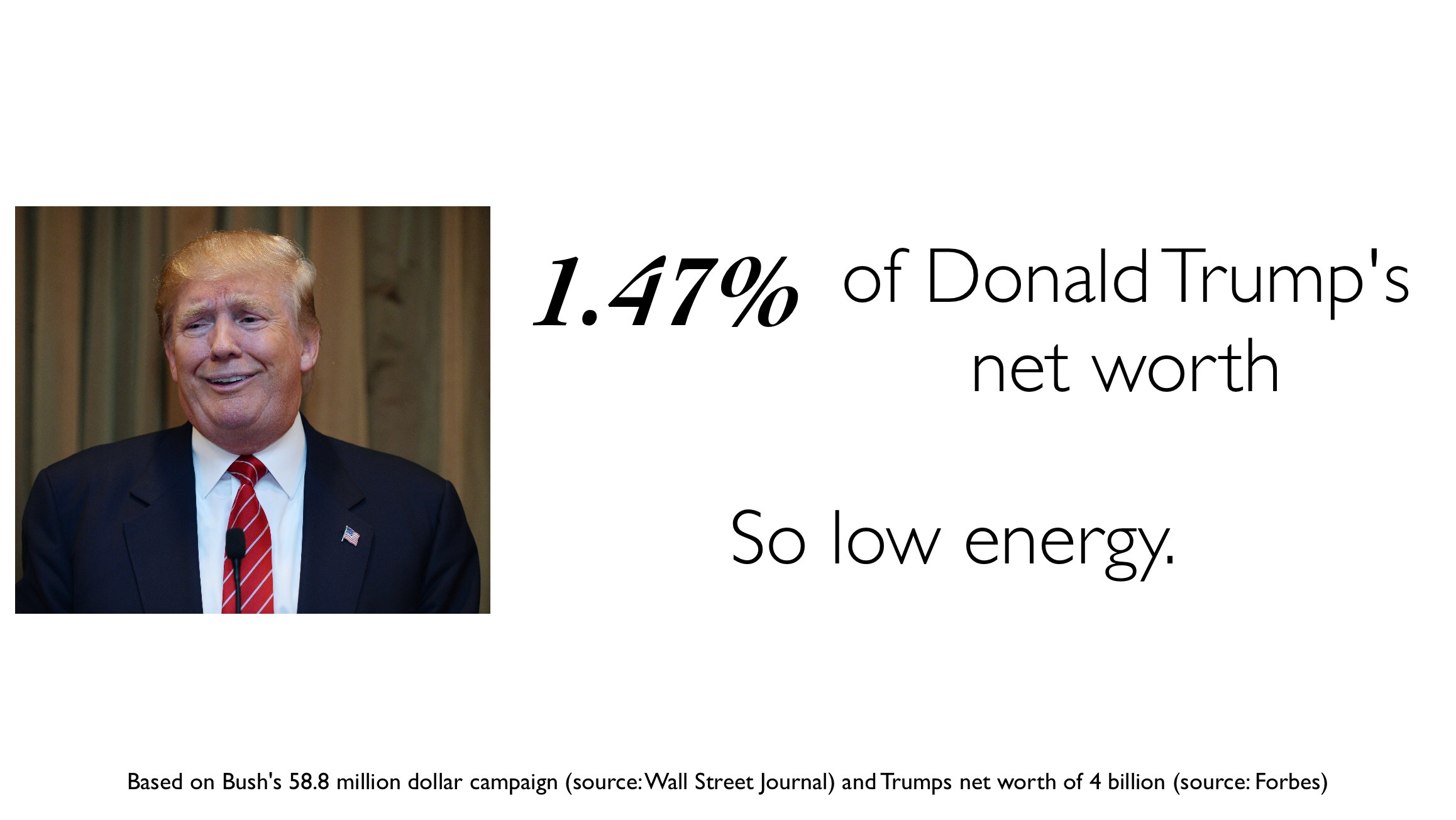
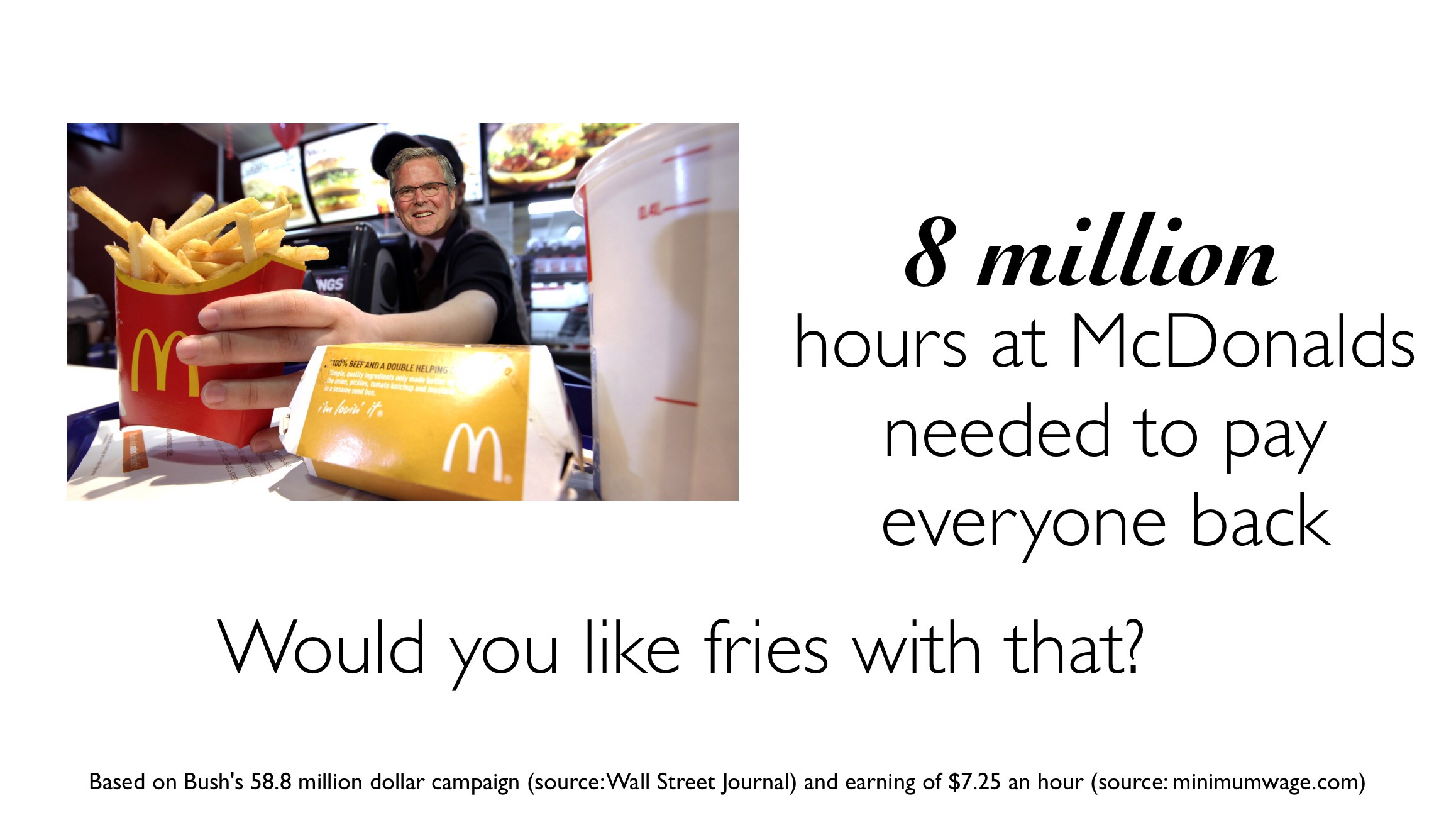
Jeb Bush is now yesterday’s news, but nobody seems to have talked about what it took to get his presidential campaign off the ground. Bush, the former governor of Florida and brother of President George W. Bush, spent $58.8 million on his campaign (including super PACs and donations). That’s almost five times as much as Hillary Clinton has spent! Here’s a breakdown of what other things could have been bought with that $58.8 million . .  .


Hopefully this fun little comparison has made you realize how expensive — and potentially wasteful — a political campaign can be.

Replace ‘No Homework Tuesdays’ with Work-free Weekends for Real Break

By Chris Acampora and Kristen Plahn

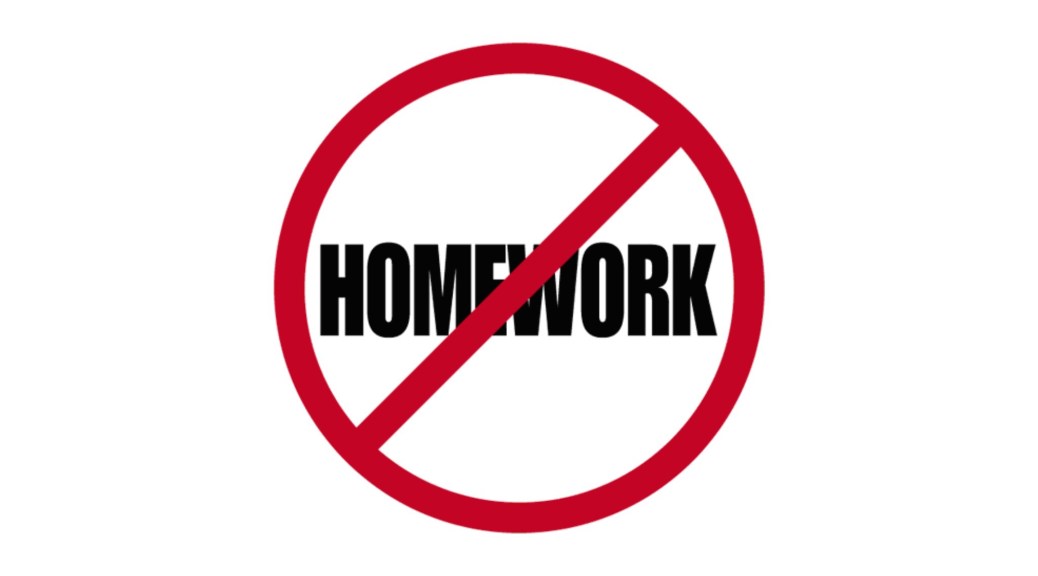
In December, students were given the gift of no homework assignments on Tuesdays. But, was this a rip-off? Tuesdays in December are limited and that makes homework-free days hard to come by. If the school system wishes to continue with “No Homework Tuesdays,” as they are dubbed, then they should consider having more than the two half days in December that we had this year. The combo of a half day with no homework almost creates a day off, a day that is free to do things with friends and family.

Superintendent Matthew Ferron started “No Homework Tuesdays” across the district this past December to give students “family time.” But the policy actually reduced it. Because of Tuesday’s lack of homework, many teachers gave homework on the weekend to make up for it. The weekends are prime time for being with family; a Tuesday, not so much. In addition, “No Homework Tuesdays” could actually be counterproductive, and increase student workload. If you look at the five Tuesdays we had in December, you might realize that Christmas break was one week and some teachers gave homework during the first week in the month which. That reduced our “No Homework Tuesdays” to a mere three days. Since Tuesdays are mid week, teachers who can’t assign homework that day just push plans back a day.  If there are five school days in a week, and only four days to give homework, where does the last one go? The weekend.

A possible solution to this dilemma is a “Work-free Weekend” policy in the month of December. This would benefit teachers as much as their students. Students are going to put more effort into homework on the weekday, rather than the weekend, where most homework can be rushed through late Sunday night or early Monday morning. This means teachers will have a higher success rate on homework, increasing test grades and students’ final grades. It’s truly a win-win for teachers, because it gives students and teachers more family time. Teachers also can move ahead with teaching with a full week available, rather than feeling they have to skip Tuesday nights.

We propose the idea that, in the 2016-2017 school year, “No Homework Tuesdays” are replaced with the “Work-free Weekends in the Month of December” policy. This idea will benefit students and teachers simultaneously, making the busy month of December better for all. We hope this idea is seriously considered by administration as a viable option for the student body next school year.

Why It Isn’t Cool to Litter in School


Every day at Hanover High, students are free to use the water fountains. I find the fountains we have here to be very clean, unlike many offered in other schools. But one time when I was about to fill up my water bottle, I noticed an (almost) empty chocolate milk bottle left on top. I thought to myself, “that’s disgusting,” as I tossed it into the trash can, located not even 10 feet from the fountain.

About a week later, I noticed a wrapper with crumpled up chocolate chip cookie pieces crushed inside it right on top of the same fountain. I shook my head in annoyance, thinking about the horrific fact that some students at my school don’t even have the consideration to throw away their trash where it belongs. They leave it right on top of something we should all be taking care of for the sake of its purpose, as we are lucky to have these high quality fountains.

One morning, I was minding my own business while going for a bathroom break in the middle of Digital Media class, and noticed something else lying on top of the water fountain — this time, it was two sharp nails most likely used for some kind of woodshop project. I was furious to see that a high schooler would have the ignorance to do something like that, probably thinking it’s funny and would not affect anyone. Someone could seriously get hurt accidentally touching those nails by not noticing them, as they blended in with the color of the fountain pretty well. Many people such as myself are against littering, and those same people are sure smart enough to respect the property they live on, or go to school or work in. Once you think about it, it isn’t that hard to do.

I strongly believe that it is important to recycle and throw away your trash when needed to do so, and also to keep your belongings used for whatever purpose in the appropriate places; tools aren’t to be left out on drinking fountains, HHS. After reading this, hopefully more students will be aware of this problem I encountered, and
I won’t be seeing any crumpled bottles, wrappers or unusual belongings left on the fountains for quite some time. You can always make a difference by putting things in the right place.

A Different Kind of Resolution

Like most people, I make New Year’s resolutions that I think will help me achieve my goals. For example, I want a better body, so I am going to go to the gym more. I want to be smarter, so I am going to read more. I want to be a better student, so I am going to spend more hours studying and complete assignments earlier.

Every New Year’s Eve, I like to imagine myself a year later: hotter, smarter and with stellar study habits. Sadly, many years have gone by without any feeling of success. I often become so overwhelmed with the hope of the New Year that I always think the next year will be different.

I let this cycle go on for far too long. I felt so much pressure and anxiety over my resolutions that they became incredibly tiresome. It was easier to accept defeat than to deal with the constant pressure I put on myself to achieve. This was never more true than with school. Here, the constant need to do better had an adverse affect. I would wilt under the pressure.

This year I decided to break the cycle. My resolution is not to achieve a better grade, but to feel happier while working for my grades. I tried to recall the times when I had been successful in school. On all of those occasions, I was participating in something that I loved. My best grades were in the subjects that I loved the most. Therefore, I concluded that if I tried my best to enjoy what I was doing, rather than obsessing over perfection, I would be more successful. If my new experiment works, I will not only achieve my goal of being a better student, but will have done it in a way that is beneficial to me.

It’s Beginning to Look a Lot Like… Spring?!

The month of December is here, but would we know what time of year it is without the morning radio updates telling us how many days there are until the holidays? Maybe not. Lately, the weather has been more fitting for a chilly spring morning or a mild fall day. For anyone with winter dread, which seems to be a lot of New England folks still recovering from last year’s streak of blizzards , this oddly warm weather is a blessing. At least one month less of shoveling and home-bound weekends!

Yet, being young and not yet fed up with Massachusetts winters, I cannot help but wish for snow. It seems this time of year’s magic always comes more to life with a beautiful snowfall just in time for the holidays. Unfortunately for snow-lovers like me, the remainder of the month is forecast to be pretty rainy and around 50 degrees on average, according to weather.com.

My fruitless wishing for snow gets me thinking about the reason why the past few Decembers have been so green. Should I wish for snow for a less selfish reason, like the survival of the polar bears who are suffering from the detrimental effects of global warming?
I decided to do some research, and this is what I found out: according to the Northeast Climate Impacts Assessment (NECIA) team, the northeastern United States has gradually warmed up every decade at a rate of roughly .5 degrees Fahrenheit since 1970. Snowfall coverage has decreased, while spring has come more quickly and summer has presented increasing numbers of very hot days (www.neaq.org). As such, according to ample amounts of evidence, it is fair to say that global warming is playing an active role in our green New England Decembers.

These shocking results certainly call for action toward minimizing our footprint. Angela Fritz from The Washington Post makes it clear that the most direct cause for this warm December is tied to El Niño, the irregularly occurring climatic changes that impact the equatorial Pacific area. As a result, pressure is expected to build over North America, meaning that the continent’s regional temperatures will be above average for December. However, as Fritz points out to those wishing for a warm winter and shorts, El Niño does not necessarily mean that the entire winter will be warm.

Luckily, these warm-wishers have some good news for December at least. And for snow-lovers like me, well, we’ll just have to wait until January comes around. In the meantime, we can work on doing all we can to save our planet from the terrible effects of global warming, where lack of a pretty winter day is the least harmful consequence.